


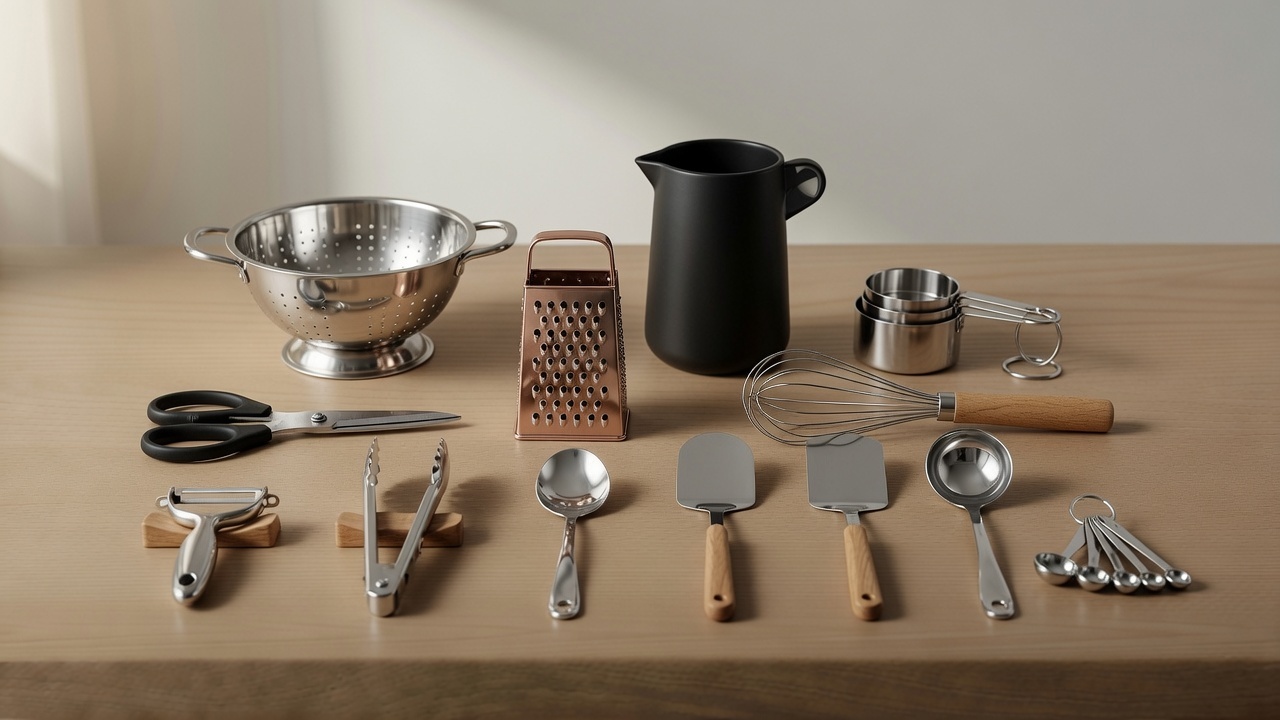
This data is a MarketHub standard RFQ dataset that integrates market analysis, manufacturing analysis, Standard RFQ Model, AI analysis (PRP), and RFQ Index so that it can be utilized by cooking tool manufacturers, OEM/ODM companies, export companies, overseas buyers , and distribution companies .
Cooking tools include ladles, spatulas, tongs, whisks, spoons, silicone tools, stainless steel tools, and wooden tools used during the cooking process. Since many of these products come into direct contact with food, the safety of food contact materials is critical.
The cooking utensil market is a key sub-category of the kitchenware market. The global kitchenware market is projected to continue growing beyond 2026; Fortune Business Insights forecasts that the global kitchenware market will reach $137.64 billion in 2034 , projecting a CAGR of **7.02%** from 2026 to 2034. Grand View Research also projected growth from $78 billion in 2026 to $123.3 billion in 2033 .
Cooking tools are connected to home cooking, meal kits, the food service industry, cafes, hotels, catering, and franchise kitchen operations. General consumers prioritize durability and design, while B2B buyers place importance on food contact safety, ease of cleaning, heat resistance, delivery reliability, bulk packaging, and replacement cycles.
Products are classified by material, including stainless steel, silicone, wood, bamboo, nylon, PP, and TPE . Recently, due to the reduction of plastic use and the spread of eco-friendly consumption, the demand for stainless steel, bamboo, and wooden cookware, as well as BPA-free and high-heat-resistant silicone products, is increasing.
From a regulatory perspective, reviewing food contact materials is essential. The EU applies safety and market distribution standards to food contact materials based on Regulation (EC) No. 1935/2004, establishing the principle that materials in contact with food must not harm human health or inappropriately alter the properties of the food.
From a MarketHub perspective, cooking tools are an RFQ strategic item that expands from household goods (B2C) → dining out/cafes → hotels/catering → franchise operation supplies .
| division | Main Products |
|---|---|
| Basic cooking tools | ladle, spatula, spatula, tongs, whisk |
| silicone | Silicone spatula, silicone spatula, silicone tongs |
| stainless steel | Stainless steel ladle, tongs, whisk |
| Wood and bamboo | Wooden spatula, bamboo cooking utensil |
| Set type | 5-piece, 7-piece, and 10-piece cooking utensil sets |
| commercial use | Large ladle, large tongs, food service cooking utensils |
| premium | Cooking tool for non-stick pans |
| PB | Cooking tools exclusively for distribution brands |
The recommended items for MarketHub opinion
-first RFQ registration are silicone cooking tool sets, stainless steel tongs, wooden spatulas, bamboo cooking tools, commercial cooking tools, and PB brand cooking tool sets .
Major manufacturing processes
- Material Selection
- Mold design
- Injection molding
- Silicone molding
- Metal Pressing and Bending
- Wood cutting and grinding
- assembly
- Surface treatment
- Food contact test
- packaging
OEM, ODM, and Private Label production are active.
★★★★★ Very High
Cooking tools are highly suitable for OEM production as they are easy to customize in terms of color, material, handle design, logo, set composition, and packaging.
★★★★☆ High
There is high potential for ODM development in areas such as high-heat-resistant silicone, a design specifically for non-stick pans, a foldable structure, a premium handle, and the application of eco-friendly materials.
★★★★☆
Although cooking utensils are not items purchased repeatedly as quickly as detergents or consumables, periodic replacement occurs in the food service, catering, hotel, and franchise kitchens due to damage, wear and tear, and hygiene management standards.
In the B2B market, recurring RFQs are possible from restaurants, cafes, hotels, cafeterias, schools, hospitals, nursing facilities, food factories, etc.
Major markets
- USA
- Canada
- japan
- germany
- uk
- france
- australia
- UAE
- vietnam
- thailand
For North America and Europe, food contact safety and eco-friendly materials are important; for Japan, quality, design, and miniaturization; and for Southeast Asia and the Middle East, demand from the food service and hotel markets is important.
- ISO 9001
- FDA Food Contact Review
- EU Food Contact Materials
- Regulation (EC) No 1935/2004
- EU GMP Regulation (EC) No 2023/2006
- LFGB
- REACH
- BPA-Free Exam
- FSC or eco-friendly packaging certification
※ Leaching tests, heat resistance, and hazardous substance reviews may vary depending on the material and the exporting country.
- Global kitchenware brand
- large marts
- online platform
- Home furnishing brand
- Hotel chain
- restaurant franchise
- food service companies
- food ingredient distribution company
- Kitchenware Importer and Distributor
- PB brand
Representative requirements
- Product types
- subject matter
- heat resistance temperature
- size
- color
- Set composition
- Food contact test
- MOQ
- OEM
- ODM
- packaging
- Delivery date
- Sample provided
- Price conditions
General standards
- Sample: Consultation
- Single item OEM: 3,000~10,000 units
- Cookware sets: 1,000~5,000 sets
- Commercial products: Consultation
- ODM: Negotiable based on the scope of mold and material development
- PB: Consultation
- Individual packaging
- Set box
- Hanging package
- Blister packaging
- paper box
- Commercial bulk packaging
- Eco-friendly packaging
- export packaging
General standards
- Sample: 2~4 weeks
- OEM: 30~60 days
- ODM: 60~120 days
- Recurring Orders: 30–45 days (negotiable)
It may vary depending on mold development and food contact testing.
- heat resistance
- durability
- Food contact safety
- Dissolution test
- Handle strength
- Deformation and breakage inspection
- Surface finish
- Odor and Off-odor Management
- Washing stability
- Packaging quality
- Production history management
- QA/QC
Rating: ★★★★★
Cooking tools are the representative RFQ item in the kitchenware category.
especially
- silicone cooking utensil set
- stainless steel cookware
- Bamboo and wooden cooking utensils
- Commercial cooking utensils
- PB brand set
There is a high possibility of a global RFQ occurring.
| item | detail |
|---|---|
| Product Name | |
| Product Type | Ladle / Spatula / Tongs / Set |
| subject matter | Silicone / Stainless Steel / Wood / PP |
| heat resistance temperature | |
| size | |
| color | |
| Food contact test | □ Possession □ Required |
| MOQ | |
| OEM | □ Possible □ Not Possible |
| ODM | □ Possible □ Not Possible |
| Hopeful exporting country | |
| certification | |
| Delivery date | |
| Packaging method | |
| Terms of trade | FOB / CIF / EXW |
| Sample provided | □ Possible □ Not Possible |
| Repeat purchase | □ Quarterly □ Semi-annually □ Annually |
Automatic analysis
- Recommendation of suitable manufacturing companies
- Expected Price Analysis
- MOQ suitability
- HS CODE Candidate
- Review of food contact regulations
- Material and heat resistance risk
- Review of country-specific certifications
- Logistics and Packaging Analysis
- OEM/ODM Conformity
- Possibility of repeat purchase
- AI Comprehensive Suitability
| Evaluation items | evaluation |
|---|---|
| marketability | ★★★★★ |
| Growth potential | ★★★★☆ |
| Repeat purchase | ★★★★☆ |
| OEM conformity | ★★★★★ |
| ODM Conformity | ★★★★☆ |
| global demand | ★★★★★ |
| Ease of export | ★★★★☆ |
| Certification difficulty | ★★★☆☆ |
| Logistics ease | ★★★★★ |
| Possibility of RFQ occurrence | ★★★★★ |
| AI Recommendation (PRP) | ★★★★★ |
Cooking tools are not merely simple kitchen accessories; they are RFQ-compliant items that combine food contact safety, material reliability, set configuration, and brand packaging. Overseas buyers place importance not only on price but also on heat resistance, food contact testing, packaging quality, set configuration, and delivery stability .
Domestic manufacturers can collaborate with global kitchenware brands, hotel and restaurant franchises, and online distributors by forming private brand (PB) sets of silicone, stainless steel, and wooden cooking tools.
① Find products. (Need Products)
When domestic and international purchasing companies, distributors, hotels, food service franchises, and public institutions register products they need, they are added to the RFQ Intelligence Library and utilized for partner company reviews and future AI-based manufacturing company recommendations.
Process:
RFQ Library Registration → Collaboration Review → Recommendation of AI Manufacturing Companies Scheduled for 2027
Register
② We are looking for a manufacturing partner. (Need Manufacturer)
Brand companies, distribution companies, and food service operators can find OEM, ODM, and Private Label manufacturers.
Process:
RFQ Library Registration → Collaboration Review → Recommendation of AI Manufacturing Partner Scheduled for 2027
Register
③ We are looking for overseas buyers. (Need Buyers)
Register if you are a domestic manufacturing company wishing to engage in business cooperation with overseas kitchenware brands, importers, or hotel and restaurant purchasing companies.
Process:
RFQ Library Registration → Cooperation Review → Recommendation of AI Countries and Buyers Scheduled for 2027
Register
Contact : mail@markethub.org
- Dataset Version : 2026.7
- Category : Household Goods (B2C) → Kitchenware
- Library : Cooking Utensils
- Next Update : Scheduled for 2027