


Economy Type
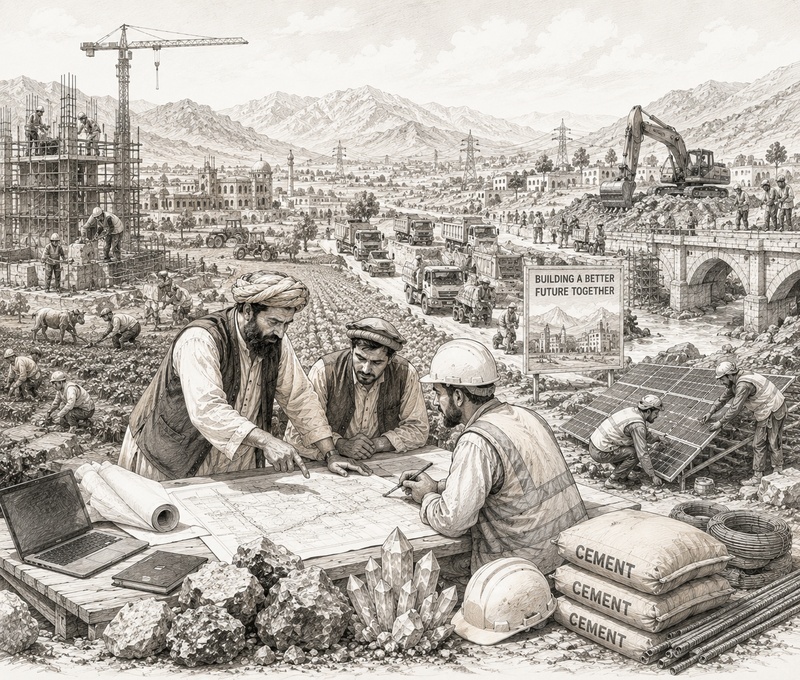
Reconstruction Economy
Afghanistan is classified as a Reconstruction Economy country.
This is because the center of the national economy is formed not by the general consumer market or manufacturing, but by national reconstruction and international development projects . Although industry and social infrastructure have been severely damaged by long-term conflict, the country has a structure in which reconstruction projects, mineral development, agricultural recovery, and the construction of energy infrastructure are proceeding simultaneously.
Furthermore, the potential of key minerals such as lithium, copper, and rare earth elements, which are attracting global attention, and the geopolitical location connecting Central and South Asia are considered important factors that will determine national competitiveness in the long term.
Country Definition
Afghanistan is a long-term strategic market with two futures: a 'reconstruction economy' and a 'key mineral supply chain'.
Why It Matters
Although the current market size is not large, it is a country of high strategic importance in terms of international reconstruction projects and critical mineral supply chains. If the international situation and infrastructure recovery progress in the future, it has the potential to provide new growth opportunities in various fields, such as mineral development, logistics corridors, and agricultural modernization.
Korea Perspective
For South Korea, Afghanistan is more of a market for international development cooperation and project-based collaboration than a market for general consumer goods exports . Areas such as smart agriculture, water management, solar power, medical facilities, construction technology, and mineral cooperation are sectors that can be considered in the mid-to-long term.
Key Keywords
- Reconstruction Economy
- Project Market
- Mining
- Lithium
- Agriculture
- Infrastructure
- International Development
- Central Asia Gateway
- Long-term Opportunity
Afghanistan is a strategic landlocked country connecting Central and South Asia, and historically, it has been a geopolitical hub where Eastern and Western civilizations intersected. This location holds significant meaning today in terms of transportation, logistics, and energy networks.
While the prolonged conflict has significantly weakened the industrial base and national governance system, it has simultaneously served as a backdrop for the continuous creation of reconstruction projects and development cooperation initiatives involving the international community. Therefore, when understanding Afghanistan, one must view the reconstruction process itself as an economic activity , rather than focusing solely on the current economic scale.
Future national competitiveness is expected to depend heavily on political stability as well as mineral development, transportation infrastructure, improvements in agricultural productivity, and the recovery of access to international finance.
Key Features
- Strategic location connecting Central Asia and South Asia
- Possesses abundant mineral resources
- agriculture-centered economic structure
- International reconstruction project-centered market
- Coexistence of long-term growth potential and high political and institutional risks
Afghanistan is a strategic landlocked country connecting Central and South Asia, and historically, it has been a geopolitical hub where Eastern and Western civilizations intersected. This location holds significant meaning today in terms of transportation, logistics, and energy networks.
While the prolonged conflict has significantly weakened the industrial base and national governance system, it has simultaneously served as a backdrop for the continuous creation of reconstruction projects and development cooperation initiatives involving the international community. Therefore, when understanding Afghanistan, one must view the reconstruction process itself as an economic activity , rather than focusing solely on the current economic scale.
Future national competitiveness is expected to depend heavily on political stability as well as mineral development, transportation infrastructure, improvements in agricultural productivity, and the recovery of access to international finance.
Key Features
- Strategic location connecting Central Asia and South Asia
- Possesses abundant mineral resources
- agriculture-centered economic structure
- International reconstruction project-centered market
- Coexistence of long-term growth potential and high political and institutional risks
The Afghan economy is heavily reliant on agriculture and the service sector, while its manufacturing base remains limited. Although national income and the size of the consumer market are not large, international organizations and development cooperation projects play a significant role in economic activity.
The current market is more of a project market than a general consumer market . The restoration of social infrastructure such as roads, bridges, power, water management, and educational facilities, as well as agricultural modernization projects, are being continuously promoted, and these projects are forming market demand.
Mineral development is considered the greatest long-term growth engine. In particular, lithium, copper, and iron ore are receiving international attention amidst the restructuring of global supply chains and are regarded as key resources that will transform the future economic structure.
Market characteristics
- Limitation on the size of the consumer market
- International development project center
- High proportion of agriculture
- High potential for mineral development
- Continued demand for infrastructure reconstruction
MarketHub Point
It is appropriate to approach the current market as a project market rather than a sales market.
Agriculture forms the foundation of Afghanistan's national economy, while mining holds the greatest potential to drive future growth. Wheat, fruits, nuts, and livestock farming play vital roles in people's livelihoods and exports, and improving agricultural productivity is considered a high-priority task in the process of national reconstruction.
Mineral resources are a sector of the greatest interest to the international community. The strategic value of resources such as copper, lithium, rare earth elements, and iron ore is increasing due to the energy transition and the expansion of supply chains for high-tech industries. However, political stability, infrastructure expansion, and improvements to the investment environment must precede full-scale development.
The construction, energy, food processing, and water management industries are also considered sectors with high growth potential alongside the reconstruction economy.
Key industries
- agriculture
- mine
- erection
- energy
- food processing
- Water management
Key resources
- lithium
- copper
- ironstone
- rare earth elements
- Natural gas (in some regions)
MarketHub Point
Currently, agriculture sustains the economy, and in the future, mining is highly likely to determine national competitiveness.
As a landlocked country, Afghanistan relies heavily on the ports and land logistics networks of neighboring nations such as Pakistan and Iran for international trade. This structure directly impacts logistics costs, transit times, and supply chain stability.
Major exports consist of dried fruits, nuts, carpets, medicinal herbs, and some minerals, while major imports include food, petroleum products, machinery, pharmaceuticals, and daily necessities. Due to a limited manufacturing base, the economy relies on sourcing most industrial and consumer goods from overseas.
In the long term, the establishment of transportation corridors connecting Central Asia and South Asia and the expansion of key mineral supply chains are considered key variables that will transform the national trade structure.
major trading partners
- Pakistan
- Iran
- china
- India
- United Arab Emirates
- Uzbekistan
Supply chain characteristics
- Land logistics centered on landlocked countries
- dependence on neighboring countries' ports
- Mineral Supply Chain Potential
- Sensitive to political and financial risks
MarketHub Point
Afghanistan's competitiveness lies in the strategic value of its future supply chain rather than its current logistics scale.
Afghanistan differs in nature from typical overseas investment markets. Its current core market is centered on reconstruction, international procurement, and development cooperation, rather than the sale of consumer goods . Therefore, it is advisable for companies to prioritize long-term project participation and network building over short-term sales performance.
The private investment environment still carries high risks due to political uncertainty and financial constraints. On the other hand, projects promoted by international organizations and multilateral development banks can serve as a relatively stable channel for entry, and continuous demand is expected in basic infrastructure sectors such as agriculture, drinking water, healthcare, education, energy, and roads.
Furthermore, while the development of key minerals has the potential to transform the national economy in the future, actual commercialization requires political stability, improvements in laws and institutions, and the establishment of infrastructure.
Market characteristics
- Project market focus rather than consumer market
- High proportion of projects commissioned by international organizations
- Continued demand for infrastructure reconstruction
- Mineral development is a long-term investment sector.
Key Opportunities
- Smart farming
- Water management and water purification facilities
- Solar power and distributed power
- Construction and Infrastructure
- Mineral development cooperation
- Construction of medical and educational facilities
Major Risks
- Political and institutional uncertainty
- International sanctions and financial transaction restrictions
- Burden of logistics and insurance costs
- Lack of investment stability
Afghanistan's future growth potential is projected to depend heavily on political stability and changes in relations with the international community. If national reconstruction accelerates and access to international finance improves, mineral development, the establishment of transportation corridors, agricultural modernization, and the expansion of energy infrastructure have the potential to drive economic growth.
In particular, key minerals such as lithium, copper, and rare earths are gaining strategic importance due to the global energy transition and the expansion of supply chains for high-tech industries, and land logistics networks connecting Central Asia and South Asia are also considered a foundation for long-term growth.
On the other hand, since the pace of economic recovery may be limited if political instability and international sanctions are prolonged, an approach that understands the country focusing on medium- to long-term structural changes rather than short-term performance is necessary.
Changes to Watch Out For in the Future
- Whether international relations improve
- Expansion of mineral development
- Construction of traffic corridors
- Improving agricultural productivity
- Expansion of energy infrastructure
- Whether international development projects will continue
Market Position
Project Market + Frontier Reconstruction Economy
Frontier market centered on reconstruction projects and international development cooperation rather than the consumer market
Key Opportunities
- Key mineral supply chain
- Smart farming
- Water management and water purification facilities
- Solar power and distributed energy
- Social infrastructure (SOC) reconstruction
Recommended Strategy
Observe
We continuously monitor political and institutional changes, international sanctions, and mineral development policies.
↓
Prepare
Secure capabilities to participate in the international procurement market, and build experience in ODA and international organization projects as well as local partnerships.
↓
Participate
If political and economic conditions improve, participation will be phased in, focusing on mineral, agriculture, infrastructure, and energy projects.
Final Assessment
Afghanistan is a long-term strategic market that should be approached with a focus on the future reconstruction economy and key mineral supply chains, rather than the current consumer market.
Scope of investigation
This material was compiled by cross-reviewing publicly available data from international organizations, governments, research institutes, and industry sources, as well as major foreign media.
international organizations
- United Nations (UN)
- World Bank
- International Monetary Fund (IMF)
- World Trade Organization (WTO)
- UNCTAD
- FAO
- Asian Development Bank (ADB)
Government and public institutions
- Afghanistan National Statistics and Information Authority
- Da Afghanistan Bank (public data)
- KOTRA
- Korea Export-Import Bank Overseas Economic Research Institute
- Korea Institute for International Economic Policy (KIEP)
Major foreign media
- Reuters
- Bloomberg
- Financial Times
- The Wall Street Journal
- The Economist
- Nikkei Asia
- BBC
- AP
- Al Jazeera
Research and industrial data
- Google Scholar public paper
- OECD and International Development Reports
- World Economic Forum
- Public industry analysis data from McKinsey, PwC, Deloitte, etc.
Writing Verification
This document was prepared in accordance with the following principles.
- Written based on facts and open sources
- Cross-review of international organizations, government and industry data, academic papers, and foreign media
- Summary based on the latest publicly available data
- Reflecting the perspective of utilization by South Korean companies and public institutions
- Apply MarketHub Country Intelligence standard template
- Applying the same structure and standards to 195 countries
Afghanistan is a country that is difficult to evaluate solely based on its current economic size. To correctly assess the country's strategic value, it is necessary to understand the two axes of the Reconstruction Economy and Resource Potential together.
It is advisable for South Korea to establish a foundation for long-term cooperation in areas such as international development cooperation, project exports, smart agriculture, water management, energy, and infrastructure construction, rather than focusing on short-term entry into consumer markets. If political stability improves and cooperation with the international community expands in the future, Afghanistan has the potential to develop into a strategic hub connecting Central and South Asia, as well as a key nation in future resource supply chains.