


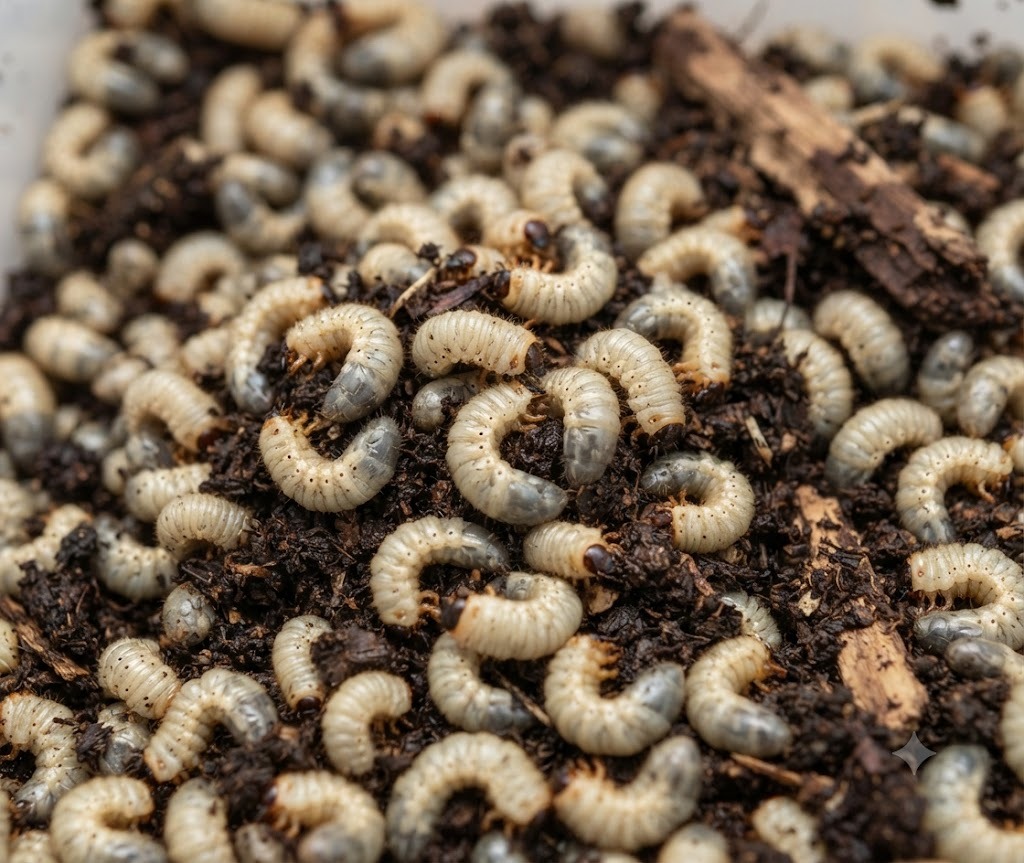
The white-spotted flower beetle is a representative domestic industrial insect that already has an institutional foundation as a food ingredient. As white-spotted flower beetle larvae are included as a general food ingredient in the list of 10 domestic edible insect species released by the Rural Development Administration in 2026, they can be viewed not merely as research insects but as raw materials applicable to the actual food industry. ( Rural Development Administration )
Industrially, larvae are more important than adult insects. Since drying and powdering the larvae or isolating their proteins allows for expansion into food, feed, and functional materials, MarketHub manages the entire supply chain —from breeding insects → eggs → larvae → harvesting → drying/powdering/protein isolation → food/feed/functional buyers— as a single supply chain.
Judgment axis | Key points |
| Key production stage | larva |
| production purpose | Food, feed, and functional materials |
| Main Products | Dried larvae, powder, protein, lipids, and other fractions |
| production core | Parent insects, egg laying, larval growth, food, environment |
| Quality Core | Protein, Fat, Moisture, Hygiene, Raw Material History |
| Major risks | Differences in feed and substrate, microorganisms, and variations in raw material components |
| AX | Temperature and humidity, biomass, feed, yield, and processing yield |
| RFQ | Larvae·Powder·Protein·Functional Ingredient·Buyer |
| Final goal | Conversion from farm raw materials to standardized industrial raw materials |
In particular, a study comparing five domestic commercial farms found that the dry yield varied from **14.12% to 27.28%** depending on the feed source, and protein and fat composition also differed by farm. In other words, it is important to note that even among the same white-spotted flower beetle, what is fed and how it is raised affects the quality of the final raw material . ( PubMed )
The white-spotted flower beetle is a beetle that undergoes metamorphosis from egg to larva to pupa to adult, and the larva is the stage primarily utilized in the food, feed, and raw material industries. In Korea, larvae are recognized as food ingredients, so MarketHub manages the species itself and food-grade larvae separately. ( Rural Development Administration )
Even for the same larvae, buyers vary depending on whether they are in the fresh, dried, powder, defatted, or protein-separated form. Therefore, instead of trading under the single name "White-spotted Flower Beetle," Product Entities are established for each processing stage.
division | Main purpose | Product Entity |
| Jongchung | breeding | Adults and colonies |
| egg | multiplication | Egg Lot |
| larva | raw material | Fresh Larvae |
| dry larva | Food and Feed | Dried Larvae |
| powder | Food and Feed | Larval Powder |
| Degreased powder | High-protein ingredients | Defatted Powder |
| Protein separation | Food and materials | Protein Isolate |
| Geological fractions | subject matter | Insect Oil |
The basic structure is White-spotted Flower Chafer → Life Stage → Processing Stage → Product → Buyer .
For the white-spotted flower beetle, it is more practical to distinguish production uses and processing purposes first , rather than classifying by variety . Even if the same larvae are used for food, animal feed, protein materials, or functional materials, the feed, harvest time, processing methods, and ingredient specifications may differ.
Particularly when targeting functional materials, detailed characteristics such as amino acids, fatty acids, and extractable components may become more important than simple protein content. Since comparative studies of domestic farms have also shown differences in protein and fatty acid composition depending on feed, rearing designs tailored to specific production purposes are necessary. ( PubMed )
Production type | Key criteria | Major Buyers |
| For food use | Hygiene and nutritional components | food companies |
| for animal feed | Nutrition and Unit Price | feed company |
| For protein | Protein content and processability | raw material companies |
| functional materials | Extraction ingredients and specifications | biotech companies |
| breeding insect | spawning and reproductive capacity | Insect farm |
At MarketHub, production is reverse engineered in the order of Use → Specification → Rearing → Processing .
The structure of the white-spotted flower beetle involves adult beetles laying eggs, raising the hatched larvae for a certain period, and then harvesting them as industrial raw materials. To determine actual economic viability, farm productivity must be linked not only to the number of eggs laid but also to the survival, growth, rearing period, and drying yield of the larvae.
Feed is a particularly important variable. A study comparing larvae from five domestic farms used different feed sources, including fermented oak sawdust, mixed sawdust, commercial feed, fermented feed, and mushroom substrate byproducts, and confirmed differences in final dry yield and protein and fat composition. ( PubMed )
Management area | Things to see at a farm |
| Jongchung | spawning and survival |
| egg | Hatching rate |
| larva | Growth and uniformity |
| prey | Raw materials, input quantity, and price |
| environment | Temperature and humidity |
| density | Biomass per rearing box |
| harvest | Timing · Live weight |
| process | drying yield |
| expense | feed, electricity, and labor costs |
Therefore, it is appropriate to view the farm benchmark in the order of feed input → live weight → drying yield → final raw material kg, rather than the larval live weight kg .
Since the white-spotted flower beetle is used as a food ingredient, rearing substrates, hygiene, processing safety, and consistency of composition are more critical management areas than livestock infectious diseases. Even within the same species, composition can vary depending on the feed and drying methods used at each farm, so the production lot must be linked to the feed/substrate lot.
Toxicity assessments of freeze-dried larval powder have shown that no significant issues regarding single-dose or 13-week repeated-administration toxicity or genotoxicity were identified under the test conditions. However, since this is based on research results regarding specific test substances and conditions, it should not be used as grounds to automatically guarantee the safety of all products. ( PubMed )
step | Key Management |
| Jongchung | Colony·Batch |
| prey | Feed/Substrate Lot |
| breeding | Environment and Density |
| harvest | Date · Live Weight |
| Preprocessing | Cleaning/Inactivation |
| dry | Method and moisture |
| smash | Particle Size/Powder Lot |
| Ingredient test | Protein, fat, etc. |
| circulation | Product Lot · Buyer |
The representative traceability structure is Feed/Substrate → Rearing Batch → Harvest → Processing → Powder/Protein Lot → Buyer .
In Korea, the larvae of the white-spotted flower beetle are recognized as a general food ingredient, so the foundation for entry into the food industry is clear. Domestic industrial insect surveys have also shown the white-spotted flower beetle to be one of the most produced species for edible and medicinal purposes; the 2020 survey reported that 69.6% of producers of edible and medicinal insects cultivated this species. However, as this is based on the 2020 survey results, it is utilized only as an industrial structure benchmark and not as a metric for the number of farm households as of 2026. ( AGRIS )
The problem is that recognition as a food ingredient differs from actual market demand. For farmers, the profit structure with buyers varies depending on whether they sell the dried larvae as is or process them into powder, protein, or functional materials.
Participants | Things needed | RFQ |
| Insect farm | Breeder, feed, and sales channels | Producer |
| food companies | Dry/Powder | Food RFQ |
| feed company | Protein source | Feed RFQ |
| raw material companies | Defatted powder · Protein | Ingredient |
| functional material company | Extracted and standardized raw materials | Material |
| processing company | Drying, grinding, and separation | Processing |
| Research Institute | Nutritional and functional | R&D |
| local government | Insect industry cluster | Regional AX |
MarketHub places more importance on the standardized B2B raw material supply market than on the sale of raw materials from farms .
In international trade, live insects must be distinguished from food powder, feed ingredients, and protein fractions. This is because standards for food, feed, quarantine, and customs clearance may vary depending on the product's intended use and degree of processing.
While the white-spotted flower beetle can be used as a food ingredient in Korea, this does not mean it is automatically permitted in overseas markets. For actual exports, the destination country's regulations regarding Novel Food, food ingredients, and feed ingredients, as well as facility and inspection requirements, must be verified separately.
Breeder → Larva Rearing → Harvesting → Inactivation/Drying → Powder/Protein → Inspection → Packaging → Import/Export → Buyer
Confirmation area | Main contents |
| Bio | Species and growth stages |
| dried product | For food and feed purposes |
| powder | Moisture, protein, hygiene |
| protein | Extraction method and purity |
| functional materials | Ingredients and Uses |
| trade | HS · Customs · Country of Origin |
| regulation | Food · Feed · Novel Food |
| Buyer | Specifications, Quantity, Delivery Date |
In the actual RFQ, the Product Form + Intended Use + Regulatory Status + HS + Buyer Specification are verified again at the time of transaction.
The white-spotted flower beetle has great potential to expand beyond simple dried insects into industrial raw materials from which proteins, lipids, and functional components are isolated . Domestic research has shown that larval protein isolates exhibited high essential amino acid content and good solubility characteristics, and immune-related responses were observed in cell tests. However, these results are still at the research stage demonstrating material potential and do not confirm any health functional effects. ( PubMed )
Therefore, in PRP , nutritional content, processability, yield, price, and Buyer Specification are verified before functional claims . In particular, raw material standardization is key, as feed differences between farms can affect protein and fat composition. ( PubMed )
Product Entity | Main uses |
| Fresh Larvae | Biomaterials |
| Dried Larvae | Food and Feed |
| Larval Powder | Food formulation |
| Defatted Powder | High-protein ingredients |
| Protein Isolate | Research on food and functional materials |
| Insect Oil | lipid raw materials |
| Hydrolysate | Materials Research |
| Other fractions | Bio-materials research |
The key PRP questions are: which is more profitable—live larvae or dried/powdered? Does changing the feed improve protein content? What is the protein isolation yield? How can functional research results be distinguished from actual permitted product claims? And can the raw material specifications required by the buyer be stably and repeatedly produced ?
The white-spotted flower beetle is an industrial insect suitable for data-driven production management and automation, as it allows for indoor batch rearing. By continuously recording temperature, humidity, feed quantity, rearing density, and larval biomass, it is possible to compare under which conditions production volume and composition remain stable.
In the next stage of AX, larval quantity and growth status can be estimated via video, or automatic feeding, separation, and harvesting can be connected. However, the most important thing is to connect the production data of farms with the ingredient and yield data of processing companies .
Apply AX | Expected effects |
| environmental sensor | Temperature and humidity stability |
| Feed Lot Management | Tracking food and ingredients |
| Automatic feeder | Standardization of input quantity |
| Video analysis | Growth and biomass estimation |
| Automatic weight | Yield prediction |
| Batch comparison | Productivity and component analysis |
| Processing yield | Cost Management |
| Buyer Matching | Standardized planned production |
The basic structure is Feed → Environment → Larval Biomass → Harvest → Drying Yield → Protein/Yield → Buyer Price .
The core issue in the white-spotted flower beetle industry is not whether farms can produce it, but rather whether a stable supply of uniform raw materials can be secured . If feed and drying methods vary from farm to farm, variations in protein, fat, and moisture content will increase, potentially making large-scale procurement difficult for food and feed companies.
Furthermore, the mere existence of extensive functional research does not automatically create a market. Failure to distinguish between biological activity results from the research stage and the actual feasibility of labeling food or health functional food can lead to a loss of market trust.
problem | Data to verify |
| Growth deviation | Food, Environment, Density |
| survival rate | Rearing environment and hygiene |
| feed | Substrate/Input Amount |
| drying yield | Farmers and processes |
| component deviation | Protein and fat |
| hygiene | Microorganisms and processing |
| Functional verification | Distinction between research and licensing |
| Selling price | By product type |
| Buyer shortage | Monthly demand and specifications |
| Lack of joint processing | Facilities and yield |
The basic solution structure is Batch Data → Rearing Standard → Joint Processing → Ingredient Standard → Buyer Test → Contract Production .
For the Request for Quotation (RFQ) of the white-spotted flower beetle, it is important to subdivide the process down to the processing stage rather than just trading live larvae. This is because food companies may request powder, feed companies may request nutritional raw materials, and functional material companies may request protein isolates or extracts.
Farmers do not need to own all the facilities. It may be more efficient to register production farms and drying, grinding, defatting, and protein separation companies separately, and combine them into a single supply chain according to buyer requirements.
RFQ Type | Collaboration Examples |
| Jongchung | production troops |
| larva | Biomaterials |
| dry larva | Food and Feed |
| powder | food ingredients |
| Degreased powder | High-protein ingredients |
| Protein separation | Functional and food materials |
| process | Drying, grinding, and degreasing |
| OEM·ODM | Insect food |
| feed ingredients | Livestock, fisheries, pets, etc. |
| AX Pilot | Standardization of production and processing |
Component analysis, processing yield, contract price, and Buyer Specification are managed at the Verified/NDA stage.
The white-spotted flower beetle is an item for which Buyer Specifications must be obtained before production . It is difficult to make an accurate match based solely on a request for "500kg of white-spotted flower beetles," as it is impossible to determine whether they are for food or animal feed, live or powder form, or as a protein source.
Therefore, MarketHub first structures the product purpose, processing stage, and ingredient conditions, and then connects production farms with processing companies.
① Find products/raw materials.
Need Products & Materials
Companies and institutions seeking live larvae, dried larvae, powder, defatted powder, protein, and raw materials for functional materials register their purchase demands. MarketHub reviews farms and companies capable of supplying these items by verifying their intended use, ingredients, processing form, quantity, delivery time, and safety conditions.
RFQ Submission → Product Specification Review → Connecting Producers and Companies → AI Matching
Register
② We are looking for production and processing partners.
Need Suppliers & Manufacturers
We are seeking necessary partners, including insect farms, dryers, grinders, degreasing companies, extractors, protein separation firms, and OEM and ODM firms. We verify not only production volume but also feed lot, ingredient standards, processing yield, and quality control capabilities.
RFQ Submission → Review of Production/Processing Capabilities → Partner Connection → AI Partner Matching
Register
③ We are looking for domestic and international buyers.
Need Buyers
Production farms and processing companies seek new buyers, including food, feed, raw material, and bio-companies. We verify product type, ingredients, supply volume, and price to connect them with suitable purchasing partners.
RFQ Submission → Product & Supply Capability Review → Buyer Connection → AI Buyer Matching
Register
Contact : mail@markethub.org
In the White-spotted Flower Beetle dataset, the key entities are not individuals, but the Rearing Batch, Feed Lot, and Product Lot . It is necessary to know which batch ate which food and in which environment it grew in order to link this to the final protein and fat composition.
In particular, as demonstrated in comparative studies of domestic farms, dry yield and nutritional composition can vary depending on the feed; therefore, Feed/Substrate should be regarded as the core of the relationship rather than merely as supplementary information. ( PubMed )
Dataset | Simply put |
| Master | Growth stage, product, and use standards |
| Entity | Farm · Batch · Processing Company · Buyer |
| Relationship | Feed · Rearing · Processing · Products |
| Runtime | Biomass, Composition, Yield, Price |
The representative structure is as follows.
Breeder → Egg Lot → Larval Batch → Feed/Substrate Lot → Environment → Harvest → Drying → Powder/Protein → Buyer
Economic feasibility is:
Feed Cost + Facilities/Energy + Labor → Live Larvae kg → Drying Yield → Protein Yield → Product Price → Margin
Calculate as.
The white-spotted flower beetle is an industrial insect recognized as a domestic food ingredient, backed by a production base in farms, and supported by research on nutrition and protein. However, since recognition as a food ingredient, functional research, and recognition as a health functional food are distinct concepts, MarketHub must list them separately. ( Rural Development Administration )
This registered edition was verified based on the Rural Development Administration's official edible insect list for 2026, the basis for registration as a food ingredient by the Ministry of Food and Drug Safety, comparative studies on nutritional components in domestic commercial farms, and research on protein isolation and safety. ( PubMed )
Evidence | source |
| A | Ministry of Food and Drug Safety, Rural Development Administration, Official Government Data |
| B | PubMed Articles · National Research Institutes |
| C | Verification Industry Data |
| D | Farm and business data |
| E | Additional verification needed |
Key factual basis
- The larva of the white-spotted flower beetle is included among the 10 types of edible insects recognized as general food ingredients in Korea in 2026. ( Rural Development Administration )
- The Ministry of Food and Drug Safety has added the larvae of the white-spotted flower beetle, which were previously a temporary food ingredient, to the list of food ingredients to allow general business operators to use them. ( Ministry of Food and Drug Safety )
- In a comparative study of five domestic commercial farms, dry yields varied from 14.12% to 27.28% depending on the feed source, and differences in protein and fat composition were also confirmed. ( PubMed )
- Protein isolates from the larvae of the white-spotted flower beetle are being studied for their physicochemical properties as food ingredients and alternative proteins, as well as their potential as functional materials. However, research results should not be confused with actual claims of health efficacy. ( PubMed )
- Research results indicate that no significant toxicity or mutagenicity issues were observed with freeze-dried larva powder under specific animal and genotoxicity test conditions. However, this does not replace product-specific safety verification. ( PubMed )
- A domestic survey of industrial insects confirmed that the white-spotted flower beetle is an industrial insect widely produced for edible and medicinal purposes. However, as the survey was conducted in 2020, it is not directly used based on the 2026 production scale. ( AGRIS )
Version History
Version | Main contents | situation |
| v1.0 | First Registration of RFQ Structures for Food, Feed, Protein, and Functional Materials | complete |
| v1.1 | Enhancement of Official Statistics on Domestic Farms, Production Volume, Price, and Distribution for 2026 | expected |
| v2.0 | Feed·Batch·Drying Yield·Protein·PRP Runtime connection | expected |
| v3.0 | Insect Farms · Processing Companies · Food · Feed · Materials Buyer Verified Matching | expected |