

Judgment axis | Key judgment |
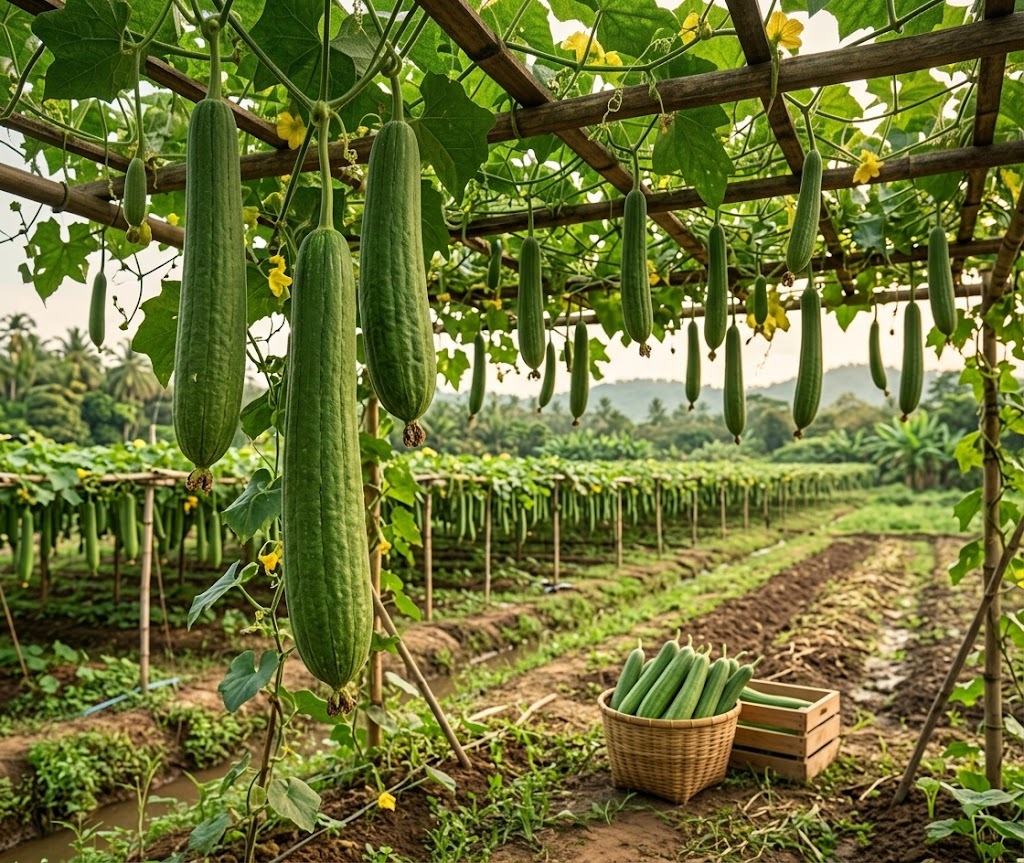
| Item Identity | It is a vining fruiting vegetable belonging to the genus Luffa of the Cucurbitaceae family; young fruits are edible, and ripe fruits are used as fibrous household material. |
| Key role | Fresh young fruits, dining out, school meals, pre-processed foods, Asian ingredients, natural loofahs, and eco-friendly living materials |
| Harvesting principle | Edible loofah is classified into an immature stage with soft tissue and underdeveloped seeds and fibers, while household loofah is classified into a stage where a fiber network has formed after full maturation and drying. |
| Product separation | Young fresh fruit, washed, cut, and processed for food are managed as well as ripe fruit, dried scouring pads, cut scouring pads, and household materials as separate products. |
| Separation of similar items | Verification of Plant Entity or Variety relationships with other loofah species such as gourds, bitter melons, cucumbers, pumpkins, winter melons, and Luffa acutangula |
| Domestic statistics | Latest national statistics on nationwide cultivation area and production volume of *Susu-mi-gowi* (loofah gourd) alone: To be entered after verification of official raw data. |
| Domestic cultivation basis | The Rural Development Administration provides official cultivation information on germination, growth temperature, irrigation, staking, harvesting, and the use of loofahs for food. |
| Climate characteristics | According to Nongsaroo standards, it is a high-temperature vegetable that thrives in summer heat and strong sunlight, but it is susceptible to excessive moisture, so drainage management is necessary. |
| Supply and demand risk | Mixing of edible and non-edible uses, misjudgment of ripeness, fruit fibrosis, shortage of edible buyers, loofah quality variation, risks of drying, hygiene, and mold |
| Operating Principles | Seed-Plant-Fruit-Harvest Stage-Food/Fiber Branch-Buyer RFQ Connection |
| Final goal | Separate buyers for edible, processed, and natural loofahs before cultivation, and determine harvest maturity and product destination based on contracts. |
The Rural Development Administration's Nongsaroo describes the optimal germination temperature for the loofah gourd as 25–30°C and the optimal growth temperature as 20–30°C, introducing it as a thermophilic vegetable that thrives even in high summer temperatures and strong sunlight. It also explains that while the plant prefers sufficient soil moisture, it is susceptible to excessive waterlogging, making drainage management crucial. These values represent general cultivation information from Nongsaroo, and separate adjustments are required for production recipes specific to region, variety, and facility. ( Nongsaroo )
Plant Identity
Basic fields | Loofah registration criteria |
| Korean name | loofah gourd |
| Common name | Loofah |
| English name | Sponge gourd / Luffa / Vegetable sponge |
| Representative scientific name | Luffa aegyptiaca Mill. |
| Related scientific names | Luffa cylindrica (L.) M.Roem. — Use historical/alternative classification |
| classification | Cucurbitaceae · Luffa |
| Edible parts | Mainly young fruit |
| Separate usage area | Fiber network of fully ripened fruit |
| Non-edible · Separate management | Stem, senescent leaves, fruit peel, seeds, disease, rotten parts |
| Major harvesting stages | Young edible fruit / Intermediately mature fruit / Mature fibrous fruit / For seed production |
| Basic product form | Fresh fruit · Washed fruit · Cut fruit · Edible raw materials · Ripe dried fruit · Natural loofah · Cut fibers |
| Basic processing stage | Edible: Washing → Peeling → Select → Cutting → Heating / Fiber: Ripening → Drying → Peeling → Seed Removal → Washing → Re-drying → Cutting |
| Basic use | Stir-fries, Soups, Stews, Eating Out, School Meals, Asian Cuisine, Natural Loofahs, Household Materials |
| Similarity Principle | Taxon verification separate from other Luffa species such as Luffa acutangula |
Kew currently manages Luffa aegyptiaca Mill. as an accepted species. ( Plants of the World Online )
While Luffa cylindrica has been widely used in the past and in some literature, the Kew dataset lists Luffa aegyptiaca as the central accepted name. Therefore, MarketHub preserves L. cylindrica from past datasets as a Synonym/Alternative Taxonomy rather than deleting it. ( Plants of the World Online )
Product Master
Product ID | Product type | Key Management Standards |
| LUF-P01 | Young loofah gourds immediately after harvest | Variety · Harvest Date · Ripeness · Fruit ID |
| LUF-P02 | tender young edible fruit | Length, diameter, hardness, degree of fibrosis |
| LUF-P03 | Edible ripe fruit | Pericarp color, hardness, and seed development |
| LUF-P04 | Selected edible fruit | Size, straightness, appearance, and wounds |
| LUF-P05 | Fresh fruit for dining out | Texture · Harvest Day / Cycle · Specifications |
| LUF-P06 | For multicultural ingredients | Variety, ripeness, length |
| LUF-P07 | For school meals | Safety, Standards, Supply Cycle |
| LUF-P08 | Washing sponge gourd | Washing water, product temperature, microorganisms |
| LUF-P09 | Peeled loofah gourd | Peeling yield · Flesh color |
| LUF-P10 | Slice | Thickness, Fibrosis, and Cookability |
| LUF-P11 | Cube/Chunk | Specifications and heating suitability |
| LUF-P12 | Pre-treatment for stir-fries and soups | Ripening, cutting, refrigeration |
| LUF-P13 | Frozen edible scouring pad | Pretreatment, Freezing, and Thawing Quality |
| LUF-P14 | Edible Purees and Processed Raw Materials | Moisture, viscosity, and heating properties |
| LUF-P15 | Intermediate maturity and | Re-evaluation of edible suitability · Fiber development |
| LUF-P16 | Mature fibers | Peel browning, dryness, fiber network |
| LUF-P17 | Dry scrubber | Fiber mesh, drying, mold, foreign matter |
| LUF-P18 | peeling loofah | Removal of fruit skin and seeds |
| LUF-P19 | Washing natural loofah | Washing, hygiene, and re-drying |
| LUF-P20 | Kitchen cutting scouring pad | Length, diameter, density, dryness |
| LUF-P21 | Bathroom and body scrubber | Fiber texture, washing, hygiene, packaging |
| LUF-P22 | Textile materials for crafts and packaging | Shape, density, processability |
| LUF-P23 | Ripe fruit for seed collection | Variety · Maturity · Seed Lot |
| LUF-P24 | Loofah seeds | Variety, Germination Rate, Purity |
| LUF-P25 | Fruit peel by-products | Amount Generated · Dry Condition · Resource Recovery |
| LUF-P26 | Seed by-products | Research on varieties, safety, and utilization |
| LUF-P27 | Non-standard young fruit | Cutting and processing upon food safety compliance |
| LUF-P28 | Disease and Decay Division | Excluding food and household sponge products |
| LUF-P29 | Eco-friendly PB household scouring pads | Raw Material Lot · Washing · Drying · Packaging |
| LUF-P30 | Food PB finished products | Raw Material Lot · Manufacturing Lot · Labeling · Use-by Date |
Classification criteria | Subdivision type | Management principles |
| Plant classification | Luffa aegyptiaca | Separated from other Luffa Species |
| Related scientific names | L. cylindrica | Synonym/Alternative taxonomy preservation |
| Varieties and resources | Loofah and resources by fruit type | Managed by variety name and accession |
| Edible parts | young fruit | Food Product |
| non-edible core part | Fiber network of ripe fruit | Non-food Fiber Product |
| Harvesting stage | Young fruit · Edible ripeness · Intermediate ripeness · Full ripeness · Seed collection | Product Branch |
| Fiber development | None · Initial · Intermediate · Complete | Key Points for Food/Fiber Assessment |
| Family type | elongated, cylindrical, etc. | Actual length and diameter measurement |
| Cultivation method | Open-field, greenhouse, tunnel, and trellis cultivation | Production Dataset |
| Distribution methods | Fresh fruit, washing, peeling, cutting, drying | Product Separation |
| Processing form | Cooking, Freezing, Drying, Peeling, Washing, Cutting | Process Lot |
| Final use | Edibles · Food Service · Dining Out · Household Scouring Pads · Crafts · Private Brand | Buyer separation |
| Transaction type | In-kind · Regular supply · Contract farming · OEM · PB | Contract |
| origin | Domestic/Regional/Imported | Traceability |
step | Essential Dataset | Management purpose |
| Cultivation plan | Species·Varieties·Food/Fiber Goal | Product Destination |
| satellite | Variety · Seed Lot · Germination Rate | Traceability |
| Seedling cultivation | Sowing date, germination, seedling age | Initial quality |
| Transplanting and Sowing | Date, planting, and cultivation method | Production schedule |
| Installation of supports and poles | Structure, height, and fixation | Vine and fruit support |
| invitation | Lure net · Work day | Negligence-based and work-related |
| Growth management | Plant height, lateral branches, number of leaves | Production forecast |
| rising | Temperature, Precipitation, Solar Radiation, Wind Speed | High-temperature crop management |
| Soil moisture | Moisture and drainage | Overwatering Risk |
| Watering | Date/Time/Quantity | Growth management |
| dispute | Soil testing, fertilizer, and timing | productivity |
| flowering | Female flowers, male flowers, blooming date | Fruit set prediction |
| correction | Pollination and Fruit Set Rate | Fruit Set |
| Fruit set | Fruit ID · Fruit Set Date | Harvest Prediction |
| Excessive negligence | Length, Diameter, Weight | Determination of edible harvest |
| Fiber development | Texture and hardness | Food/Fiber branch |
| pests | Occurrence, Diagnosis, and Control | Product rate |
| Harvest judgment | Edible: Soft, seeds, fiber / Fiber: Fully ripe, skin browning | Product Classification |
| Edible harvest | Harvest Date · Fruit ID | Food Harvest Lot |
| Harvest at full maturity | Skin color and dryness | Fiber Harvest Lot |
| Selection | Size, wounds, and diseases | Grade |
| Food washing | Water quality and methods | hygiene |
| Edible peel | Peel and yield | process |
| Edible cut | Slice·Chunk | Dining Out & School Meals |
| cold storage | Product temperature and period | Fresh quality |
| freezing | Pretreatment and freezing | Year-round supply |
| Fully ripened dried | Natural/Facility Drying · Time · Humidity | Fiber formation and preservation |
| ecdysis | Remove outer shell | natural loofah |
| Seed removal | Seed Lot Separation | Scrubber finished |
| Scrubber cleaning | Removal of foreign matter and residue | Hygiene of household products |
| Reconstruction | Final moisture and mold prevention | Zhejiang Province |
| cutting | Length and specifications | Household Scouring Pad Product |
| packaging | Food/Non-food Separation | Sales unit |
| shipment | Buyer · Lot · Delivery Date | Delivery |
The Rural Development Administration suggests an optimal germination temperature of 25–30°C and a growth temperature of 20–30°C for the loofah gourd, describing it as a thermophilic crop that thrives in high temperatures and strong sunlight. It also explains that while the plant prefers sufficient soil moisture, it is susceptible to excessive waterlogging. ( Nongsaroo )
Quality items | Edible raw materials | Pre-processed food | natural loofah | finished product | Public rating |
| Species | essential | succession | succession | tracking | Public |
| Varieties and resources | essential | succession | succession | tracking | Public/Verified |
| mountainous district | essential | succession | succession | mark | Public |
| producer | ID | succession | succession | - | Verified |
| Lot | Food Lot | Process Lot | Fiber Lot | Manufacturing Lot | Verified/NDA |
| Harvest day | essential | succession | essential | tracking | Verified |
| Harvesting stage | Young/Proper | succession | Hard-boiled | tracking | Verified |
| Skin color | Fresh green light records | Before removal | browning and drying | By product | Member |
| length | Actual measurements | Selection | Actual measurements | standard | Member |
| diameter | Actual measurements | Selection | Actual measurements | standard | Member |
| weight | Object/Lot | Batch | Before and after drying | By product | Verified |
| hardness | Edible core | cut parts | - | - | Verified |
| Seed development | Eating proficiency | Cut confirmation | Seed removal | - | Verified |
| Fibrosis | It must be low | core | It must be high | Fiber Grade | Verified |
| flesh color | check | core | - | - | Member |
| wound | Selection | Processing review | Exterior grade | By product | Member |
| disease and decay | exception | exception | Exclusion from hygiene non-compliance | exception | Verified |
| alien substance | check | purifying | eliminate | management | Verified |
| pesticide residues | test | succession | Raw material history if necessary | Food complies with standards | Verified/NDA |
| microorganism | If necessary | Fresh-cut key | Hygiene review after washing | By product | Verified/NDA |
| Peeling yield | - | If necessary | Skin removal rate | - | NDA |
| Cutting yield | - | core | Standard cutting yield | - | NDA |
| Weight before and after drying | - | - | core | Product Yield | Verified/NDA |
| Final moisture | - | - | core | Storage | Verified |
| Fiber network uniformity | - | - | core | Grade | Member/Verified |
| fiber density | - | - | core | By use | Verified |
| mold | - | - | Must be tested | Finished Product Management | Verified |
| Cleaning history | food | food | Fiber washing | finished product | Verified |
| packaging | For food use | Refrigeration/Freezing | For non-food use | division | Member |
| save | cold storage | By product | Dry storage | By product | Verified |
| Expiration date | The relevant city | corresponding | - | finished food products | Member |
| Shipment | record | record | record | record | NDA |
| Returns and Claims | record | record | record | record | NDA |
| Repurchase | Buyer Connection | connection | connection | connection | NDA |
Lot Master Required Field
Lot ID · Item · Product Type · Accepted Scientific Name · Related Scientific Name · Variety · Accession · Food/Fiber Purpose · Cultivation Type · Origin · Cultivation Area · Producer · Seed Lot · Sowing/Planting Date · Flowering Date · Fruit Set Date · Harvest Date · Harvest Stage · Skin Color · Length · Diameter · Weight · Tissue Hardness · Seed Development · Fiber Development · Flesh Color · Check for Diseases, Spoilage, & Damage · Pesticide Use Records · Pesticide Residue & Microbiological Test Report · Edible Lot · Washing · Peeling · Cutting · Freezing History · Fiber Lot · Drying · Peeling · Seed Removal · Washing · Re-drying · Cutting History · Final Moisture Content · Mold Inspection · Packaging Date · Best Before Date (Food) · Shipper · Returns · Claims · Repurchase
Customers | Purchase criteria | Cooperation opportunities |
| Local food | Young fruit, region, freshness | Fresh RFQ |
| Multicultural food ingredient distribution | Variety, Length, Ripening | Specialty market |
| Asian restaurants | Young fruit, year, regular supply | Foodservice RFQ |
| Korean and Fusion Dining | Cutting and cooking properties | Menu development |
| school meals | Safety, Standards, and Cutting Convenience | Preprocessed Product |
| HMR | Slice · Chunk · Frozen | semi-finished products |
| Meal kit | Washing, cutting, and small packaging | Meal Kit |
| online vegetable mall | Fresh Fruits · Recipes | Specialty Product |
| natural household goods company | Fully ripe, fiber density, dry | Fiber RFQ |
| Eco-friendly household goods brand | Washing, Size, and Fiber Texture | PB |
| Zero waste store | Plastic-free household sponge | Retail |
| Hotel & Spa | Natural loofah for the body | Premium Non-food |
| craft business owner | Tubular shape, length, fiber mesh | Craft Material |
| Local tourism and experiences | Tunnel and drying sponge production | Agro-tourism |
| Agricultural education institutions | Vine, Fruit, and Loofah Experience | Education |
| Seed company | Variety, Fruit Shape, Germination | Seed |
| Research Institute | Variety, fiber, edibility, processing | PRP |
step | Key variables | Operational judgment |
| satellite | Species · Varieties · Origins | production base |
| Production in the producing area | Food/Fiber Purpose | Contract-based |
| Edible harvest | Immaturity and degree of fibrosis | Fresh Supply |
| Harvest at full maturity | Browning, fiber mesh, drying | Fiber Supply |
| Edible sorting | Size, hardness, and wounds | Buyer Grade |
| Edible pretreatment | Washing, peeling, cutting | Foodservice |
| Refrigeration/Freezing | Product temperature and period | Food supply |
| Fiber drying | Moisture and mold | Raw Material |
| Peeling and seed removal | Workability and yield | Sponge Grade |
| Washing and drying | Hygiene, color, and smell | Living Product |
| Cutting and packaging | Size and shape | Retail |
| RFQ | Food/Fiber Product | AI Match |
| Repurchase | Taste or durability/quality | Repeat trading |
HS·Trade Management
Since fresh edible loofah and dried natural loofah are completely different products, they are not managed under a single HS.
Product | HS Operating Principles |
| Fresh/Refrigerated Young Loofah Cucumbers | Verification of current HSK fresh vegetable sub-classification official |
| Frozen edible scouring pad | Check frozen vegetables three times |
| Pickled and processed products | Prepared vegetables verified three times |
| Fully ripened dried loofah ingredients | Separate verification for plant-based materials/other product classifications |
| Processed natural loofah | Check HS separately depending on processing status and use. |
| satellite | Confirmation of seed classification for sowing |
Products and processes | Key conditions | RFQ conversion |
| young life | Year, size, no fibrosis | Fresh RFQ |
| Selected fresh fruit | Length, Diameter, Appearance | Specialized distribution |
| Washing and | Hygiene and temperature | School meals and dining out |
| Peeling | Peeling yield · Tissue | HMR |
| Slice | Thickness · Year | Stir-fries and stews |
| Chunk | Size and heating properties | school meals |
| freezing | Blanching status · Freeze | HMR |
| Edible puree | Yield and viscosity | Review of food ingredients |
| Fully ripened | Browning and fibrosis | Fiber Raw Material |
| Natural drying and | Final moisture · mold | household scrubbers |
| peeling loofah | Peel removal · Fiber net | Processor |
| Seed removal loofah | Seed removal rate | PB raw materials |
| Washing sponge | Foreign matter, odor, hygiene | Household goods |
| Reconstruction scrubber | Final moisture content and shelf life | Retail |
| Cut kitchen scouring pad | Specifications and Density | PB |
| Body scrub | Fiber texture · Softness | Spa/Beauty |
| Craft fibers | Shape and size | Craft |
| pericarp | Generation amount · Drying | Review of compost and materials |
| satellite | Variety · Germination | Seed/Research |
| Non-standard young fruit | Cutting and processing when safety is satisfactory | Product Recovery |
| Rotten and moldy ripe fruit | Excluding food and household sponges | Review of waste and compost |
Since Nongsaroo specifies that fully ripened loofah gourds are utilized as actual loofahs, the fiber product is not a byproduct but a main product that can be produced as a target from the beginning . ( Nongsaroo )
By-product and Non-food Product Principles
Edible young fruit production:
Raw material → Peel, stem, cutting residue
Production of fully ripened loofahs:
Ripe fruit → Pericarp → Seed → Fiber network
The byproduct structure is different.
When producing natural loofahs, the fiber net is the core raw material for the finished product, and the peel and seeds become by-products.
PRP — Product Research Profile
PRP ID | Product Research Profile |
| PRP-LUF-01 | Luffa aegyptiaca–L. cylindrica Taxonomy Mapping |
| PRP-LUF-02 | Domestic Varieties & Genetic Resources – Fruit Type Mapping |
| PRP-LUF-03 | Variety – Edible young and suitable |
| PRP-LUF-04 | Variety – Mature fiber density |
| PRP-LUF-05 | Germination Temperature – Seedling Stability |
| PRP-LUF-06 | Growth temperature – Fruit production |
| PRP-LUF-07 | Drainage and excessive moisture – growth relationship |
| PRP-LUF-08 | Flowering and Fruit Set – Harvesting by Week |
| PRP-LUF-09 | Fruit Age – Fiber Development |
| PRP-LUF-10 | Edible ripeness – texture |
| PRP-LUF-11 | Edible ripeness – seed development |
| PRP-LUF-12 | Fresh Storage · Shelf-life |
| PRP-LUF-13 | Fresh-cut cutting and cooking quality |
| PRP-LUF-14 | Freezing–Thaw Cooking Characteristics |
| PRP-LUF-15 | Fiber Yield |
| PRP-LUF-16 | Drying method – Fiber color · Mold |
| PRP-LUF-17 | Automated peeling and seed removal |
| PRP-LUF-18 | Natural loofah fiber density and durability |
| PRP-LUF-19 | Food vs. Fiber Economic Arbitrage |
| PRP-LUF-20 | Harvest Stage–Product–Buyer AI Match |
first of all | Execution item | Performance indicators |
| 1 | Species·Variety·Origin·Harvest Date·Fruit ID·Lot Mandatory | Required input rate |
| 2 | Separation of Food/Fiber Product Purposes | Destination designation rate |
| 3 | Connection between weather, flowering, fruit set, fruit enlargement, and fiber development | Runtime connection rate |
| 4 | Datafication of quality, certificates, drying, and processing history | Lot completion rate |
| 5 | Farms–Food Processing–Household Goods–Buyer RFQ Connection | Match rate |
| 6 | Video AI Negligence Detection | Fruit Detection Accuracy |
| 7 | AI Fruit Length and Diameter Measurement | Actual measurement error |
| 8 | Video evaluation of edible ripeness | Sewage probability |
| 9 | Prediction of fibrosis stages | Product Branch Accuracy |
| 10 | Weekly Edible Yield Forecast | Forecast Error |
| 11 | Estimated quantity of ripe loofah | Fiber Supply Error |
| 12 | Pest and disease AI diagnosis | Early detection rate |
| 13 | Predicting the drying endpoint | Target moisture error |
| 14 | Mold Risk Detection | Reduction in defect rate |
| 15 | Automated peeling and seed removal | Working time per kg |
| 16 | Food vs. Fiber Value Prediction | Net Value |
| 17 | AI Buyer Match | Sample approval rate |
| 18 | Traceability | Finished Product → Fruit Lot Traceability |
| 19 | Repurchase Runtime | Buyer repurchase rate |
Problem group | Problem Definition | Required data |
| Lack of nationwide production statistics | Production scale for both food and household use is unclear | National and Regional Statistics |
| Mixed use of scientific names | Mixture of L. aegyptiaca and L. cylindrica | Taxonomy |
| Mixed Species | Product names such as Neunggak scouring pads can be used interchangeably. | Taxon |
| Mixed edible and non-edible materials | The final use of the same fruit varies depending on the degree of ripeness | Harvest Stage |
| Misjudgment of harvest maturity | Quality degradation due to fiberization of edible fruit | Fruit Age |
| Variation in variety and fruit shape | Differences in length, diameter, and edibility | Variety |
| Vine and attraction labor | Tunnel and duct management required | Labor |
| High temperature and moisture management | Risk of excessive moisture and poor drainage | Climate·Soil |
| Fruit set deviation | Male and female flowers and pollination effects | Flower Data |
| Negligence, bending, and appearance | Impact of sorting rate | Imaging |
| Shortage of edible buyers | Domestic consumer market restrictions possible | Buyer |
| Lack of cooking information | Low awareness of usage among general consumers | Recipe |
| Lack of Fresh distribution information | Shelf-life standards lacking | Post-harvest |
| Lack of edible processing standards | Slice·HMR Standard Not Formed | Processor |
| Variation in ripeness | Fiber Yield Difference | Maturity |
| Poor drying | Residual moisture, discoloration | Drying |
| Mold Risk | Hygiene and storage issues with household scouring pads | Moisture |
| Fiber density variation | Differences in durability and usability | Fiber Quality |
| Escape labor | Rise in ripeness and processing costs | Processing |
| Seed removal labor | Household Scouring Pad Product Cost | Processing |
| Natural loofah size insufficient | Different standards for length, diameter, and density | Buyer Spec |
| Disruption of food-to-consumer supply chain | Need to separate two industries from a single farm | Relationship |
| Lack of verification of eco-friendly value | Quantitative evidence needed for claims of plastic replacement | LCA |
| HS classification problem | Separation of Food/Fiber Import/Export Statistics Needed | Customs |
| Contract production shortage | Product loss if cultivated without the purpose of harvesting | Contract |
| Insufficient repurchase data | Insufficient accumulation of buyer preferences for food and household goods | Repurchase |
RFQ Type | Public Registration | Verify/NDA |
| Procurement of edible loofahs from the source | Species · Variety · Region · Shipping Date | Farm, Volume, Unit Price |
| Children and sales | Length, ripeness, and fruit shape | Lot · Price · Inventory |
| Children and purchase | Size, Year, Fibrosis | MOQ · Target Price |
| Regular supply | Product · Period · Cycle | Weekly volume and price |
| contract farming | Food/Fiber Purpose/Variety | Area, Quantity, Price |
| Multicultural ingredients | Variety, Length, Ripening | actual demand |
| For dining out | tender young fruit and cutting | Delivery cycle |
| For school meals | Safety and Standards | Test Reports and Quantity |
| HMR | Slice·Chunk | Processing conditions |
| freezing | Cutting and freezing | Thawing quality |
| Fully ripened loofah raw material | Ripness, Length, Diameter | Actual quantity |
| Dry scrubber | Moisture and fiber net | Lot · Unit Price |
| Washing natural loofah | Hygiene, Dryness, Density | Grades · MOQ |
| Kitchen cutting scouring pad | Length, Diameter, Durability | Buyer Spec |
| Body scrub | Fiber texture and hygiene | Sample Evaluation |
| Eco-friendly PB | Natural materials · Sources | MOQ · Packaging |
| Zero waste store | Standards and packaging materials | Regular supply |
| for crafts | Form and fiber structure | Quality and quantity |
| Experiences and Tourism | Passage · Tunnel · DIY | Local Product |
| satellite | Species · Varieties | Seed Lot |
| export | Food/Fiber Product | HS · Quarantine · Price |
| Technology demonstration | Sukdo AI · Drying · Automatic peeling | Dataset |
| Research cooperation | Taxonomy · Fiber · Edible | PRP |
| by-product | Pericarp and seeds | Safety and Use |
① Need Products & Materials
Companies and institutions seeking necessary products, agricultural products, raw materials, and processed goods register purchasing demands. Registered requests are utilized to review cooperation with potential suppliers and producers based on the RFQ Intelligence Library.
Process:
RFQ Registration → Supplier/Product Review → Collaboration Connection → Future AI Matching
Register
② We are looking for production and manufacturing partners. (Need Suppliers & Manufacturers)
Register a request to find necessary production and supply partners, ranging from farms and producer organizations to processing companies, OEM, ODM, and private label manufacturers.
Process:
RFQ Registration → Review of Production & Manufacturing Capabilities → Collaboration Connection → Future AI Partner Matching
Register
③ We are looking for domestic and international buyers. (Need Buyers)
Farmers, producer organizations, and manufacturing companies are requesting cooperation with new buyers, such as domestic and international distributors, importers, brand companies, and food service and catering businesses.
Process:
RFQ Registration → Product & Supply Capability Review → Market & Buyer Connection → Future AI Buyer Matching
Register
Contact : mail@markethub.org
Version | Main contents | situation |
| v1.0 | Taxonomy · Plant Identity · Young and Edible · Mature and Fiber · Fresh · Fiber · RFQ Basic Structure Registration | complete |
| v1.1 | Verification of official raw data on domestic production, varieties, regions, markets, Food/Fiber HS codes, and import/export | expected |
| v2.0 | Detailed specifications for Edibility, Fiber Development, Drying, Dehulling, Fiber Quality, and Fresh Product | expected |
| v3.0 | Producer–Food Processing/Household Goods–Distribution–Buyer Verified Container Combination | expected |