

Judgment axis | Key judgment |
| Item Identity | The representative entity is Pleurotus ostreatus (Jacq.) P. Kumm., identified as MycoBank No. 174220. ( MycoBank ) |
| Key role | It is a representative mass-produced edible mushroom produced year-round through facility-type substrate cultivation and supplied to fresh food distribution, the restaurant industry, catering, HMR, and pre-processed food markets. |
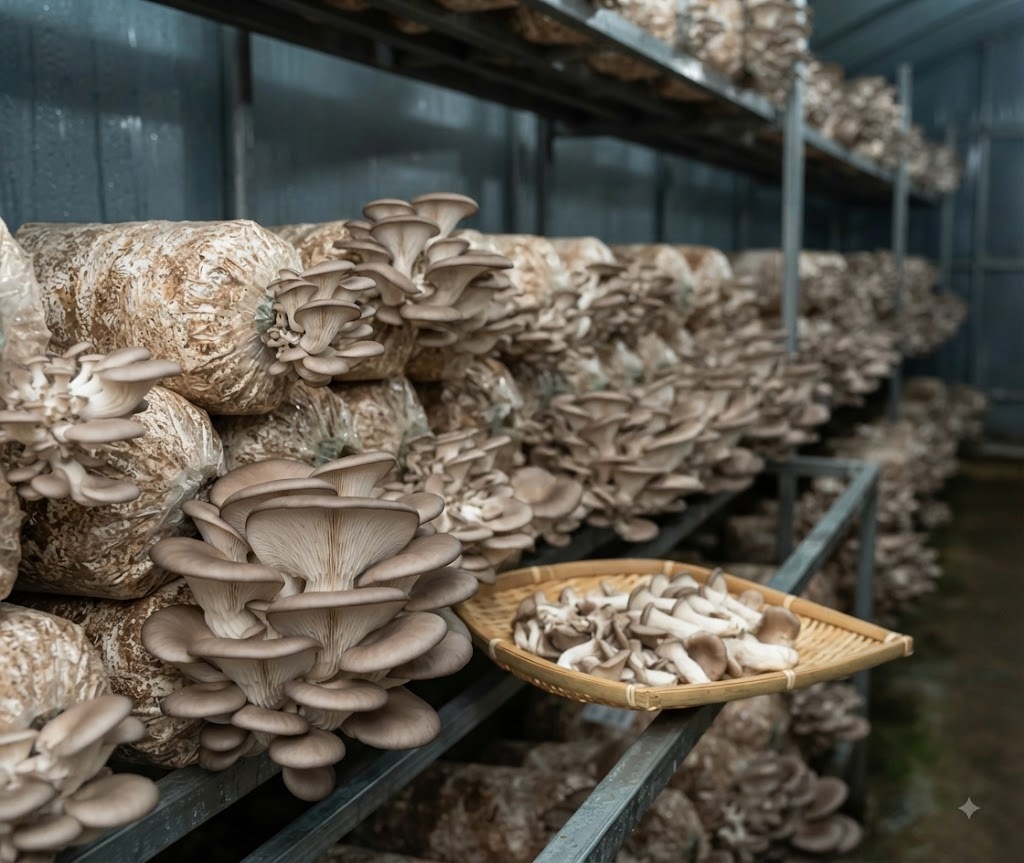
| production method | Bottle cultivation, bag cultivation, and bed cultivation are managed as separate Production Types. Nongsaroo specifies all three methods as major cultivation methods for oyster mushrooms. ( Nongsaroo ) |
| Harvesting principle | Record Strain, Spawn, Substrate, Batch, Culture Date, Germination Date, Harvest Date, Cap Size, Stem Length, Cluster Uniformity, and Harvest Number in the Lot. |
| Product separation | Separate into Fresh Cluster → Trimmed/Packaged → Cut/Prepared → Dried/Powder or HMR Ingredient. |
| Separation of similar items | The large oyster mushroom (King Oyster) is a separate Entity No. 193, and other Pleurotus varieties and species, such as yellow and pink, are managed as separate Strain/Species Masters. |
| Domestic official statistics | It is confirmed that oyster mushrooms are managed as a separate statistical item in the KOSIS Agricultural and Forestry Production Index. The latest raw tables for production volume and cultivated area will be entered later after verification of the official raw data. ( KOSIS ) |
| Cultivation environment | The Nongsaro bed cultivation work schedule presents management guidelines such as indoor humidity of 85–90% and temperature of 15–18℃ during the mushroom formation period. These are technical data standards for bed cultivation and are not applied uniformly to all varieties or systems. ( Nongsaro ) |
| Smart Farm | The Rural Development Administration announced that its ICT pilot project applied environmental sensors, air circulation, and remote growth control, and that in 10 regional pilots in 2017, production volume and income increased by an average of 25%, with farmer satisfaction at 92%. ( Rural Development Administration ) |
| domestic varieties | The oyster mushroom varieties 'Soltari' and 'Sena', developed by the Rural Development Administration, demonstrate the potential for overseas technology and spawn businesses for domestic mushroom varieties, as there are exclusive licensing agreements in Vietnam for the period 2023–2025. ( Rural Development Administration ) |
| Supply and demand risk | The key factors are spawn quality, culture medium raw materials, sterilization and inoculation contamination, culture environment, CO₂ and ventilation, harvesting labor, freshness, cold chain distribution, packaging and microorganisms, and price and overproduction. |
| Operating Principles | Connect Species/Strain–Spawn–Substrate–Incubation–Fruiting–Harvest Lot–Product–Buyer RFQ. |
| Final goal | The goal is to enhance supply stability and buyer suitability by accumulating cultivation environment, substrate, quality, delivery, and repurchase into a single runtime. |
Basic fields | detail |
| Korean name | Oyster mushrooms |
| English name | Oyster Mushroom |
| Representative scientific name | Pleurotus ostreatus (Jacq.) P. Kumm. |
| Biological classification | Fungi → Basidiomycota → Agaricomycetes → Agaricales → Pleurotaceae → Pleurotus |
| Fungal Name DB | MycoBank No.174220 ( MycoBank ) |
| Edible parts | fruiting body |
| Non-edible · Separate management | spawn, mycelial culture, medium, spent medium, contaminated medium |
| Major production stages | Substrate preparation → Sterilization/Fermentation → Inoculation → Mycelial culture → Fruiting → Fruiting body growth → Harvesting |
| Major harvesting stages | Cap unfolded, stem length, cluster shape, size, Buyer Spec standards |
| Basic product form | Fresh Cluster·Trimmed Fresh·Packaged·Cut·Dried·Powder |
| Basic processing stage | Sorting → Trimming → Pre-cooling → Packaging or cutting → Drying → Grinding |
| Basic use | Fresh food retail, catering, dining out, HMR, meal kits, processed foods |
| Similarity Principle | Separation of Species/Products from other species of the genus Pleurotus and King Oyster mushrooms |
Product Master
Product | Product stage | Key Management Standards |
| Oyster Mushroom Strain | strain | Species · Strain ID · Breeding Institute |
| Spawn Lot | spawn | Date of manufacture · Vitality · Purity · Contamination |
| Cotton Substrate Lot | Cotton substrate | Raw materials, moisture, fermentation |
| Sawdust Substrate Lot | sawdust substrate | Tree species, particle size, nutrients |
| Bottle Substrate Lot | Bottle cultivation | Culture medium weight, sterilization, inoculation |
| Bag Substrate Lot | bag cultivation | Bag · Mixing · Sterilization |
| Bed Substrate Lot | Bed cultivation | Medium type, thickness, fermentation, moisture |
| Incubated Substrate | culture | Mycelial attachment and contamination |
| Fruiting Lot | Occurrence stage | Fertilization, Environment, Harvest Cycle |
| Fresh Oyster Cluster | raw materials | Mushrooms, Mustard Greens, Stems, Harvest Date |
| Trimmed Oyster Mushroom | Selected | Removal of stem and substrate residue |
| Small Pack Oyster | small packaging | Weight, uniformity, and packaging |
| Bulk Foodservice Pack | For dining out | Specifications, Weight, Delivery Time |
| Pre-cut Oyster Mushroom | Preprocessing | Cutting, microorganisms, refrigeration |
| Dried Oyster Mushroom | dried product | Drying history · Moisture |
| Oyster Mushroom Powder | powder | Parent Lot · Particle Size · Microorganisms |
| Frozen Oyster Mushroom | frozen food | Pretreatment, freezing, temperature |
| HMR Ingredient | HMR ingredients | Cutting, Packaging, and Standardization |
| Mushroom Seasoning | Seasoning ingredients | Pleurotus ostreatus content · Formula |
| OEM·PB Product | finished product | MOQ · Formula · Contract |
| Spent Mushroom Substrate | waste badges | Raw materials, contamination status, recycling |
Classification criteria | Subdivision type | Management principles |
| Species | Pleurotus ostreatus | Primary Entity |
| Similar species | Other Pleurotus spp. | Separate Species |
| Varieties and strains | verified varieties such as Soltari and Sena | Strain Master |
| Cultivation type | Bottles, bags, and mushroom beds | Production Type |
| Types of culture media | Cotton, sawdust, and other agricultural by-products | Substrate Entity |
| cultivation facilities | General cultivation facilities · Smart farms | Facility Entity |
| culture stage | Inoculation, mycelial growth, fruiting, growth | Runtime |
| Harvest cycle | After the 1st and 2nd rounds | Yield separation |
| Harvesting stage | Specifications for mustard greens, stems, and clusters | Buyer Grade |
| Distribution methods | Fresh · Chilled · Frozen · Dried | Product Separation |
| Preprocessing | Trimmed·Cut | For food manufacturing |
| Processing form | Powder·Seasoning | Processing Entity |
| Final use | Retail, Food Service, Restaurant, HMR, Exports | Application |
| Transaction type | Regular Supply · Contract Production · OEM · PB | RFQ |
step | Essential Dataset | Management purpose |
| Production plan | Species · Strain · Cultivation Method · Buyer | Production Design |
| Strain selection | Strain ID · Breeding institution · Characteristics | Identity |
| Starter culture production | Manufacturing date, medium, vitality, contamination | Spawn Quality |
| Culture medium raw materials | Cotton, sawdust, and agricultural by-products | Raw material traceability |
| Raw material receipt | Origin · Lot · Moisture | Traceability |
| Media grinding | Island | Culture medium uniformity |
| combination | Ingredient Ratios · Nutritional Sources | productivity |
| Moisture control | Batch Water Content | Mycelial growth |
| fermentation | Temperature, Period, Flipping | Bed cultivation |
| Oral bottling, bagging, granulation | Weight and shape | Production Type |
| sterilization | Temperature and time | pollution prevention |
| cooling | Medium temperature | Vaccination preparation |
| inoculation | Spawn Lot · Date | Traceability |
| Mycelial culture | Temperature · Period · CO₂ | Colonization |
| pollution inspection | Mold, bacteria, and pests | Loss Control |
| Induction of occurrence | Temperature, humidity, ventilation, light | Primordia |
| feet | Date · Number of individuals | Yield Forecast |
| Fruiting body growth | Temperature, humidity, CO₂, light, ventilation | quality |
| Harvest judgment | Mustard Greens, Stems, Clusters, Buyer Grade | Harvesting at the right time |
| harvest | Date, Harvest Cycle, Weight | Harvest Lot |
| Trimming the base | Removal of substrate residue | Fresh QC |
| Selection | Size, color, shape, damage | Grade |
| Pre-cooling | Fresh Product | Shelf-life |
| cold storage | Temperature and period | Fresh Quality |
| packaging | Small packaging · Bulk | Buyer Delivery |
| cutting | For HMR | Processing |
| dry | Temperature, time, moisture | Dried Product |
| smash | Island | Powder |
| freezing | Pretreatment and freezing | Frozen |
| shipment | Buyer · Quantity · Date | transaction |
| waste badges | Usage frequency, contamination, and treatment | Circularity |
Quality items | raw oyster mushrooms | Pre-treated products | Dry/Powder | finished product | Public rating |
| Species | essential | succession | succession | tracking | Public/Verified |
| Strain | essential | succession | succession | tracking | Verified |
| cultivation method | Bottle/Bag/Mushroom Bed | succession | succession | tracking | Public/Verified |
| Badge Lot | essential | succession | succession | tracking | Verified/NDA |
| production facilities | essential | succession | succession | tracking | Verified |
| Harvest cycle | essential | succession | succession | tracking | Verified |
| Harvest day | essential | succession | succession | tracking | Verified |
| Cluster shape | core | Before amputation | Raw material characteristics | By product | Verified |
| Cap size | core | Standardization | Raw material characteristics | By product | Verified |
| God-colored | core | Raw material inheritance | Dry color | QC | Verified |
| God's unfolding diagram | core | Raw material inheritance | — | — | Verified |
| Great length | core | Cutting specifications | Raw material characteristics | By product | Verified |
| Thickness | Grade | Standardization | — | By product | Member |
| uniformity | core | core | Powder excluded | By product | Verified |
| impairment | core | core | Raw material inspection | QC | Verified |
| alien substance | check | core | core | core | Verified |
| substrate residue | core | eliminate | Raw material inspection | — | Verified |
| moisture | Fresh | By product | core | By product | Verified |
| microorganism | If necessary | core | core | Conformity to standards | Verified/NDA |
| pesticide residues | Conformity to standards | test | Raw material inheritance | Conformity to standards | Verified/NDA |
| heavy metals | Risk-based | test | test | Conformity to standards | Verified/NDA |
| Pre-cooling history | core | succession | — | tracking | NDA |
| Refrigeration history | core | core | — | tracking | NDA |
| Cutting history | — | essential | — | succession | NDA |
| Drying history | — | — | essential | succession | NDA |
| Grinding history | — | — | Powder is essential. | succession | NDA |
| Freezing history | The relevant city | The relevant city | — | succession | NDA |
| packaging | essential | essential | essential | essential | Verified |
| Expiration date | By product | By product | By product | essential | Verified |
| Shipment | essential | essential | essential | essential | Verified |
| Returns and Claims | record | record | record | record | NDA |
| Repurchase | Buyer Connection | Buyer Connection | Buyer Connection | Buyer Connection | NDA |
Lot Master Required Field
Lot ID · Item/Product Type · Scientific Name · Strain/Cultivar · Spawn Lot · Cultivation Method (Bottle/Bag/Bed) · Substrate Ingredients · Origin · Substrate Batch · Mixing · Moisture · Sterilization History · Production Facility · Room/Rack · Inoculation Date · Mycelial Culture Start/Completion Date · Fruiting Date · Harvest Cycle · Harvest Date · Cap Size · Color · Circulation · Stem Length · Thickness · Cluster Weight · Uniformity · Deformity · Damage · Substrate Residue · Contamination · Foreign Matter Check · Pesticide Usage Records · Pesticide Residue · Microorganism · Heavy Metal Test Report · Pre-cooling · Refrigeration History · Raw Material Lot · Cutting · Drying · Freezing · Grinding History · Packaging Date · Best Before Date · Shipper · Returns · Claims · Repurchase
Customers | Purchase criteria | Cooperation opportunities |
| spawn companies | Species·Strain·Vitality | Spawn RFQ |
| Badge company | Ingredients, Moisture, Sterilization | Substrate Supply |
| mushroom farm | Strains, Culture Media, Purchasing Sources | Production cooperation |
| Producer organizations | Scheduled Production · Joint Sorting | Local distribution |
| wholesale market | Freshness, Weight, Cluster | Fresh |
| Large-scale distribution | Standard sizes, small packaging, regular delivery | Retail |
| Online fresh food distribution | Freshness and Packaging | Fresh Delivery |
| food service companies | Price, Specifications, Delivery Time | Foodservice |
| School and public meals | Domestic, Safety, Frequency | Regular supply |
| franchise | Uniform size and period | Contract Supply |
| HMR | Cutting, Standardization, Microorganisms | Pre-processing |
| Meal kit | Fresh Cut · Small Packaging | Meal-kit |
| Food manufacturing | Drying, Powdering, Freezing | Ingredient |
| Seasonings | Powder | Seasoning |
| OEM·PB | HMR · Frozen · Processed | Private Label |
| export companies | Shelf life, packaging, HS | Export |
| smart farm companies | Environmental control and sensors | AX |
| Research Institute | Strain, medium, storage, automation | R&D |
step | Key variables | Operational judgment |
| Strain development | Domestic varieties · Royalties | IP Supply |
| Starter culture production | Vitality·Pollution·Lot | Production Base |
| Culture medium raw materials | Origin · Price · Moisture | Raw Material |
| Media manufacturing | Blending and sterilization | Yield |
| Inoculation and culture | Pollution rate and period | Production |
| growth | Environment and Harvest Cycle | Fresh Supply |
| Sorting and packaging | Grade · Weight | Market |
| Cold chain | Temperature · Delivery Time | Shelf-life |
| Domestic distribution | Wholesale, Distribution, Food Service, and Food Service | Demand |
| Preprocessing | Cut·Pack | HMR |
| process | Dry · Freeze · Powder | Value Add |
| export | Variety, Storage, Packaging | Global RFQ |
| Variety Technology Transfer | Royalty · Territory | IP Trade |
| RFQ | Specifications, Quantity, Delivery Date | Procurement |
| Repurchase | Quality, Price, Delivery Time | Supplier Score |
In 2023, the Rural Development Administration announced that it had signed an exclusive license agreement with a Vietnamese company for the three-year period from 2023 to 2025 regarding the domestic oyster mushroom varieties 'Soltari' and 'Sena' . This demonstrates that the scope of transactions in the oyster mushroom supply chain can expand beyond just fruiting bodies to include IP related to varieties, spawn, and cultivation technologies . ( Rural Development Administration )
Trade Dataset
item | v1.0 processing |
| Fresh Oyster Mushroom HS | Future verification of the Korea Customs Service's current HS-K |
| Chilled Oyster Mushroom HS | Check Fresh/Refrigerated Classification |
| Frozen Oyster Mushroom HS | Frozen classification verification |
| Dried Oyster Mushroom HS | Check dry product classification |
| Mushroom Powder HS | Verification by degree of processing and composition |
| Spawn HS | Verification of spawn customs classification |
| Substrate HS | Verification by medium raw material and inoculation medium |
| Korea's import volume | Input after official verification of raw data |
| Korea's export volume | Input after official verification of raw data |
| Major exporting countries | Input after verification of raw data by the Korea Customs Service |
| Major importing countries | Input after verification of raw data by the Korea Customs Service |
| Customs clearance unit price | Calculated only within the same HS, Product, and Unit |
| Variety Royalty | NDAs by Contract and Territory |
| Quarantine | Check by Spawn, Culture Medium, and Mushroom Product |
| FTA | Check origin criteria by country and HS code |
Products and processes | Key conditions | RFQ conversion |
| Fresh Cluster | Mustard greens, stems, mushrooms, freshness | Fresh RFQ |
| Trimmed Fresh | Removal of stem and substrate residue | Retail |
| Small Pack | Weight, Packaging, Uniformity | Retail/PB |
| Bulk Pack | Grade · Delivery Date | Foodservice |
| Pre-cut | Cutting, Refrigeration, Microorganisms | HMR |
| Frozen | Pretreatment and freezing | Industrial Food |
| Dried | Moisture, color, scent | Ingredient |
| Dried Slice | Thickness and moisture | Soup/HMR |
| Powder | Particle size and microorganisms | Seasoning |
| Extract | Parent Lot · Extraction Conditions | Food Ingredient |
| Seasoning Base | Powder/Extract·Formula | OEM |
| Off-grade Fruit Body | Exterior Grade Below Standard | Review of processing conversion |
| Stem/Base Trim | Jeongseon by-products | Powder and Extraction Review |
| Spent Substrate | waste badges | Review of compost, feed, and biomaterials |
| Contaminated Substrate | pollution | Food supply chain exclusion |
Nongsaroo features an example of farming technology utilizing ginkgo nut shells and similar materials as substrates for bottle cultivation of oyster mushrooms, demonstrating that oyster mushroom substrates can serve as a Biomass Conversion Platform capable of recycling agricultural by-products . However, as this technology is a research case under specific conditions, it cannot be generalized to all substrates. ( Nongsaroo )
PRP — Product Research Profile
Oyster mushroom PRP operates with the following structure.
Species/Strain → Spawn → Substrate Formula → Sterilization/Fermentation → Incubation → Fruiting Environment → Harvest Grade → Post-harvest → Processing → Buyer Application → RFQ Performance
PRP | Key research questions |
| Strain PRP | Which strain is suitable for yield, color, morphology, and export storage? |
| Spawn PRP | How spawn vitality, purity, and contamination are linked to production yield |
| Substrate PRP | How do cotton, sawdust, and byproduct substrates affect yield and quality? |
| Bottle PRP | Are bottle weight, formulation, sterilization, and culture suitable for uniform production? |
| Bag PRP | Are the culture, growth, and workability of the bag medium suitable for the target farm? |
| Bed PRP | Are fermentation, moisture, granularity, and the environment of occurrence linked to productivity? |
| Fresh PRP | Do the mustard greens, stems, clusters, and shelf life match Buyer Grade? |
| Export PRP | Is the destination country's shelf life secured through harvesting, packaging, and cold management? |
| Smart Farm PRP | What are the effects of sensors, ventilation, air circulation, and environmental control on quantity and uniformity? |
| Processing PRP | What food ingredients can be converted from off-grade and trim? |
| By-product PRP | Under what conditions can spent substrate be used as compost, animal feed, or biomaterials? |
first of all | Execution item | Performance indicators |
| 1 | Species·Strain·Spawn·Substrate·Harvest Lot required value | Essential Field Completion Rate |
| 2 | Separation of Production Entities from Bottles, Bags, and Beds | Cultivation method identification rate |
| 3 | Media Ingredients, Mixing, Moisture, and Sterilization Log Connection | Substrate Traceability |
| 4 | Datafication of inoculation, culture, and contamination | Contamination Rate |
| 5 | Temperature, humidity, and CO₂ sensor connection | Sensor Coverage |
| 6 | Air Circulation/Ventilation Runtime | Environment Uniformity |
| 7 | Sensing internal temperature of the culture medium | Thermal Risk Detection |
| 8 | Mycelial growth video AI | Colonization Score |
| 9 | Contamination AI determination | Detection Accuracy |
| 10 | The foot predicts | Fruiting Forecast |
| 11 | Production volume forecast | Yield Forecast |
| 12 | Video AI Selection of God-tier Songi | Grade Accuracy |
| 13 | Automatic harvest timing determination | Harvest Accuracy |
| 14 | Pre-cooling and refrigeration IoT connection | Cold-chain Coverage |
| 15 | Export Shelf-life forecast | Rejection/Loss Rate |
| 16 | Analysis of uniformity by production room | CV/Uniformity |
| 17 | Badge Productivity Analysis | kg/Batch |
| 18 | Product–Buyer AI Match | RFQ → Sample Conversion Rate |
| 19 | Buyer Ratings & Repurchase Link | Repeat Order Rate |
Problem group | Problem Definition | Required data |
| Mixed Species · Variety Mix | Various species and varieties mixed under the oyster mushroom product name | Species/Strain |
| Spawn quality variation | Differences in vitality and pollution affect productivity | Spawn QC |
| Supply and demand of culture medium raw materials | Fluctuations in the price and quality of cotton, sawdust, and nutrients | Material Supply |
| Mixing deviation | Differences in moisture, nutrients, and particle size | Formula |
| Non-uniform fermentation | Decline in productivity of bed cultivation | Fermentation |
| Poor sterilization | germs and contamination | Sterilization |
| Inoculation contamination | Batch disposal/quantity reduction | Inoculation |
| Excessive incubation temperature | High temperature risk including self-respiratory heat | Internal Temperature |
| Uneven mycelial growth | Production variation between bottles, bags, and beds | Colonization |
| CO₂ deviation | Changes in the shape of the hat and stem | CO₂ |
| Non-uniform ventilation | Differences in marketability by facility location | Airflow |
| humidity deviation | Differences in growth and quality | RH |
| Uneven feet | Dispersion of production volume and harvest days | Primordia |
| Mushroom quality variation | Differences in top, top, and uniformity | Vision QC |
| Harvest labor | Burden of repetitive manual work | Labor |
| freshness deterioration | Quality loss during storage and transportation | Cold Chain |
| microorganism | Pre-processing and HMR Safety | Microbiology |
| Packaging condensation | spoilage and quality degradation | Packaging |
| overproduction | Facility-type simultaneous shipment price drop | Supply Forecast |
| Price fluctuations | Changes in farmgate prices | Market Price |
| Export Zhejiang Province | Long-distance transportation quality maintenance | Shelf-life |
| Variety IP Management | Management of overseas propagation and licenses | License |
| Waste culture medium disposal | Large amount of by-products generated | SMS Dataset |
| Buyer Spec Discrepancy | Differences in specifications between school meals, dining out, and retail | RFQ |
| Repurchase not reflected | Delivery results unlinked to strain and culture medium improvement | Buyer Evaluation |
RFQ Type | Public Registration | Verify/NDA |
| Pleurotus ostreatus strain | Species · Strain · Uses | Breeding institutions and characteristic data |
| Supply of spawn | Strain · Shape | Manufacturer · Lot · Quantity · Unit Price |
| Culture medium raw materials | Cotton, sawdust, and by-products | Origin · Quantity · Unit Price |
| Bottle media | Badge type and use | Formula · Quantity · Price |
| Bag culture medium | Bag Size · Strain | Mixing, Quantity, Price |
| mushroom bed cultivation raw materials | Cotton and other culture media | Moisture and fermentation conditions |
| Fresh oyster mushrooms for sale | Variety, cultivation type, and expected harvest | Farm price, quantity, actual unit price |
| Buy fresh oyster mushrooms | Size, Cluster, Stem, Cap Spec | Target quantity and price |
| Regular supply | Grade · Period | Monthly/Weekly Volume |
| contract production | Strain · Standard | Facilities, Production Capacity, Unit Price |
| School meal delivery | Domestic and safe | Delivery cycle and volume |
| Foodservice delivery | Size, Price, Cycle | Buyer demand |
| HMR ingredients | Trimmed/Cut | Microorganisms and Packaging |
| Meal kit | Fresh Cut | Use-by date · Refrigeration |
| dried product | Moisture · Origin | Lot · Price |
| powder | Particle size and microorganisms | Parent Lot·COA |
| frozen food | Pretreatment and freezing | Temperature Log |
| OEM·PB | HMR · Seasoning · Frozen | MOQ · Formula |
| export | Fresh · Destination Country | HS · Quarantine · Shelf-life |
| Variety Technology Transfer | Strain · Territory | Royalty/License |
| Smart farm demonstration | Environmental sensors and control | raw data |
| Utilization of spent culture medium | Raw material composition and contamination | Quantity and processing conditions |
| Research cooperation | Variety · Medium · Environment · Storage | IP · Exam materials |
① Need Products & Materials
Companies and institutions seeking necessary products, agricultural products, raw materials, and processed goods register purchasing demands. Registered requests are utilized to review cooperation with potential suppliers and producers based on the RFQ Intelligence Library.
Process:
RFQ Registration → Supplier/Product Review → Collaboration Connection → Future AI Matching
Register
② We are looking for production and manufacturing partners. (Need Suppliers & Manufacturers)
Register a request to find necessary production and supply partners, ranging from farms and producer organizations to processing companies, OEM, ODM, and Private Label manufacturers.
Process:
RFQ Registration → Review of Production & Manufacturing Capabilities → Collaboration Connection → Future AI Partner Matching
Register
③ We are looking for domestic and international buyers. (Need Buyers)
Farmers, producer organizations, and manufacturing companies are requesting cooperation with new buyers, such as domestic and international distributors, importers, brand companies, and food service and catering businesses.
Process:
RFQ Registration → Product & Supply Capability Review → Market & Buyer Connection → Future AI Buyer Matching
Register
Contact : mail@markethub.org
Version | Main contents | situation |
| v1.0 | Fungal Identity · Species–Strain–Spawn · Bottle/Bag/Bed Cultivation · Fresh · Pretreatment · Processing · Smart Farm · RFQ Basic Structure Registration | complete |
| v1.1 | Verification of raw data for national production statistics, production by facility, production by region, HS code, imports and exports, and price formulas | expected |
| v2.0 | Subdivision by Bottle, Bag, and Bed: Media, Environment, Occurrence Order, Fresh, Cut, Dried, Frozen, Powder Quality, Yield, and PRP | expected |
| v3.0 | Breeding & Spawn Companies – Culture Medium Companies – Smart Farms & Production Farms – Pre-processing & Processing Companies – Food Service, Restaurant, HMR, Distribution, Export Buyer Verified Container Combination | expected |