

Judgment axis | Key judgment |
| Item Identity | The representative scientific name for kelp is Saccharina japonica, and the National Institute of Fisheries Science manages it as a major cultured seaweed of the family Laminariaceae, order Laminariales, class Brown algae. ( National Institute of Fisheries Science ) |
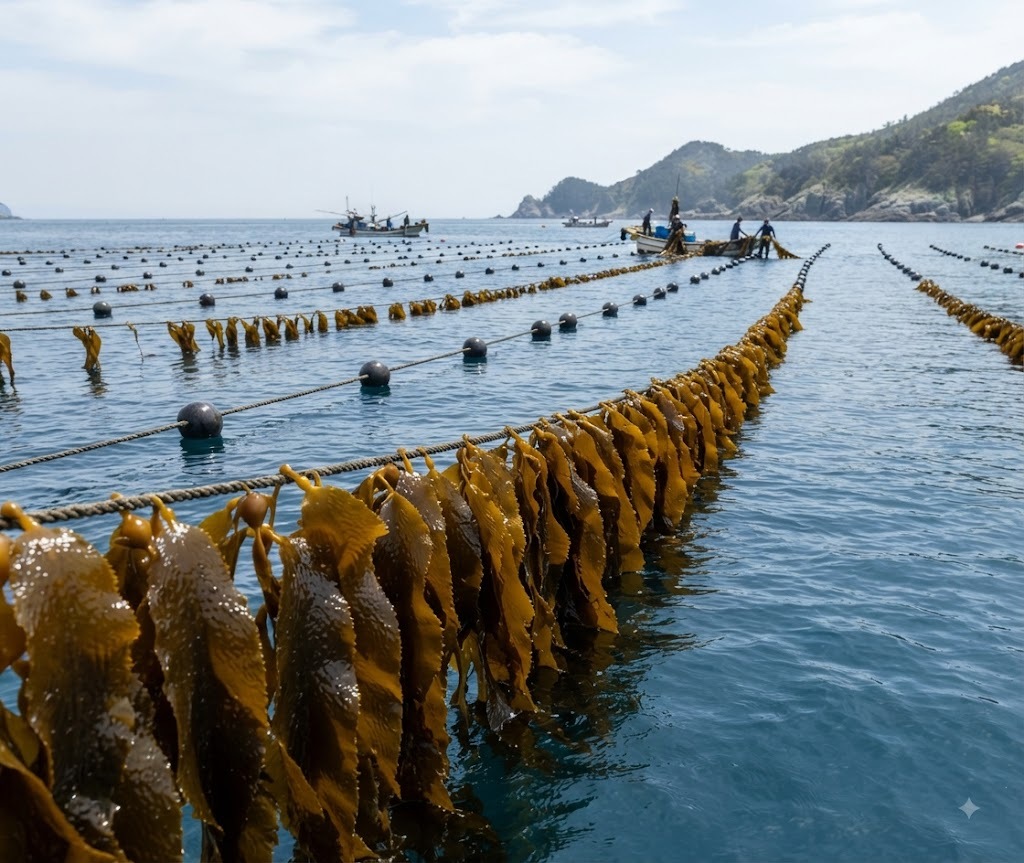
| Key role | It is a large-scale marine aquaculture item that simultaneously supplies edible fresh, salted, and dried kelp, as well as raw seaweed for abalone feed. The National Institute of Fisheries Science also explains that most domestic kelp is used for human consumption and as abalone feed. ( National Institute of Fisheries Science ) |
| Harvesting principle | Species, varieties, seed lot, transplanting date, main rearing date, aquaculture area, rope, water temperature, harvesting date, leaf length, leaf width, thickness, fresh weight, and uses are converted into lots. |
| Product separation | Separated into seeds → seedlings → cultured raw materials → edible fresh kelp/abalone feed → salting → drying → cutting → powder and broth ingredients. |
| Separation of similar items | It separates the species *U. pinnatifida* from *Undaria pinnatifida* and does not classify other overseas kelp species, such as giant kelp, as the same entity based solely on the trade name "kelp." The National Institute of Fisheries Science also explains that the utilization structures of Chile's *Macrocystis pyrifera* and Korean *Dasi* differ. ( National Institute of Fisheries Science ) |
| domestic production | Domestic aquaculture production of kelp in 2025 is projected to reach 567,689 tons, a 4.3% increase compared to 544,406 tons in 2024. ( National Institute of Fisheries Science ) |
| 2024 Production Trends | The official production volume for 2024 is 542,340 tons, based on the figure released prior to data revision, while the finalized and adjusted figure for 2024 in the comparison table published in 2026 is 544,406 tons. For the latest comparison, the latter value takes precedence, and the statistical version is preserved. ( National Institute of Fisheries Science ) |
| Climate Risk | In 2024, production of kelp used as abalone feed decreased compared to the previous year due to poor crop yields from late spring to summer caused by rising water temperatures. ( National Institute of Fisheries Science ) |
| Early growth risk | In tests conducted by the National Institute of Fisheries Science, damage such as thallus melting may occur if wakame and kelp are exposed to temperatures above 22°C for more than one week; therefore, it is important to monitor water temperature during transplanting and main cultivation. ( National Institute of Fisheries Science ) |
| Production period | The technical responses from the National Institute of Fisheries Science generally suggest seed collection and temporary transplanting around September to October, main rearing from November to May or June of the following year, and major harvesting around May or June. This is a reference that varies depending on water temperature by region and year. ( National Institute of Fisheries Science ) |
| Variety development | The National Institute of Fisheries Science has developed SUGWON 301 using domestic kelp seeds for the purpose of extending the abalone feed supply period. ( National Institute of Fisheries Science ) |
| Operating Principles | Connect Variety–Gametophyte/Seed–Seed Rope–Farm Site–Grow-out–Harvest–Usage Allocation–Processing–Buyer RFQ. |
| Final goal | We establish a supply chain that tracks everything from seeds to sea area, water temperature, harvest, processing, RFQ, and repurchase while separating the demand for edible abalone and abalone feed. |
Kelp production in 2025 was projected to reach 567,689 tons , a 4.3% increase from 544,406 tons in 2024. The Ministry of Oceans and Fisheries explains that seaweed crop conditions, including kelp and wakame, were favorable in 2025 due to stable oceanographic conditions. ( Ministry of Finance and Economy )
Basic fields | detail |
| Korean name | Kelp |
| English name | Sea tangle / Kelp |
| Representative scientific name | Saccharina japonica |
| Past literature names | Records regarding the notation of Laminaria japonica are preserved as Historical Taxonomic Names. |
| classification | Class Brown algae → Order Laminariales → Family Laminariales |
| Edible parts | Broad thallus center |
| Non-edible · Separate management | Gametophyte · Zoospore · Seedling · Seedling · Cultivation rope · Attached organism · Discarded raw material |
| Major production stages | Selection of parent plants → Management of spores and gametophytes → Seedling collection → Transplanting → Main cultivation → Growth → Harvesting |
| Major harvesting stages | Leaf length, leaf width, thickness, fresh weight, tissue, and optimal timing by use |
| Basic product form | Fresh kelp, Wrap kelp, Salted kelp, Dried kelp, Cut kelp, Powder, For broth, Abalone feed |
| Basic processing stage | Washing → Sorting → Salting or Drying → Cutting → Grinding/Packaging |
| Basic use | Broth, Wraps, Side Dishes, School Meals, Dining Out, HMR, Food Ingredients, Abalone Feed |
| Similarity Principle | Separation of Species from Other Brown Algae such as Wakame, Gompi, Laminaria, and Giant Kelp |
The National Institute of Fisheries Science's marine ecotoxicity testing method specifies kelp as Saccharina japonica and describes it as a major cultivated seaweed belonging to the class Brown Algae, order Laminariales, and family Laminariaceae. The Integrated Information System for Fisheries Food also uses the same scientific name and the English name "Sea tangle." ( National Institute of Fisheries Science )
Some past domestic records list kelp as Laminaria japonica . Therefore, MarketHub does not remove this notation but links to the Historical Taxonomic Name. ( National Institute of Fisheries Science )
Product Master
Product | Product stage | Key Management Standards |
| Kelp Species Master | Biological Entity | Saccharina japonica |
| Variety/Cultivar | varieties | Variety Name · Breeding Organization · Rights |
| Male Gametophyte | male actor | Strain ID · Generation |
| Female Gametophyte | female gametophyte | Strain ID · Generation |
| Parent Sporophyte | imitation | Variety, Origin, Maturity |
| Seed Culture Lot | satellite | Variety, Production Date, Vitality |
| Seed Rope | occupation | Seed Lot · Seed Collection Date |
| Nursery Rope | Gaisik | Sea area, water temperature, survival |
| Grow-out Rope | Main positive | Farm Site · Rope ID |
| Fresh Food-grade Kelp | Edible fresh kelp | Date of collection, thickness, color, foreign matter |
| Abalone-feed Kelp | abalone feed | Weight, Freshness, and Supply Time |
| Young Kelp | Early harvest raw materials | Uses and Size |
| Mature Kelp | Primary maturation | Thickness, broth, and dryness suitability |
| Ssam Kelp | For wraps | Tenderness · Thickness · Salted/Raw |
| Salted Kelp | Salt | Salinity, Moisture, Raw Lot |
| Dried Kelp | Dried kelp | Moisture, color, thickness, foreign matter |
| Broth-grade Kelp | For broth | Thickness, Size, Flavor, Grade |
| Cut Kelp | cut parts | Width, length, moisture |
| Shredded Kelp | Shredded products | Cutting uniformity |
| Kelp Flake | Flake | Size and moisture |
| Kelp Powder | powder | Particle size and microorganisms |
| HMR Ingredient | Pre-processed raw materials | Cutting, Salt, Packaging |
| OEM·PB Product | finished product | Formula·MOQ |
| Off-grade Kelp | Non-product | Processing conversion after safety verification |
| Processing Residue | by-product | Verification of food, feed, and material conversion |
Classification criteria | Subdivision type | Management principles |
| Species | Saccharina japonica | Primary Entity |
| Historical Taxonomy | Laminaria japonica | Alias Mapping |
| varieties | Traditional, selected, and bred varieties | Variety Master |
| Seed form | Actors · Royal Ancestral Shrine · Royal Ancestral Shrine | Seed Product |
| production stage | Seed collection, transplanting, and main cultivation | Runtime |
| Aquaculture area | City/Province/City/County/Fishing Ground | Farm Site |
| Style rope | Rope/Line ID | Lot Traceability |
| Harvest purpose | Edible / Abalone feed | Usage Entity |
| Harvesting stage | Young/Mature | Product Separation |
| Original form | Fresh kelp | Fresh |
| Primary processing | Washing, salting, and drying | Intermediate |
| Secondary processing | Sliced, shredded, powdered, and broth packs | Processed |
| Final use | Edible, catering, food service, food manufacturing, abalone farming | Application |
| Transaction type | Source contracts, regular supply, OEM, PB, exports | RFQ |
step | Essential Dataset | Management purpose |
| Production plan | Variety · Use · Farm Site · Buyer | Production Design |
| Imitation selection | Variety, Origin, Maturity | Seed Source |
| Management of rogues and gametes | Strain · Culture Day | Genetic Identity |
| Seed culture | Culture · Vitality | Seed QC |
| Seed collection | Seed Lot·Rope ID | Traceability |
| Indoor cultivation | Temperature, light, period | Seed Growth |
| Gaisik | Date, water temperature, leaf size | Sea Adaptation |
| Gaisik survival | Elimination · Complete Recording | Survival |
| Main positive | Farm·Rope·Date | Production |
| water temperature | Daily and period | Growth/Risk |
| salt | Actual measurements | Environment |
| Nutrients | Nitrogen, phosphorus, etc. | Growth |
| flow velocity | ocean currents and tides | Growth |
| blue | Wind and Facility Risk | Facility |
| ilsa | Light environment | Photosynthesis |
| Attached organisms | Types and degrees | Quality |
| Sikhae | Occurrence and damage rates | Yield |
| Growth measurement | Leaf length, leaf width, and thickness | Forecast |
| Purpose determination | Edible/Abalone feed | Allocation |
| Harvest judgment | Size, thickness, and timing | Harvest |
| Collection | Rope · Date · Weight | Harvest Lot |
| Collection at the production site | Time · Weight | Logistics |
| Edible sorting | Thickness, color, damage, foreign matter | Food Grade |
| Selection of abalone feed | Freshness and weight | Feed Grade |
| purifying | Water and foreign matter | Food Safety |
| Salt | Salt, Period, Salinity | Salted Product |
| dehydration | moisture | Processing |
| dry | Temperature, time, moisture | Dried Kelp |
| cutting | Length and width | Product |
| smash | Entry to the island | Powder |
| packaging | Material and weight | Distribution |
| save | Humidity and temperature | Shelf-life |
| shipment | Buyer · Lot · Quantity | Delivery |
Quality items | Fresh kelp | Salted kelp | Drying and cutting | finished product | Public rating |
| Species | essential | succession | succession | tracking | Public/Verified |
| Variety | essential | succession | succession | tracking | Verified |
| Seed Lot | essential | succession | succession | tracking | Verified/NDA |
| production area | essential | succession | succession | origin | Public/Verified |
| Farm Site | essential | succession | succession | tracking | Verified/NDA |
| Rope ID | essential | succession | succession | tracking | Verified |
| Gaisikil | essential | succession | succession | tracking | Verified |
| This formation day | essential | succession | succession | tracking | Verified |
| Collection date | essential | succession | succession | tracking | Verified |
| use | Food/Feed | Food | Food | By product | Public |
| Leaf chest | core | Inheritance of raw materials | By standard | — | Verified |
| Leaf width | core | Inheritance of raw materials | By standard | — | Verified |
| thickness | core | core | Key ingredient for broth | By product | Verified |
| color | core | core | Dry color | By product | Verified |
| texture | core | core | After retaking the exam | By product | Verified |
| biomass | essential | Input weight | raw material yield | Product weight | Verified |
| alien substance | core | core | core | core | Verified |
| Attached organisms | core | Raw material inspection | — | — | Verified |
| impairment | core | core | Grade | QC | Verified |
| salt | — | core | When salting raw materials | By product | Verified |
| moisture | Fresh | By process | core | core | Verified |
| Rehydration rate | — | By product | core | HMR Key | Verified |
| microorganism | If necessary | core | core | Conformity to standards | Verified/NDA |
| heavy metals | test | test | test | Conformity to standards | Verified/NDA |
| ingredients such as iodine | When requested by the product/buyer | By product | By product | By product | Verified |
| radioactivity | When Policy/Buyer Requires | If necessary | If necessary | destination country's requirements | Verified/NDA |
| purifying | raw materials | essential | History inheritance | tracking | NDA |
| Salting history | — | essential | succession | tracking | NDA |
| Drying history | — | — | essential | tracking | NDA |
| packaging | Mountain area transportation | essential | essential | essential | Verified |
| Expiration date | Fresh standard | By product | By product | By product | Verified |
| Shipment | essential | essential | essential | essential | Verified |
| Returns and Claims | record | record | record | record | NDA |
| Repurchase | Buyer Connection | Buyer Connection | Buyer Connection | Buyer Connection | NDA |
The National Institute of Fisheries Science's Integrated Fisheries Food Information manages kelp as a separate fishery food and classifies food form and nutritional information by product and condition. Therefore, the components of fresh kelp are not directly applied to dried kelp or powder products. ( National Institute of Fisheries Science )
Lot Master Required Field
Lot ID · Item/Product Type · Scientific Name · Historical Taxonomic Name · Variety/Cultivar · Male/Female Gametophyte ID · Seed Culture Lot · Seed Rope ID · Seed Producer · Date of Seed Collection · Date of Temporary Transplantation · Date of Main Cultivation · Farm Site/Sea Area · Producer/Producer Organization · Farming Method/Rope ID · Water Temperature · Salinity · Nutrients · Flow Rate · High Temperature · Sprout Melting · Feeding Damage · Attached Organisms · Date/Time of Collection · Use (Food/Abalone Feed) · Leaf Length · Leaf Width · Thickness · Fresh Weight · Color · Tissue · Damage · Foreign Matter · Fresh Lot · Washing · Salting · Dehydration · Drying · Cutting · Grinding History · Moisture · Salinity · Rehydration Rate · Test Report for Microorganisms, Heavy Metals, Iodine, Radioactivity, etc. · Packaging Date · Best Before Date · Shipper · Returns · Claims · Repurchase
characteristic | base year | black eye | Official source/judgment |
| Kelp farming production volume | 2025 | 567,689 tons | Ministry of Maritime Affairs and Fisheries · National Institute of Fisheries Science ( Ministry of Finance and Economy ) |
| Kelp farming production volume | 2024 | 544,406 tons | 2024 Base Values in the Comparison Table to be Published in 2026 ( National Institute of Fisheries Science ) |
| Kelp production volume | First announcement in 2024 | 542,340 tons | 2025 발표자료. Statistics Version Retained ( National Institute of Fisheries Science ) |
| Kelp production volume | 2023 | 596,471 tons | 2025 발표자료 ( National Institute of Fisheries Science ) |
| 2025 Year-on-year | 2025/2024 | +4.3% | Ministry of Oceans and Fisheries ( National Institute of Fisheries Science ) |
| Recent 5-year average | Announcement criteria | 590,865 tons | 2026 Official Comparison Table ( National Institute of Fisheries Science ) |
| Edible production | recent | Input after official verification of raw data | Need to be separated from total production |
| abalone feed production | recent | Input after official verification of raw data | Need to be separated from total production |
| Production volume by region | recent | To be entered later after verification of raw data from KOSIS and Marine and Fisheries Statistics. | Needs by City/Province and City/County |
step | Key variables | Operational judgment |
| Variety development | Traditional, bred varieties, and variety rights | Genetic Supply |
| satellite | Gametophyte · Employment · Vitality | Seed |
| Gaisik | Water temperature, season, and survival rate | Production Start |
| Main positive | Sea area, rope, water temperature | Grow-out |
| growth | Leaf length, leaf width, and thickness | Yield |
| harvest | Food/Feed Purpose | Harvest |
| Allocation of uses | Edible vs. Abalone Feed | Supply Allocation |
| Collection at the production site | Weight · Time | Logistics |
| Fresh kelp | Freshness and thickness | Fresh Market |
| Salt | Salinity and yield | Intermediate |
| dry | Moisture, thickness, and yield | Food Ingredient |
| Cutting and powder | standard | HMR/OEM |
| abalone feed | Supply period and freshness | Feed Supply |
| Domestic distribution | Price and stock | Market |
| export | Product type and country of origin | Trade |
| RFQ | Purpose, Specifications, Quantity, Period | Procurement |
| Repurchase | Yield, Quality, Delivery Time | Supplier Score |
The most important supply chain relationships for kelp are as follows.
Kelp Harvest → Food Demand + Abalone Feed Demand
The Ministry of Oceans and Fisheries' analysis that the decline in production in 2024 was directly linked to poor yields of kelp used as feed for non-edible abalone supports this relationship. ( National Institute of Fisheries Science )
Furthermore, the National Institute of Fisheries Science explains that while overseas Macrocystis pyrifera is primarily used as an industrial raw material for products such as alginate, the domestic kelp market is centered on edible and abalone feed. Therefore, when comparing the global kelp market, not only the species but also the end-use structure is classified. ( National Institute of Fisheries Science )
Trade Dataset
item | v1.0 processing |
| Fresh Kelp HS | Input after direct verification of the current HS-K by the Korea Customs Service |
| Salted Kelp HS | Verification by salting state and degree of processing |
| Dried Kelp HS | Verification by product description and processing status |
| Cut/Prepared Kelp HS | Verification based on whether it is a prepared product |
| Kelp Powder HS | Verification by ingredient and degree of processing |
| Seeds and seeds | Separate verification of aquatic plant seeds and quarantine systems |
| Export volume | Input after official verification of raw data by the Korea Customs Service |
| export value | Input after official verification of raw data |
| Import volume | Input after official verification of raw data |
| Major exporting countries | HS raw data verification |
| Major importing countries | HS raw data verification |
| Customs clearance unit price | Calculation only within the same HS, product type, and unit |
| FTA | Check Country, HS, and Origin Criteria |
| Quarantine | Verification by seed, fresh, and processing status |
| Variety rights | Aquatic Plant Variety Protection Dataset Link |
Products and processes | Key conditions | RFQ conversion |
| Fresh Food-grade Kelp | Origin, Thickness, Color, Freshness | Fresh RFQ |
| Abalone-feed Kelp | Freshness · Biomass · Supply Time | Feed RFQ |
| Ssam Kelp | Tenderness, thickness, salting | Retail/Foodservice |
| Salted Kelp | salinity and moisture | B2B Ingredient |
| Desalted Kelp | Desalination degree · Microorganisms | HMR |
| Dried Whole Kelp | Thickness, moisture, color | Retail |
| Broth-grade Kelp | Size, thickness, flavor | Food Manufacturer |
| Cut Dried Kelp | Cut Size · Moisture | HMR |
| Shredded Kelp | Width and length | Side Dish |
| Kelp Flake | particle size | Soup/Seasoning |
| Kelp Powder | Particle size and microorganisms | Ingredient |
| Broth Pack | Kelp + auxiliary ingredients | OEM/PB |
| Frozen Kelp | Pretreatment and freezing | Industrial |
| Off-grade Kelp | Exterior Grade Below Standard | Powder and Processing Review |
| Trim Residue | Cutting by-products | Raw material conversion verification |
| Processing Residue | Non-marketable by-products | Separate verification of feed, compost, and biomaterials |
| Feed Residue | Abalone feed residue | Aquaculture farm environmental management targets |
While there is broad potential for the commercialization of kelp as a food, functional, and industrial material, specific functionalities or medical efficacy may be used as RFQ Claims only when food regulations, official research, and the recognition conditions of individual products have been verified.
PRP — Product Research Profile
Kelp PRP operates with the following structure.
Species → Variety → Seed → Farm Environment → Harvest → Food/Feed Allocation → Processing Yield → Product Grade → Buyer Application → RFQ Performance
PRP | Key research questions |
| Species PRP | Is it confirmed to be actual S. japonica? |
| Variety PRP | Do growth period, thickness, yield, and high water temperature characteristics differ by variety? |
| Seed PRP | Is the vitality of the acting body and workers linked to the survival rate in the field? |
| Temperature PRP | What is the relationship between water temperature during transplanting and main cultivation, and droplet and growth? |
| Farm PRP | How water temperature, salinity, flow rate, and nutrients change production yield |
| Harvest PRP | How do the optimal harvesting times differ between abalone for human consumption and abalone feed? |
| Food/Feed Allocation PRP | What is the impact of abalone demand on edible supply and prices? |
| Thickness PRP | How leaf thickness is linked to suitability for wraps, broth, and drying |
| Salting PRP | What are the effects of salting conditions on color, texture, and yield? |
| Drying PRP | What are the effects of drying conditions on moisture, color, flavor, and yield? |
| Broth PRP | What is the relationship between thickness, dryness, variety, and Buyer evaluation for broth? |
| Feed PRP | Do the required biomass and supply timings for each abalone growth stage coincide? |
| Export PRP | How do Fresh/Salted/Dried standards differ by country? |
| By-product PRP | What are the safe utilization routes for cut and non-marketable raw materials? |
first of all | Execution item | Performance indicators |
| 1 | Make Species·Variety·Seed Lot mandatory | Seed Traceability |
| 2 | Connecting male/female spouse/employee IDs | Genetic Traceability |
| 3 | Farm Site GIS Registration | Site Coverage |
| 4 | Rope ID · Production Section Management | Rope Traceability |
| 5 | Real-time water temperature linkage | Water Temp Coverage |
| 6 | Linking salinity, nutrient, and flow velocity data | Environment Coverage |
| 7 | AI-based time prediction | Nursery Survival |
| 8 | Early warning of high water temperature and sprout wilt | Risk Detection Rate |
| 9 | Video AI Leaf Length and Width Measurement | Growth Measurement |
| 10 | Automatic measurement of thallus thickness | Quality Prediction |
| 11 | Yield prediction | Harvest Forecast |
| 12 | Food/Feed Demand Forecasting | Allocation Accuracy |
| 13 | Linking abalone biomass demand | Feed Supply Coverage |
| 14 | Automatic calculation of processing yield | Processing Yield |
| 15 | AI screening for color and foreign matter | Grade Accuracy |
| 16 | Automatic moisture control | Moisture Compliance |
| 17 | Production volume, price, and feed demand forecasting | Supply Forecast |
| 18 | Product–Buyer AI Match | RFQ → Contract Rate |
| 19 | Buyer Evaluation → Improvement of Species and Sea Areas | Repeat Order Rate |
Problem group | Problem Definition | Required data |
| Mixed use of scientific names | Mixture of Saccharina japonica and the former Laminaria japonica | Taxonomy |
| Lack of breed history | Lack of distinction between traditional and bred varieties | Variety |
| Variation in seed viability | Difference in survival rates after transplantation | Seed QC |
| High temperature | Decline in crop yield of young thallus and late-season fodder | Water Temperature |
| Completely melted | Early growth physiological disorders | Temperature/Light/Salinity |
| climate change | Changes in farming and harvesting seasons | Climate |
| Typhoons and rough seas | Losses in employment and facilities | Marine Weather |
| Salinity fluctuations | Freshwater and rainfall influence | Salinity |
| Fluctuations in nutrients | Impact on growth and productivity | Nutrients |
| Current speed and tide | Growth and Facility Stability | Current |
| Attached organisms | Decline in marketability and growth | Fouling |
| Sikhae | False thallus loss | Predation |
| Fishing grounds overcrowding | bird movement and productivity issues | Farm Density |
| Fluctuation in production volume | Annual deviation due to ocean conditions | Production |
| Edible/Feed Mixture | Mistaking total production for food supply | Usage Allocation |
| dependence on the abalone industry | Feed demand determines abalone stocking and growth | Abalone Biomass |
| Summer Feed Gap | Kelp supply terminated due to late high water temperatures | Feed Calendar |
| Falseness thickness variation | Differences in suitability for wraps, broth, and dried ingredients | Morphology |
| Discontinuity of raw-processing history | Farm Lot is not inherited by processed goods | Traceability |
| Salting deviation | Difference in salinity and yield | Processing |
| Drying deviation | Differences in moisture, color, and quality | Drying |
| Heavy metals and safety | Food and Export Risk | COA |
| Changes in physical quantity and prices | Competition in demand for edible and feed | Market |
| Differences in export standards | Product Specs by Country | Buyer |
| waste aquaculture materials | Marine Environment Risk | Waste |
| Repurchase not reflected | Buyer evaluations unlinked to species and fishing ground improvements | Evaluation |
RFQ Type | Public Registration | Verify/NDA |
| Kelp varieties | Variety · General characteristics | Training Institutions, Rights, Performance |
| male and female gametophytes | Varieties/Forms | Culture ID · Quantity |
| Seed supply | Variety · Season | Vitality and Price |
| Employment supply | Variety · Seedling Collection Date | Seed Lot · Quantity |
| Fresh kelp sales | Origin and Harvest Season | Fish price, actual quantity, unit price |
| Purchase edible raw materials | Thickness, color, size | Daily/Weekly Demand |
| Abalone feed sales | Fresh biomass | Volume and Price |
| abalone feed purchase | Supply period/weight | Fish farms and actual demand |
| Regular supply | Season/Origin | Weekly/Monthly Volume |
| Contract Form | Variety·Food/Feed | Producer and Price |
| Ssam dasim | Size and Year | MOQ · Price |
| Salted kelp | Salinity and thickness | Yield/Unit Price |
| Dried kelp | Moisture, thickness, color | Manufacturer · MOQ |
| For broth | Thickness · Grade | Buyer Spec |
| Cut kelp | Cut Size | Foodservice |
| powder | Particle Size · COA | HMR · Ingredient |
| school meals | Domestic and safe | Cycle/Volume |
| dining out | Fresh, Salted, and Dried | Demand |
| HMR · Broth | Cut, Dried, Powder | COA·MOQ |
| OEM·PB | Product form | Formula·MOQ |
| export | Fresh/Salted/Dried | National HS Certification |
| High-temperature demonstration | Species/Sea Area | Environment and Production Source Data |
| Feed Supply Demonstration | Abalone farming + kelp | Demand and Supply Runtime |
| Research cooperation | Variety, Seed, Climate, Processing | IP · Exam materials |
① Need Products & Materials
Companies and institutions seeking necessary products, agricultural products, raw materials, and processed goods register purchasing demands. Registered requests are utilized to review cooperation with potential suppliers and producers based on the RFQ Intelligence Library.
Process:
RFQ Registration → Supplier/Product Review → Collaboration Connection → Future AI Matching
Register
② We are looking for production and manufacturing partners. (Need Suppliers & Manufacturers)
Register a request to find necessary production and supply partners, ranging from farms and producer organizations to processing companies, OEM, ODM, and private label manufacturers.
Process:
RFQ Registration → Review of Production & Manufacturing Capabilities → Collaboration Connection → Future AI Partner Matching
Register
③ We are looking for domestic and international buyers. (Need Buyers)
Farmers, producer organizations, and manufacturing companies are requesting cooperation with new buyers, such as domestic and international distributors, importers, brand companies, and food service and catering businesses.
Process:
RFQ Registration → Product & Supply Capability Review → Market & Buyer Connection → Future AI Buyer Matching
Register
Contact : mail@markethub.org
Version | Main contents | situation |
| v1.0 | S. japonica Identity · Historical Taxonomy · Variety · Seeds · Transplantation · Main Rearing · Edible/Abalone Feed · Raw · Salted · Dried · Broth · Powder · RFQ Basic Structure Registration | complete |
| v1.1 | Verification of raw data for regional production volume, food/feed production share, varieties, seed companies, aquaculture farms, HS codes, imports/exports, and price formulas | expected |
| v2.0 | Quality, Yield, and PRP Segmentation by Variety, Seed, Water Temperature, Harvest, Food/Feed Allocation, Salted/Dried/Broth/HMR | expected |
| v3.0 | Breeding/Seed Institutions – Kelp Aquaculture Farms/Producer Organizations – Salting/Drying/Food Processing – Abalone Farms – Catering/Food Service/HMR/Distribution/Export Buyer Verified Container Combination | expected |