


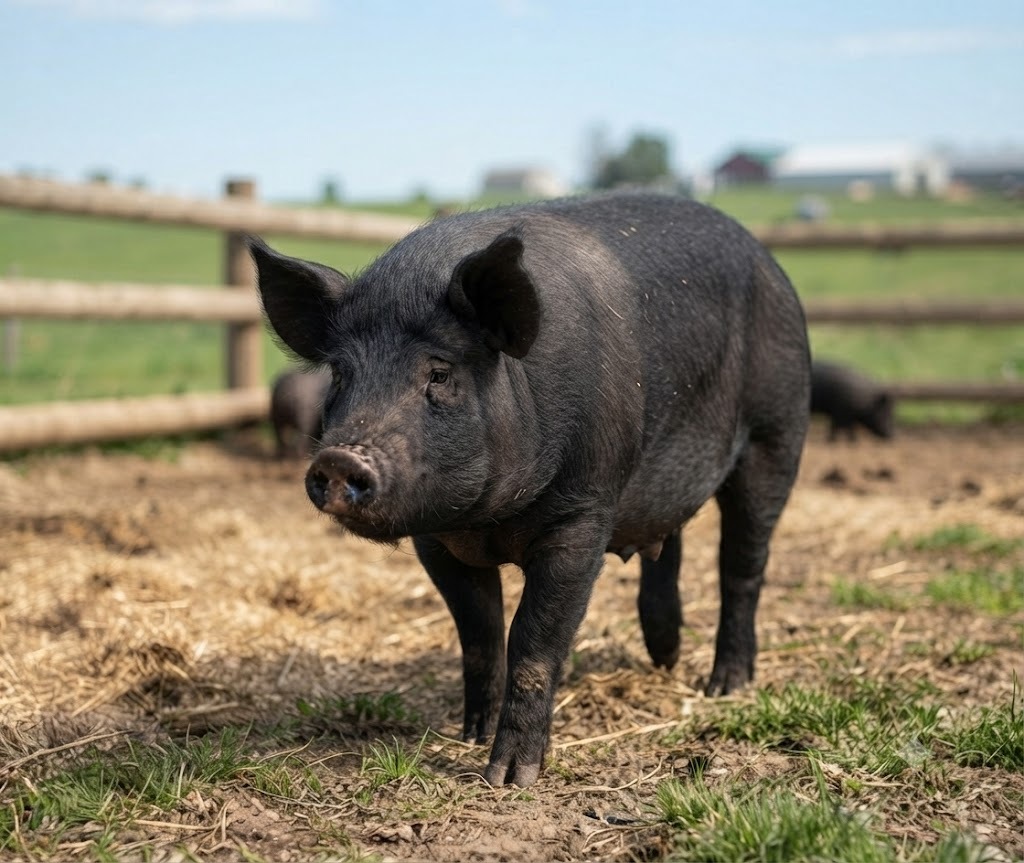
Pigs are a representative intensive livestock product that progresses through breeding pigs, sows, piglets, and fattening pigs to produce pork. Because the production cycle is relatively short and feed costs account for a large proportion of expenses, managing breeding performance, piglet survival rates, feed efficiency, growth rate, and timing of shipment together is directly linked to farm profitability.
MarketHub does not view pigs simply as livestock for pork production. It views the entire supply chain —from breeding pigs → breeding → piglets → feed → growing/fattening → disease/sanitation → shipment → slaughter/processing → pork → Buyer— as a single entity, connecting farm productivity improvement with actual transactions.
Judgment axis | Key points |
| production | Breeding pigs, sows, piglets, growing pigs, finishing pigs |
| production core | Breeding · Piglet Survival · Feed Efficiency · Weight Gain · Shipment |
| Major risks | Livestock infectious diseases such as ASF and foot-and-mouth disease |
| quality | Shipping weight, carcass, part, chilled, and frozen quality |
| Major costs | Feed, labor costs, energy, veterinary care, and disease control |
| environment | Manure, foul odor, heatwave, ventilation |
| AX | Linking breeding, feed, weight, disease, and shipment data |
| RFQ | Piglets · Breeding Pigs · Feed · Pork · Processing · Buyer |
| Final goal | Reduction of production losses and securing stable sales channels |
In 2026, African Swine Fever (ASF) was one of the biggest disease control issues for the domestic pig farming industry. According to the Ministry of Agriculture, Food and Rural Affairs, 24 cases of ASF occurred across seven cities and provinces nationwide between January 16 and March 16; as there were no further outbreaks, movement restrictions in quarantine zones nationwide were lifted on April 22. However, high-risk areas remained subject to enhanced management. ( Mafra )
While pig production is primarily focused on meat, management practices on farms vary significantly depending on the production stage, such as breeding pigs, gilts, sows, piglets, growing pigs, and finishing pigs. In particular, breeding farms and finishing farms differ in their production goals and key indicators, even when raising the same type of pig.
Pork is not the only product produced from pigs. There are reproductive resources such as piglets, breeding stock, and semen; after slaughter, edible by-products, fat, bones, and blood are produced, and manure can be converted into compost or energy resources.
division | Main purpose | major products |
| breeding pigs | heredity and reproduction | Breeding sow, gilt, semen |
| Breeding pigs | Piglet production | piglets |
| Growing and fattening pigs | meat | Shipment money |
| slaughter and processing | Meat | Pork and pork parts |
| by-product | Food and Industry | visceral fat, bone, blood |
| excretions | Resource circulation | Compost, Liquid Fertilizer, Energy |
In MarketHub, pigs are treated as a single Livestock Master, while piglets, breeding pigs, pork, semen, and by-products are linked as separate Product Entities.
In pig farming, it is important to consider the combination of breeds and strains and the production objectives together, rather than the breed itself. Various breeds such as Yorkshire, Landrace, Duroc, and Berkshire are used for commercial crossbreeding, and even within the same pig, reproductive performance, growth, and meat quality characteristics can vary depending on the maternal and paternal lines and the mating combination.
For farmers, it is more important to know which pigs are being raised and for what purpose than to know many breeds. For breeding pigs, genetic ability and health status are important; for sows, litter size and weaning performance are key; and for fattening pigs, weight gain, feed efficiency, and market performance are crucial.
division | example | On-site management |
| livestock species | pig | Pig |
| Variety/Lineage | Yorkshire·Landrace·Duroc, etc. | Genetics and crossbreeding |
| production purpose | Breeding, Piglets, and Fattening | Farm role |
| production stage | Sow, Piglet, Growing, Finishing | Step-by-step management |
| product | Live animals, pork, semen | Standards and quality |
| Buyer | Farming, Processing, Distribution, Food Service | Purchase conditions |
The basic structure is managed as follows: Livestock type → Breed/line → Production purpose → Production stage → Product → Buyer .
Pig farming productivity begins with the breeding of sows. It is not enough to simply produce a large number of piglets; farm income increases only when the piglets survive and are weaned in good health, and continue through the growing and fattening stages without loss, leading to an actual number of pigs shipped.
In this process, feed is one of the most important cost factors. Therefore, to assess the actual productivity of a farm, one must look not only at the litter size and piglet survival rate but also at feed intake, daily weight gain, feed conversion ratio, mortality rate, and slaughter age.
Management area | Things to see at a farm |
| breeding | Mating · Pregnancy · Childbirth · Number of Offspring |
| piglets | Birth weight, weaning, and death |
| feedstuff | Feed Type, Intake, Price |
| growth | Body weight, daily gain, and shipping age |
| feed efficiency | Feed Conversion Ratio · Fattening Costs |
| health | Disease, Vaccine, Death |
| environment | Temperature, humidity, ventilation, and water supply |
| expense | Feed, labor costs, veterinary care, energy |
In pig farming in particular, it is crucial to consistently monitor the connection between feed, growth, slaughter age, and production costs. Even with the same slaughter weight, producing a product with less feed and a shorter production period can significantly alter a farm's turnover and profitability.
Due to the high stocking density of pigs and the frequent movement of people, vehicles, feed, and shipments, disease control management is as important as productivity. When a disease outbreak occurs, it is not confined to a single farm but can affect movement restrictions, shipment disruptions, disease control costs, and the supply and demand of the entire region.
The 2026 ASF cases demonstrated that the scope of disease control cannot be viewed solely as farm access management. Following the detection of ASF genes in pig plasma protein feed ingredients and compound feed produced using them during an epidemiological investigation by the Ministry of Agriculture, Food and Rural Affairs, the government implemented a plan to strengthen disease control management throughout the entire cycle, from farms and slaughterhouses to feed manufacturing. ( Mafra )
Management stage | Major records |
| breeding pigs · breeding | Farm · Lineage · Breeding |
| birth | Sow · Date of Birth · Date of Birth |
| breeding | Feed, Weight, Health |
| Disinfection | Vaccine, testing, entry, disinfection |
| movement | Standing, shipping, and vehicles |
| slaughter | Conductor Number/Grade |
| process | Part/Product Lot |
| circulation | Refrigeration · Freezing · Buyer |
Foot-and-mouth disease, as well as African Swine Fever (ASF), is a significant runtime risk. In July 2026, foot-and-mouth disease was confirmed at a pig farm in Yecheon, North Gyeongsang Province, and the government conducted tracing and detailed inspections of farms linked to the epidemiological case. Therefore, information on diseases and movement restrictions must not be treated as static text but must be continuously updated to the latest status. ( Mafra )
The pig farming industry begins at breeding farms and extends to breeding farms, piglet farms, fattening farms, feed companies, slaughterhouses, meat processing enterprises, distribution, and the food service industry. Depending on the type of farm, operations from breeding to shipment may be managed on a single site, or each production stage may be separated across different farms.
For farmers, it is crucial not only to produce high-quality pigs but also to ensure a stable supply of piglets and feed, as well as secure distribution channels. MarketHub connects this industry network through RFQs to identify potential for cooperation between supplying farms, companies, slaughterhouses, processors, and buyers.
Participants | Things needed | Possibility of cooperation |
| breeding farm | Excellent system and disease control | Breeding RFQ |
| breeding farm | Gilts, Semen, Feed | Production RFQ |
| fattening farm | Piglets, Feed, and Shipment Locations | Fattening RFQ |
| feed company | Stable farm demand | Feed Supply |
| slaughterhouse | A fixed number of shipments | Shipment contract |
| meat processing company | Part, Quality, Quantity | Product RFQ |
| Food service and food companies | Specifications, Price, Delivery Time | Buyer RFQ |
| import and export companies | Quarantine, volume, and price | Trade RFQ |
| local government | Disinfection, odor, manure, productivity | Regional AX |
According to the Korea Animal Products Quality Evaluation Institute, the volume of pigs graded in July 2026 was approximately 1,469,801 , a 3.6% increase compared to the same month of the previous year. In the same month, the wholesale auction price for pigs, excluding Jeju, was 6,236 won per kg , approximately 2.0% lower than the previous year; these figures are managed using Runtime data due to significant fluctuations over time. ( Korea Animal Products Quality Evaluation Institute )
After being shipped from the farm, pork is supplied to buyers after undergoing slaughter, cooling, trimming, processing into cuts, packaging, and refrigerated or frozen logistics. In this process, it is essential to be able to track which pig from which farm is connected to which carcass and product in order to manage both quality issues and supply stability.
International trade is even more complex. Live animals, breeding pigs, semen, chilled pork, frozen pork, and edible by-products each have different HS codes and quarantine conditions, and whether they can be traded depends on disease conditions such as ASF and foot-and-mouth disease, as well as the approved facilities and sanitary certifications required by the destination country.
supply chain
Farm → Shipment → Slaughter → Carcass → Shaping/Processing → Refrigeration/Frozen Storage → Distribution → Buyer
Confirmation area | Main contents |
| product | Live animals, pork, semen, and by-products |
| origin | Country·Region·Farm |
| quality | Part · Weight · Grade · Fat |
| Quarantine | Disease, Hygiene, and Approved Facilities |
| trade | HS · Customs · FTA · Origin |
| distribution | Refrigeration, freezing, and transport period |
| Buyer | Quantity, Price, Delivery Time |
Therefore, when a pork import/export RFQ is received on MarketHub, the latest quarantine conditions at the time of transaction are re-checked based on the country of origin + country of destination + product type + facility + disease status .
A pig cannot be evaluated solely by its pork belly. After slaughter, various cuts such as loin, tenderloin, neck, foreleg, hind leg, ribs, and pork belly are produced, and internal organs, fat, bones, and blood are also utilized as food or raw materials for processing.
PRP is an analysis that goes beyond just looking at farm productivity and connects the final buyer's desired pork back to the production stage . For example, if a specific buyer wants a cut with a certain weight and fat content, the shipping weight, feed, genetic lineage, and processing specifications can be examined together.
product | Main uses |
| Piglets and breeding pigs | Breeding and fattening |
| pork | Distribution, Food Service, Food |
| semen | breeding pigs · breeding |
| interior decoration | Food and Processing |
| province | Food and raw materials |
| bone and blood | Food and industrial raw materials |
| excretions | Compost and energy |
Key PRP questions include whether piglet mortality can be reduced, feed efficiency can be improved, the time to market can be shortened, why differences in carcass performance occur among farms, and whether the specific cuts and quality desired by buyers can be reliably supplied .
The purpose of Pig Farming AX is not to install many cameras and sensors on the farm. It is important to detect losses such as breeding failure, feed waste, stunted growth, signs of disease, and ventilation problems using data before humans notice them late.
Since pigs are often managed at the herd level, it is practical to link data regarding pens, sows, litters, feed, environment, and shipment. In particular, water intake, feed consumption, body weight, coughing and behavioral changes, and temperature and humidity can be utilized to detect abnormal signs early.
Apply AX | farm effect |
| breeding data | Improvement of sow productivity |
| Automatic weight | Check growth status |
| Feed intake | Feed efficiency management |
| Negative water volume detection | Early detection of health abnormalities |
| Video and Behavioral AI | Abnormal behavior detection |
| Temperature, humidity, and ventilation | Heatwave and Respiratory Risk Management |
| Shipment forecast | Optimization of shipping timing |
| Conductor information feedback | Improvement of fattening methods |
| Buyer Matching | Expansion of sales channels |
The basic structure is recording → comparison → anomaly detection → prediction → decision-making . Performance should be judged based on whether farms have actually reduced mortality rates, feed costs, and shipping age, rather than the fact that AI has been introduced.
The problems facing pig farms are interconnected. Rising piglet mortality rates lead to a decrease in the actual number of pigs shipped, reduced feed efficiency increases production costs, and persistent ventilation and temperature issues can result in disease and stunted growth.
Furthermore, if farm-specific problems are left as individual experiences, the same problems will recur. By comparing data from multiple farms to identify common causes and verifying solutions on the farms, the issue can be expanded into a regional pig farming AX project.
problem | Data to verify |
| Sow productivity | Sanjasu · Iyudusu |
| Piglet mortality | Birth, reason, disease |
| feed costs | Feed Price · FCR · Weight Gain |
| growth delay | Weight and shipping age |
| ASF · Foot-and-mouth disease | Inspection, Entry, and Movement |
| respiratory problems | Ventilation, Temperature, Humidity, and Health |
| heatwave | Temperature, drinking water, intake, mortality |
| Foul odor and manure | Livestock barn and manure treatment |
| Price fluctuations | Slaughter, Price, Supply and Demand |
| outlet | Product · Specifications · Buyer |
As of July 28, 2026, 22,838 pigs were reported to have died due to heatwaves. As the government is also strengthening cooling equipment and measures to address heat stress, heatwaves in pig farming need to be managed not merely as a seasonal issue, but as a runtime problem that considers productivity, mortality, and facility investment together. ( Mafra )
A pig farming RFQ does not refer solely to a request to sell pork. It can also include requests to procure breeding pigs, gilts, piglets, semen, and feed; to contract with slaughterhouses and processors; or to find companies that can solve issues related to odor, manure, and smart livestock farming.
Farmers are not required to disclose all sensitive information, such as prices or production volumes, from the outset. It is appropriate to register basic items, regions, and intentions for cooperation as Public, while sharing actual prices, volumes, farm productivity, and contract conditions at the Verified or NDA stage.
RFQ Type | Collaboration Examples |
| breeding pigs and gilts | Purchasing and Supply |
| piglets | Standing sales |
| semen | Breeding and improvement |
| feedstuff | Compound feed and raw materials |
| Shipment money | Slaughter and joint shipment |
| pork | Supply by part and specification |
| process | Meat Processing · OEM |
| Regular supply | Food service and food companies |
| Import and export | Pork and breeding resources |
| Disinfection | Farm, Feed, and Vehicle Management |
| AX Demonstration | Productivity, Disease, Environment |
| environment | Odor and manure resource recovery |
MarketHub operates by verifying production capacity, disease prevention, quality, delivery time, and the possibility of continuous supply together, rather than simply matching the lowest price.
MarketHub Livestock Library is not merely a livestock resource center where you simply read information and leave. Its core function is to allow farmers, businesses, and buyers to first register the items or cooperation conditions they need, and then connect them with producers, processing companies, and markets capable of actual supply.
The scope of RFQs for pigs is broad, ranging from breeding pigs and piglets to feed, pork, processing, import/export, disease control, and the environment. Therefore, requests can be received by categorizing them into three areas: purchasing, production partners, and securing buyers.
① Find products/raw materials.
Need Products & Materials
Companies and institutions seeking necessary breeding pigs, piglets, pork, feed, raw materials, and processed products register their purchase demands. MarketHub verifies basic conditions such as item, specifications, quantity, and region, and reviews the potential for cooperation with supplying farms and companies.
RFQ Registration → Supply Feasibility Review → Connecting Producers and Companies → AI Matching
Register
② We are looking for production and manufacturing partners.
Need Suppliers & Manufacturers
We seek necessary production and supply partners, including pig farms, producer organizations, slaughterhouses, meat processing plants, OEMs, and ODM companies. We verify the feasibility of cooperation by reviewing actual production scale and disease prevention, processing, and supply capabilities.
RFQ Submission → Production Capability Review → Partner Connection → AI Partner Matching
Register
③ We are looking for domestic and international buyers.
Need Buyers
Farms and production companies seek new buyers, including food service companies, restaurants, catering services, distributors, and importers. We verify products and continuous supply capabilities to connect suitable markets with buyers.
RFQ Submission → Product & Supply Capability Review → Buyer Connection → AI Buyer Matching
Register
Contact : mail@markethub.org
The dataset is not intended to create new administrative tasks for farmers. It is a structure designed to connect existing farm data regarding breeding, piglets, feed, diseases, weight, and shipment to identify the causes of recurring problems and utilize the findings for future production.
For example, if the shipping age of fattening pigs is delayed, one must look not only at the result but also at which farm or pen the piglets were introduced, what feed they ate, and whether there were any diseases or environmental problems to find the cause.
Dataset | Simply put |
| Master | Standards for livestock type, lineage, product, etc. |
| Entity | Actual Farm, Sow, Pig Herd, Company, Buyer |
| Relationship | The connection between feed, farms, pigs, and products |
| Runtime | Information that changes like price, weight, and disease |
The representative connections are as follows.
Farm → Sows/Piglets/Herd → Feed → Health → Growth → Shipment → Carcass → Pork → Buyer
Just as the connection between feed ingredients and farms was treated as important in the analysis of actual causes of disease control during the 2026 ASF epidemiological investigation, the feed batch → supplier → farm relationship in swine farming also becomes an important relationship dataset. ( Mafra )
In the pig farming industry, information such as prices and production volumes, as well as diseases like ASF, foot-and-mouth disease, and movement restrictions, changes rapidly. Therefore, to determine which information is accurate, the verification date and the time of application must be managed along with the source.
MarketHub distinguishes between relatively static Master information, such as scientific names and production stages, and continuously changing Runtime information, such as diseases, prices, and shipment volumes. This 002 edition was compiled by first verifying the latest publicly available data for 2026 from the Ministry of Agriculture, Food and Rural Affairs and the Korea Animal Products Quality Evaluation Institute. ( Mafra )
Evidence | source |
| A | Government, International Organizations, Official Statistics |
| B | Papers · Research Institutes |
| C | Association/Verification Industry Data |
| D | Corporate and Market Data |
| E | Additional verification needed |
Key factual basis
- Ministry of Agriculture, Food and Rural Affairs Strengthens Full-Cycle ASF Disease Control Management by 2026 — 24 Cases Expected from January to March 2026, Disease Control Expanded to Farms, Slaughterhouses, and Feed Manufacturing Plants. ( Mafra )
- Ministry of Agriculture, Food and Rural Affairs ASF Epidemiological Investigation — Analysis of various outbreak risks including feed ingredients, illegal livestock products, and wild boars. ( Mafra )
- Ministry of Agriculture, Food and Rural Affairs, Changes to ASF Quarantine Standards for Pig Farms in June 2026 — Strengthened Measures Including Verification and Storage of Disinfection Certificates for Vehicles Entering Farms in Affected Areas. ( Mafra )
- Ministry of Agriculture, Food and Rural Affairs, Foot-and-mouth disease outbreak at a pig farm in Yecheon, North Gyeongsang Province in July 2026. ( Mafra )
- Korea Animal Products Quality Evaluation Institute, July 2026 Livestock Grading Statistics — 1,469,801 pigs graded, wholesale auction price 6,236 won/kg. ( Korea Animal Products Quality Evaluation Institute )
- Ministry of Agriculture, Food and Rural Affairs, 2026 Heatwave Response — 22,838 pig deaths as of July 28. ( Mafra )
Version History
Version | Main contents | situation |
| v1.0 | First registration based on 2026 precision survey | complete |
| v1.1 | Rearing·Price·ASF·Foot-and-Mouth Disease·Import/Export Runtime Update | expected |
| v2.0 | Sow, Piglet, Feed, Carcass PRP/AX Connection | expected |
| v3.0 | Verified Supplier/Buyer Matching | expected |