


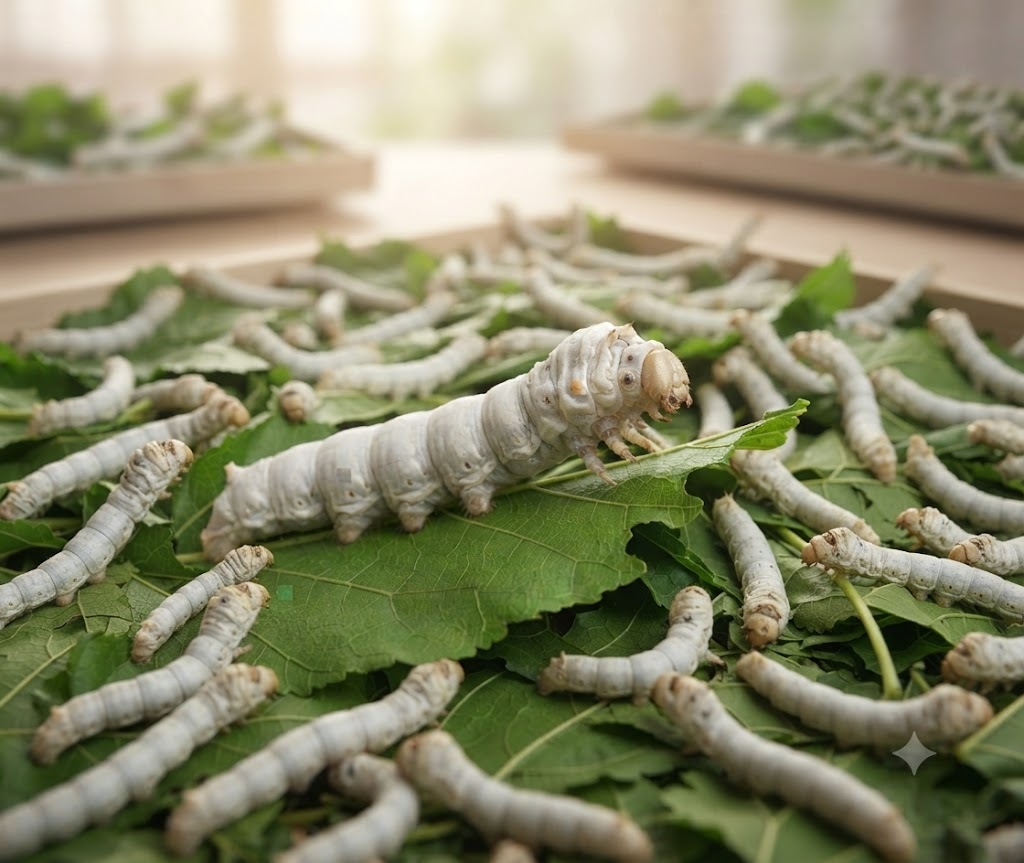
While silkworms have traditionally been industrial insects raised for silk production, Korea's sericulture industry is already expanding from an industry focused on cocoon and silk production to one that produces food, functional ingredients, and biomaterials . Since completely different products—such as silkworm powder, red silkworms, cocoons, and pupae—are produced depending on the growth stage at which the same silkworm is harvested, it is crucial to determine the production objective first.
By 2026, the Rural Development Administration is also intensifying research to expand sericulture products into the food and biomaterial industries. With the development of smart production systems alongside research on the functionality of silkworms at different growth stages, the industrialization of red silkworms, and the utilization of silk protein, it is appropriate to view future sericulture as a single industrial chain encompassing the following stages : mulberry tree → silkworm egg → silkworm → cocoon → silk/food/biomaterial → buyer . ( Rural Development Administration )
Judgment axis | Key points |
| production purpose | Sericulture seeds, silkworm production, cocoons, functional ingredients |
| Basic food | Mulberry leaves and artificial feed |
| major products | silkworm cocoon, silkworm cocoon, pupa |
| High value-added products | Red silkworm pupae, silkworm powder, silk protein, white silkworm pupae, etc. |
| production core | Superior silkworm eggs, temperature and humidity, feed, and growth stage |
| Major risks | Disease, temperature and humidity anomalies, labor intensity |
| AX | Environmental sensors, automatic feeding, and breeding box automation |
| RFQ | Silkworms, silkworms, cocoons, silkworms, food, bio-raw materials |
| Final goal | Transforming traditional sericulture into a high-value-added materials industry |
In particular, silkworms are a livestock species where "when to harvest" becomes the product strategy. While silk must be obtained by raising them to the cocoon stage, producing functional materials such as red silkworms and silkworm powder requires harvesting products at specific larval stages, so the rearing stage must be adapted to meet buyer demand.
The silkworm (*Bombyx mori*) is a holometabolous insect that grows by feeding on mulberry leaves and then builds a cocoon. In sericulture, the life cycle, starting from a silkworm egg, going through the larval stages from the first to fifth instars to become a mature silkworm, and then metamorphosing into a pupa inside a cocoon, is directly linked to production.
In the past, the primary purpose was to extract silk from cocoons, but now the silkworm itself is an important raw material. As the Rural Development Administration is researching components by growth stage, such as DNJ in 3-day-old fifth-instar silkworms and high-protein red silkworms in the mature stage, MarketHub manages silkworms, cocoons, pupae, and silk as distinct Product Entities. ( Rural Development Administration )
production stage | Main purpose | Product Entity |
| silkworm eggs | Sericulture | Silkworm Egg |
| young silkworm | breeding | Young Larvae |
| 5th instar silkworm | Food and Functional | Silkworm powder, etc. |
| silkworm | functional ingredients | Hongjam |
| cocoon | Sericulture and silk | Cocoon |
| pupa | Food and raw materials | Silkworm Pupa |
| silk | Textiles and Bio | Fibroin·Sericin |
In other words, the basic structure of MarketHub is Silkworm → Growth Stage → Production Purpose → Product → Processing → Buyer .
With silkworms, you must first decide not only the breed but also what product to produce . This is because breeds suitable for cocoon production, breeds suitable for producing functional silkworm raw materials, and breeds used for producing special materials such as white silkworms may differ.
In fact, the South Chungcheong Agricultural Research and Extension Services is supplying silkworm eggs for farm distribution for 2025–2026 by accepting advance applications for varieties such as Geumokjam and Golden Silk. The Rural Development Administration is also conducting research on variety selection tailored to product purposes, such as designating the Dodam silkworm as a suitable variety for the production of Baekgangjam. ( Rural Development Administration )
division | production purpose | Key Management |
| Sericulture | Silkworm egg production | Breed and health |
| For the cocoon | Sericulture production | High yield · Hardness |
| For food use | Silkworm raw materials | Growth stages and hygiene |
| Hong Jam-yong | Silkworm processing | Harvest time · Protein |
| Baekgangjamyong | special ingredients | Variety, strain, process |
| For bio use | Silk protein | Kochi · Processing quality |
Therefore, it is important to record Breed → Growth Stage → Production Purpose → Product Specification separately.
Since silkworm rearing involves short growth stages and is sensitive to environmental changes, it is crucial to maintain consistent temperature, humidity, feed, and hygiene. Because the stages progress rapidly from egg hatching to larvae, adult silkworms, and mature silkworms, a problem occurring at one stage can immediately affect subsequent production volume and product quality.
In particular, traditional mulberry leaf farming requires both mulberry tree cultivation and labor, and recently, there has been a growing trend toward increasing productivity by combining artificial feed with automated rearing. The smart production system unveiled by the Rural Development Administration in 2025 is equipped with functions for automatic feeding, processing of rearing by-products, and IoT environmental management, and was presented as a new production model to address labor shortages and abnormal climate conditions. ( Rural Development Administration )
Management area | Things to see at a farm |
| Sericulture | Breeds and Hatching Rates |
| feedstuff | Mulberry leaves and artificial feed |
| growth | Spirit Age, Growth, Uniformity |
| environment | Temperature, humidity, and ventilation |
| hygiene | Rearing boxes and residue management |
| disease | Abnormal individuals/Deaths |
| harvest | Silkworm, mature silkworm, cocoon |
| production costs | Feed, Labor, Facilities |
Farm productivity should not be judged simply by how many silkworms were raised, but rather by connecting it to the process from silkworm eggs → survival → reaching the target growth stage → production of marketable raw materials .
Since silkworms are raised in high-density conditions over a short period, hygiene and environmental management are critical. Poor temperature and humidity control, or the accumulation of rearing byproducts, can lead to stunted growth or disease problems; therefore, it is necessary to record rearing rooms, feed, and environmental conditions on a production lot basis.
Furthermore, when silkworms are used as food or functional ingredients, the standardization of the raw material and its production history become more important than simple growth performance. As the Rural Development Administration has identified the establishment of standard production criteria for raw materials and the forecasting of industrial demand as key tasks in its 2026 support plan for young sericulture farmers, the direction of meeting industrial raw material specifications starting from the farm level is being strengthened. ( Rural Development Administration )
step | Key Management |
| silkworm eggs | Variety · Production Date · Lot |
| hatching | Hatching rate · Date |
| breeding | Temperature, humidity, and feed |
| growth | Age and uniformity |
| health | Abnormal individuals/Deaths |
| harvest | Growth stage/date |
| process | Steaming, drying, ancestral rites, etc. |
| product | Product Lot · Buyer |
The representative traceability structure is Egg Lot → Rearing Batch → Growth Stage → Harvest Lot → Processing Lot → Product → Buyer .
While Korea's sericulture industry appears to have shrunk in scale when viewed solely through the lens of traditional silkworm farming, its identity changes when encompassing functional materials and the food and bio sectors. The government has already outlined a direction to expand sericulture into a high-tech biomaterials industry in the 3rd Insect and Sericulture Industry Development Plan, and in line with the new plan for 2026, initiatives for functional materials and export industrialization are gaining momentum. ( Mafra )
Furthermore, by the end of 2025, the National Institute of Agricultural Sciences, the Korea Sericulture Association, and health functional food companies established a cooperative system for fostering young sericulture farmers and industrialization. This demonstrates that buyers for sericulture farms can expand beyond just sericulture businesses to include food, health functional food, and bio-companies. ( Rural Development Administration )
Participants | Things needed | RFQ |
| Sericulture farms | Silkworm eggs, feed, and sales channels | Producer |
| Sericulture organ | superior varieties | Breeding |
| business | Silkworm cocoons and sericulture | Silk RFQ |
| food companies | Silkworm, pupa, red silkworm | Ingredient |
| health supplement company | Standard functional ingredients | Material |
| biotech companies | Fibroin and Sericin | Bio-material |
| Research Institute | Variety/Functionality | R&D |
| local government | Sericulture complex and young farmers | Regional AX |
Therefore, MarketHub separates the sericulture market into Silk Market + Food Market + Functional Material Market + Bio-material Market .
The supply chain of the silkworm industry varies significantly depending on the final product. Traditional sericulture proceeds from the cocoon through reeling and refining to silk, whereas food and functional raw materials undergo separate processing steps involving the harvesting of the silkworms themselves or pupae, followed by steaming, freeze-drying, and powdering.
In international trade, different HS codes and quarantine and food standards may apply to silkworm eggs, cocoons, silkworm silk, pupae, food ingredients, and biomaterials, respectively. Therefore, in MarketHub RFQs, the product form and intended use must be verified first rather than being consolidated into a single "Silkworm Product."
Sericulture Supply Chain
Silkworm Seed → Silkworm Egg → Rearing → Cocoon → Drying/Spinning → Sericulture → Textiles/Materials Buyer
Functional Ingredient Supply Chain
Silkworm Eggs → Rearing → Target Growth Stage → Steaming/Drying → Powder/Extraction → Food/Bio Buyer
Confirmation area | Main contents |
| Sericulture | Variety · Silkworm Egg |
| silkworm cocoon | Color, weight, and coarseness |
| Jamsa | Specifications and machining drawings |
| pupa | Uses in food and raw materials |
| Silkworm raw materials | Growth stages and processing methods |
| biomaterials | Fibroin and Sericin |
| trade | HS · Customs · Country of Origin |
| Buyer | Specifications, Quantity, Certification |
In actual import and export, Product Form + Intended Use + Food/Bio Requirement + HS + Origin are verified again at the time of transaction.
Silkworms are one of the items with the most diverse Product Trees among MarketHub’s livestock RFQs . Food and functional materials can be produced from live silkworms, and silk proteins such as fibroin and sericin can be extracted from cocoons in addition to silkworm silk, while the pupae inside the cocoons also serve as separate raw materials.
The Rural Development Administration is expanding sericulture into a bio-material industry by 2026 through functional research on silkworms, such as DNJ and red silkworms. Past studies have also investigated the potential of sericin extracted from silkworm cocoons as a bio-material, and the development of medical materials utilizing silk has been pursued. However, claims regarding medical and health efficacy must be labeled by distinguishing between research results and actual approved products. ( Rural Development Administration )
Product Entity | Main uses |
| silkworm cocoon | Sericulture and silk |
| Jamsa | Textiles and materials |
| pupa | Food and raw materials |
| Silkworm powder | Food and raw materials |
| Hongjam | Functional food research and ingredients |
| Baekgangjam | Herbal medicines and functional materials |
| Fibroin | Biomaterials |
| Sericin | Bio, Cosmetics, and Materials |
Key questions regarding PRP include at which growth stage to harvest, which product between cocoons and functional ingredients offers higher profitability for the farm, whether the product can meet the ingredients, moisture, and processing specifications desired by the buyer, and whether to perform primary processing on the farm or supply it to a specialized company .
Silkworm AX is already entering the automation phase in actual field operations. The smart silkworm production system unveiled by the Rural Development Administration automates the transportation of rearing boxes, the feeding of artificial feed, and the removal of rearing by-products, while managing the temperature and humidity of the rearing rooms in real time using IoT sensors. ( Rural Development Administration )
The system demonstrated a production processing capacity of approximately 25,000 silkworms per hour through automation . However, what is important on MarketHub is not the number itself, but rather comparing, on a farm-by-farm basis, how much labor time, survival rate, uniformity, and raw material production costs actually improve before and after automation. ( Rural Development Administration )
Apply AX | farm effect |
| Automatic feeder | Reduction of working hours |
| Automatic transport of breeding boxes | Reduction in workload |
| Automatic byproduct removal | Hygiene management |
| Temperature and Humidity IoT | Environmental stabilization |
| Growth records | Determining harvest time |
| Disease anomaly detection | Early response to losses |
| Production Cost Analysis | Economic feasibility by product |
| Buyer Matching | Purpose production |
The basic structure is silkworm eggs → automated rearing → growth data → harvesting at the target stage → processing into product raw materials → Buyer .
The problems facing the domestic sericulture industry are not limited to a simple decrease in the number of farms. Labor-intensive rearing, a shortage of mulberry fields and rearing facilities, a decline in successor farmers, small-scale fragmented production of products, mismatches in raw material specifications, and a lack of stable buyers are all interconnected.
The reason the government is simultaneously promoting smart farming technology, standardized raw material production, the nurturing of young farmers, and functional research with industry linkages by 2026 is that it is difficult for the industry to revive by increasing production alone. The chain must follow : farm production → standardized raw materials → processing companies → commercialization → buyers . ( Rural Development Administration )
problem | Data to verify |
| labor shortage | Rearing time and manpower |
| Silkworm egg supply and demand | Variety · Application · Supply |
| Uneven growth | Temperature, humidity, and feed |
| Disease and death | Batch · Environment |
| Lack of raw material standards | Ingredients, Moisture, Processing |
| Kochi sales channels | Sericulture · Price |
| Sales channels for functional ingredients | Buyer · Specifications |
| aging facilities | Level of automation |
| Shortage of young farmers | Farmers and successors |
| Lack of market information | Demand by Product |
The basic solution structure is Problem Discovery → Production Data → Automation/Standardization → Pilot → Buyer Evaluation → Contract Production .
If the silkworm RFQ is designed as a single transaction of "selling silkworm cocoons," industrial scalability is limited. This is because seed farms, silkworm rearing farms, sericulture businesses, food companies, and health functional food and bio-material companies each have different raw material requirements and quality standards.
In particular, for functional and bio-materials, it is crucial to incorporate the industry's specifications starting from raw material production. Rather than farmers producing first and then seeking buyers, a structure involving contract production is more suitable, where the variety, growth stage, processing method, and raw material specifications required by the buyer are verified first .
RFQ Type | Collaboration Examples |
| Sericulture | High-quality silkworm eggs |
| feedstuff | Mulberry leaves and artificial feed |
| silkworm | Supply according to growth stage |
| silkworm cocoon | Sericulture and Bio |
| pupa | Food and raw materials |
| Hongjam | functional ingredients |
| Baekgangjam | special materials |
| Jamsa | Textiles and products |
| Silk protein | biomaterials |
| AX Pilot | Automated breeding and standardized production |
Sensitive production volume, component analysis, Buyer Specification, and contract price are managed at the Verified/NDA stage.
Silkworms are a product where the RFQ (Request First) principle is particularly important . This is because even for the same silkworm, the timing of harvesting varies depending on whether the buyer wants silkworms, red silkworms, pupae, or silk protein.
Therefore, MarketHub does not decide what to produce after raising silkworms. The key is to first identify the necessary Product Entities and Specifications, and then design the rearing plan in reverse .
① Find products/raw materials.
Need Products & Materials
Companies and institutions seeking necessary raw materials, such as silkworm seeds, silkworms, cocoons, silkworm silk, pupae, red silkworms, and silk protein, register their purchasing demands. MarketHub reviews suitable producers and suppliers by verifying varieties, growth stages, processing methods, quantities, and quality conditions.
RFQ Registration → Raw Material/Specification Review → Connecting Sericulture Farms/Companies → AI Matching
Register
② We are looking for production and processing partners.
Need Suppliers & Manufacturers
We seek necessary production and processing partners, including sericulture institutions, silkworm farms, silk processing companies, food processors, freeze-dryers, extractors, and bio-material companies. We evaluate not only production capacity but also raw material standardization and processing and traceability capabilities.
RFQ Submission → Review of Production/Processing Capabilities → Partner Connection → AI Partner Matching
Register
③ We are looking for domestic and international buyers.
Need Buyers
Sericulture farms and processing companies seek new buyers in the textile, food, health functional food, bio, and research sectors. We verify the growth stage, processing method, and supply volume of products and raw materials to connect them with suitable buyers.
RFQ Submission → Product & Supply Capability Review → Buyer Connection → AI Buyer Matching
Register
Contact : mail@markethub.org
The most important feature of the silkworm dataset is that the growth stage is directly linked to the product . Even with the same variety of silkworms, completely different industrial raw materials are produced depending on whether they are harvested at a specific point in the 5th instar, raised to mature silkworms, or made to spin cocoons.
Therefore, storing only a single number of silkworms has low utility value. PRP and productivity analysis are possible only when the variety, egg lot, feed, rearing environment, growth stage, harvest date, processing method, and final buyer are linked together.
Dataset | Simply put |
| Master | Variety, Growth Stage, and Product Standards |
| Entity | Sericulture agencies, farms, silkworm batches, companies |
| Relationship | Connecting breeding, harvesting, processing, and products |
| Runtime | Temperature, humidity, growth, yield, and price |
The representative structure is as follows.
Silkworm Egg Lot → Rearing Batch → Feed → Environment → Growth Stage → Harvest → Product Lot → Processing → Buyer
Cocoon production is:
Silkworm → Mature Silkworm → Cocoon → Pupa + Cocoon Shell → Silkworm/Fibroin/Sericin → Buyer
It can be broken down into.
Once this structure is established, it will be possible to compare which direction yields the highest profit when converting the same silkworm rearing to sericulture production, food production, or biomaterial production .
As of 2026, the focus of policy and research in the silkworm industry is rapidly shifting from traditional sericulture to smart production, functional raw materials, and biomaterials. In May 2026, the Rural Development Administration directly linked research on the functionality of sericulture products to the expansion of the biomaterials industry and is pursuing smart production, young farmers, and industry cooperation in parallel. ( Rural Development Administration )
From a policy perspective, the "Act on the Promotion and Support of the Functional Sericulture Industry" stipulates a comprehensive five-year plan as well as a support system for research and development, technical education, and farm income. In 2025, policy research was conducted for the 4th Plan for Insects and Functional Sericulture (2026–2030), and in 2026, the Rural Development Administration officially announced the launch of the Insects and Sericulture Industrialization Project covering the period from this year to 2030. ( Law Information Center )
Evidence | source |
| A | Ministry of Agriculture, Food and Rural Affairs, Rural Development Administration, Ministry of Food and Drug Safety, Official Data |
| B | National research institutes and papers |
| C | Korea Sericulture Association · Verified Industry Data |
| D | Company and Transaction Data |
| E | Additional verification needed |
Key factual basis
- The Rural Development Administration is conducting research on the functionality of silkworms at each growth stage to expand sericulture products into the food and bio-material industries by 2026. ( Rural Development Administration )
- DNJ has been studied in 3-day-old fifth-instar silkworms, and research on high-protein red silkworm production technology utilizing mature silkworms, as well as various functional studies, is accumulating. However, regarding claims of health effects, research results must be distinguished from actual recognition as food or health functional food. ( Rural Development Administration )
- The supply of silkworm eggs for farm distribution in 2025–2026 is being carried out through regional agricultural research institutes, and varieties such as Geumokjam and Golden Silk are being actually distributed. ( Rural Development Administration )
- The Rural Development Administration has developed a smart silkworm production system that combines rearing box transportation, artificial feed delivery, byproduct management, and IoT temperature and humidity control . ( Rural Development Administration )
- In 2025, technology for the mass production and standardization of silkworm pupae using Dodam silkworms and domestic Beauveria bassiana was announced, expanding the potential for the localization of specialty foods and bio-raw materials. ( Rural Development Administration )
- Silk proteins such as sericin and fibroin obtained from silkworm cocoons have been utilized in research on bio-medical materials in addition to fibers. ( Rural Development Administration )
- Government R&D is being promoted from 2026 to 2030 to expand the development and industrialization of functional and specialty food materials in the insect and sericulture industries. ( Rural Development Administration )
Version History
Version | Main contents | situation |
| v1.0 | First registration of structures for sericulture, sericulture, silkworms, food, and biomaterials | complete |
| v1.1 | Strengthening statistics on domestic sericulture farms, silkworm eggs, cocoons, and product prices | expected |
| v2.0 | Growth Stage·Smart Rearing·PRP Runtime Connection | expected |
| v3.0 | Sericulture Farms · Food · Bio Buyer Verified Matching | expected |