

Judgment axis | Key judgment |
| Item Identity | Representative root vegetables of the Raphanus lineage of the Brassica family |
| Key role | Kimchi, Kkakdugi, Dongchimi, Soup, Stew, School Meals, Food Service, Pre-processing, Drying, Pickling, HMR Ingredients |
| Harvesting principle | Evaluate variety, cultivation type, root enlargement, weight, hardness, appearance, hollowness, hollowness, and Buyer use together. |
| Product separation | Whole radish, washed radish, cut radish, shredded radish, cubed radish, radish for kimchi, dongchimi, dried radish slices, dried products, etc. are managed as separate products. |
| Separation of similar items | Separate turnips/radishes from plant/variety groups and market roles |
| Domestic statistics | Although a statistical system for open-field vegetable cultivation area exists in KOSIS, the area and production volume of radishes alone for 2026 are entered into this v1.0 version after cross-validating the raw data. |
| Production Risk | Risks by crop type, such as cold bolting, drought, monsoon, heavy rain, typhoon, soft rot, and root knot disease |
| Quality Risk | Cracks, splits, cavities, windbreaks, deformation, wounds, decay, storage loss |
| Processing risk | Cutting yield, salting loss, drying yield, and fermentation quality variation |
| Operating Principles | Seed–Production Lot–Root Harvest Lot–Cut/Processing Lot–Buyer RFQ Connection |
| Final goal | Structuring contract procurement and repurchase by linking origin, cultivation method, variety, and processing use with buyer specifications |
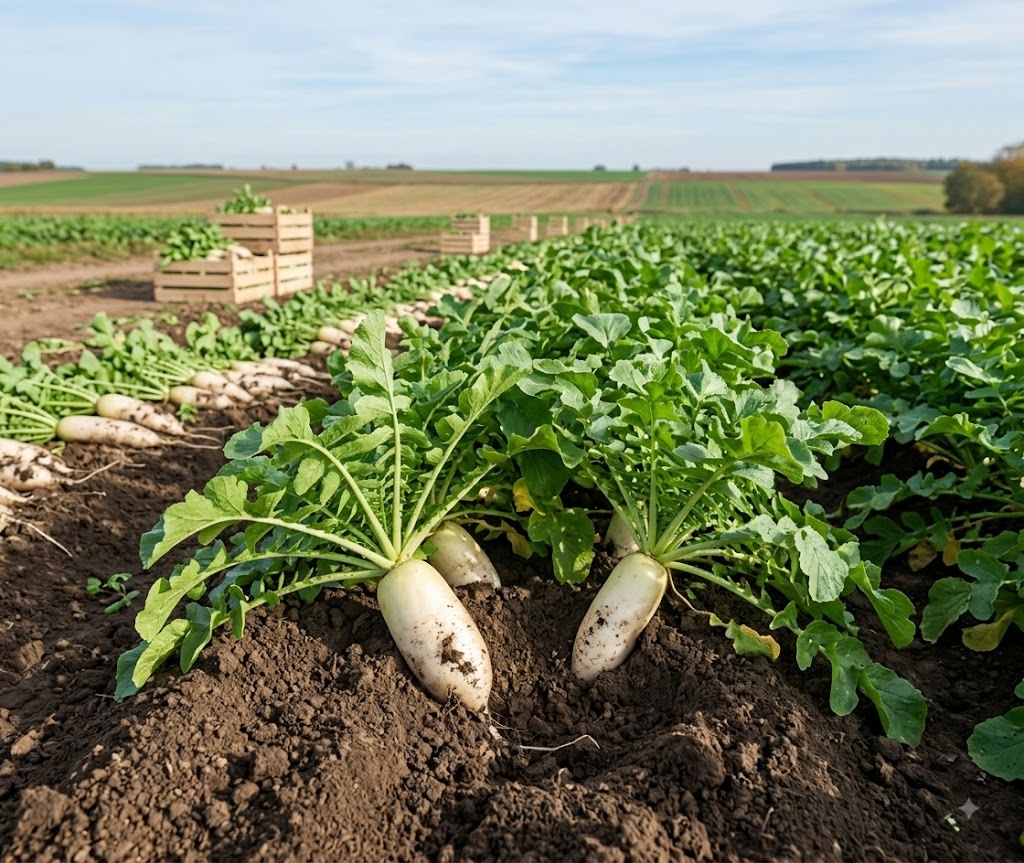
The Rural Development Administration describes radish as a major food ingredient representing Korea, along with napa cabbage, chili peppers, and garlic, and explains that traditional Joseon radishes have evolved into various native varieties as they adapted to regional climates and soils. ( Nongsaroo )
The farming schedule for highland radishes identifies flower stalk elongation due to low temperatures, spring drought, monsoon rains, heavy rainfall, typhoons, soft rot, and clubroot as major production risks. Particularly in highland and semi-highland areas, sowing timing and the issue of bolting due to low temperatures are key factors in determining the actual cropping method. ( Nongsaroo )
Plant Identity
Basic fields | No registration criteria |
| Korean name | radish |
| English name | Radish / Korean radish |
| Agricultural practical scientific name | Raphanus sativus L. |
| Current Taxonomic Name | Raphanus raphanistrum subsp. sativus (L.) Schmalh. |
| classification | Brassicaceae · Raphanus |
| Edible parts | Mainly thickened roots |
| Separate edible parts | Leaves & Greens — Manage as a separate product |
| Non-edible · Separate management | Aging roots, diseased parts, rotten parts, seedling stems, etc. |
| Major harvesting stages | Young Radish / Commercial Radish / For Kimchi Making / For Processing / For Seed Collection |
| Basic product form | Whole radish, washed radish, peeled radish, cut radish, shredded radish, cubed radish, dried radish slices, pickled radish, kimchi ingredients |
| Basic processing stage | Washing → Sorting → Peeling and Selection → Cutting → Salting, Drying, Fermentation, and Freezing |
| Basic use | Raw food · Kimchi · Kkakdugi · Dongchimi · Soup · Stew · Stir-fry · School meals · HMR · Dried |
| Similarity Principle | Separated into a separate entity/variety group from turnips and radishes |
While Raphanus sativus is widely used in the agricultural field, Kew currently treats it as a synonym for Raphanus raphanistrum subsp. sativus. Therefore, MarketHub preserves both names to link existing agricultural, food, and trade data with the latest plant classification. ( Plants of the World Online )
Product Master
Product ID | Product type | Key Management Standards |
| RAD-P01 | Mountain harvest Tongmu | Variety · Cultivation Type · Harvest Date · Lot |
| RAD-P02 | Radishes for Kimjang | Weight, root type, hardness, moisture, appearance |
| RAD-P03 | Radish for general raw consumption and cooking | Size, Hardness, Freshness |
| RAD-P04 | Radish for Dongchimi | Size, shape, texture, and uniformity |
| RAD-P05 | Radish for cubed radish | Hardness, cutting yield, moisture |
| RAD-P06 | Washing | Washing water, appearance, and product temperature |
| RAD-P07 | Park Pi-mu | Peeling yield · Flesh color |
| RAD-P08 | Cutting Block | Specifications, Weight, Microorganisms |
| RAD-P09 | Diced radish | Size, Hardness, and Fermentation Suitability |
| RAD-P10 | financial obligation | Thickness, length, and texture |
| RAD-P11 | Slice | Thickness · Cooking Use |
| RAD-P12 | Pre-processing for school meals | Washing, cutting, and refrigeration |
| RAD-P13 | Bulk for food service | Standards, Delivery, and Regular Supply |
| RAD-P14 | Kimchi factory ingredients | Variety, cultivation method, cutting, and salting suitability |
| RAD-P15 | Pickled Radish Ingredients | Hardness and salt-pickling yield |
| RAD-P16 | Ingredients for dried radish strips | Drying suitability, flesh, and cutting specifications |
| RAD-P17 | Sliced raw dried radish | Thickness, length, and weight before drying |
| RAD-P18 | dried radish strips | Moisture, Color, and Rehydration Rate |
| RAD-P19 | Radish greens | Leaf quality, harvest date, and pesticide history |
| RAD-P20 | Siraegi ingredients | Radish greens and drying suitability |
| RAD-P21 | dried radish greens | Moisture, color, foreign matter, rehydration |
| RAD-P22 | Frozen Radish | Cutting, Blanching, Freezing |
| RAD-P23 | Radish puree · Processed ingredients | Grinding, heating, and yield |
| RAD-P24 | Non-standard health product | Safety and Processability |
| RAD-P25 | Seed-producing radish | Variety · Maturity · Seed Lot |
| RAD-P26 | Radish seeds | Variety, Germination, Purity |
| RAD-P27 | PB Kimchi and Pickled Finished Products | Raw Material Lot · Processing Batch |
| RAD-P28 | HMR finished product ingredients | Cutting specifications · Cooking suitability |
Classification criteria | Subdivision type | Management principles |
| Plant classification | Raphanus cultivation | Separation from Brassica, such as turnips |
| Taxonomy | R. sativus / R. raphanistrum subsp. sativus | Preservation of scientific names by source |
| varieties | Actual varieties for spring, summer, autumn, and winter cultivation. | Verification of variety name |
| Edible parts | Roots and radish greens | Product Separation |
| Harvesting stage | Young · Product · Processing · Seed collection | Separate Product |
| Cultivation method | Spring radish, highland radish, autumn radish, winter radish, etc. | Separation of production areas and harvest seasons |
| Root type | Length, Diameter, Shape | Buyer Spec |
| Distribution methods | Mud radish, washed radish, peeling, cutting | Product Separation |
| Processing form | Kimchi, Pickled, Dried, Siraegi, Frozen | Process Lot |
| Final use | Kimchi · School Meals · Dining Out · HMR · Dried Food · PB | Buyer-specific management |
| Transaction type | Wholesale · Regular Supply · Contract Farming · OEM · PB | Contract |
| origin | Domestic/Imported | Traceability |
step | Essential Dataset | Management purpose |
| Cultivation plan | Variety · Cultivation Type · Region · Buyer · Target Harvest Time | demand-based production |
| satellite | Variety · Seed Lot · Germination | Traceability |
| sowing | Sowing date, sowing quantity, planting | Crop management |
| Germination and emergence | Appearance rate · Missed weeks | Early growth |
| Thinning | Workdays · Weekly Intervals | Root enlargement |
| Growth management | Leaf count and root enlargement | Harvest Forecast |
| rising | Temperature, Precipitation, Solar Radiation | Nomination/Quality Risk |
| Watering | Soil moisture and irrigation amount | Management of muscle heat and hypertrophy |
| drainage | Flooding and drainage conditions | Management of flood damage |
| dispute | Soil testing, base fertilizer, top dressing | Quality and growth |
| low temperature | Low temperature exposure · Flower stalk elongation | Nomination Risk |
| pests | Soft rot, root knot disease, etc. | Production stability |
| Harvest judgment | Root size, weight, hardness, appearance | Buyer Spec |
| harvest | Harvest Date · Root Lot | Harvest Lot |
| Cut the radish greens | Radish greens Product Separation | By-product/Product |
| purifying | Removal of wash water and sediment | hygiene |
| Selection | Size, shape, and defects | Grade |
| Pre-cooling | Temperature control as needed | Freshness |
| save | Temperature and humidity, weight loss, spoilage | Supply control |
| peeling | Yield if necessary | Processing cost |
| cutting | Cube·Slice·Julienne | Buyer Spec |
| Salted meat | Salinity, Time, Yield | Kimchi and pickles |
| dry | Cutting, Temperature, Moisture | Dried radish |
| Dried radish greens | Dryness, foreign matter, moisture | Siraegi |
| freezing | Cutting, Pre-processing, Freezing | HMR |
| packaging | Raw materials, pre-processed products, and dried products | trading unit |
| shipment | Buyer · Lot · Delivery Date | Delivery |
Quality items | raw materials | Pre-treated products | processed goods | finished product | Public rating |
| Taxon | essential | succession | succession | tracking | Public |
| varieties | essential | succession | succession | tracking | Public/Verified |
| Cultivation method | essential | succession | tracking | - | Public/Member |
| mountainous district | essential | succession | succession | mark | Public |
| farmhouse | ID | succession | tracking | - | Verified |
| Lot | essential | Process Lot | Processing Lot | Manufacturing Lot | Verified/NDA |
| Sowing date | record | succession | - | - | Verified |
| Harvest day | core | succession | succession | tracking | Verified |
| Root weight | Actual measurements | Batch | Input | - | Verified |
| length | Actual measurements | Selection | Cutting specifications | - | Member |
| diameter | Actual measurements | Selection | Cutting specifications | - | Member |
| Root type | Photos and actual measurements | Selection | - | - | Member |
| peel condition | wounds/contamination | purifying | - | - | Member |
| flesh color | Cut confirmation | core | Product quality | By product | Verified |
| Tissue hardness | core | core | Pickled vegetables and kimchi | finished product | Verified |
| Moisture status | check | Fabrication aptitude | drying yield | By product | Verified |
| cavity | Cutting inspection | Removal/Rating | Processability | - | Verified |
| winds | test | Processability | Product quality | - | Verified |
| cracks and splits | test | Selection | Processing conversion | - | Verified |
| strain | Selection | Cutting and switching | - | - | Member |
| disease and decay | exception | exception | Food conversion ban | - | Verified |
| Foreign matter/soil | check | purifying | Compliance with standards | Compliance with standards | Verified |
| pesticide residues | test | succession | Compliance with standards | Compliance with standards | Verified/NDA |
| microorganism | If necessary | Fresh-cut key | Pickled vegetables and kimchi | Compliance with standards | Verified/NDA |
| Peeling yield | - | core | Cost reflection | - | NDA |
| Cutting yield | - | core | Input | - | NDA |
| pickling yield | - | - | The essence of kimchi and pickles | By product | NDA |
| drying yield | - | - | The key to dried radish | By product | NDA |
| Rehydration rate | - | - | Dry product core | Cooking products | Verified |
| packaging | mountainous district | Preprocessing | processed goods | finished product | Member |
| save | essential | cold storage | By product | By product | Verified |
| Expiration date | The relevant city | Fresh-cut | processed goods | Labeling standards | Member |
| Shipment | record | record | record | record | NDA |
| Claim | record | record | record | record | NDA |
| Repurchase | Buyer Connection | connection | connection | connection | NDA |
Lot Master Required Field
Lot ID · Item/Product Type · Taxonomic Name · Variety · Cultivation Type · Origin/Cultivation Area · Producer · Seed Lot · Sowing Date · Harvest Date · Root Weight · Length/Diameter/Root Shape · Skin/Flesh Color · Tissue Hardness · Moisture Status · Hollowness/Windbreak · Cracks/Deformation · Diseases/Spoilage · Pesticide Use History · Pesticide Residue/Microbiological Report · Pre-cooling/Storage History · Raw Material Lot · Radish Greens Lot · Washing/Peeling/Cutting/Salting/Drying/Freezing History · Packaging Date · Best Before Date · Shipper · Returns/Claims · Repurchase
Customers | Purchase criteria | Cooperation opportunities |
| Production Area Distribution Organizations · Agricultural Cooperatives | Variety, Cultivation Type, Shipping Period, Specifications | Contract shipment |
| wholesale market | Size, Grade, Origin, Shipment Volume | Spot trading |
| Kimchi manufacturer | Variety, moisture, hardness, cutting, and pickling suitability | contract farming |
| Kkakdugi manufacturer | Hardness · Cube Yield | RFQ for processing |
| Dongchimi manufacturers | Size, shape, and texture | Exclusive specifications |
| Pickled food companies | Hardness and salt-pickling yield | Raw material supply |
| Dried radish manufacturer | Drying suitability, flesh, and yield | Processing contract |
| Siraegi manufacturers | Radish greens quality and drying properties | Dual Product |
| food service companies | Cleaning, Cutting, and Safety | Pre-processed delivery |
| food service companies | Slice · Cube · Regular Supply | Foodservice |
| HMR manufacturers | Cut · Frozen · Heating suitability | semi-finished products |
| Meal kit | Small packaging · Fresh-cut | Regular supply |
| Large-scale distribution | Specifications, Packaging, Freshness | Retail |
| online | Washing, small packaging, and origin | D2C |
| PB | Kimchi, Pickles, Dried Foods, HMR | OEM/PB |
| exporters | Product · Quarantine · Packaging | Trade RFQ |
| Research Institute | Variety, Cultivation Method, Storage, Processing | PRP |
step | Key variables | Operational judgment |
| satellite | Variety and cropping suitability | production base |
| Mountain production | Spring, highland, autumn, and overwintering cultivation types | Year-round supply |
| contract farming | Buyer Specifications · Estimated Quantity | Supply Planning |
| harvest | Weight, Hardness, Quality | Product Decision |
| Washing and sorting | Soil, specifications, defects | Grade |
| save | Temperature, humidity, spoilage, weight loss | Shipment control |
| Preprocessing | Peeling, cutting, and julienning | School Meals · HMR |
| pickles | Salinity, Time, Yield | Kimchi and pickles |
| dry | Dried radish strips and dried radish greens | Long-term supply |
| process | Kimchi, Kkakdugi, Dongchimi | Processor |
| Distribution and supply | Refrigeration, Packaging, Delivery Time | Buyer SLA |
| RFQ | Type, Standard, Processing Use | Match |
| Repurchase | Yield, Quality, Delivery Time | Repeat trading |
Trade Management
Since the HS and statistical ranges may vary depending on the product form, verification is performed separately for each product.
Product | HS Operating Principles |
| Fresh/Refrigerated Radish | Check current Korea Customs Service HSK detailed classification |
| Frozen Radish | Frozen vegetables are classified separately. |
| Dried radish | Check dried vegetables three times |
| Pickled Radish | Classification of prepared and preserved vegetables |
| Kimchi and kkakdugi | Kimchi and processed products verified three times |
| Dried radish | Check by drying state and seasoning status |
| satellite | Seeds for sowing are separate |
Products and processes | Key conditions | RFQ conversion |
| Tongmu | Cultivation type, variety, weight | Fresh RFQ |
| Washing | Appearance and hygiene | Retail |
| Park Pi-mu | Peeling yield | Foodservice |
| Cube | Hardness and size | Kkakdugi · HMR |
| Slice | Thickness and Cookability | dining out |
| financial obligation | Thickness and length | Kimchi and salad |
| Ingredients for Kimchi | Moisture, hardness, salting | Kimchi factory |
| Dongchimi | Size and uniformity | fermented foods |
| For cubed radish kimchi | Hardness · Cube Yield | Processor |
| Pickled | salinity and tissue | PB |
| Dried radish ingredients | pulp and drying yield | Drying RFQ |
| Dried radish | Moisture, Color, Rehydration | Retail |
| Radish greens | Freshness and pesticide history | Food Product |
| Siraegi ingredients | Leaf condition and dryness | Processor |
| Siraegi | Moisture, color, foreign matter | HMR·Retail |
| Frozen radish | Cut · Freeze | HMR |
| Non-standard health product | Safety, Joint, Organization | Processing Recovery |
| Corruption | Food supply chain exclusion | Review of waste and compost |
By-product conversion
Since both the roots and greens of the radish can be utilized, greens are not fixed as a waste byproduct.
Root Product
→ Raw radish, kimchi, pickled radish, dried radish slices
Leaf Product
→ Radish greens and dried radish leaves
Separate into.
PRP — Product Research Profile
PRP ID | Product Research Profile |
| PRP-RAD-01 | Variety–Cultivation Type–Region Mapping |
| PRP-RAD-02 | Sowing Date – Low Temperature – Bolting Risk |
| PRP-RAD-03 | Weather – Root enlargement |
| PRP-RAD-04 | Watering – Root Cracks · Quality |
| PRP-RAD-05 | Rainfall/Drainage – Soft Rot Risk |
| PRP-RAD-06 | Continuous Crop – Root Knot Disease Risk |
| PRP-RAD-07 | Variety – Root type · Weight |
| PRP-RAD-08 | Harvest season – Common · Winds |
| PRP-RAD-09 | Hardness – Suitable for cubed radish |
| PRP-RAD-10 | Moisture – Kimchi Fermentation Suitability |
| PRP-RAD-11 | Cutting Standards – Salting Yield |
| PRP-RAD-12 | Dried Radish Cutting – Drying Yield |
| PRP-RAD-13 | Drying conditions – Color/Rehydration |
| PRP-RAD-14 | Radish greens – Drying suitability of dried radish greens |
| PRP-RAD-15 | Storage – Weight Loss · Spoilage |
| PRP-RAD-16 | Non-standard Product Recovery |
| PRP-RAD-17 | Fresh vs. Processing Net Value |
| PRP-RAD-18 | Cultivation Type – Market Price – Shipment Time |
| PRP-RAD-19 | Kimchi Raw Material Spec by Buyer |
| PRP-RAD-20 | Variety–Harvest–Buyer AI Match |
first of all | Execution item | Performance indicators |
| 1 | Variety, cultivation type, origin, sowing date, harvest date, and Lot are mandatory. | Required input rate |
| 2 | Product Separation: Whole Radish, For Kimchi, Dongchimi, Dried Radish, Radish Greens | Product identification rate |
| 3 | Linking weather, soil, growth, and harvest data | Runtime connection rate |
| 4 | Data conversion of quality, certificates, storage, and processing history | Lot completion rate |
| 5 | Connecting Farms – Kimchi, School Meals, HMR – Buyer RFQ | Match rate |
| 6 | Video AI Root Size and Shape Selection | Grade Accuracy |
| 7 | AI disease and foliage diagnosis | Early detection rate |
| 8 | Low Temperature and Bolting Risk Prediction | Nomination damage rate |
| 9 | Harvest timing prediction | Harvest Error |
| 10 | Production volume forecast | Forecast Error by Crop Type |
| 11 | Storage loss prediction | spoilage and weight loss rate |
| 12 | Prediction of cutting yield | Actual measurement error |
| 13 | Prediction of processing suitability for Kimchi and Kkakdugi | Buyer approval rate |
| 14 | Prediction of dried radish drying yield | Input–Output Error |
| 15 | Radish Greens & Dried Radish Leaves Product Recovery | Utilization rate |
| 16 | Price/Shipping Arbitrage | Net Value per kg |
| 17 | AI Buyer Match | Sample approval rate |
| 18 | Traceability | Finished Product → Root Lot Traceability |
| 19 | Repurchase Runtime | Buyer reorder rate |
Problem group | Problem Definition | Required data |
| Mixed cultivation methods | Production conditions vary by season and region | Crop Type |
| Mixed varieties | Differences in Kimchi, Dongchimi, and Processing Suitability | Variety |
| Low-temperature bolting | Flower stalk elongation due to low temperature exposure | Temperature |
| Spring drought | Root enlargement and quality impact | Soil Moisture |
| rainy season and heavy rain | Flooding, disease, and quality loss | Rainfall |
| typhoon | Leaf and root damage and shipping disruptions | Weather |
| soft rot | Production and storage losses | Disease |
| Root knot disease | Decline in productivity of continuous cropping land | Soil · Disease |
| heat | Decline in appearance and product quality | Irrigation |
| cavity | Internal quality defects | Maturity |
| winds | Deterioration of texture and processing quality | Harvest Timing |
| Size deviation | Buyer specification discrepancy | Root Size |
| Shape transformation | Fresh Grade reduction | Soil·Growth |
| Harvest season concentration | Farmgate prices and logistics burdens | Supply |
| Storage loss | spoilage/weight loss | Storage |
| Washing and pretreatment loss | Food processing yield reduction | Yield |
| Kimchi processing variation | Differences in hardness, moisture, and pickling suitability | Processing |
| Dried radish yield | Effects of variety, cutting, and drying | Drying |
| Unused radish greens | Loss of leaf value due to root-centric trading | By-product |
| Discrepancy in contract farming | Mismatch between production volume and buyer demand | Contract |
| Price fluctuations | Fluctuations due to crop type and shipment concentration | Market |
| Lot history interruption | Lack of tracing from raw materials to kimchi/dried products | Traceability |
| Dispersion of test reports | Disconnection of safety information between farms and construction companies | COA |
| Repurchase not reflected | Buyer evaluations are not fed back to varieties and cultivation types | Repurchase |
RFQ Type | Public Registration | Verify/NDA |
| Procurement of goods from mountainous regions | Variety, Cultivation Type, Region, Shipping Time | Farm, Volume, Unit Price |
| No sales | Standards, Cultivation Type, Origin | Lot · Price |
| No purchase | Weight, Size, Purpose | MOQ · Target Price |
| Regular supply | Product · Period · Cycle | Weekly volume and price |
| contract farming | Variety, Cultivation Type, Buyer's Purpose | Area, Quantity, Price |
| For Kimchi | Hardness, moisture, size | Processing test · Unit price |
| For cubed radish kimchi | Hardness · Cube Yield | Buyer Spec |
| Dongchimi | Size, shape, and uniformity | Delivery conditions |
| For pickling | Hardness and saltiness suitability | Process Test |
| For dried radish slices | pulp and drying yield | Raw Material Spec |
| For dried radish greens | Radish greens and drying suitability | Leaf Lot |
| For school meals | Cleaning, Cutting, and Safety | Report |
| For dining out | Slice·Cube | Delivery cycle |
| HMR | Cut/Frozen | Processing conditions |
| Meal kit | Fresh-cut | Expiration date |
| PB | Kimchi, pickled, dried | MOQ · OEM |
| export | Fresh/Processed | HS·Quarantine |
| Technology demonstration | Harvesting, storage, and AI sorting | Dataset |
| Research cooperation | Cultivation type, variety, processing | PRP |
① Need Products & Materials
Companies and institutions seeking necessary products, agricultural products, raw materials, and processed goods register purchasing demands. Registered requests are utilized to review cooperation with potential suppliers and producers based on the RFQ Intelligence Library.
Process:
RFQ Registration → Supplier/Product Review → Collaboration Connection → Future AI Matching
Register
② We are looking for production and manufacturing partners. (Need Suppliers & Manufacturers)
Register a request to find necessary production and supply partners, ranging from farms and producer organizations to processing companies, OEM, ODM, and private label manufacturers.
Process:
RFQ Registration → Review of Production & Manufacturing Capabilities → Collaboration Connection → Future AI Partner Matching
Register
③ We are looking for domestic and international buyers. (Need Buyers)
Farmers, producer organizations, and manufacturing companies are requesting cooperation with new buyers, such as domestic and international distributors, importers, brand companies, and food service and catering businesses.
Process:
RFQ Registration → Product & Supply Capability Review → Market & Buyer Connection → Future AI Buyer Matching
Register
Contact : mail@markethub.org
Version | Main contents | situation |
| v1.0 | Plant Identity · Taxonomy · Crop Form · Production · Kimchi · Pretreatment · Drying · Radish Greens · RFQ Basic Structure Registration | complete |
| v1.1 | Verification of official production, region, market, price, HS, and import/export raw data | expected |
| v2.0 | Subdivision of Product Specifications by Variety, Cultivation Type, Hardness, Hollowness, Pickling, Kimchi, and Drying | expected |
| v3.0 | Producer–Local Distribution–Kimchi·School Meals·HMR–Buyer Verified Container Combination | expected |