


Judgment axis | Key judgment |
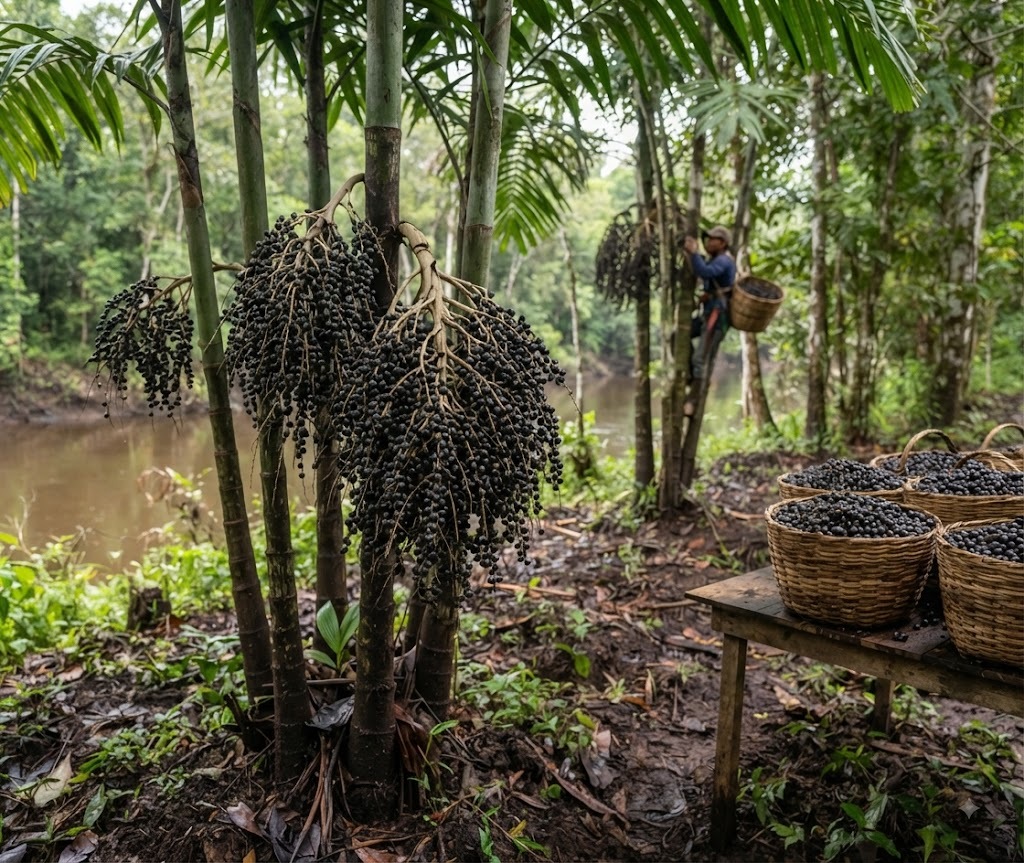
| Item Identity | The representative plant entity for No. 182 is Euterpe oleracea Mart. of the Arecaceae family. It is an accepted species from Kew. ( Plants of the World Online ) |
| Key role | It is a representative crop connected through the production-pulp processing-cold chain-export chain, in which fruits from the Amazon region are rapidly pulped at the source and converted into frozen pulp, puree, beverage base, powder, and processed food . |
| Harvesting principle | Record Species, origin, harvest date, fruit maturity, cluster, and Farm/harvesting area in Lot, and separate raw materials for pulp processing, seeds, and by-products. |
| Product separation | Separate into Fresh Fruit → Selected Fruit → Açaí Pulp → Frozen Pulp/Puree → Concentrate or Powder → Bowl·Smoothie·Beverage Ingredient. |
| Separation of similar items | E. oleracea and E. precatoria are different accepted species, so they are not registered as the same Plant Entity. ( Plants of the World Online ) |
| Brazil Official Statistics | IBGE's 2024 extractive acai production was 247.5 thousand tons , of which Pará accounted for 168.5 thousand tons, or 68.1% . This must be managed separately from cultivated PAM statistics. ( Agência de Notícias ) |
| Cultivation statistics | IBGE conducts separate surveys on cultivated acai production within PAM, with Pará being the core production area. The latest national figures for cultivated types and wild-harvested types are not arbitrarily aggregated. ( IBGE ) |
| Domestic statistics | Since the government-approved statistics on South Korea's acai cultivation area and production volume were not verified in this v1.0 version, they will be entered later after verification of the official raw data. |
| Processing standards | Brazil's MAPA operates a PIQ system for fruit juices and pulps, and acai pulp is also subject to the relevant quality and product classifications. ( Agricultura ) |
| Supply and demand risk | The key factors are production concentration in Brazil and the Amazon, distinction between cultivated and harvested types, rapid quality deterioration after harvest, microorganisms and foreign matter, pulping hygiene, frozen distribution, mixing of species and origin, pulp dilution and solid content, exchange rates and frozen logistics. |
| Operating Principles | Species-Origin-Production Type-Farm/Extraction Area-Fruit Lot-Pulp Batch-Frozen/Powder Product-Buyer Connect RFQ. |
| Final goal | It is to build supply chain intelligence that connects botany, quality, processing, and cold chain data, ranging from fruits native to Brazil to Korean frozen pulp, smoothies, and PB buyers. |
Basic fields | detail |
| Korean name | Asai |
| English name | Açaí / Acai |
| Representative scientific name | Euterpe oleracea Mart. |
| classification | Arecaceae → Euterpe → E. oleracea |
| Edible parts | The pulp portion centered on the exocarp and mesocarp recovered from the fruit |
| Non-edible · Separate management | Large seeds, fibrous residues, foreign matter, non-marketable fruit, etc. |
| Major harvesting stages | Mature fruit suitable for pulp processing |
| Basic product form | Fresh Fruit·Pulp·Frozen Pulp·Pure·Concentrate·Powder |
| Basic processing stage | Harvesting → Sorting → Washing → Softening/Pretreatment → Pulping → Sieving → Cooling/Freezing → Concentration/Drying |
| Basic use | Acai bowls, smoothies, beverages, desserts, food ingredients, private brands, exports |
| Similarity Principle | Plant Entity separate from other Euterpe species such as E. precatoria |
Kew describes Euterpe oleracea as a palm tree that grows in wet tropical biomes and is a food-use species. ( Plants of the World Online )
Product Master
Product | Product stage | Key Management Standards |
| Açaí Seed Lot | breeding materials | Species·Seed Source·Lot |
| Açaí Seedling Lot | Seedling cultivation | Seed Lot · Age · Health |
| Cultivated Açaí Field Lot | Cultivation type | Farm · Cultivation Method · Harvest Year |
| Extractive Area Lot | Collection type | Region · Extraction Area · Management Organization · Origin |
| Fresh Açaí Bunch | Harvesting stage | Harvest date, cluster, maturity status |
| Fresh Fruit | raw materials | Species · Origin · Color · Damage · Weight |
| Selected Açaí Fruit | Selected items | Removal of immaturity, overripeness, damage, and foreign matter |
| Washed Fruit | Washed items | Washing water · Hygiene · Batch |
| Açaí Pulp | Key processed products | Fruit Lot · Pulping · Solids · Microorganisms |
| Frozen Açaí Pulp | frozen products | Pulp Batch · Freezing · Storage Temperature |
| Açaí Puree | Puree | Pulp content, homogeneity, and presence of additives |
| Açaí Concentrate | Concentrate | Raw Material Batch, Solids, Concentration Process |
| Açaí Pulp with Water | Diluted products | Check Brazil PIQ Type and Solids |
| Açaí Juice/Beverage Base | Beverage ingredients | Ingredient ratio, moisture, and blending |
| Freeze-dried Açaí Powder | freeze-dried powder | Parent Pulp · Moisture · Particle Size |
| Spray-dried Açaí Powder | Spray-dried product | Carrier · Raw Material Ratio · Particle Size |
| Whole Fruit-derived Powder | Fruit-derived powder | Method of removing raw parts and seeds |
| Açaí Bowl Base | For dining out | Formula including frozen pulp, sugars, fruit juice, etc. |
| Smoothie Base | For beverages | Viscosity, Brix, Mixing Ratio |
| Açaí Blend | mixed products | Acai content, other fruits, sweeteners |
| OEM·PB Açaí Product | finished product | Formula · MOQ · Raw Material Lot · Contract |
Classification criteria | Subdivision type | Management principles |
| Plant classification | E. oleracea / E. precatoria, etc. | Plant Entity by Species |
| production method | Cultivated / Extractive | Linked with the IBGE statistical system |
| Edible parts | Fruit pulp | Separation of Seed and Fiber Residue |
| Harvesting stage | Immature, ripe, overripe | Fruit Maturity field |
| origin | Brazil→State→Municipality→Farm/Area | Traceability |
| Distribution methods | Fresh Fruit·Pulp·Frozen Pulp | Product Separation |
| Processing form | Puree·Concentrate·Powder | Process Entity |
| Solids and Dilution | By Pulp Type | PIQ·Buyer Spec |
| frozen state | chilled/frozen | Cold chain separate |
| Final use | Bowl·Smoothie·Juice·Dessert·Ingredient | Application |
| Transaction type | Source Procurement · Import · Regular Supply · OEM · PB | RFQ |
| Authentication · Origin | Organic, Fair Trade, local certification, etc. | Verification of actual evidence |
The IBGE separately tracks Brazilian acai production into cultivated acai and wild harvesting. In 2024, wild harvesting acai production was 247.5 thousand tons, with Pará accounting for the largest share at 168.5 thousand tons. ( Agência de Notícias )
step | Essential Dataset | Management purpose |
| Production plan | Species · Cultivation/Harvesting Type · Area · Buyer | Supply plan |
| satellite | Species·Seed Source·Lot | Identity |
| Seedling cultivation | Seedling Age · Growth · Seed Lot | Plant Quality |
| formula | Farm · Job · Density | Cultivation history |
| Management of extraction areas | Area · Region · Sampled Tissue | Extractive Traceability |
| growth | Tree height, crown, inflorescence, fruit set | Production forecast |
| rising | Rainfall, temperature, flooding, humidity | Supply Risk |
| Soil and water environment | Real environments such as lowlands and floodplains | Production characteristics |
| Fertilization and watering | When applicable to cultivation type | Field Management |
| pests | Occurrence and Control | Loss and Safety |
| Flowering and fruit setting | Date · Song Yi-su | Yield Forecast |
| Excessive negligence | Size, color, maturity | Harvest Forecast |
| Harvest judgment | Excessive Color · Maturity · Buyer | Harvesting at the right time |
| Pine mushroom harvest | Date, Worker, Location | Bunch Lot |
| Departure | Cluster → Fruit | Fruit Lot |
| Origin sorting | Immaturity, damage, or foreign matter | Quality |
| transit | Harvest → Processing Time | Maintaining quality |
| purifying | Water quality and hygiene | Safety |
| Pretreatment and softening | Time, temperature, water | Pulping suitability |
| Pulping | Pulp recovery, water usage, and yield | Core Process |
| constitution | Remove Seed/Fiber | Product Purity |
| Homogenization | By product | Pulp Uniformity |
| Sterilization and sanitation treatment | Application by product and country | Safety |
| cooling | Pulp temperature control | Quality |
| freezing | Freezing time and temperature | Frozen Product |
| Frozen storage | Temperature and period | Cold Chain |
| concentration | Solid content and process | Concentrate |
| dry | Freezing/spraying, etc. | Powder |
| packaging | Material · Weight · Lot | Delivery |
| shipment | Buyer · Quantity · Date | Transaction tracking |
Quality items | Fresh Fruit | Açaí Pulp | Frozen Pulp/Puree | Powder/Concentrate | finished product | Public rating |
| Species | essential | succession | succession | succession | tracking | Public/Verified |
| Production type | Cultivation/Harvesting | succession | succession | succession | tracking | Public/Verified |
| Origin | essential | essential | succession | succession | mark | Public/Verified |
| Farm/Area | essential | succession | succession | succession | tracking | Verified |
| Lot | essential | essential | essential | essential | essential | Verified/NDA |
| Harvest day | essential | succession | succession | succession | tracking | Verified |
| Maturity | core | Raw material inheritance | Raw material inheritance | succession | tracking | Verified |
| appearance | Color/Damage | Color and homogeneity | Color and thawing status | By product | QC | Member |
| weight | essential | Batch | Batch | Batch | By product | NDA |
| alien substance | core | core | core | core | core | Verified |
| Seeds and fiber residues | — | core | succession | By product | QC | Verified |
| moisture | state of negligence | By product type | By product type | Powder Core | By product | Verified |
| Total solids | — | core | core | Concentrate Core | By product | Verified/NDA |
| pH | — | core | By product | By product | By product | Verified/NDA |
| Color | Excessive color | core | core | By product | By product | Verified |
| microorganism | If necessary | core | core | core | Conformity to standards | Verified/NDA |
| pathogenic microorganisms | Raw material risk | core | core | By product | Conformity to standards | Verified/NDA |
| pesticide residues | Cultivation type center | Raw material verification | Raw material inheritance | test | Conformity to standards | Verified/NDA |
| heavy metals | Risk-based | test | test | test | Conformity to standards | Verified/NDA |
| Cleaning history | — | essential | succession | succession | tracking | Verified |
| Pulping history | — | essential | succession | succession | tracking | NDA |
| Amount of water added | — | Key Points by Product Type | succession | — | tracking | NDA |
| Sterilization history | — | When applying | succession | succession | tracking | NDA |
| Freeze history | — | — | essential | — | tracking | Verified/NDA |
| Freezing temperature | — | — | core | — | Cold Chain | NDA |
| Thawing history | — | — | Key to distribution | — | finished product | NDA |
| Concentration history | — | — | — | Concentrate is essential. | tracking | NDA |
| Drying history | — | — | — | Powder is essential. | tracking | NDA |
| Carrier | — | — | — | Essential for spray-dried | mark | NDA |
| packaging | raw materials | essential | essential | essential | essential | Verified |
| Expiration date | — | By product | By product | By product | essential | Verified |
| Shipment | essential | essential | essential | essential | essential | Verified |
| Returns and Claims | record | record | record | record | record | NDA |
| Repurchase | Buyer Connection | Buyer Connection | Buyer Connection | Buyer Connection | Buyer Connection | NDA |
Lot Master Required Field
Lot ID · Item/Product Type · Scientific Name · Species Verification · Production Type (Cultivated/Extractive) · Country/State/City/Farm/Harvesting Area · Producer/Harvesting Organization · Seed/Plant Lot · Harvest Date · Cluster Lot · Fruit Maturity · Weight/Size/Color/Damage/Foreign Matter · Pesticide Use History (Cultivated Type) · Pesticide Residue/Microorganism/Heavy Metal Test Report · Harvest→Processing Time · Washing/Softening/Pulping/Sieving History · Water Added Amount · Total Solids/pH · Pulp Parent Lot · Sterilization/Cooling/Freezing/Frozen Storage History · Concentration/Drying/Carrier History · Packaging Date · Best Before Date · Shipper · Returns/Claims · Repurchase
Customers | Purchase criteria | Cooperation opportunities |
| Frozen fruit importer | Species·Origin·Pulp Spec·Cold Chain | Brazil RFQ |
| Acai specialty store | Frozen Pulp · Color · Viscosity · Flavor | Regular supply |
| Cafes · Franchises | Bowl Base · Smoothie Base | B2B |
| Hotels and food service companies | Frozen Pulp Portion | Foodservice |
| Juice manufacturer | Puree·Concentrate·Brix | Beverage |
| Smoothie manufacturer | Frozen Pulp Blend | RTD/Foodservice |
| Ice cream and desserts | Color, pulp content, viscosity | Ingredient |
| Yogurt and dairy products | Puree·Powder | Application |
| Bakery | Powder·Puree | Food Ingredient |
| HMR | Frozen Portion·Puree | Meal Product |
| Powder manufacturing and distribution | Powder · Carrier · Origin | B2B |
| Online/Distribution | Frozen Pulp Powder | Retail |
| PB | Bowl·Smoothie·Powder | Private Label |
| General health foods | Ingredient Content and Labeling | Food Ingredient |
| Export and re-export companies | Brazil Origin · Processing Source | Trade |
| Research Institute | Pulping, Freezing, Color, Microorganisms, Supply Chain | R&D |
The key to acai's international supply chain lies in on-site pulping and freezing rather than the fruit itself . The Brazilian government operates a registration, quality, hygiene, and labeling system for pulp and fruit juice, and regulations and customs classifications for export acai also vary depending on the Product Form and processing method. ( Serviços e Informações do Brasil )
step | Key variables | Operational judgment |
| Brazilian production | Cultivated/Extractive·State | Origin Risk |
| harvest | Maturity · Season · Bunch | Raw Material |
| Collection at the production site | Time and temperature | Quality |
| Washing and sorting | Hygiene and foreign matter | Raw QC |
| Pulping | Pulp Yield·Water Addition | Core Processing |
| Cooling/Freezing | Time and temperature | Cold Chain |
| save | Frozen Inventory | Supply |
| Brazil exports | HS·Pulp Spec·Certificate | Export |
| International frozen logistics | Container·Temperature | Quality |
| Korean imports | HS · Food Inspection · Origin | Compliance |
| domestic cold storage | Temperature and thawing management | Cold Chain |
| Portioning/OEM | Portion·Formula | Product |
| Bowl/Smoothie Manufacturing | Blend · Sugars · Other Fruits | Application |
| Powder distribution | Drying·Carrier·COA | Ingredient |
| RFQ | Spec·MOQ·Delivery | Procurement |
| Repurchase | Color · Flavor · Price · Delivery Time | Supplier Score |
Trade Dataset
item | v1.0 processing |
| Fresh Açaí Fruit HS | Future verification of the Korea Customs Service's current HS-K |
| Frozen Açaí Pulp HS | Verification based on product composition and presence of added sugars |
| Açaí Puree HS | Verification by processing state |
| Concentrate HS | Verification based on solid content and additives |
| Juice/Beverage Base HS | Verification by beverage composition |
| Freeze-dried Powder HS | Verification of official classification in powder form |
| Spray-dried Powder HS | Separate verification by Carrier and Composition |
| Korea's import volume | Input after official verification of raw data |
| Korean import value | Input after official verification of raw data |
| Major countries of origin | Korea Customs Service verification of raw data by country of origin |
| Customs clearance unit price | Calculated from the same HS, same product, and same unit |
| Brazil production statistics | Cultivated PAM / Extractive PEVS separate |
| FTA | Verification by Country, HS, and Criteria of Origin |
| Quarantine | Check Fresh Fruit/Seed and Processed Pulp separately |
| Food standards | Linking Korea MFDS, Brazil MAPA, and destination country standards |
Products and processes | Key conditions | RFQ conversion |
| Fresh Fruit | Species·Origin·Maturity | Processor RFQ |
| Selected Fruit | Maturity, foreign matter, damage | Pulp Processor |
| Washed Fruit | Hygiene and cleaning | Food-grade |
| Açaí Pulp | Solids · pH · Pulp Yield | Core RFQ |
| Frozen Pulp | Pulp Spec · Freezing · Cold Chain | Cafe/Foodservice |
| Açaí Puree | Homogeneity and content | Beverage/Dessert |
| Concentrate | Solid content and concentration process | B2B |
| Bowl Base | Pulp, sugars, other fruits | Foodservice/OEM |
| Smoothie Base | Viscosity · Formula | Beverage |
| Freeze-dried Powder | Parent Pulp · Moisture · Particle Size | Premium Ingredient |
| Spray-dried Powder | Carrier content | Food Manufacturer |
| Blend Powder | Acai content · Other ingredients | PB |
| Seed Fraction | Pulping byproduct | Separate verification of bio, materials, feed, etc. |
| Fiber Residue | Processing residue | Review of feed, compost, and bio-utilization |
| Reject Fruit | Non-commercial products and | Processing conversion is after safety verification |
In acai, seeds make up the majority of the fruit and the pulp is relatively thin, so separating Fruit Weight and Recoverable Pulp Yield is important for RFQ cost calculation. Since actual yields vary by production region, fruit condition, and pulping equipment, they are entered in the Verified Pilot.
Since Brazil's MAPA PIQ system provides a foundation for classifying and managing acai products based on characteristics such as solid content, Buyer RFQs should require actual pulp content, water addition, solid content, and the presence of additives, rather than simply 100% açaí. ( Agricultura )
PRP — Product Research Profile
PRP | Key research questions |
| Fresh Fruit PRP | Which fruit species, origin, and level of maturity are suitable for pulping? |
| Production Type PRP | How do the origin, supply stability, and price structure differ between cultivated and harvested types? |
| Pulp PRP | Do the Fruit Lot, water addition, pulping process, and solid content match the Buyer Spec? |
| Frozen Pulp PRP | Is the Cold Chain maintained from pulping at the source to the point of use by the buyer? |
| Puree PRP | Are the pulp content, additives, and viscosity suitable for the finished product requirements? |
| Powder PRP | Are the Parent Pulp, Drying Method, Carrier, and Particle Size Clear? |
| Bowl PRP | Can you distinguish between pure pulp and sweetened/blended bowl base? |
| Export PRP | Do the Brazilian Product Spec match the Korean HS, Food Standards, and Buyer Spec? |
first of all | Execution item | Performance indicators |
| 1 | Species·Origin·Cultivated/Extractive·Harvest Lot required value | Essential Field Completion Rate |
| 2 | Separation of Fresh Fruit, Pulp, Frozen Pulp, Puree, Powder Products | Product identification rate |
| 3 | Linking weather, water level, flowering, fruit set, and harvest data | Production Coverage |
| 4 | Video AI screening for overcoloration, maturity, damage, and foreign matter | Grade Accuracy |
| 5 | Bunch→Fruit Lot Tracking | Harvest Traceability |
| 6 | Harvest-to-Pulp Time Automatic Recording | Lead-time compliance rate |
| 7 | Fruit → Pulp Yield Data Conversion | Pulp Yield |
| 8 | Automatic recording of water addition and total solids | PIQ Spec Compliance Rate |
| 9 | Microorganisms, pH, and COA Automatic Connection | Safety Coverage |
| 10 | Freezer temperature IoT connection | Cold-chain completion rate |
| 11 | Detection of freeze escape and thaw events | Excursion Rate |
| 12 | Production volume and season forecast | Supply Forecast |
| 13 | Pulp Yield Prediction | Yield Forecast |
| 14 | Price and frozen inventory forecast | Supply Risk |
| 15 | Product–Buyer AI Match | RFQ → Sample Conversion Rate |
| 16 | Buyer Ratings & Repurchase Link | Repeat Order Rate |
Problem group | Problem Definition | Required data |
| E. oleracea–E. Precatoria used interchangeably | Açaí common name under Species mixed | Scientific Name |
| Mixed cultivation–harvesting statistics | PAM·PEVS Production Volume Overlap·Misunderstanding | Production Type |
| Disconnection from origin | Difficulty in tracing the origin of powders and pulp | Farm/Area |
| Fruit maturity variation | Variation in color, pulp yield, and quality | Maturity |
| Post-harvest quality degradation | Delay in collection at production sites | Harvest-to-Pulp Time |
| Weather and Water Level Risk | Changes in Amazon Production and Harvest Accessibility | Climate/Hydrology |
| pests | Cultivation-type production loss | Pest Dataset |
| alien substance | Incorporation of the extraction and pulping processes | QC |
| microorganism | Safety Risk of High-Moisture Pulp Foods | Microbiology |
| pesticide residues | Cultivated supply chain | Spray·COA |
| Pulp yield variation | Difference in recoverable pulp compared to fruit | Yield |
| Amount of water added is unknown | Distortion of Pulp Standard and Price Comparison | Process Data |
| Solid content variation | Product Grade Discrepancy | Total Solids |
| freezing delay | Deterioration of color, microorganisms, and sensory properties | Process Time |
| Cold Chain Sever | Frozen pulp quality degradation | Temperature Log |
| Thawing and Refreezing | Quality and Safety Risk | Excursion Log |
| Puree–Pulp confusion | Difference in actual content of the Product Form | Product Master |
| Powder Parent Lot Disconnection | Difficulty in identifying the species and origin of the powder | Genealogy |
| Carrier unknown | Distortion of the actual acai content in the powder | Formula |
| Sweetened Bowl Base Mix | Confusion between pure pulp and added-grade products | Ingredient List |
| HS classification error | Customs classification differences between Frozen, Puree, and Powder | HS Mapping |
| Price and Exchange Rate Risk | Changes in Brazil's procurement costs | Trade/FX |
| Frozen logistics costs | The core of international export costs | Logistics |
| Repurchase not reflected | Buyer experience is not linked to supplier selection | Buyer Evaluation |
RFQ Type | Public Registration | Verify/NDA |
| Cultivated Açaí Fruit | Species·State·Season | Farm · Quantity · Unit Price |
| Extractive Fruit | Species · Region · Collection Type | Organization, volume, and price |
| Fresh Fruit Purchase | Maturity·Origin | Actual quantity · Delivery time |
| Pulp raw material supply | Product Type · Origin | Solids · Price · COA |
| Frozen Pulp | Species·Pulp Type | Lot · Freezing Condition · Unit Price |
| Puree | Content · General Standards | Formula · Unit Price |
| Concentrate | Solid content and uses | Concentration conditions and prices |
| Freeze-dried Powder | Drying Method · Origin | Parent Lot·COA |
| Spray-dried Powder | Carrier unveiled | Content · Formula · Price |
| Bowl Base | Uses · General Configuration | Sugars, other fruits, and fruit combinations |
| Smoothie Base | Viscosity · Fruit Profile | Formula·MOQ |
| Regular supply for cafes and restaurants | Frozen Portion · Period | Monthly Usage · Actual Unit Price |
| HMR · Dessert | Puree/Pulp Specifications | Formula |
| OEM·PB | Bowl·Smoothie·Powder | MOQ · Recipe · Contract |
| import | Brazil Origin·Product | HS · Volume · Unit Price |
| Export and re-export | Product · Destination Country | HS · Origin · Regulation |
| Cold-chain demonstration | Frozen Pulp | Temperature Log |
| Technology demonstration | AI Sorting, Pulping, and Yield | raw data |
| Research cooperation | Species · Production · Processing · Cold Chain | IP · Exam materials |
① Need Products & Materials
Companies and institutions seeking necessary products, agricultural products, raw materials, and processed goods register purchasing demands. Registered requests are utilized to review cooperation with potential suppliers and producers based on the RFQ Intelligence Library.
Process:
RFQ Registration → Supplier/Product Review → Collaboration Connection → Future AI Matching
Register
② We are looking for production and manufacturing partners. (Need Suppliers & Manufacturers)
Register a request to find necessary production and supply partners, ranging from farms and producer organizations to processing companies, OEM, ODM, and private label manufacturers.
Process:
RFQ Registration → Review of Production & Manufacturing Capabilities → Collaboration Connection → Future AI Partner Matching
Register
③ We are looking for domestic and international buyers. (Need Buyers)
Farmers, producer organizations, and manufacturing companies are requesting cooperation with new buyers, such as domestic and international distributors, importers, brand companies, and food service and catering businesses.
Process:
RFQ Registration → Product & Supply Capability Review → Market & Buyer Connection → Future AI Buyer Matching
Register
Contact : mail@markethub.org
Version | Main contents | situation |
| v1.0 | Plant Identity · E. oleracea/E. precatoria Isolation · Cultivated/Extractive · Fruit · Pulp · Frozen · Puree · Powder · Cold Chain · RFQ Basic Structure Registration | complete |
| v1.1 | IBGE Latest Cultivated PAM Detailed Statistics · Korean HS · Import Market · MFDS Food Standards Official Raw Data Verification | expected |
| v2.0 | Quality by Fresh Fruit, Pulp, Frozen Pulp, Puree, Concentrate, Powder, and Bowl Base, PIQ, Cold-Chain, and PRP Segmentation | expected |
| v3.0 | Brazil Farm·Extractive Community–Pulp Processor–Cold-chain Exporter–Korea Import·Food·Cafe·PB Buyer Verified Container Combination | expected |