

Judgment axis | Key judgment |
| Item Identity | The commercial name Spirulina primarily refers to Arthrospira platensis biomass in the food industry. The FDA GRAS Notice also uses this name. The NCBI currently designates the relevant taxon as Limnospira platensis and links Arthrospira platensis and Spirulina platensis to the previous names. ( FDA HFPAP External ) |
| biological role | Instead of harvesting specific edible parts of plants, the entire biomass of cultured photosynthetic microorganisms is used as a food ingredient. |
| Key Production Role | It is a cultivation industry that follows the process of spawn/strain → Seed Culture → Production Culture → Biomass Harvest → Concentration → Drying → Powder/Tablet/Ingredient. |
| Harvesting principle | A Harvest Lot is generated based on strain, culture tank, culture water, nutrients, light, temperature, pH, culture time, biomass density, and contamination test results. |
| Product separation | Wet Biomass/Paste → Dried Biomass → Flake → Powder → Granule/Tablet → Food Ingredient/Product are managed as separate products. |
| Separation of similar items | No. 200 is biologically isolated from Chlorella, and actual Spirulina products are not integrated with the same raw materials without verifying Limnospira/Arthrospira Species/Strains. |
| Domestic regulations | The Ministry of Food and Drug Safety manages spirulina within the functional ingredient system for health functional foods and has revised regulations, including strengthened heavy metal standards, functional claims, and precautions for consumption, to reflect the results of the 2023 re-evaluation. ( Ministry of Food and Drug Safety ) |
| Overseas food evidence | FDA GRN 127 specifies Spirulina as the dry biomass of *A. platensis* and terminated the GRAS Notice for the use of this ingredient in certain foods at levels of 0.5 to 3 g per serving. This is a specific U.S. GRAS Notice and is not used as a Korean food standard. ( FDA HFPAP External ) |
| Food utilization | FDA GRN 417 suggests dried A. platensis biomass as an ingredient for various food groups, including beverages, cereals, grains and pasta, snacks, and soups. ( FDA HFPAP External ) |
| Safety Risk | Spirulina must distinguish not only the intended strain itself but also other cyanobacteria that may be incorporated into the culture environment and their toxin risks. The WHO addresses the pathways of cyanobacteria toxin exposure and the need for analytical management in separate guidelines. ( WHO ) |
| Domestic production statistics | Since national approved statistics on the annual domestic production volume, cultivation area, and production value of Spirulina alone could not be verified in this v1.0 version, they will be entered later after verification of official raw data. |
| Supply risk | The key factors are strain identity, culture water, nutrients, pH, temperature, and light, contamination by alien cyanobacteria and microorganisms, heavy metals, drying stability, color and aroma variation, and verification of COA and origin. |
| Operating Principles | Species/Strain–Seed Culture–Production Pond/PBR–Harvest Batch–Biomass–Drying–Powder/Product–Buyer Connect RFQ. |
| Final goal | The goal is to create a repeatable food ingredient supply system by linking biomass genealogy with quality, safety, and buyer evaluations from cultivation to finished products. |
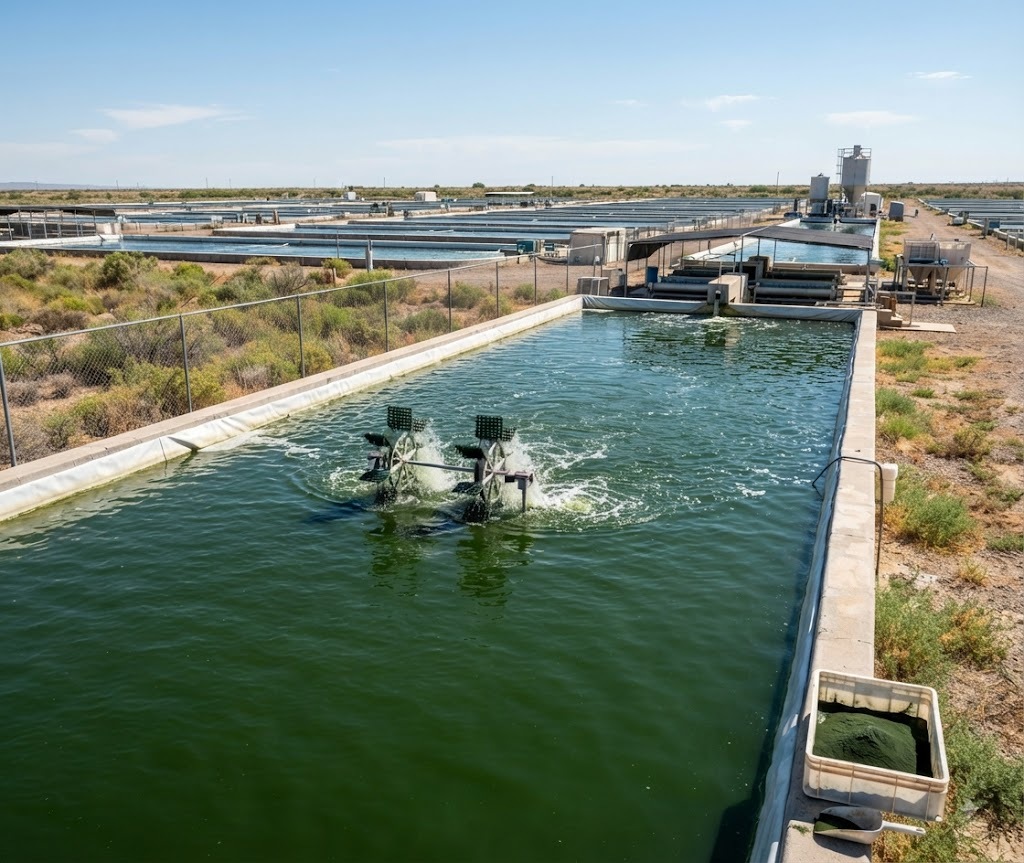
The FAO has reviewed Spirulina as a cultured biomass that has been widely used for food and feed, and has organized its production, cultivation, harvesting, processing, and utilization into a single industrial system. Therefore, the key factors for Spirulina are cultivation facility capacity, culture integrity, drying yield, and quality yield , rather than the cultivated area or yield of the agricultural product. ( FAOHome )
Basic fields | detail |
| Korean name | Spirulina |
| English name | Spirulina |
| Current Taxonomy Example | Limnospira platensis |
| Existing/Industrial Scientific Name | Arthrospira platensis |
| Past/Synonymous notation | Spirulina platensis |
| NCBI Taxonomy ID | Limnospira platensis Taxonomy ID 118562 |
| classification | Bacteria → Cyanobacteriota → Cyanophyceae → Oscillatoriales family |
| Conventional industrial classification | Although often referred to industrially as microalgae, biologically they are cyanobacteria |
| Edible parts | not a specific organ, but the entire cultured biomass harvested |
| Non-edible · Separate management | Culture wastewater · Contaminated biomass · Filtration residue · Inspection non-compliant lot |
| Major production stages | Strain Preservation → Seed Culture → Scale-up → Production Culture → Harvest |
| Major harvesting stages | Biomass Density·Culture Health·Contamination Status·Buyer Spec |
| Basic product form | Wet Biomass·Paste·Flake·Dried Biomass·Powder·Granule·Tablet |
| Basic processing stage | Filtration → Washing → Concentration → Dehydration → Drying → Grinding → Sieving → Mixing/Formulation |
| Basic use | Food ingredients, powdered foods, health functional food ingredients, food colorings, feed ingredients, etc. |
| Similarity Principle | Isolation of Chlorella, other Cyanobacteria, and Species/Strains |
As of 2026, the NCBI Taxonomy lists Limnospira platensis as the current name, linking Arthrospira platensis as a basionym and Spirulina platensis as a homotypic synonym. However, existing food regulatory data, such as those from the FDA, still use Arthrospira platensis. Therefore, MarketHub maintains three fields simultaneously: Current Scientific Name, Regulatory Name, and Commercial Name . ( NCBI )
Product Master
Product | Product stage | Key Management Standards |
| Spirulina Species Master | Biological Entity | Current·Historical Taxonomy |
| Spirulina Strain | strain | Strain ID·Culture Collection |
| Master Culture | Original species | Preservation period, generation, purity |
| Working Culture | Working strain | Parent · Culture Date |
| Seed Culture | Seed culture | Strain · Culture medium · Vitality |
| Intermediate Culture | Scale-up | Vessel·Volume·Density |
| Production Culture | Production culture | Pond/PBR·Batch |
| Culture Medium | culture medium | Water·Nutrient Formula |
| Harvest Suspension | Harvest | Biomass Density |
| Washed Biomass | Washed biomass | Washing water/purity |
| Concentrated Biomass | concentrate | Solids · Moisture |
| Spirulina Paste | humectants | Moisture, refrigeration, microorganisms |
| Dried Biomass | dried raw materials | Drying method · Moisture |
| Spirulina Flake | Flake | Size, color, moisture |
| Spirulina Powder | powder | Particle size, color, moisture, COA |
| Fine Powder | fine powder | Mesh · Dispersion |
| Granule | granules | Particle size and auxiliary materials |
| Tablet | tablet | Content, Weight, and Auxiliary Ingredients |
| Capsule Ingredient | Capsule filling material | Raw Material Lot · Particle Size |
| Food Ingredient | food ingredients | Products and specifications used |
| Beverage Ingredient | Beverage ingredients | Dispersibility, taste, color |
| Bakery/Pasta Ingredient | food ingredients | Thermal stability and color |
| Snack Ingredient | food ingredients | Flavor·Texture |
| Health Functional Ingredient | Dietary supplement ingredients | Current MFDS standards |
| Phycocyanin-related Ingredient | Pigments and extracts | Separately Extracted/Regulated Product |
| Feed-grade Biomass | for animal feed | Food Grade and Grade separation |
| Off-spec Biomass | Non-standard | Food supply chain exclusion or reprocessing verification |
Classification criteria | Subdivision type | Management principles |
| Taxonomy | Limnospira platensis / Conventional A. platensis | Maintain Name Version |
| strain | By Strain | Strain Master separation |
| spawn stage | Master / Working / Seed | Culture genealogy |
| Cultivation method | Open Raceway / Closed PBR / Tank | Production Entity |
| culture stage | Seed / Intermediate / Production | Batch separation |
| Culture environment | Outdoor / Indoor / Controlled | Facility separation |
| Harvesting type | Suspension / Paste | Product Separation |
| Drying method | Actual processes such as Spray, Drum, and Freeze | Separation of Processing |
| Product form | Flake / Powder / Granule / Tablet | Product Separation |
| Product Grade | Food/Health Functional/Feed | Standard separation |
| Final use | Drink·Snack·Pasta·Supplement·Ingredient, etc. | Application |
| Transaction type | Raw material supply, regular procurement, OEM, ODM, PB, export | RFQ |
step | Essential Dataset | Management purpose |
| Strain selection | Species·Strain·Source | Identity |
| Master Culture | Culture ID · Generation | Genetic Stability |
| Working Culture | Parent · Culture Date | Production Start |
| Seed Culture | Volume·Density | Scale-up |
| Securing culture water | Source · Processing Method | Food Safety |
| Culture water test | Microorganisms, inorganic matter, and pollutants | Input QC |
| Nutrient preparation | Raw Material · Lot · Purity | Medium |
| Preparation of culture solution | Formula·pH | Growth |
| Intermediate Scale-up | Vessel·Volume | Production |
| Production culture | Pond/PBR ID | Batch |
| Light management | Solar radiation, photoperiod, and luminous intensity | Photosynthesis |
| Temperature management | Incubation temperature | Growth |
| pH management | pH Runtime | Culture Selectivity |
| Mixing and Circulation | Agitation·Flow | Uniformity |
| CO₂ input | Input amount · Time | Carbon Supply |
| Nutrient management | N·P etc. | Biomass Production |
| Evaporation/Replenishment Water | Water Balance | Medium Stability |
| Biomass Density | Building Weight · Optical Signal | Harvest Timing |
| Microscopic examination | Morphology · Foreign organisms | Culture Health |
| Contamination test | Other Cyanobacteria·Algae·Microbes | Safety |
| Harvest judgment | Density·Quality·Contamination | Release |
| percolation | Mesh·Flow | Harvest |
| purifying | Wash water and recovery rate | Purity |
| concentration | Solids·Water Removal | Biomass |
| dehydration | moisture | Drying Prep |
| dry | Method, Temperature, Time | Stability |
| cooling | Product temperature | Quality |
| smash | Particle Size | Powder |
| constitution | Mesh | Uniformity |
| metal detection | Process inspection | Foreign Matter |
| packaging | Oxygen, moisture, and shading | Shelf-life |
| save | Temperature and humidity | Stability |
| shipment | Buyer·Lot | Traceability |
The FAO Review of Spirulina Production and Utilization outlines the overall production system, stating that commercial Spirulina is produced through cultivation and the harvesting and drying of biomass, and is utilized as food and feed. Since individual culture temperatures, pH, and productivity vary depending on the strain, facility, and cultivation method, they are not fixed to arbitrary general values in this v1.0 version. ( FAOHome )
Quality items | Wet Biomass | Dried Biomass | Powder·Granule | finished product | Public rating |
| Species | essential | succession | succession | tracking | Public/Verified |
| Strain | essential | succession | succession | tracking | Verified/NDA |
| Master Culture | succession | succession | succession | tracking | Verified/NDA |
| cultivation facility | essential | succession | succession | tracking | Verified |
| Culture Batch | essential | succession | succession | tracking | Verified |
| culture water | essential | succession | succession | tracking | Verified/NDA |
| Medium Lot | essential | succession | succession | tracking | NDA |
| Culture period | essential | succession | succession | tracking | Verified |
| pH, temperature, light | Runtime | succession | succession | tracking | NDA/Internal |
| Biomass Density | core | Yield basis | Inheritance of raw materials | — | Verified |
| Appearance and color | core | core | core | By product | Verified |
| smell | core | core | core | By product | Verified |
| moisture | Suspension | core | core | By product | Verified |
| Entry to the island | — | — | core | By product | Verified |
| alien substance | core | core | core | core | Verified |
| Other algae and cyanobacteria | core | Raw material inspection | succession | safety | Verified/NDA |
| General bacteria, etc. | test | test | test | Conformity to standards | Verified/NDA |
| pathogenic microorganisms | By inspection standard | test | test | Conformity to standards | Verified/NDA |
| heavy metals | Raw Material Risk | core | core | Conformity to standards | Verified/NDA |
| Cyanotoxin Risk | Culture Contamination Risk-based | Inspection system needed | COA | Finished Product Management | Verified/NDA |
| Drying conditions | — | core | succession | tracking | NDA |
| General ingredients such as protein | If necessary | analyze | Product specifications | Label | Verified |
| Pigment components | If necessary | analyze | Product specifications | By product | Verified |
| packaging | temporary | core | core | essential | Verified |
| Expiration date | Limited | By product | By product | By product | Verified |
| Shipment | essential | essential | essential | essential | Verified |
| Returns and Claims | record | record | record | record | NDA |
| Repurchase | Buyer Connection | Buyer Connection | Buyer Connection | Buyer Connection | NDA |
The Ministry of Food and Drug Safety strengthened heavy metal standards for Spirulina in the 2023 revision of the Standards and Specifications for Health Functional Foods . Accordingly, heavy metal standards for Health Functional Food ingredient products are set as Product Release Gates. Current permissible limits for specific items must be reconfirmed using the original text of the latest "Standards and Specifications for Health Functional Foods" during product registration. ( Ministry of Food and Drug Safety )
The WHO explains that toxins produced by cyanobacteria can be exposed through various routes, including oral ingestion, and presents a separate analytical framework for cyanobacteria and the aquatic environment. In the case of Spirulina foods, it is important to distinguish between the target Spirulina strain itself and toxin-producing cyanobacteria that may be introduced during culture . ( WHO )
Lot Master Required Field
Lot ID · Item · Product Type · Commercial Name · Current Scientific Name · Regulatory Scientific Name · Strain ID · Culture Collection/Source · Master Culture ID · Working Culture ID · Seed Culture Lot · Facility ID · Pond/PBR/Tank ID · Culture Water Source · Water Test · Medium Lot · Start Date · Harvest Date · Culture Volume · Light · Temperature · pH · Mixing · CO₂ · Nutrients Runtime · Biomass Density · Culture Health · Microscopy Result · Other Cyanobacteria/Algae Identification · Microbiology · Cyanotoxin Risk Test · Harvest Batch · Filtration · Washing · Concentration · Dehydration History · Drying Method · Drying Date · Dried Biomass Lot · Moisture · Color · Odor · Particle Size · General Composition · Heavy Metals · Microbiological Report · Grinding · Sieving · Mixing · Purification History · Packaging Date · Expiration Date · Buyer · Shipper · Returns · Claims · Repurchase
Customers | Purchase criteria | Cooperation opportunities |
| Strain preservation institution | Species·Strain | Culture Collaboration |
| Cultivation company | Strain, Productivity, Safety | Production |
| food ingredient company | Powder · COA · Particle Size | Ingredient RFQ |
| Health functional food manufacturers | MFDS Standards · COA | Functional Ingredient |
| Tablet and Capsule OEM | Powder · Flowability | OEM |
| Beverage manufacturer | Dispersibility, taste, color | Beverage |
| Confectionery and Baking | Color, thermal stability, particle size | Ingredient |
| Pasta and noodles | Color and Mixing | Product Development |
| snack companies | Flavor·Color | Snack |
| HMR | Powder · Ingredient | HMR |
| Vegan/Alternative Food | Protein, color, and flavor | New Food |
| Companies related to natural pigments | Phycocyanin raw material | Separate regulatory verification |
| Feed company | Feed-grade Biomass | Feed |
| OEM·ODM | Formula·COA | Manufacturing |
| PB | Brand·Package | Private Label |
| importer | Origin·Species·COA | Import |
| exporters | Country-specific standards and labels | Export |
| Inspection agency | Cyanotoxin · Microorganisms · Heavy Metals | Quality |
| Research Institute | Strain, Culture, Yield, Extraction | R&D |
| AX Company | Light · pH · Production Forecast · Vision | Smart Bioprocess |
U.S. FDA GRN 417 reviewed cases of using dried Spirulina biomass as an ingredient in various foods, including beverages, cereals, grains and pasta, dairy products, plant-based protein foods, snacks, and soups. Therefore, MarketHub maintains Food Ingredient RFQs as an independent domain, alongside Health Functional Foods. ( FDA HFPAP External )
step | Key variables | Operational judgment |
| Securing strains | Species·Strain·Rights | Genetic Supply |
| Seed Culture | Vitality and Purity | Production Start |
| culture water | Water quality and cost | Input |
| Nutrients | Purity, Price, Safety | Medium Supply |
| Production culture | Pond/PBR Capacity | Biomass |
| Environmental control | Light, Temperature, pH, CO₂ | Productivity |
| pollution control | Other Cyanobacteria·Microbes | Safety |
| harvest | Biomass Density | Harvest |
| Concentration and drying | Yield·Energy | Primary Processing |
| Powdering | Particle size and quality | Ingredient |
| Formulation | Tablet·Granule | Value Add |
| test | Microorganism, Heavy Metal, and Toxin Risk | Release |
| Domestic distribution | Food Supplement | Demand |
| import | Origin·Species·COA | Supply Supplement |
| export | Product Regulation | Global Market |
| RFQ | Grade·Spec·Volume | Procurement |
| Repurchase | Quality, Price, Delivery Time | Supplier Score |
Spirulina has a stronger character of a bio-manufacturing supply chain than items processed after harvesting raw materials at the farm .
The key supply chain is as follows.
Culture Collection → Production Facility → Harvest Biomass → Drying Factory → Ingredient Manufacturer → Food/Supplement Manufacturer → Buyer
Trade Dataset
item | v1.0 processing |
| Spirulina Powder HS | Enter after checking the current Korea Customs Service HSK product description |
| Dried Biomass HS | Verification by processing degree and application |
| Tablet/Capsule HS | Verification based on whether it is a health functional food or a preparation |
| Phycocyanin HS | Separate verification of extracts and pigments by use |
| Feed-grade HS | Verification based on whether it is a feed preparation |
| Domestic import volume | Input after official verification of raw data |
| Domestic import value | Input after official verification of raw data |
| Domestic export volume | Input after official verification of raw data |
| Domestic export value | Input after official verification of raw data |
| Major countries of origin | Verification of HS raw data by country |
| Major exporting countries | Verification of HS raw data by country |
| Customs clearance unit price | Calculation only within the same HS, Grade, and Product |
| FTA | Confirmation by Country, HS, and Criteria of Origin |
| Import food inspection | Check MFDS standards by product type and ingredient |
| COA | Buyer Species, Microorganisms, Heavy Metals, etc. |
Products and processes | Key conditions | RFQ conversion |
| Production Culture | Strain, Density, Purity | Biomass RFQ |
| Wet Biomass | Washing, moisture, microorganisms | Fresh Ingredient |
| Concentrated Paste | Solids · Refrigerated | Processor |
| Dried Biomass | Moisture, Color, COA | Ingredient RFQ |
| Flake | Size and color | Food Ingredient |
| Powder | Particle size, moisture, and dispersibility | Main RFQ |
| Fine Powder | Mesh · Dispersion | Beverage |
| Granule | Flowability · Auxiliary materials | Supplement |
| Tablet | Content/Weight | Health Product |
| Capsule Fill | Particle size and density | OEM |
| Beverage Mix | Dispersibility and taste | Food |
| Pasta/Bakery Ingredient | Thermal and color stability | Food |
| Snack Ingredient | Flavor and color | Snack |
| Protein-oriented Ingredient | General composition, digestibility, etc. | Separate verification of legal claims |
| Phycocyanin Raw Material | Pigment content and extraction suitability | Extractor RFQ |
| Feed-grade Biomass | Feed Spec | Feed |
| Off-color Product | Color degradation | Grade conversion verification |
| Off-spec Powder | Non-standard | Reprocessing/Disposal |
| Culture Residue | production by-products | Verification of feed, fertilizer, and biomaterials |
| Process Water | Discharge water | Environmental management |
FDA GRN 127 specifies instances where dried biomass of *A. platensis* is used as an ingredient in bars, powdered nutritional beverages, popcorn, salads, and pasta, while GRN 417 addresses the use of ingredients across a broader range of food groups. This serves as an official international precedent demonstrating that spirulina can be expanded into a food ingredient Product Library rather than remaining a Supplement Only. ( FDA HFPAP External )
PRP — Product Research Profile
Spirulina PRP operates with the following structure.
Species/Strain → Culture Medium → Cultivation System → Biomass Productivity → Harvest → Drying → Quality/Safety → Product Application → Buyer RFQ
PRP | Key research questions |
| Taxonomy PRP | What Species/Strains is the Spirulina indicated on the product? |
| Strain PRP | How do productivity, color, and composition differ by strain? |
| Seed PRP | Master→Working→Seed Culture: Is purity maintained? |
| Water PRP | What is the impact of culture water quality on product safety? |
| Medium PRP | What is the impact of the nutrient formula on productivity and safety? |
| Raceway PRP | What is the balance between production yield and pollution risk in open ponds? |
| PBR PRP | What are the productivity and investment costs of Closed PBR? |
| Light PRP | How Light Supply Connects to Biomass and Pigment Yield |
| pH PRP | How pH affects growth and contamination selectivity |
| Harvest PRP | At which biomass density is the harvest yield optimal? |
| Drying PRP | What is the effect of the drying method on color, scent, moisture, and composition? |
| Safety PRP | Is the management of other cyanobacteria, cyanotoxins, microorganisms, and heavy metals sufficient? |
| Powder PRP | Do the particle size, dispersibility, and color match the Buyer Application? |
| Food PRP | What are the additive levels, flavor, color, and processability for each food item? |
| Export PRP | Do the requirements for species names, specifications, and labels differ by country? |
first of all | Execution item | Performance indicators |
| 1 | Make Species·Strain·Culture IDs required | Identity Coverage |
| 2 | Master→Working→Seed genealogy | Culture Traceability |
| 3 | Connecting culture water IoT and inspection DB | Water QC Coverage |
| 4 | Culture Tank/PBR Digital ID | Batch Traceability |
| 5 | Real-time collection of temperature, pH, and light | Sensor Coverage |
| 6 | CO₂·Nutrients Runtime | Medium Control |
| 7 | Optical Biomass Monitoring | Density Prediction |
| 8 | AI Growth Curve Prediction | Harvest Forecast |
| 9 | Video and Microscope AI Contamination Detection | Contamination Detection |
| 10 | Abnormal culture early warning | Batch Loss Reduction |
| 11 | Harvest Timing AI | Yield Optimization |
| 12 | Concentration and drying yield prediction | Drying Yield Accuracy |
| 13 | Color/Powder AI QC | Grade Accuracy |
| 14 | COA automatic connection | Release Traceability |
| 15 | Cyanotoxin Risk Alert | Safety Compliance |
| 16 | Production Cost and Energy Analysis | Cost/kg |
| 17 | Product–Buyer AI Match | RFQ Conversion |
| 18 | Buyer Evaluation → Strain/Process Improvement | Repeat Order Rate |
Problem group | Problem Definition | Required data |
| Taxonomy mixed | The names Spirulina, Arthrospira, and Limnospira are used interchangeably. | Taxonomy Version |
| Species Unidentified | It is unclear what species the raw material actually is. | Species Test |
| Strain history interruption | Strain Source/Generation Unmanaged | Culture Genealogy |
| Spawn contamination | Inclusion of other organisms during the Seed Culture stage | Microscopy/DNA |
| Culture Water Risk | Water quality affects product safety | Water Test |
| Nutrient purity | Variation in raw material grade and contaminants | Medium COA |
| Open Pond pollution | Contamination of alien birds and Cyanobacteria | Culture Monitoring |
| Cyanotoxin Risk | Possibility of contamination with toxin-producing cyanobacteria | Toxin Test |
| microbial contamination | Harvesting, Concentration, and Drying Process Risk | Microbiology |
| heavy metals | Raw Material, Culture Water, and Process Risk | COA |
| Temperature fluctuations | Biomass productivity variation | Temperature |
| pH fluctuation | Changes in Growth and Culture Stability | pH |
| light fluctuations | Variation in productivity and pigment amount | Light |
| Nutritional imbalance | Growth · Quality Change | Nutrients |
| Harvest Timing | Under- or over-culture | Density |
| Filtration rate | Biomass Recovery Loss | Harvest Yield |
| Washing yield | raw material loss | Wash Yield |
| Drying loss | Changes in yield, color, and quality | Drying |
| Powder color variation | Buyer Grade difference | Color |
| Smell and flavor | Food Applicability Pharmaceuticals | Sensory |
| Dispersion | Applicability to Beverages and Powdered Foods | Particle Size |
| COA discrepancy | Differences in test items and methods by supplier | Test Method |
| Health Functional Claim | Inconsistency between current regulations and past functional information | MFDS Version |
| Verification of imported raw materials | Origin·Species·COA Trust | Import Data |
| Absence of production statistics | Limitations on assessing the size of the domestic industry | Facility Dataset |
| Energy costs | PBR · Drying Cost Increase | Energy |
| Buyer Spec Difference | Differences in standards for food, health supplements, and animal feed | RFQ |
| Repurchase not reflected | Buyer evaluation is not fed back to strains/processes | Evaluation |
RFQ Type | Public Registration | Verify/NDA |
| Strain supply | Species·Strain | Culture Source · Rights |
| Master Culture | Species · Forms | Culture ID · Purity |
| Seed Culture | Strain·Volume | Vitality·Lot |
| Outsourcing of production and cultivation | Culture Method · Grade | Formula Capacity |
| Wet Biomass Sales | Species·Grade | Actual quantity, moisture, unit price |
| Biomass purchase | Species·Spec | Target Quantity · Actual Unit Price |
| Dried Biomass | Moisture and color | COA·MOQ |
| Spirulina Flake | Size and color | Volume and Price |
| Powder | Particle size and moisture | COA·MOQ |
| Fine Powder | Mesh · Dispersion | Application |
| Granule | Island formation | OEM |
| Tablet | Content/Specifications | Manufacturing conditions |
| Health functional food ingredients | Current MFDS standards | COA · Functional Claim |
| General food ingredients | Product Form | Applications · Spec |
| Beverage ingredients | Dispersibility and color | Sample Test |
| Confectionery and noodles | Thermal stability and color | Application |
| snacks | Taste, Color, and Particle Size | Buyer Test |
| Pigments and extracts | Raw Material Grade | Extract Yield |
| for animal feed | Feed Grade | Feed standards |
| OEM·ODM | Product types | Formula·MOQ |
| PB | Brand·Package | Contract terms |
| import | Species·Origin | COA · Import Inspection |
| export | Product·Country | Specifications · Label |
| Smart culture demonstration | Sensor·Batch | raw data |
| Pollution AI Demonstration | Microscopy/Image | Training Data |
| Research cooperation | Strain·Medium·PBR | IP · Exam materials |
① Need Products & Materials
Companies and institutions seeking necessary products, agricultural products, raw materials, and processed goods register purchasing demands. Registered requests are utilized to review cooperation with potential suppliers and producers based on the RFQ Intelligence Library.
Process:
RFQ Registration → Supplier/Product Review → Collaboration Connection → Future AI Matching
Register
② We are looking for production and manufacturing partners. (Need Suppliers & Manufacturers)
Register a request to find necessary production and supply partners, ranging from farms and producer organizations to processing companies, OEM, ODM, and private label manufacturers.
Process:
RFQ Registration → Review of Production & Manufacturing Capabilities → Collaboration Connection → Future AI Partner Matching
Register
③ We are looking for domestic and international buyers. (Need Buyers)
Farmers, producer organizations, and manufacturing companies are requesting cooperation with new buyers, such as domestic and international distributors, importers, brand companies, and food service and catering businesses.
Process:
RFQ Registration → Product & Supply Capability Review → Market & Buyer Connection → Future AI Buyer Matching
Register
Contact : mail@markethub.org
Version | Main contents | situation |
| v1.0 | Spirulina Commodity · Limnospira/Arthrospira Taxonomy · Strain · Culture · Harvest · Dried Biomass · Powder · Food/Health Functional Food · Safety · RFQ Basic Structure Registration | complete |
| v1.1 | Verification of raw data on domestic production statistics, culture facilities, strain companies, latest standards for health functional foods, HS codes, imports and exports, and price formulas | expected |
| v2.0 | Strain, Water, Medium, Pond/PBR, Growth, Contamination, Harvest, Drying, Powder, Food Application: Quality, Yield, and PRP Segmentation by Application | expected |
| v3.0 | Culture Provider – Spirulina Manufacturer – Drying & Raw Material Processing – Health Functional Foods & Food OEM & PB – Import & Export Buyer Verified Container Combination | expected |