


Analysis Area: 16 districts and counties of Busan Metropolitan City
Core Areas: Busan Port, New Port, Port Hinterland Complexes, Shipping and Logistics Companies, Tri-Port, Logistics Data, Port Workforce
Agenda: Is the cargo volume and automation of world-class transshipment ports transshipping into AI competitiveness, high-value-added logistics, youth employment, and regional income for Busan-based companies
? Golden Time Type: Global Port Advantage + Logistics AX Conversion Risk
Assessment Current Period: 2026–2029
Reference Date: August 28, 2026
Version: Regional AX Golden Time Intelligence v3.2
Final Assessment of Enhancement Criteria: Strong Port Competitiveness, Entry into Automation, Diffusion of Regional Logistics AX Unconfirmed
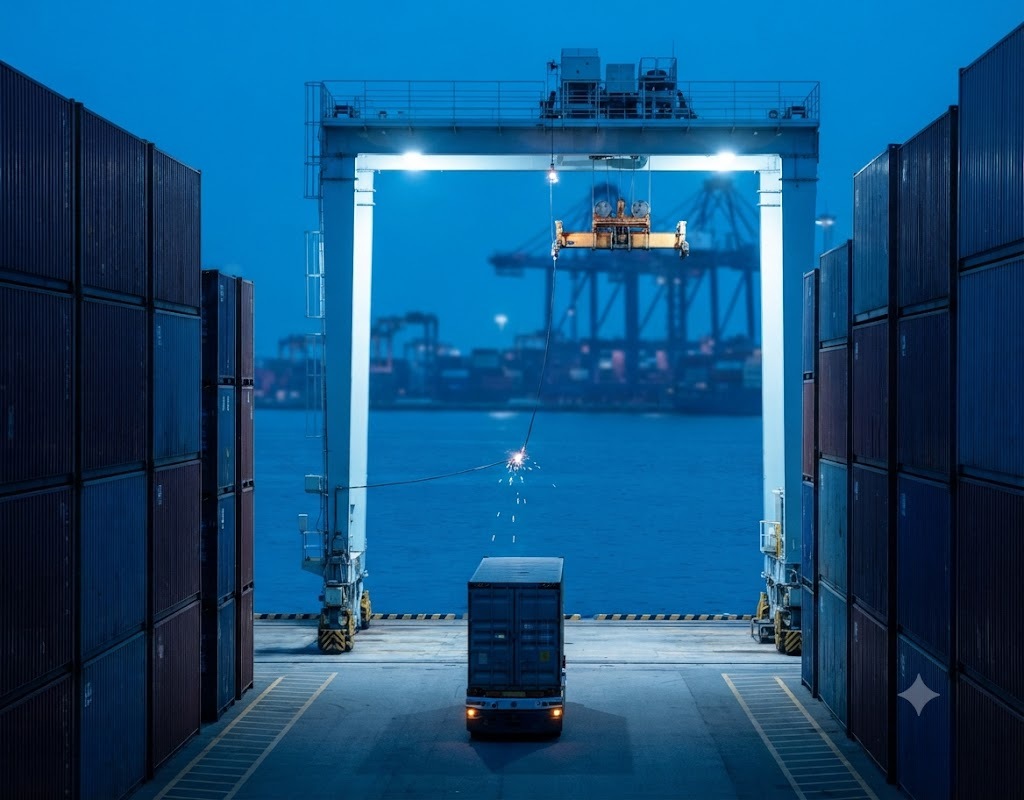
In 2024, Busan Port handled approximately 24.4 million TEU, a 5.4% increase from the previous year , recording an all-time high and maintaining its status as the world's seventh-largest container port. Looking ahead to 2025, while nationwide container throughput increased by 1.2%, Busan Port maintained its growth momentum driven by an increase in transshipment cargo. Busan is not a city lacking port capacity, but rather a city where global logistics flows are already concentrated. ( Busan Port Authority , Ministry of Oceans and Fisheries )
The structure of cargo volume is becoming clearer. In the second quarter of 2025, Busan Port's import and export cargo decreased by 0.4% compared to the same period of the previous year, while transshipment cargo increased by 5.9%; similarly, in the third quarter, import and export cargo decreased by 0.1%, whereas transshipment cargo increased by 1.6%. Port growth has shifted to a structure that relies more heavily on the transshipment function of global shipping companies passing through Busan Port, rather than on production and exports in the Busan region. ( Ministry of Oceans and Fisheries, Q2 2025 Port Cargo Volume , Q3 2025 Port Cargo Volume )
Phase 2-5 of the West Container Terminal at Busan New Port is operating as Korea's first fully automated terminal, applying automation to the entire quay, transfer, and yard areas. Busan City completed the Information Strategy Plan for the Busan Port Digital Twin Integrated Platform in 2025 and included the AI Port Testbed and Smart Logistics AX in its 2026 Work Plan. Ports have entered a stage where port operational data is combined with AI prediction, moving beyond the automation of cargo handling facilities. ( Ministry of Oceans and Fisheries , Busan Metropolitan City 2026 Major Work Plan )
However, there is no public evidence linking cargo volume, automation rates, and investment in port facilities with the AI adoption rates, data revenue, labor productivity, high-wage jobs, and local procurement amounts of logistics companies based in Busan. While port operators are digitizing, it is not determined whether local forwarders, carriers, warehouse operators, and ship supply companies have been incorporated into the same data economy.
If dominance in port operational data and platforms becomes entrenched in shipping companies, large terminal operators, and global software firms while the expansion of Jinhae New Port and fully automated piers proceeds from 2026 to 2029, Busan will fail to possess the high added value of logistics AI despite having a world-class port. Busan's current Golden Time is not a time to expand the scale of the port, but rather the final connecting segment where port data and logistics transactions can be transformed into AX performance for local companies.
Busan Port handled approximately 24.4 million TEU in 2024, with more than half of the total containers being transshipment cargo. As it simultaneously operates as a gateway for domestic import and export cargo and a transshipment hub for Northeast Asian shipping routes, Busan Port maintained its status as Korea's largest container port and a top-two transshipment port in the world. ( Busan Port Authority Port Statistics )
However, transshipment containers are not cargo produced in Busan or owned by Busan companies. Unless the loading, unloading, storage, and reshipment processes are short and integrated with the processing, distribution, transaction finance, and information services of local enterprises, the extent to which an increase in cargo volume translates into an increase in local added value is limited. A Port Throughput–Local Value GAP exists between global logistics flows and the Busan regional economy.
In the second quarter of 2026, Busan Port handled 6.46 million TEU, a 0.5% increase from the same period of the previous year; however, import and export cargo decreased by 3.0%, while transshipment cargo increased by 3.2%. As the structure dependent on transshipment continues to strengthen, changes in the port call strategies of global shipping companies will simultaneously affect cargo volume and port revenue. ( Ministry of Oceans and Fisheries, Q2 2026 Port Cargo Volume )
Busan's current structure is closer to a city through which global logistics pass on a large scale, rather than a city that controls global logistics.
A fully automated terminal is in operation at Busan New Port, where unmanned transport equipment, automated yard cranes, and terminal operating systems connect the entire cargo handling process. Approximately 340 billion won worth of domestically produced cargo handling equipment has been deployed at the automated docks, and the Ministry of Oceans and Fisheries has estimated the production inducement effect at 641.7 billion won. The physical foundation of port automation has entered the actual operation phase.
However, a fully automated terminal is a single dock operating system. An AI logistics city is a city-wide data economy that connects everything from ship arrival forecasting, terminal allocation, customs clearance, transportation, warehousing, shipper orders, and inventory to finance, insurance, and carbon information. There is no confirmed evidence that all these transactions in Busan are connected through a common data structure.
Even if productivity within the port increases, overall logistics time will not be shortened if dispatching, customs clearance, warehousing, and freight brokerage outside the port remain in telephones, documents, and individual systems. If the digital gap between terminal automation and hinterland logistics widens over the next two to three years, a dual structure will become entrenched where ports become smart while cities maintain traditional logistics methods.
Busan has started to possess smart terminals, but city-level connectivity evidence to determine it as an AI logistics city has not been secured.
In 2026, while the growth rate of import and export cargo at Busan Port slowed, transshipment cargo increased, and the Red Sea rerouting, U.S. tariff policies, and global vessel reallocation altered quarterly cargo volumes. Port competition became more sensitive to the real-time route selection and network reorganization of global shipping companies than to fixed hinterland manufacturing volumes.
The units of competition have also shifted from dock area and the number of cranes to vessel waiting times, transshipment connection times, arrival prediction accuracy, container yard turnover, land transport integration, and carbon emission data. It is a structure where AI goes beyond cargo volume forecasting and equipment dispatch to become involved in shipping companies' port selection and shippers' supply chain redesign.
While individual operational data for Busan Port is being accumulated, data standards between terminals, real-time connectivity rates among shipping companies, carriers, warehouses, and customs, and the operational reflection rate of AI predictions are not verified through public performance indicators. Between 2027 and 2029, if competing ports in Northeast Asia provide shipping companies with integrated logistics forecasting and supply chain visibility, the cost of defending port of call based solely on existing cargo volume dominance will increase.
The competitive risk for Busan Port lies not in a shortage of port facilities, but in the fact that data connection speeds are slower than the network switching speeds of global shipping companies.
In the second quarter of 2025, transshipment cargo at Busan Port reached 3.61 million TEU, significantly exceeding import and export cargo of 2.81 million TEU, and the gap between transshipment (3.4 million TEU) and import/export (2.688 million TEU) was maintained in the third quarter as well. The growth of Busan Port was driven more by cargo moved between overseas routes than by cargo produced in Busan.
Transshipment cargo moves according to the route planning and alliance reorganization of major shipping companies. Cargo volume not directly linked to Busan's manufacturing and consumer markets is highly likely to be transferred to other ports when freight rates, routes, and service conditions improve. This creates a structure where port competitiveness depends more on the choices of global shipping companies than on the cargo generation capacity of local industries.
While the proportion of transshipment and route concentration by shipping company are managed, the ripple effects of a specific shipping company's departure on terminals, port revenue, and supplier employment are not disclosed in an integrated manner. If the restructuring of shipping alliances coincides with an oversupply of new vessels over the next two to three years, shipping companies will readjust their ports of call and voyages, and Busan Port's transshipment dominance will face simultaneous pressure on prices and productivity.
Busan Port's global standing is not a fixed asset, but a conditional advantage maintained by the repeated choice of global shipping companies.
The fully automated West Container Terminal operates unmanned transport equipment and automated cargo handling equipment, and the Busan Port Authority has presented a smart port based on AI, IoT, and big data as a key mission. The application of automation has been expanded to include core cargo handling processes within the port.
In contrast, Busan's shipping and port logistics ecosystem is a mix of companies varying in scale and level of informatization, including international freight forwarding, land transportation, warehousing, inspection and measurement, ship supplies, repair, and customs clearance. There is no publicly available data available that measures these companies' AI adoption rates, API connectivity rates between systems, dedicated data personnel, and automation investment amounts using the same standard.
While port authorities and large terminals secure facilities and data, if small and medium-sized logistics companies remain stuck in manual dispatching and simple brokerage, the benefits of automation will be concentrated in port operators. If AI dispatching, predictive maintenance, and automated customs clearance become entrenched as basic conditions for transactions between 2026 and 2029, companies without digital connectivity will be fixed as subordinate performers of prime contractor platforms, even if they hold cargo volume.
Port automation in Busan has been confirmed, but the spread of AX among local logistics companies has not been confirmed.
Busan Port generates vast operational data related to vessel arrivals and departures, container handling, yard locations, terminal operations, transport vehicles, and customs clearance. In May 2025, Busan City completed its Information Strategy Plan for the establishment of the Busan Port Digital Twin Integrated Platform and subsequently moved to the consultation stage with the Ministry of Oceans and Fisheries. ( Busan Metropolitan Council 2025 Second Half Work Plan )
However, the volume of data generated is not the same as data control. If systems for shipping companies, terminals, port authorities, customs, and carriers are separated, local startups and logistics companies are unable to secure data for the entire supply chain and develop services only for limited segments.
No open operational structure has been identified that specifies data access rights, combination standards, rights to training data, operational responsibilities for AI models, and compensation for data provision by company. If global shipping companies and large platforms advance their logistics AI models based on their own data within two to three years, data generated in Busan will be converted into competitive assets for offshore platforms.
While Busan's logistics data is abundant, the judgment that it is being accumulated as a regionally controlled AI asset cannot be established.
Busan Port handles over 24 million TEU of containers and possesses the New Port hinterland and the International Industrial Logistics City. Busan City has designated the Tri-Port, connecting the port, airport, and railway, as the spatial axis of its global logistics hub strategy. Physical logistics assets are more concentrated than in any other city in Korea.
However, performance accounts showing revenue in the Busan region, local procurement, processing, assembly, packaging, re-export, logistics finance, insurance, and software revenue per 1 TEU of cargo volume are not identified. While the increase in throughput is measured, the value added left by containers in Busan is not measured with the same precision.
Even if the supply of Jinhae New Port and its hinterland increases between 2026 and 2029, if tenant companies focus on simple storage and transportation, land and facilities will expand, but the density of added value will stagnate. When the growth rate of throughput slows, rising rent, labor costs, and automation investment costs will be the first to pressure the profitability of local companies.
While the competitiveness of Busan Port's cargo volume has been established, the assessment data regarding its ability to convert that volume into regional added value is incomplete.
Busan City has completed the informatization strategic plan for the Busan Port Digital Twin Integrated Platform and included the AI Port Testbed, Smart Logistics AX, and Arctic Route Hub Port in its 2026 work plan. The Busan Port Authority is operating fully automated piers and promoting port digitalization and the expansion of overseas logistics hubs.
However, an operational system linking the Busan Metropolitan City, Busan Port Authority, Ministry of Oceans and Fisheries, Customs, terminal operators, shipping companies, and local logistics firms with identical performance indicators is not found in the publicly available data. While plans exist for each agency, a common baseline to assess the readiness level of the entire AI logistics city has not been established.
If facilities and platforms are established by each institution over the next two to three years, post-establishment linkage costs between systems will increase, and data specifications established earlier will become entrenched as de facto standards. Busan's level of preparedness is individual
The government's smart port project is determined to be in the implementation phase, while the city-level logistics AX is determined to be in the design phase.
Busan has a concentration of international freight forwarding, transportation, warehousing, and port cargo handling businesses, as well as related service companies, and the city has been promoting AI-specialized education for shipping and port logistics, as well as digital transformation projects. It is not a situation where both port and corporate infrastructure are absent.
However, the publicly available data does not confirm the ratio of training completions and supported companies to AI dispatch accuracy, vehicle empty mileage, warehouse turnover, working hours, sales, and new contracts. An outcome gap remains between participation in the support program and the transition of corporate operating systems to AX.
If AI is applied to only a small number of pilot companies for 2 to 3 years, the data gap between large companies and small and medium-sized forwarders will translate into a gap in transaction terms. While the spread of Busan Logistics AX exists in terms of business participation, there is no evidence that it has spread as a universal operating method of the local industry.
Busan has established the "Tri-Port," connecting Busan Port, Gadeokdo New Airport, and railway and road hinterland networks, as its global logistics hub strategy. Busan New Port and the International Industrial Logistics City provide port hinterland space, while Gadeokdo New Airport includes the potential for air cargo connectivity.
However, the current baseline showing the time for port-arriving cargo to be transferred to air and rail, multimodal transport volume, integrated booking ratio, transshipment costs, and customs clearance integration time has not been confirmed. The spatial proximity of the three facilities and a single logistics network are not identical.
If corporate locations and data systems are determined separately while the construction schedules of Gadeokdo New Airport and Jinhae New Port are subject to change, Tri-Port will remain as a parallel structure of three facilities even in 2028–2029. Busan’s Tri-Port exists in policy names and spatial plans, but it does not exist as a real-time complex logistics operating system.
12-1. Gangseo-gu and Busan New Port — Separation of Automated Ports and Hinterland Cities
Busan New Port has become the center of Busan's total container throughput, and full automation is in operation at the West Container Terminal. Gangseo-gu is home to a concentration of port, manufacturing, and logistics infrastructure, including the New Port hinterland, the International Industrial Logistics City, and the Noksan National Industrial Complex.
However, there is no evidence linking the level of automation in port equipment with the level of AI utilization by companies in the hinterland. Commuting traffic, truck waiting, workforce securing, data connectivity, and high-value-added activities in the hinterland are managed as separate items from dock automation.
Even if dock automation progresses within two to three years, internal port working hours will decrease, but bottlenecks in external roads, warehouses, and dispatch sections will remain. Although Gangseo-gu possesses the nation's best automated port, its performance outside the port is insufficient to classify it as an automated logistics city.
12-2. Dong-gu, Jung-gu, and Nam-gu — Functional Transformation of the North Port and Disruption of the Existing Logistics Ecosystem
Container functions at the North Port have relocated to the New Port, and the North Port area is being reorganized around redevelopment, cruises, marine tourism, and business functions. As the spatial center of port functions shifts from the original city center to the Gangseo district, the location conditions for existing commercial areas behind the port and logistics operators have also changed.
However, data linking the impact of the relocation of logistics functions from the North Port on the revenue and employment of existing transportation, warehousing, ship supplies, and repair companies with the relocation rate to the New Port and the industry conversion rate is limited. A determination gap remains between the land value of port redevelopment and the transformative potential of the existing industrial ecosystem.
If redevelopment and the relocation to the new port proceed in parallel over the next two to three years, small businesses that are unable to relocate will lose both their existing cargo volume and locations, while logistics knowledge and expertise will disappear from the original city center. Although the spatial transformation of the North Port is underway, the relocation of the existing shipping and port industry to AX has not been confirmed.
Fully automated docks have introduced unmanned transport equipment and automated cranes, and Busan City has been operating specialized AI training for shipping and port logistics. The job structure of ports has begun to shift from direct equipment operation to remote operation, data analysis, and system maintenance.
However, data linking the reduction in the number of existing port workers by job function, retraining participation rates, reassignment rates, and wage changes with the hiring scale for new AI logistics roles has not been confirmed. Jobs disappearing due to automation and those newly emerging are placed within different statistical systems.
With the expansion of automated terminals between 2026 and 2029, there will be periods where job reduction occurs faster than transition training, and new high-level positions may be filled by personnel from outside the region and system suppliers. Busan's workforce preparation is currently in the stage of establishing training courses, and the transition outcomes for the entire port workforce remain unconfirmed.
The Busan Port Digital Twin passed the stage of establishing the Information Strategy Plan in 2025, and the AI Port Testbed was incorporated as a policy agenda in 2026. Construction of Jinhae New Port is proceeding in phases based on the premise of becoming a fully automated port. The next two to three years will be a period in which facilities, data, and operational standards are determined simultaneously.
However, criteria for determining local business data access rights, system interoperability, ownership of logistics AI models, and post-automation local employment have not yet been disclosed. There is a gap between the hardware construction schedule and the speed of establishing city-level data rules.
Once the terminal operating system and shipping company platform finalize the standards, access by local companies will be restricted to the use of dependent APIs. Any modifications made after the Jinhae New Port operational structure is finalized will require simultaneous changes to equipment, software, contracts, and security systems.
Busan's irreversibility lies not in losing the opportunity to build a new port, but in local companies being relegated to the periphery within the new port's data economy.
AX Response System | Connection Evidence | Operating range | 2026–2029 Assessment Indicators |
| Port–City Logistics Data Graph | Ship, Terminal, Customs Clearance, Transportation, Warehouse, and Shipper Data | Tracking the disconnect between port interiors and urban logistics | Ratio of data-connected organizations and companies |
| Cargo Volume-Regional Value Digital Twin | TEU · Local Procurement · Processing · Employment · Tax Revenue · Data Revenue | Separation of through cargo volume and regional residual value | Regional value added per TEU |
| Early warning of transshipment risk | Shipping Line · Route · Alliance · Freight · Port Call Frequency | Advance detection of shipping line deviation and route change | Concentration of top shipping companies and routes |
| AX Runtime, a small and medium-sized logistics company | Dispatch · Empty Vehicle Rate · Warehouse Turnover · Customs Clearance Time · Sales | Tracking company performance after the support program | Productivity, Sales, and Contract Conversion Rate |
| Logistics Data Rights Ledger | Data generation, provision, access, learning, and revenue sharing | Tracking rights and usage of port data | Local business data access rate |
| Triport Operation Twin | Ports, airports, railways, roads, and hinterland complexes | Determination of actual inter-facility multimodal transport | Multimodal transport volume, transshipment time, and costs |
| Port Job Transition Monitor | Job · Age · Wage · Education · Reassignment · Recruitment | Tracking the employment transfer of automation | Transfer rate · Local hiring rate |
| Golden Time Dashboard | Cargo volume, productivity, regional value, business expansion, employment | Quarterly City Logistics AX Grade Assessment | Preparedness, Spread, Alert, and Irreversible Levels |
AX Response Assessment: The success or failure of Busan’s logistics AX depends more on the city operating system that determines in real-time whether data and transactions generated at the port contribute to the revenue, technology, and jobs of local companies, rather than on the addition of automated equipment.
Current Assessment: Possession of global ports · Entry into automated operations · Urban logistics AX not formed
2-Year Assessment: The period where the data gap between internal port automation and local logistics companies widens
3-Year Ruling: A period where the data dependency of local companies could be confirmed due to the entrenchment of Jinhae New Port's operating standards and global shipping company platforms.
Diffusion Assessment: Digitalization of the Port Authority and terminals has been confirmed, but diffusion to small and medium-sized logistics companies, hinterland complexes, and the original city center remains unconfirmed.
Determination of Irreversibility: The stage where upstream costs of local companies in the value chain surge after the port operating system and data rights structure are finalized.
Overall Assessment: Busan is a world-class port city, but it is not yet an AI logistics city.
- Busan Port total, import/export, and transshipment container cargo volume
- Transshipment concentration by shipping line, shipping alliance, and route
- Ship arrival delays and average berthing and waiting times
- Hourly handling volume and container yard turnover by terminal
- Automation equipment utilization rate, failure rate, and localization rate
- Number of agencies connected to real-time data in the port digital twin
- API connection rate between terminals, customs, transportation, and warehouses
- Adoption rates of AI, TMS, and WMS in logistics companies in Busan
- Changes in dispatch time, empty vehicle rate, warehouse turnover, and customs clearance time
- Sales, employment, and follow-up contracts of Logistics AX participating companies
- Local procurement and local value added per TEU
- Processing, assembly, and re-export ratios of companies in the hinterland industrial complex
- Logistics software, data, finance, and insurance sales
- Port data access companies and dependence on offshore platforms
- Changes in job roles, personnel, wages, and industrial accidents before and after automation
- Retraining, reassignment, and tenure rate of existing port personnel
- Regional employment rate of logistics and AI majors at universities in the Busan region
- Port, Airport, and Railroad Multimodal Transport Cargo Volume and Connection Time
- Relocation, conversion, and closure rates of existing logistics companies in the North Port
- Date of Finalization of Process, Operating Entity, and Data Standards by Jinhae New Port Project
A container is recorded as cargo volume the moment it passes through Busan Port. However, when ship arrival times, cargo routes, storage durations, customs clearance speeds, transportation demand, warehouse turnover, and final destinations are interconnected, the same container transforms into a data asset that generates forecasts and transactions. While Busan is world-class in the scale of the former, it has failed to demonstrate a global status in the ownership and utilization of the latter.
While port facilities are fixed in Busan, the economic value of logistics data is not. When shipping companies and global platforms combine data to determine routes, freight rates, inventory, and transportation, information generated in Busan does not remain as an asset of the city. This creates a structure where the port's locational advantage and the data's ownership advantage are separated.
If this separation becomes entrenched, Busan can handle more containers while shifting higher added value to external sources. Local companies perform cargo handling, transportation, and storage, while global platforms secure recurring revenue from forecasting, brokerage, optimization, and finance. The correlation between increased cargo volume and regional economic growth also continues to weaken.
Whether Busan becomes an AI logistics city is determined not by the number of AI devices installed in the port, but by whose models and revenue the data passing through Busan Port accumulates into.
Judgment point | Confirmed Evidence | Risk level | verdict |
| 2024 | Busan Port, approximately 24.4 million TEU, ranks 7th in the world, operates fully automated terminals. | caution | Securing port scale and automation infrastructure |
| 2025 | Export/Import Stagnation and Increased Transshipment; Digital Twin ISP Completed | Entry into the boundary | Increased reliance on transshipment, incomplete urban data connectivity |
| 2026 | Inclusion of AI Port Testbed and Smart Logistics AX leads to decrease in exports/imports and an increase in transshipment | boundary | Policy shift confirmed, expansion into local businesses unconfirmed |
| 2027~2028 | Jinhae New Port, Automation, and Digital Operation Standards Confirmed Section | Boundary~Critical | Potential Entrenchment of Data Rights and Platform Dominance |
| 2029 | A section that reveals the port, airport, and railway operating systems and the status of local companies | Critically possible | Quarterly confirmation of transit ports and AI logistics cities |
