

Judgment axis | detail |
| Item Identity | Crown daisy is an aromatic leafy vegetable identified as Chrysanthemum coronarium var. spatiosum, Crown daisy on the Rural Development Administration's Nongsaroo website. ( Nongsaroo ) |
| Key role | Young leaves, tender stems, and shoots are used for raw consumption, wraps, seasoned vegetable dishes, stews, soups, hot pots, dining out, and school meals; for this item, the aroma itself is a crucial factor in purchasing quality. The Rural Development Administration also introduces its uses in wraps, raw consumption, blanching, and soups. ( Nongsaroo ) |
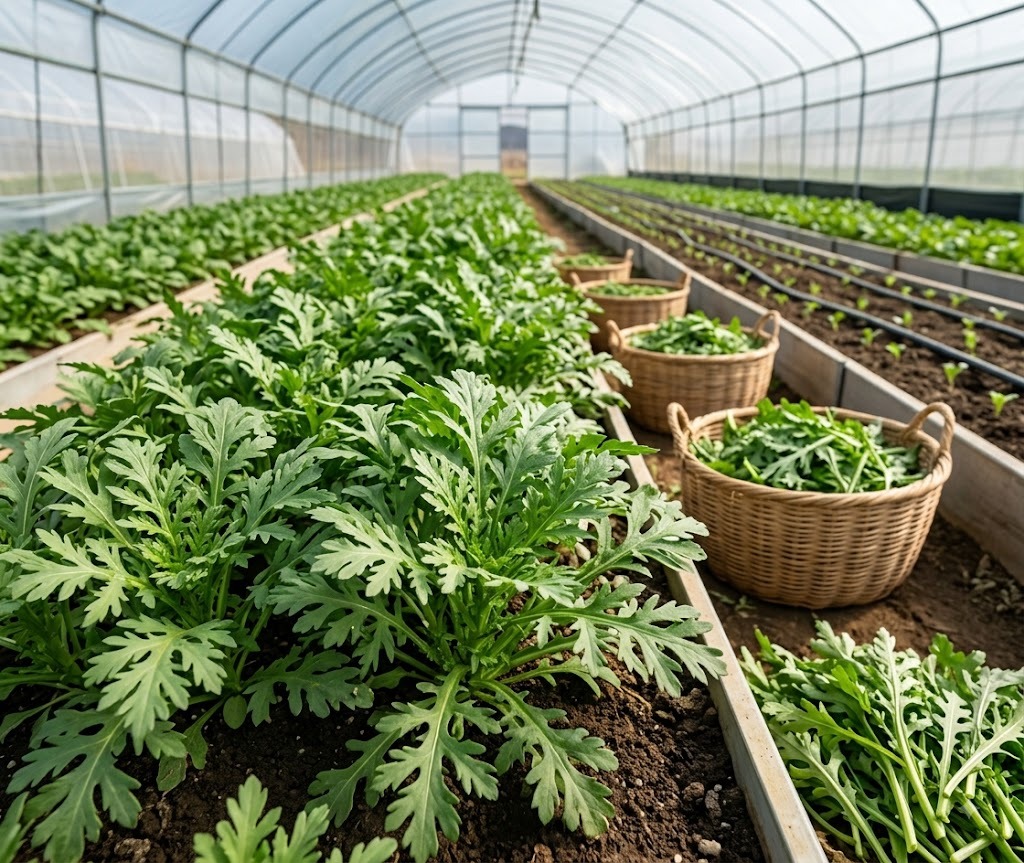
| Growth characteristics | According to Nongsaroo standards, the growing temperature range is 5–30℃, with an optimal temperature of 15–20℃; it prefers a cool climate but is relatively resistant to high temperatures. ( Nongsaroo ) |
| Harvesting principle | Check leaf size, branching, tender stem length, color, aroma, texture, bolting, yellowing, wilting, and pests and diseases, and connect the harvesting method, harvest cycle, and Lot. |
| Product separation | Separate large leaves, medium leaves, small leaves, young leaves, young shoots, whole harvest, cut harvest, bundles, washed products, cut products, products for soup and hot pot, and Fresh-cut Products. |
| Separation of similar items | Lettuce is primarily used for wraps, while crown daisies play a strong role as an aromatic herb, in soups, and in hot pots. Mugwort is a different plant entity of the Asteraceae family and is managed separately from crown daisies. |
| Varieties/Forms | Public agri-food data introduces a method of classifying varieties into large-leaf, medium-leaf, and small-leaf based on leaf size and the degree of splitting. ( Foodnuri ) |
| Quality judgment | Fresh leaf color, gloss, leaf damage, stem thickness, and elasticity are presented as product evaluation factors. ( Food Nuri ) |
| Domestic statistics | Finalized standalone national statistical values for the nationwide cultivation area and production volume of crown daisies for 2025 or the latest years could not be obtained in this verification. They will be entered later after verification using national statistics, KOSIS, agricultural business entities, and wholesale distribution data. |
| Safety Management | The Food Safety Korea pesticide residue system classifies crown daisies as leafy vegetables and provides individual MRLs for each pesticide. ( Food Safety Korea ) |
| Operating Principles | Connects data on variety group, cultivation type, harvesting method, number of harvests, leaf and stem specifications, aroma, lot, pesticides, washing, cutting, and cold chain distribution. |
| Final goal | It connects the RFQs of farms, producer organizations, origin-based distribution, washing/pre-processing, soups/hot pots/dining, food service, distribution, and PB buyers with delivery, inspection, claims, and repurchase. |
division | Registration details |
| Korean name | crown daisy |
| English name | Crown Daisy |
| Representative scientific name | Chrysanthemum coronarium var. spatiosum — As indicated by Nongsaroo, Rural Development Administration. The international taxonomy standard name is additionally verified using a separate Source Version. ( Nongsaroo ) |
| Plant classification | Leafy vegetables of the Asteraceae family |
| Edible parts | Young leaves, tender stems, young shoots, parts adjacent to the growing point |
| Non-edible · Separate management | Roots, seeds, senescent stems, hardened stems/flower stalks after bolting, diseased/rotted parts |
| Major harvesting stages | Young leaves → Young shoots → Marketable leaves/tender stems → Mature plant → Bolting → Flowering/seed stage |
| Basic product form | Whole head crown daisy, cut harvest crown daisy, young leaves, young shoots, bundled, washed, cut, for soups and hot pots, Fresh-cut |
| Basic processing stage | Sowing → Germination → Thinning → Growth → Whole plant harvesting or cutting/sequential harvesting → Sorting → Cooling → Washing → Dehydration → Cutting → Subdivision/Packaging |
| Basic use | Ssam, raw food, seasoned greens, stew, soup, hot pot, broth, shabu-shabu, eating out, school/public meals, meal kit, HMR |
| Hyangmi's role | The unique aroma of crown daisies is introduced in public agricultural resources as a characteristic utilized for flavor control in soups, stews, and meat dishes. ( Nongsaroo ) |
| Similarity Principle | Even if there is some overlap in aroma and cooking use with lettuce, mugwort, Korean aster, water celery, parsley, etc., it is managed as a separate Plant Entity. |
Product Master
Product Master | Key Management Standards |
| Large-leaved crown daisy | Leaf size, splitting, stem, harvest date, use |
| Mid-leaf crown daisy | Leaf size, shape, scent, and uniformity |
| Perilla frutescens | Leaf size, branching, scent, young leaves, suitability for outdoor planting |
| Common garland chrysanthemum | Plant weight, number of leaves, stem length, freshness |
| Cut harvest crown daisy | Cutting height, harvest cycle, and regeneration status |
| Young shoots of crown daisy | Harvest stage · Leaf size · Stem age · Aroma |
| Young crown daisy leaves | Harvest age, leaf size, hygiene |
| Crown of daisies for wraps | Leaf size, age, scent, appearance |
| For soups and hot pots | Stem length, leaf quantity, aroma, cooking suitability |
| For shabu-shabu | Uniform length, tender stems, packaging |
| Washed crown daisy | Raw Material Lot · Washing Water · Dehydration · Microorganisms |
| Cut crown daisy | Cutting length, leaf, stem ratio, washing |
| Fresh-cut | Raw Material Lot · Washing · Cutting · Refrigeration · Use-by Date |
| For school meals | Safety, Standards, Finishing Rate, Delivery Time |
| For dining out | Scent · Stem Year · Delivery Cycle · Specifications |
| For meal kits | Washing, cutting, portioning, refrigeration |
| For HMR | Cooking, Cutting, and Heating Suitability |
| PB small packaging | Origin, Weight, Harvest Date, Brand |
| Selected items | Yellowing, wilting, bolting, aging, wounds, potential for resource utilization |
Classification criteria | Subdivision type | Management principles |
| Variety/Leaf type | Large leaf / Medium leaf / Small leaf | Separation by leaf size, splitting, scent, and uses |
| Harvesting stage | Young leaves / Young shoots / Marketable leaves/stems / Mature / Before bolting | Separation of product specifications |
| Harvesting method | Head harvest / Cutting harvest / Sequential harvest | Harvest Type required value |
| Cultivation method | Spring / Summer / Autumn / Winter · Facilities | Verification of actual calendars by region |
| Cultivation type | Open field / Facility / Other | Separation of environment, production costs, and quality |
| Product type | Bundle / Bundle / Bulk / Small Packaging | Separation of specifications by buyer |
| Distribution methods | Raw Material / Sorting / Cooling / Washing / Pre-processing | Step-by-step Lot inheritance |
| Processing form | Washing / Cutting / Portioning / Pre-cooking | Process Lot Separation |
| Final use | Ssam / Soups & Hot Pots / Eating Out / School Meals / Shabu-shabu / Meal Kits / HMR | Separation of Buyer Specification |
| Transaction type | Source Procurement / Regular Supply / Contract Farming / Pre-processing / PB | Quantity, unit price, and contract are Verified/NDA |
| Sense of quality | Aroma / Color / Year / Texture | Managed separately as a Buyer evaluation dataset |
The Rural Development Administration advises that the growing temperature range for crown daisies is 5–30°C, with the optimal temperature being 15–20°C. They explain that while it prefers a cool climate, it tolerates high temperatures relatively well, and in warmer regions, it can even overwinter outdoors. ( Nongsaroo )
step | Essential Dataset | Management purpose |
| Cultivation plan | Region, variety group, cultivation type, area, contract status | Supply plan |
| satellite | Variety · Seed Company · Seed Lot | Variety Traceability |
| sowing | Sowing date, sowing quantity, cultivation site | Production history |
| germination | Germination date, germination rate, temperature | Initial growth management |
| Thinning | Date, spacing, growth condition | uniformity |
| soil | pH · Organic matter · Drainage · Moisture | production environment |
| Watering | Water source, date, and amount of water | Maintaining soft tissue |
| dispute | Fertilizer, Input Date, Input Amount | Growth, Aroma, and Yield Management |
| rising | Temperature, rainfall, humidity, and day length | Growth and bolting prediction |
| Facility Environment | Temperature, humidity, and ventilation | Year-round production |
| Growth | Number of leaves, leaf size, plant height, stem thickness | Harvest forecasting |
| Fragrance characteristics | Variety, Harvest Stage, Field Evaluation | Buyer suitability |
| bolting | Date of emergence, plant height, flower stalk | Productability Management |
| pests | Occurrence, Damage, and Control | Quality and quantity |
| pesticide | Medication, Date of Use, Safe Use Period | Pesticide residue verification |
| Harvest judgment | Leaf size, stem age, color, scent, bolting | Shipment suitability |
| Harvest of heads | Harvest date, weight, number of leaves | Raw Lot |
| Cut harvest | Cutting position, date, weight | Sequential production |
| Regeneration Management | New shoots, growth, and expected harvest | Next harvest plan |
| Sequential harvesting | Harvest cycle, quantity, and quality | Runtime supply |
| Selection | Leaves, stems, yellowing, wounds, foreign matter | Buyer specifications |
| cooling | Temperature and time | wilting inhibition |
| purifying | Washing water, method, and time | hygiene |
| dehydration | Method and time | Fresh-cut quality |
| cutting | Length-leaf-stem ratio | School meals · Meal kits |
| packaging | Weight, packaging material, and packaging date | Traceability |
| save | Temperature, humidity, and period | Preserving flavor and freshness |
| delivery | Refrigeration conditions and time | Cold-chain |
| Incoming inspection | Color, scent, wilting, size, foreign matter | Buyer rating |
| Claim | Yellowing, wilting, aging, odor, foreign matter | Supplier Score |
| Repurchase | Buyer · Product · Quantity · Cycle | Next production plan |
The official pesticide residue classification of Korea Food Safety Agency classifies crown daisies as Vegetables – Leafy Vegetables . Since MRLs are provided for each individual pesticide, the permissible limit for the actual Lot is directly linked to the latest pesticide-specific standards at the time of inspection. ( Korea Food Safety Agency )
Quality items | Fresh crown daisy | Washing and cutting | For soups and school meals | Fresh-cut | Public rating |
| Origin·Variety·Farm·Lot | core | core | core | core | Verified |
| Cultivation type and harvest date | core | core | importance | core | Verified |
| Harvesting method/order | core | importance | importance | importance | Verified/NDA |
| Leaf size | core | core | importance | core | Verified/NDA |
| Leaf splitting | importance | importance | importance | importance | Verified/NDA |
| Leaf color and gloss | core | core | core | core | Verified/NDA |
| Stem length | core | core | core | core | Verified/NDA |
| Stem thickness | core | core | importance | core | Verified/NDA |
| Stem year | core | core | core | core | Verified/NDA |
| incense | core | core | core | core | Verified/NDA |
| bolting | core | importance | importance | importance | Verified/NDA |
| Yellowing and wilting | core | core | core | core | Verified/NDA |
| Leaf and stem wounds | core | core | core | core | Verified/NDA |
| pests | core | core | core | core | Verified/NDA |
| Soil and foreign matter | core | core | core | core | Verified/NDA |
| Pesticide usage records | core | core | core | core | NDA |
| Pesticide Residue Test Report | core | core | core | core | NDA |
| Cleaning history | By product | core | By product | core | NDA |
| microorganism | importance | core | core | core | NDA |
| Cutting specifications | Not applicable | core | By product | core | Verified/NDA |
| Packaging weight | core | core | core | core | Verified/NDA |
| refrigeration conditions | importance | core | core | core | Verified/NDA |
| Expiration date | By Product | core | By product | core | Verified/NDA |
| Incoming inspection | importance | core | core | core | NDA |
| Returns and Claims | importance | core | core | core | NDA |
| Repurchase | importance | core | core | core | NDA |
Public agri-food information provides criteria for selecting products when purchasing that have fresh, deep-colored, and glossy leaves, stems that are not excessively thick, and minimal leaf damage. These elements are converted into the Appearance Quality Field in MarketHub for use. ( Foodnuri )
Lot Master Required Field
Lot ID · Item · Product Type · Scientific Name · Variety Group · Leaf Shape · Cultivation Method · Crop Type · Origin · Cultivation Area · Producer · Sowing Date · Harvesting Method · Harvest Cycle · Harvest Date · Leaf Size · Splitting · Color · Gloss · Stem Length · Thickness · Year · Aroma Evaluation · Bolting Status · Yellowing · Wilting · Damage · Pests · Foreign Matter · Weight · Specifications · Grade · Pesticide Use History · Pesticide Residue · Microbial Test Report · Raw Material Lot · Washing · Dehydration · Cutting History · Packaging Date · Use-by Date · Storage Conditions · Shipper · Refrigerated Delivery · Incoming Inspection · Returns · Claims · Repurchase
Customers | Purchase criteria | Cooperation opportunities |
| Farm and Producer Organizations | Variety group · Cultivation type · Specifications · Expected harvest | Joint shipment and contract farming |
| Nonghyup · Production Area Distribution | Leaves, stems, bundles, weight, quantity | Joint Selection RFQ |
| wholesale market | Freshness, color, weight, packaging | Shipment from the production area |
| traditional market | Scent, Freshness, Bundle, Price | local distribution |
| local food | Producer, region, harvest date | Direct transaction |
| Large-scale distribution | Appearance, weight, small packaging, supply stability | PB · Regular supply |
| food ingredient company | Specifications, Finishing Rate, Safety, Delivery Time | Dining Out & School Meals |
| Korean restaurant | Suitability for flavor, tender stems, soups, and stews | Foodservice RFQ |
| Hot pot specialty restaurant | Length, flavor, freshness, and regular supply | RFQ for hot pot |
| Shabu-shabu companies | Young shoots, length, uniformity, freshness | Shabu-shabu RFQ |
| Sashimi Restaurants · Seafood Dining | Uses for aromatic vegetables, soups, and spicy stews | Foodservice supply |
| School and public meals | Safety, Standards, Foreign Matter, Inspection | School Meal RFQ |
| Hospital and welfare meals | Hygiene, cleaning rate, and regular supply | Contract delivery |
| Meal kit | Washing, cutting, portioning, refrigeration | Hot pot and stew meal kits |
| HMR | Cutting, Cooking, Mixing | Ingredients for soups, stews, and hot pots |
| Salad · Fresh-cut | Young leaves, scent, microorganisms | Mix Product |
| Online distribution | Origin, Harvest Date, Small Packaging | Direct from the farm |
| PB business operator | Product form, packaging, and regionality | Chrysanthemum greens PB |
| Seed company | Large, medium, small leaves, bolting, quantity | Variety Verification |
| Research Institute | Variety, Aroma, Bolting, Storage, Harvest Period | joint research |
| local government | Facility-grown leafy vegetables, school meals, local food, and dining out linkages | Local Chrysanthemum Greens AX Business |
step | Key variables | Operational judgment |
| satellite | Large, Medium, Small Leaf, Variety, Lot | Product conformity |
| sowing | Crop type, region, and sowing date | Scheduled for supply |
| production | Weather, Soil, Irrigation, Growth | Production risk |
| Growth | Leaves, stems, scent, bolting | Harvest season |
| Harvest of heads | Weight, number of leaves, length | Raw Lot |
| Cutting and sequential harvesting | Order, Weight, Recycling | Repeat supply |
| Selection | Color, aroma, stem, freshness | Buyer specifications |
| cooling | Time and temperature | wilting prevention |
| purifying | Water, microorganisms, and foreign matter | School Meals · Fresh-cut |
| cutting | Length-leaf-stem ratio | Soups and Meal Kits |
| packaging | Bundles · Bulk · Small packages | Distribution Channels |
| refrigerated distribution | Temperature and time | Quality responsibility |
| RFQ | Product · Specifications · Quantity · Delivery Date | AI Match |
| contract | Quantity, Unit Price, Inspection | Terms of trade |
| delivery | Lot · Quantity · Delivery | Implementation verification |
| Buyer rating | Aroma, Freshness, Preparation Rate, Cookability | Supplier Score |
| Repurchase | Reorders/Contract Extensions | Next planting and harvesting plan |
Products and processes | Key conditions | RFQ conversion |
| Common mustard greens | Leaves, stems, scent, weight | Retail & Food Service RFQ |
| Large-leaved crown daisy | Leaf size, scent, stem | Soup & Hot Pot RFQ |
| Medium-to-small leaf crown daisy | Leaf shape, fragrance, and saturation | Ssam·Dining Out RFQ |
| young shoots | Year, Leaf Size, Scent | Shabu-shabu · Premium Dining |
| young leaves | Harvesting stage · Microorganisms | Salad Mix |
| Bundle | Number, weight, and uniformity | Distribution RFQ |
| Washed crown daisy | Washing, dehydration, microorganisms | School meals · Meal kits |
| Cut crown daisy | Ratio of cutting length, leaves, and stem | Soups and Stews HMR |
| Soup/Hot Pot Pack | Chrysanthemum greens Lot · Other vegetable Lot · Mixture | Meal Kit RFQ |
| Shabu Shabu Pack | Length, young shoots, and small portions | Food Service · Private Brand |
| Fresh-cut Mix | Young leaves, mixed fertilizer, hygiene | Salad · PB |
| Candidates for blanching ingredients | Blanching time, color, aroma, and yield | Verification of Side Dishes and HMR |
| Dry product candidate | Drying conditions, fragrance, moisture | Verification of Seasonings and Food Ingredients |
| Powder candidate | Drying, Grinding, Flavor, Particle Size | Materialization demonstration |
| Selected items | Aging, wounds, fragrance, safety | Separate verification of processing conversion |
| Stems and cultivation residues | Amount/State | Review of composting and resource utilization |
PRP — Product Research Profile
PRP items | Details of investigation and verification |
| PRP-01 Taxonomy | Agricultural scientific names and the latest international taxonomy consistency |
| PRP-02 large leaf | Leaf size, stem, yield, and marketability |
| PRP-03 mid-layer | Leaf splitting, fragrance, and suitability for external use |
| PRP-04 small lobules | Young leaves, aroma, salad suitability |
| PRP-05 Spring Cultivation | Growth, Harvest, Scent |
| PRP-06 Summer Cultivation | High temperature adaptation, bolting, quality |
| PRP-07 Autumn Cultivation | Growth, Harvest, Market |
| PRP-08 Winter·Facility | Cold resistance, cold protection, and harvest |
| PRP-09 Harvesting Method | Comparison of Head Harvest and Cutting Harvest |
| PRP-10 Sequential Harvest | Quantity and quality by harvest cycle |
| PRP-11 scent | Aroma evaluation based on variety, harvest stage, and storage |
| PRP-12 Nomination | Temperature, day length, variety, and marketability |
| PRP-13 washing | Foreign matter, wash water, microorganisms |
| PRP-14 storage | Yellowing, wilting, and loss of fragrance |
| PRP-15 Soups & Hot Pots | Aroma, color, and texture after heating |
| PRP-16 Shabu-shabu | Stem year, length, and scent |
| PRP-17 meal | Trimming rate, foreign matter, cooking yield |
| PRP-18 Fresh-cut | Young leaves · Washing · Refrigeration · Microorganisms |
| PRP-19 Buyer | Specifications · Flavor · MOQ · Delivery Time |
| PRP-20 Reorder | Quality · Claims · Repurchase |
| PRP-21 by-product | Treatment of aged leaves, stems, and residues |
first of all | Execution item | Performance indicators |
| 1 | Make Variety Group, Crop Type, Harvesting Method, Harvest Cycle, and Lot mandatory values | Required value input rate |
| 2 | Large leaves – Medium leaves – Small leaves – Young shoots – Washing – Separation of product for soup | Misclassification reduction rate |
| 3 | Linking weather, growth, and bolting data | Accuracy of Nomination Prediction |
| 4 | Measuring leaf size, splitting, and plant height using video AI | Accuracy of specification judgment |
| 5 | Automatic determination of stem thickness and length | Buyer specification compliance rate |
| 6 | AI Detection of Yellowing, Wilting, and Wounds | Quality judgment accuracy |
| 7 | Digitization of Scent Sensory Score | Fragrance quality recording rate |
| 8 | Automatic recording of production volume by sequential harvesting cycle | Harvest data integrity |
| 9 | Prediction of expected harvest yield | Supply forecasting accuracy |
| 10 | Pesticide Use – Harvest – Report Linkage | Document linkage rate |
| 11 | Datafication of cleaning and microbiology | Hygiene history rate |
| 12 | Cold-chain temperature and time tracking | Refrigeration compliance rate |
| 13 | Farmhouse – Soup/Hot Pot – School Meal – Meal Kit Buyer AI Match | RFQ Match Rate |
| 14 | Buyer feedback on aroma, preparation rate, and cookability | Delivery conformity rate |
| 15 | Reflect repurchase in the next planting and harvesting cycle plan | Repurchase linkage rate |
Problem group | Problem Definition | Required data |
| Changes in scientific name notation | Agricultural data and the latest international taxonomy may differ in notation. | Taxonomy · Source · Version |
| Leaf-shaped mixed | Treat large, medium, and small leaves as the same product | Variety · Leaf Shape · Buyer |
| Fragrance quality not managed | The aroma, a core value of crown daisy, is not included in the trade standards. | Variety, Aroma, Harvest Date |
| Harvesting stage mixed | A mixture of young shoots, marketable leaves, and senescent leaves | Harvest stage · Texture |
| Mixed harvesting of whole plants and cut plants | Unmanaged differences in product and quantity by harvesting method | Harvest Type |
| Lack of sequential harvesting history | Quality and quantity by harvest cycle not recorded | Order, Weight, Quality |
| bolting | Marketability declines due to flower stalk elongation | Temperature, Photoperiod, Bolting |
| Stem hardening | Cookability deteriorates due to late harvest | Harvest date, stem thickness, and year |
| Yellowing and wilting | Freshness deterioration after harvest | Temperature, humidity, and time |
| Scent reduction | Flavor changes during storage and distribution | Time · Temperature · Sensory |
| Leaf damage | Pressing and tearing of tender leaves | Packaging, Shipping, Inspection |
| pests | Decline in marketability of leaves and stems | Occurrence, Control, and Damage |
| pesticide residues | Safety management required for raw food, soups, and school meals | Pesticides · Harvest Date · MRL |
| alien substance | Soil, insects, and foreign matter between leaves and stems | Sorting, washing, and inspection |
| Washing hygiene | Microbial management is necessary after pretreatment. | Washing water and microorganisms |
| Discrepancy in school meal standards | Difference in leaf-stem ratio and trimming rate | Buyer Specifications and Inspection |
| Length deviation for dining out | Uneven length required by hot pot and shabu-shabu businesses | Stem length · Buyer |
| supply forecasting | It is an item that can be harvested sequentially, but the planned quantity is not being utilized. | Growth, number of cycles, and estimated quantity |
| Raw Material – Pre-processing Lot Disconnection | Difficulty tracing farms after washing and cutting | Raw Lot · Process Lot |
| Repurchase not reflected | Buyer aroma and freshness evaluations are not fed back into production | Evaluation · Claims · Reorders |
| Lack of byproduct data | Unmanaged processing volume of aged leaves, stems, and sorted products | Generation volume and treatment costs |
RFQ Type | Public Registration | Verify/NDA |
| Regular crown daisy sourced from the production area | Origin, Leaf Shape, Size, Shipping Time | Farm · Quantity · Unit Price · Lot |
| Large-leaved crown daisy | Leaf size, uses, and harvest period | Variety, Quantity, Price |
| Medium-to-small leaf crown daisy | Leaf shape, scent, and uses | Producer · MOQ · Price |
| young shoots | Length, Year, Scent, Packaging | Quantity · Unit Price · Lot |
| Regular supply | Product · Period · Delivery Zone | Weekly Volume, Unit Price, and Contract |
| contract farming | Variety Group, Cultivation Type, Quality Standards | Area, Quantity, and Contract Conditions |
| Sequential harvest supply | Harvest period and specifications | Quantity and Price by Round |
| For soups and hot pots | Stem length, scent, packaging | Actual specifications, quantity, and unit price |
| For shabu-shabu | Young shoots · Uniform length · Freshness | Supply volume, price, contract |
| Washed crown daisy | Washing, Packaging, Refrigeration | Microbiology, Test Reports, MOQ |
| Cut crown daisy | Cutting length, leaf, and stem ratio | Facilities, Yield, Unit Price |
| School and public meals | Safety, Standards, Inspection, Delivery Time | Test Reports, Quantities, Contracts |
| dining out | Scent, Stem Year, Delivery Cycle | Unit Price · Claim · Contract |
| Meal kit | Washing, cutting, portioning, refrigeration | Sample · Expiration Date · Price |
| HMR | Cutting and mixing for stews, hot pots, and soups | Process, Yield, Unit Price |
| Fresh-cut | Young leaves · Wash · Refrigerate | Microorganisms and expiration dates |
| Distribution Private Brand | Origin, Product Type, Packaging | MOQ · Brand · Price |
| Technology demonstration | Harvest forecasting, image selection, and fragrance data conversion | Sensors, AI, Test Results |
| Research cooperation | Variety, Aroma, Bolting, Storage | Samples and test results |
| local government cooperation | Greenhouse leafy vegetables, school meals, dining out, local food | Farms, Facilities, and Business Conditions |
① Need Products & Materials
Companies and institutions seeking necessary products, agricultural products, raw materials, and processed goods register purchasing demands. Registered requests are utilized to review cooperation with potential suppliers and producers based on the RFQ Intelligence Library.
Process:
RFQ Registration → Supplier/Product Review → Collaboration Connection → Future AI Matching
Register
② We are looking for production and manufacturing partners. (Need Suppliers & Manufacturers)
Register a request to find necessary production and supply partners, ranging from farms and producer organizations to processing companies, OEM, ODM, and private label manufacturers.
Process:
RFQ Registration → Review of Production & Manufacturing Capabilities → Collaboration Connection → Future AI Partner Matching
Register
③ We are looking for domestic and international buyers. (Need Buyers)
Farmers, producer organizations, and manufacturing companies are requesting cooperation with new buyers, such as domestic and international distributors, importers, brand companies, and food service and catering businesses.
Process:
RFQ Registration → Product & Supply Capability Review → Market & Buyer Connection → Future AI Buyer Matching
Register
Contact : mail@markethub.org
Version | Main contents | situation |
| v1.0 | Registration of basic structure for Chrysanthemum greens plant identity, leaf shape, aroma, sequential harvesting, soup, hot pot, school meals, and RFQ | complete |
| v1.1 | Verification of raw data on Taxonomy, National, and Regional Production and Markets | expected |
| v2.0 | Large leaves, medium leaves, small leaves, young shoots, washing, cutting, meal kit Product Specification Separation | expected |
| v3.0 | Farm – Sequential Harvesting – Pre-processing – Soups/Stews/School Meals – Meal Kits/PB Buyer Verified Container Combination | expected |