


Judgment axis | Key judgment |
| Item Identity | A fruit vegetable and fruit-type crop of South American origin that utilizes the fruit of Solanum muricatum of the Solanaceae family. |
| Key role | Fresh Fruit · Premium Small Fruit · Dessert · Fresh-cut · Hotel · Dining · Juice · Puree · Frozen · Private Brand (PB) |
| Harvesting principle | Evaluate peel color, stripes, firmness, aroma, soluble solids, ripeness, and Buyer's intended use together, rather than just size. |
| Product separation | Unripe fruit, fruit ripe for distribution, fully ripe fresh fruit, fresh-cut, juice, puree, frozen, and fruit for processing are managed as separate products. |
| Separation of similar items | Tomatillo, tomato, eggplant, and other Solanum fruits are separate entities |
| Domestic statistics | Official national statistics on nationwide exclusive Pepino cultivation area and production volume: To be entered after verification of official raw data |
| Domestic production basis | Domestic official national production statistics and standard cultivation guidelines were not sufficiently verified in v1.0 and are therefore not estimated. |
| Harvest and storage risks | Differences in fruit color and ripeness by variety, fruit softening, weight loss, quality variation during storage, bruising and damage |
| Market Risk | Domestic consumer awareness, buyer scale, standard specifications, and pricing system have not been sufficiently verified |
| Operating Principles | Seed/Propagation–Plant–Fruit–Maturity–Quality–Cold Chain–Buyer RFQ connection |
| Final goal | First, verify premium fresh fruit, hotel, fresh-cut, and processed fruit buyers, and expand production scale based on actual repurchase data. |
Kew manages Solanum muricatum as an accepted species and lists Colombia, Ecuador, and Peru as its origins. ( Plants of the World Online )
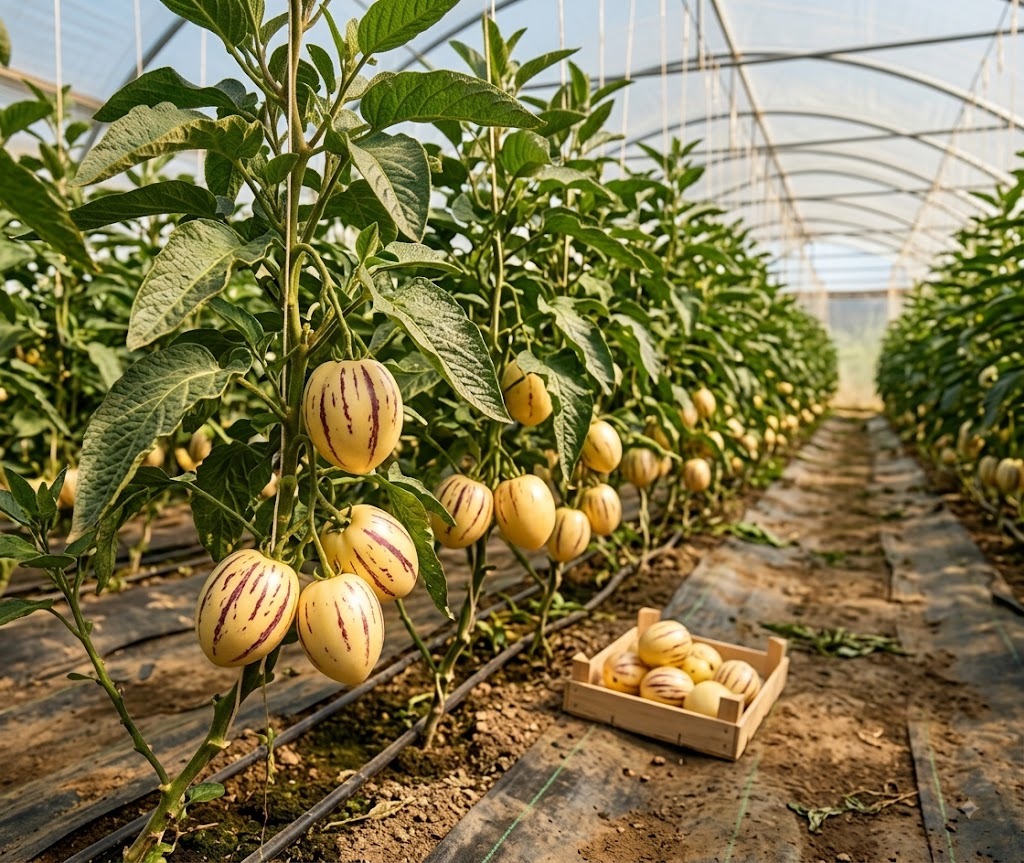
The USDA’s historical genetic records document Pepino fruits with purple stripes on a yellow or cream background, as well as various fruit shapes such as heart-shaped and oval. This is used solely as genetic evidence demonstrating the diversity of fruit shape and color within Pepino, rather than as a standard specification for a specific variety. ( ARS GRIN )
Plant Identity
Basic fields | Pepino registration criteria |
| Korean name | Pepino |
| English name | Pepino / Pepino dulce |
| Representative scientific name | Solanum muricatum Aiton |
| classification | Solanaceae · Solanum |
| Edible parts | Mainly fruit flesh |
| Non-edible · Separate management | Stem, leaf, root, calyx, diseased fruit, decayed fruit, sorting residue |
| Major harvesting stages | Immature fruit / Ripe fruit for distribution / Ripe fruit for consumption / Overripe fruit / For seed production |
| Basic product form | Fresh fruit · Selected fruit · Small packaging · Fresh-cut · Juice · Puree · Frozen · Processed ingredients |
| Basic processing stage | Sorting → Washing → Peeling/Selection → Cutting → Juicing/Grinding/Puree → Refrigeration/Freezing/Heating |
| Basic use | Raw Food · Dessert · Salad · Hotel · Cafe · Fresh-cut · Beverage · HMR · PB |
| Similarity Principle | Separation of Tomatillo, Tomato, Eggplant, and Other Solanum Fruits and Species |
Kew recognizes Solanum muricatum Aiton as an accepted species. ( Plants of the World Online )
The relationship between Pepino and Solanum muricatum is also specified in the USDA GRIN lineage genetic resource data. ( ARS GRIN )
Product Master
Product ID | Product type | Key Management Standards |
| PEP-P01 | Pepino immediately after harvest | Variety · Fruit ID · Harvest Date · Ripeness · Lot |
| PEP-P02 | Misuk Pepino | Skin color, firmness, aroma, and potential for ripening |
| PEP-P03 | Distribution ripening | Hardness, Color, Pressure Resistance, Delivery Time |
| PEP-P04 | edible ripe fruit | Aroma, texture, sweetness, color, appearance |
| PEP-P05 | Premium selection and | Uniformity, shape, stripes, and flawlessness |
| PEP-P06 | Small and medium-sized retail department | Weight, Packaging, Freshness |
| PEP-P07 | For hotels and restaurants | Degree of ripeness, size, and delivery cycle |
| PEP-P08 | For dessert | Aroma, texture, and sugar-acid balance |
| PEP-P09 | Washing Pepino | Washing water, product temperature, microorganisms |
| PEP-P10 | Peeling Pepino | Peel yield, flesh color, texture |
| PEP-P11 | Fresh-cut Cube | Cutting size, browning, microorganisms |
| PEP-P12 | Fresh-cut Slice | Thickness, texture, refrigeration |
| PEP-P13 | Salad ingredients | Ripening, shape retention, packaging |
| PEP-P14 | Pepino Juice Ingredients | Sweetness, Aroma, and Juice Yield |
| PEP-P15 | Pepino juice | Juicing, filtration, heat treatment, packaging |
| PEP-P16 | Pepino puree | Viscosity, color, scent, and solid content |
| PEP-P17 | Frozen fruit pulp | Cutting, freezing, and thawing quality |
| PEP-P18 | frozen puree | Solids, Freezing, Thawing |
| PEP-P19 | Sauce/Dessert Base | Puree, Flavor, Viscosity |
| PEP-P20 | Beverage and Smoothie Ingredients | Frozen/Puree Specifications |
| PEP-P21 | HMR Dessert Ingredients | Cut · Puree · Refrigerate/Freeze |
| PEP-P22 | Overripe processed raw materials | Safety, fragrance, softening, and processing suitability |
| PEP-P23 | Fruit for seed production | Variety · Maturity · Seed Lot |
| PEP-P24 | Seeds and breeding materials | Variety · Purity · Source |
| PEP-P25 | Non-standard health and | Defects, safety, and processability |
| PEP-P26 | by-product | Pericarp, cut debris, seeds |
| PEP-P27 | PB finished products | Raw Material Lot · Processing Batch · Labeling · Use-by Date |
Classification criteria | Subdivision type | Management principles |
| Plant classification | Solanum muricatum | Separated from other Solanum species |
| Variety · Accession | Actual varieties and genetic resources | Prohibition of estimating breed based solely on appearance |
| Negligence | Oval, heart-shaped, spherical, etc. | Actual Measurement and Photo Dataset |
| Skin color | Cream, yellow, greenish-yellow, etc. | Separately record ripeness and variety |
| stripe | Presence/Intensity of purple tones | Variety/Quality Attribute |
| Harvesting stage | Unripe, ripe for distribution, fully ripe, overripe | Product Separation |
| hardness | Actual value | Distribution · Fresh-cut standards |
| Sweetness | TSS measurement | Management by variety and ripeness |
| incense | Sensory and sensor analysis possible | Buyer Preference |
| Distribution methods | Fresh fruit · Washed · Fresh-cut · Refrigerated · Freezed | Product Separation |
| Processing form | Juices, Purees, Frozen Sauces | Process Lot |
| Final use | Retail · Hotels · Dining · Desserts · Beverages · HMR | Buyer RFQ |
| Transaction type | Spot supply · Regular supply · Contract production · OEM · PB | Contract |
| origin | Domestic/Imported | Origin Traceability |
Since the USDA Genetic Resources Record describes Pepino fruit with various appearances, including cream, yellowish-green, and purple stripes, the presence of purple stripes is not used as a criterion for species identification. ( ARS GRIN )
step | Essential Dataset | Management purpose |
| Cultivation plan | Variety · Region · Cultivation Type · Buyer · Product | demand-based production |
| breeding materials | Seeds/Vegetative Propagation Source·Lot | Breed Traceability |
| Seedling cultivation | Breeding date, seedling age, growth | Tomb quality |
| formula | Date, planting distance, number of plants | Production schedule |
| survival | Missing plants/growth | Initial stability |
| Landlords and Inducements | Method/Workday | Negligence protection |
| pruning | Number of stems · lateral branches · work | Growth control |
| rising | Temperature, solar radiation, precipitation, and wind speed | growing environment |
| Facility Environment | Temperature, humidity, and ventilation | stable production |
| Watering | Soil moisture and irrigation amount | Excessive negligence |
| dispute | Soil testing, fertilizer, and timing | Quality and Production Volume |
| flowering | Flower ID · Blooming Date | Fruit set prediction |
| Pollination and Fruit Set | Fruit ID · Fruit Set Date | Production forecast |
| Enemy | Fruit trees and seasons | Fruit quality |
| Excessive negligence | Size, Weight, Color | Harvest Prediction |
| Change in peel color | Color and stripes | Accommodation assessment |
| Sweetness | TSS | Harvest · Buyer Suitability |
| hardness | Firmness | Harvesting and distribution |
| incense | Sensory | Eating proficiency |
| pests | Occurrence, Diagnosis, and Control | Safety and Product Rate |
| Harvest judgment | Color, Hardness, TSS, Scent, Buyer's Purpose | Harvest Stage |
| harvest | Date · Fruit ID · Weight | Harvest Lot |
| Selection | Size, shape, appearance, wounds | Grade |
| Pre-cooling | Temperature and time | Freshness |
| purifying | Water quality and methods | hygiene |
| save | Temperature, Period, Weight Loss | Shelf-life |
| peeling | Selective yield | Fresh-cut |
| cutting | Cube·Slice | Ready-to-eat |
| Juicing | Input/Juice Extraction Amount | Juice Yield |
| Puree | Crushing, Yield, Viscosity | Ingredient |
| freezing | Whole/Cut/Purée | Long-term distribution |
| packaging | Buffering, weight, gas environment, etc. | Product Protection |
| shipment | Buyer · Lot · Delivery Date | Delivery |
Quality items | Fresh fruit | Pre-treated products | processed goods | finished product | Public rating |
| Species | essential | succession | succession | tracking | Public |
| Variety · Accession | essential | succession | tracking | tracking | Public/Verified |
| mountainous district | essential | succession | succession | mark | Public |
| producer | ID | succession | tracking | - | Verified |
| Lot | essential | new | Process Lot | Manufacturing Lot | Verified/NDA |
| Harvest day | core | succession | succession | tracking | Verified |
| Harvesting stage | essential | core | Raw material specifications | tracking | Verified |
| Fruit color | core | Selection | Color | By product | Member |
| stripe | Color, intensity, pattern | Selection | - | - | Member |
| Family type | Photos and actual measurements | Selection | - | - | Member |
| Length and diameter | Actual measurements | Selection | Batch | If necessary | Member |
| weight | Object/Lot | Batch | Input | By product | Verified |
| hardness | core | Fresh-cut key | Raw material characteristics | By product | Verified |
| TSS | Ripening and quality | Raw material specifications | Juice and Puree | finished product | Verified |
| Sando | If necessary | Raw material specifications | Beverages and Purees | finished product | Verified |
| Dangsanbi | If necessary | Buyer Spec | Product development | - | Verified |
| incense | Sensory | Fresh-cut | Product Quality | By product | Member/Verified |
| flesh color | Cut confirmation | core | Product color | finished product | Member |
| Seed development | Ripening and variety | Check when cutting | - | - | Member |
| Wounds/Compression | core | Selection | Processing review | - | Verified |
| Sunburn/Surface damage | check | Selection | Processing suitability | - | Verified |
| corruption | exception | exception | Food conversion ban | - | Verified |
| alien substance | check | purifying | Compliance with standards | Compliance with standards | Verified |
| pesticide residues | test | succession | Compliance with standards | Compliance with standards | Verified/NDA |
| microorganism | If necessary | Fresh-cut key | processed goods | Compliance with standards | Verified/NDA |
| weight loss rate | Storage test | The relevant city | - | - | Verified |
| Storage period | Record by condition | cold storage | By product | By product | Verified |
| Peeling yield | - | The relevant city | Cost reflection | - | NDA |
| Cutting yield | - | core | Input | - | NDA |
| Juice extraction yield | - | - | Juice core | Cost reflection | NDA |
| Puree yield | - | - | Purée Core | Cost reflection | NDA |
| freezing | - | - | Freezing and thawing | Product specifications | Verified |
| packaging | Fresh fruit | Fresh-cut | processed goods | Final | Member |
| Expiration date | The relevant city | core | processed goods | Labeling standards | Member |
| Shipment | record | record | record | record | NDA |
| Returns and Claims | record | record | record | record | NDA |
| Repurchase | Buyer Connection | connection | connection | connection | NDA |
Lot Master Required Field
Lot ID · Item · Product Type · Scientific Name · Variety · Accession · Cultivation Type · Origin · Growing Area · Producer · Propagation/Seed Lot · Planting Date · Flowering Date · Fruit Set Date · Harvest Date · Harvest Stage · Skin Color · Stripes · Fruit Shape · Length · Diameter · Weight · Hardness · TSS · Acidity · Sugar-Acid Ratio (at measurement) · Aroma · Flesh Color · Wounds · Bursts · Sunscald · Diseases · Spoilage · Pesticide Use History · Pesticide Residue · Microbiological Report · Pre-cooling · Storage · Weight Loss History · Raw Material Lot · Peeling · Cutting · Juicing · Puree · Freezing History · Packaging Date · Best Before Date · Shipper · Returns · Claims · Repurchase
Customers | Purchase criteria | Cooperation opportunities |
| Specialized fruit distribution | Ripness, Sweetness, Appearance, Freshness | Specialty Fruit |
| Department stores and premium retail | Fruit shape, stripes, small packaging | Premium Retail |
| hotel | Uniform ripeness, aroma, and cutness | Dessert/Fruit Plate |
| restaurant | Fresh · Salad · Dessert | Foodservice |
| cafe | Fruit pulp, flavor, juice, smoothie | Beverage |
| Dessert specialty store | Sugar balance · Puree | Dessert Ingredient |
| Fresh-cut company | Hardness, browning, microorganisms | Convenience Fruit |
| Salad company | Maintaining shape after cutting | Ready-to-eat |
| Juice production | TSS · Flavor · Juice Yield | Juice RFQ |
| Puree preparation | Color, Viscosity, Yield | Ingredient |
| frozen fruit company | Cutting, freezing, and thawing | Frozen |
| HMR | Dessert · Smoothie · Sauce Base | Meal Solution |
| Meal kit | Fresh small packaging | Recipe Product |
| PB | Domestic · Origin · Story | Premium PB |
| Online specialty mall | Small quantity, small packaging, ripening information | D2C |
| Seed and breeding institutions | Variety, Sugar Content, Aroma, Fruit Set | Variety Research |
| Research Institute | Regional adaptation, maturity, storage | PRP |
| importer | Fresh·Processed | Comparison of domestic products |
step | Key variables | Operational judgment |
| Seeds and breeding materials | Variety · Source · Quarantine | production base |
| domestic production | Crop type, shipping period, and estimated yield | Supply Forecast |
| Import procurement | Fresh/Frozen/Purée | Supply Gap |
| harvest | Ripness · TSS · Hardness · Scent | Product Decision |
| Selection | Size, color, stripes, wounds | Buyer Grade |
| Pre-cooling/Refrigeration | Product temperature and storage period | Fresh quality |
| Fresh-cut | Maturity, cutting, microorganisms | Convenience |
| Juicing | TSS · Fragrance · Yield | Juice |
| Puree | Color, Solids, and Yield | Processor |
| freezing | Cutting, freezing, and thawing | Year-round supply |
| Packaging and distribution | Shock, Temperature, Lead-time | Loss management |
| RFQ | Product · Ripeness · Quality | AI Match |
| Repurchase | Flavor · Shelf-life · Delivery time | Repeat trading |
HS·Trade Management
Pepino does not arbitrarily apply a single HS because tariff classification may vary depending on the product form, such as fresh fruit, frozen fruit, puree, or juice.
Product | Operating Principles |
| Fresh/Refrigerated Pepino | Confirmation of the current Korea Customs Service HSK Fruit/Vegetable Subclassification Official |
| Fresh-cut | Check classification by degree of processing |
| Frozen Pepino | Check Frozen Fruit and Vegetable Classification |
| Pepino puree | Verification of whether it is a product made of fruit |
| Pepino juice | Fruit juice classified separately |
| processed beverages | Beverage products HS code separate |
| Seeds and breeding materials | Quarantine and three-step verification separately |
Products and processes | Key conditions | RFQ conversion |
| Fresh fruit | Variety, Ripness, Sweetness, Aroma | Premium Fresh |
| Selection and | Size, color, and appearance | Retail |
| Washing and | Hygiene and temperature | Hotels and Restaurants |
| Peeled flesh | Peeling yield · Flesh color | Fresh-cut |
| Cube | Hardness, browning, cutting | salad |
| Slice | Thickness and shape retention | dessert |
| Fresh-cut Cup | Ripening, Microorganisms, and Use-by Date | Retail |
| Juice ingredients | TSS · Flavor · Juice Yield | Beverage |
| juice | Filtration, heat treatment, and packaging | PB |
| Puree | Color, scent, viscosity, and solid content | Ingredient |
| Frozen Cube | Frozen and thawed tissues | HMR |
| frozen puree | Solids · Freezing | Smoothie |
| Dessert Base | Puree and Sugar-Acid Balance | Bakery/Dessert |
| Source Base | Puree · Viscosity | Foodservice |
| Non-standard health and | Safety and maturity | Juice/Purée |
| Overripe | Fragrance, softening, and safety | Review of processing conversion |
| pericarp | Generation Amount · Safety | By-product research |
| satellite | Variety and Survival | Seed/Research |
| Disease and Decay Division | Food supply chain exclusion | waste/compost |
Product Conversion Principles
Poor appearance + Appropriate ripeness + Food safety compliance
→ Review of juice, puree, and frozen ingredients
Overripe + No spoilage + Suitable for processing
→ Separately verified as a puree/beverage product
Spoilage, disease, or safety non-compliance
→ Exclusion from food supply chain
PRP — Product Research Profile
PRP ID | Product Research Profile |
| PRP-PEP-01 | Mapping of Solanum muricatum varieties and genetic resources |
| PRP-PEP-02 | Fruit color/stripes – variety/ripeness separation |
| PRP-PEP-03 | Domestic region and facility adaptability |
| PRP-PEP-04 | Propagation Methods – Early Growth |
| PRP-PEP-05 | Flowering and Fruit Set – Fruit Trees |
| PRP-PEP-06 | Fruit Set Date – Fruit Enlargement – Ripening |
| PRP-PEP-07 | Skin Color–Hardness–TSS Relationship |
| PRP-PEP-08 | Sukdo – Aroma and Flavor |
| PRP-PEP-09 | Ready-to-eat vs. Hard-boiled |
| PRP-PEP-10 | Harvest maturity – Storage life |
| PRP-PEP-11 | Storage temperature–weight loss |
| PRP-PEP-12 | Storage – Hardness and TSS changes |
| PRP-PEP-13 | Fresh-cut cutting · browning |
| PRP-PEP-14 | Fresh-cut microorganisms · Shelf-life |
| PRP-PEP-15 | Juice yield and aroma preservation |
| PRP-PEP-16 | Puree color, viscosity, and solids |
| PRP-PEP-17 | Frozen–thawed tissue |
| PRP-PEP-18 | Standard Surgery Product Recovery |
| PRP-PEP-19 | Domestic – Imported Effective Cost |
| PRP-PEP-20 | Harvest Stage–Quality–Buyer AI Match |
As post-harvest studies listed in FAO AGRIS evaluated TSS, firmness, weight loss, and shelf life as key variables, Pepino PRP prioritizes research on the connection between ripeness and storability over cultivation yield . ( Agris )
first of all | Execution item | Performance indicators |
| 1 | Species·Variety·Origin·Harvest Date·Fruit ID·Lot Mandatory | Required input rate |
| 2 | Separation of unripe, distribution-appropriate ripe, ripe, and processed products | Product identification rate |
| 3 | Linking weather, growth, flowering, fruit set, and fruit enlargement data | Runtime connection rate |
| 4 | TSS, Hardness, Scent, Storage, and Test Report Data Conversion | Quality Dataset Completion Rate |
| 5 | Farm–Distribution–Fresh-cut–Processing–Buyer RFQ Connection | Match rate |
| 6 | Video AI Negligence Detection | Fruit Detection Accuracy |
| 7 | AI Color and Stripe Analysis | Accommodation classification accuracy |
| 8 | Image-based fruit size and weight prediction | Actual measurement error |
| 9 | TSS prediction model | Error compared to actual measurement |
| 10 | Hardness and maturity prediction | Buyer non-conformity rate |
| 11 | Harvest forecasting | Harvest Date Error |
| 12 | Production volume forecast | Weekly Forecast Error |
| 13 | Quality prediction during storage | Disposal and return rates |
| 14 | Fresh-cut Shelf-life prediction | Expiration date error |
| 15 | Juice and Puree Yield Prediction | Input–Output Error |
| 16 | Fresh→Processing Transition Decision | Product Recovery Rate |
| 17 | AI Buyer Match | Sample approval rate |
| 18 | Traceability | Finished Product → Fruit Lot Traceability |
| 19 | Repurchase Runtime | Buyer repeat purchase rate |
Problem group | Problem Definition | Required data |
| Lack of domestic production statistics | Difficulty in assessing the scale of the national industry | National Statistics |
| Lack of variety information | Unclear variety and source of domestic distribution resources | Variety |
| Variation in fruit shape and color | Difficulty setting product specifications | Morphology |
| Stripe deviation | Confusion regarding variety, ripeness, and appearance evaluation | Image |
| Insufficient assessment of maturity | Risk of judging edibility based solely on color | TSS·Firmness |
| Scent variation | Buyer taste evaluation difference | Sensory |
| Sugar content variation | Effects of variety, cultivation, and ripeness | TSS |
| Longitude deviation | Influence on Distribution and Fresh-Cut Aptitude | Firmness |
| Fruit softening | Delivery and shelf losses | Storage |
| weight reduction | Deterioration of storage and marketability | Weight Loss |
| Pressure wounds | Loss in distribution of fruits | Handling |
| Insufficient storage standards | Lack of domestic Shelf-life data | Temperature |
| Fresh-cut browning/softening | Restrictions on the marketability of convenience fruits | Processing |
| Microbial management | Safety of cut products | Microbiology |
| Juice yield not established | Unclear economic feasibility of processing | Juice Yield |
| Puree yield not established | Ingredient cost unclear | Purée Yield |
| Lack of awareness among domestic buyers | Unclear demand in the general fruit market | Buyer |
| Lack of specialized distribution | Failure to establish stable sales channels | Channel |
| Lack of price standards | Absence of transaction standards | Market Price |
| Import competition unclear | Insufficient assessment of domestic cost advantage | Trade |
| HS classification verification required | Separation of statistics by product is necessary | Customs |
| Lack of pest and disease data | Accumulation of domestic cultivation experience is necessary | Pest/Disease |
| Contract production shortage | Possibility of expanding production without demand | Contract |
| Non-products and lack of utilization | Lack of processing routes for fresh fruit scraps | Recovery |
| Insufficient repurchase data | One-time Specialty Consumption Risk | Repurchase |
RFQ Type | Public Registration | Verify/NDA |
| Pepino source sourcing | Variety, Region, Shipment Date | Farm, Volume, Unit Price |
| Fresh fruit sales | Variety, Ripeness, Fruit Shape | Lot · Price · Inventory |
| Buying fresh fruit | Weight, Ripeness, Sweetness | Target Price · MOQ |
| Premium selection and | Appearance, Stripes, Sweetness | Actual specifications and prices |
| Regular supply | Product · Period · Cycle | Weekly Volume and Unit Price |
| contract production | Variety · Target Ripening · Buyer | Area, Quantity, Price |
| For hotels | ripeness, aroma, and appearance | Delivery cycle |
| Cafe · Dessert | Sweetness, Aroma, and Puree Suitability | Sample |
| Fresh-cut | Hardness and cutting ability | Shelf-life · Report card |
| salad | Cube/Slice · Organization | Delivery cycle |
| For juice | TSS · Flavor · Extraction | Yield and price |
| For puree | Ripness, Viscosity, Color | Yield · MOQ |
| freezing | Cut/Purée | Thawing quality |
| HMR | Puree/Dessert Base | Manufacturing conditions |
| PB | Domestic, Origin, Variety | MOQ · Packaging |
| online | Small Packaging & Ripening Guide | Return conditions |
| import | Fresh/Frozen/Purée | HS · Country of Origin · Price |
| export | Fresh/Processed | Quarantine, Price, and Volume |
| Seeds and reproduction | Variety · Source | Lot·Contract |
| Technology demonstration | Ripening, Storage, and AI Screening | Dataset |
| Research cooperation | Variety, Storage, Processing | PRP |
| Standardized surgery | Processable raw materials | Safety and yield |
① Need Products & Materials
Companies and institutions seeking necessary products, agricultural products, raw materials, and processed goods register purchasing demands. Registered requests are utilized to review cooperation with potential suppliers and producers based on the RFQ Intelligence Library.
Process:
RFQ Registration → Supplier/Product Review → Collaboration Connection → Future AI Matching
Register
② We are looking for production and manufacturing partners. (Need Suppliers & Manufacturers)
Register a request to find necessary production and supply partners, ranging from farms and producer organizations to processing companies, OEM, ODM, and private label manufacturers.
Process:
RFQ Registration → Review of Production & Manufacturing Capabilities → Collaboration Connection → Future AI Partner Matching
Register
③ We are looking for domestic and international buyers. (Need Buyers)
Farmers, producer organizations, and manufacturing companies are requesting cooperation with new buyers, such as domestic and international distributors, importers, brand companies, and food service and catering businesses.
Process:
RFQ Registration → Product & Supply Capability Review → Market & Buyer Connection → Future AI Buyer Matching
Register
Contact : mail@markethub.org
Version | Main contents | situation |
| v1.0 | Plant Identity · Variety · Ripeness · Fresh · Fresh-cut · Juice · Puree · Frozen · RFQ Basic Structure Registration | complete |
| v1.1 | Verification of official raw data on domestic production, region, variety, market, HS code, and import/export | expected |
| v2.0 | Detailed quality standards by variety, ripeness, TSS, firmness, aroma, fresh-cut, juice, and purée | expected |
| v3.0 | Producer – Fresh-cut · Beverage · Processing – Hotel · Distribution – Buyer Verified Container Combination | expected |