

Judgment axis | Key judgment |
| Item Identity | A perennial spice vegetable using the rhizomes, stems, and leaves of Eutrema japonicum of the Brassica family. |
| Key role | Fresh wasabi · Japanese cuisine · Sashimi · Sauce · Dressing · Processed paste · Powder · Leaf for wraps |
| Harvesting principle | Cultivation type, variety, growing period, rhizome thickness, shape, leaf quality, and Buyer's intended use are assessed together. |
| Product separation | Separate propagation seedlings, leaves, petioles, rhizomes, washed rhizomes, crushed raw rhizomes, paste, frozen, dried, and powder. |
| Separation of similar items | Separate the roles of horseradish, mustard, and radish, as well as Species and Products. |
| Domestic statistics | Nationwide Wasabi Sole Cultivation Area and Production Volume: To be entered after verification of official raw data |
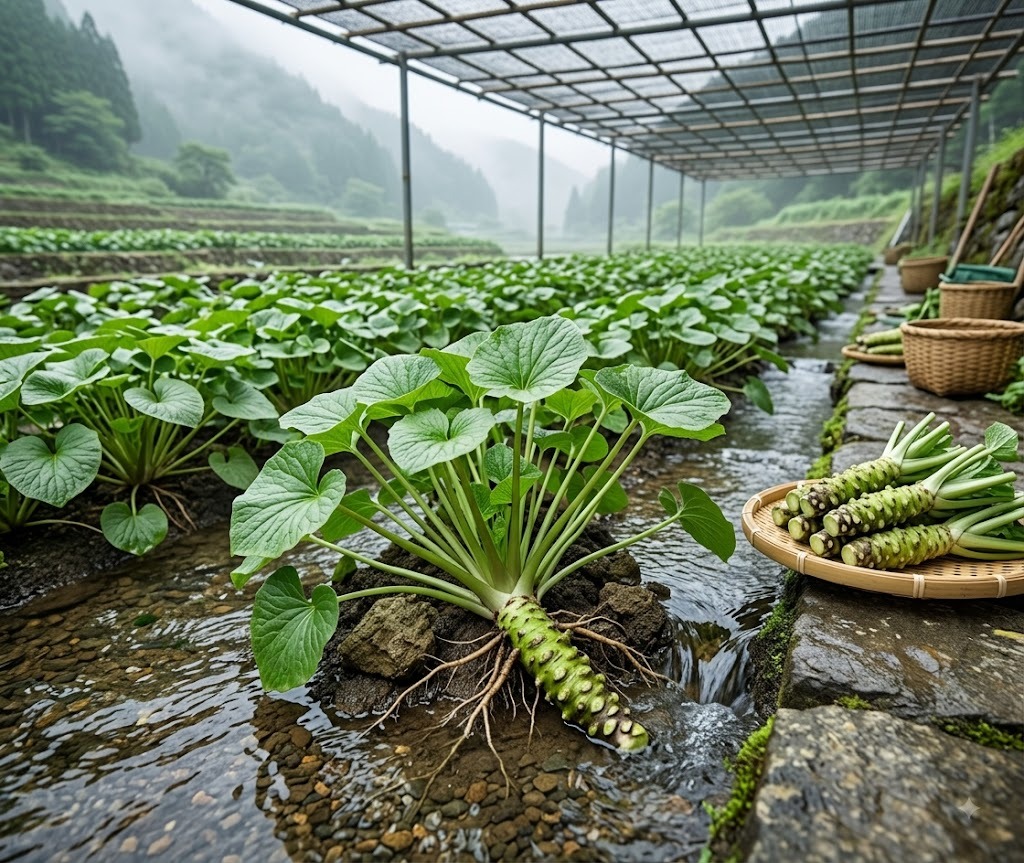
| Domestic cultivation types | The Rural Development Administration distinguishes between field cultivation and water cultivation, and has explained that research and cultivation in Korea are still limited. ( Nongsaroo ) |
| Leaf production | The technology for producing horseradish leaves using hydroponics is registered in the Rural Development Administration's Agricultural Application Technologies. ( Nongsaroo ) |
| Smart Farm | In 2026, the Rural Development Administration introduced the Jeju Agricultural Technology Center's container plant factory for hydroponic horseradish cultivation as a field case study. ( Rural Development Administration ) |
| Quality Risk | Rhizome thickness, linearity, epidermis, wounds, decay, fibrosis, leaf yellowing, and flavor variation after processing |
| Production Risk | High temperature, rhizosphere oxygen deficiency, water quality, drainage, diseases, growing period, uneven growth |
| Operating Principles | Plant Material–Cultivation Type–Rhizome/Leaf Lot–Processing–Buyer RFQ |
| Final goal | Separate fresh rhizomes, leaves, paste, and powder, and feed back actual processing yield and buyer evaluations to the next production. |
Plant Identity
Basic fields | Wasabi Registration Standards |
| Korean name | Wasabi |
| English name | Wasabi / Japanese wasabi |
| Representative scientific name | Eutrema japonicum (Miq.) Koidz. |
| Kew status | Accepted species |
| Major Synonyms | Eutrema wasabi Maxim., Wasabia japonica (Miq.) Matsum., Wasabia wasabi |
| classification | Brassicaceae · Eutrema |
| Living type | perennial |
| Edible parts | Rhizome and stem |
| Separate edible parts | leaf and leaf stalk |
| Non-edible · Separate management | Diseases, decayed tissue, senescent leaves, and process waste |
| Major harvesting stages | Seedlings, young leaves, leafy vegetables, leaf stalks, immature rhizomes, commercial rhizomes, rhizomes for processing |
| Basic product form | Fresh Rhizome·Leaf·Petiole·Washed·Trimmed·Grated·Paste·Frozen·Dried·Powder |
| Basic processing stage | Washing → Trim → Grinding/Crushing → Mixing → Paste → Freeze-drying/Powder |
| Basic use | Fresh Wasabi · Japanese Cuisine · Sauces · Dressings · Seasonings · Leafy Vegetables · Processed Ingredients |
| Similarity Principle | Operate horseradish, mustard, and radish as separate Plant Entities |
Kew treats both Eutrema wasabi and Wasabia japonica as synonyms of Eutrema japonicum. ( Plants of the World Online )
Product Master
Product ID | Product type | Key Management Standards |
| WAS-P01 | Seed/Propagation Material | Variety, lineage, and soundness |
| WAS-P02 | Grave and official residence | Young age, muscle system, soundness |
| WAS-P03 | hydroponic seedlings | Uniformity and root zone conditions |
| WAS-P04 | Field cultivation Plant | Cultivation site/growth stage |
| WAS-P05 | Water cultivation plant | Water quality, temperature, and flow rate |
| WAS-P06 | young leaves | Leaf length, color, year |
| WAS-P07 | Leaf for wraps | Size, Appearance, and Freshness |
| WAS-P08 | petiole | Length, thickness, color |
| WAS-P09 | Leaf + Leaf stalk Bundle | Uniformity and harvest date |
| WAS-P10 | Immature rhizome | Thickness, length, and growth period |
| WAS-P11 | Fresh rhizomes | Weight, Diameter, Shape |
| WAS-P12 | Premium Fresh Rhizome | Linearity, epidermis, appearance |
| WAS-P13 | Processing Rhizome | Internal soundness and yield |
| WAS-P14 | Washing muscle | Cleanliness · Wounds |
| WAS-P15 | Trimmed Rhizome | Crown/Root Removal Standards |
| WAS-P16 | Whole Chilled Rhizome | Refrigeration and packaging |
| WAS-P17 | Grated Fresh Wasabi | Grinding Point · Lot |
| WAS-P18 | Wasabi Purée | Raw material ratio and particle size |
| WAS-P19 | Wasabi Paste Raw Material | Rhizome Raw Material & Processing Spec |
| WAS-P20 | Wasabi Paste Finished | Ingredient Composition · Batch |
| WAS-P21 | Frozen Grated Wasabi | Freeze history |
| WAS-P22 | Frozen Rhizome | Freezing and thawing |
| WAS-P23 | Dried Wasabi | Moisture, fragrance |
| WAS-P24 | Wasabi Powder | Moisture content and particle size |
| WAS-P25 | Leaf Powder | Leaf Lot · Moisture |
| WAS-P26 | Pickled Leaf/Petiole | Ingredients and Pickling History |
| WAS-P27 | Sauce Ingredient | Paste/Purée Spec |
| WAS-P28 | Dressing Ingredient | Scent and viscosity |
| WAS-P29 | Foodservice Portion | Weight and packaging |
| WAS-P30 | Extra-standard healthy muscles | Processing upon safety compliance |
| WAS-P31 | Processing residue | Resource utilization research |
| WAS-P32 | PB·OEM finished products | Raw Material Lot · Manufacturing Batch |
Classification criteria | Subdivision type | Management principles |
| Taxonomy | Eutrema japonicum | Species Master |
| Synonym | E. wasabi·Wasabia japonica, etc. | Source connection |
| cultivation method | Fields, Water, Hydroponics, Facilities, Plant Factories | Production Separation |
| Cultivation purpose | Rhizome · Leaf · Rhizome + Leaf | Product Separation |
| breeding materials | Seeds, seedlings, and vegetative propagation materials | Check Source |
| Edible parts | Rhizome, leaves, leaf stalks | Product Separation |
| Harvesting stage | Young Leaf·Leaf·Immature Rhizome·Mature Rhizome | Product Separation |
| Close diameter specifications | Weight, length, diameter, shape | Buyer Spec |
| Leaf size | Leaf length, leaf width, leaf color | Buyer Spec |
| Distribution methods | Soil/Water Harvested·Washed·Trimmed·Chilled | Product Separation |
| Processing form | Grated·Purée·Paste·Frozen·Dry·Powder | Process Lot |
| Final use | Fresh Wasabi · Japanese Cuisine · Sauce · Dressing · Wrapping Vegetables | Buyer |
| Transaction type | In-kind · Regular supply · Contract farming · OEM · PB | Contract |
| origin | Domestic/Imported | Traceability |
step | Essential Dataset | Management purpose |
| Cultivation plan | Rhizome/Leaf Purpose · Buyer · Shipping | Production Strategy |
| breeding materials | Variety · Lineage · Source Lot | Traceability |
| Seedling cultivation | Age, Growth, Root System | Official quality |
| Selection of cultivation method | Fields, water, hydroponics, facilities | Production Model |
| cultivation area | Altitude, Shading, Environment | Site management |
| Substrate/Soil | Breathability and water permeability | Root zone management |
| water quality | Water quality during hydroponics and water cultivation | Production safety |
| formula | Date · Density | Production schedule |
| survival | Survival rate and root zone status | uniformity |
| rising | Temperature, solar radiation, and humidity | Growth Risk |
| sunshade | Light environment | Leaf and rhizome growth |
| Irrigation and flow | Moisture and flow rates | Root zone environment |
| Nutrient solution | EC, pH, etc. during hydroponic cultivation | Growth management |
| pests | Occurrence, Diagnosis, and Control | Product rate |
| Leaf growth | Number of leaves, leaf length, leaf width | Leaf Forecast |
| Leaf harvest | Harvest Date · Leaf Lot | Leaf Product |
| Myocardial hypertrophy | Length, Diameter, Weight | Rhizome Forecast |
| Rhizome harvest determination | Size · Appearance · Buyer Spec | Harvest |
| Harvesting rhizomes | Date/Damage | Traceability |
| purifying | soil and foreign matter | Fresh |
| Trim | Leaf stalks, roots, damaged parts | commercialization |
| Selection | Diameter, weight, shape | Grade |
| Pre-cooling | Product temperature if necessary | Freshness |
| save | Temperature, moisture loss, spoilage | Supply |
| Grinding | Time · Arrival | Fresh Grated |
| Purée | Grinding and mixing | Ingredient |
| Paste | Mixing · Batch | Finished Product |
| freezing | Roots and crushed products | Year-round supply |
| dry | Leaves and rhizomes | Ingredient |
| powder | Moisture content and particle size | Food Material |
| packaging | Fresh/Processed | Sales unit |
| shipment | Buyer · Lot · Delivery Date | Delivery |
Quality items | Original rhizome | leaf and leaf stalk | Pre-processed and processed products | finished product | Public rating |
| Species | essential | essential | succession | tracking | Public |
| Synonym/Source Taxon | Master | Master | succession | - | Public |
| Variety/Lineage | essential | essential | succession | tracking | Public/Verified |
| cultivation method | Fields, Water, and Hydrography | Fields and hydroponics | succession | tracking | Member |
| mountainous district | essential | essential | succession | mark | Public |
| producer | ID | ID | tracking | - | Verified |
| Lot | Rhizome Lot | Leaf Lot | Process Lot | Batch | Verified/NDA |
| Official date | record | record | succession | - | Verified |
| Harvest day | core | core | tracking | tracking | Verified |
| Muscle thickness | Actual measurements | - | Input | - | Verified |
| Rhizome length | Actual measurements | - | Selection | - | Member |
| Root diameter | Actual measurements | - | Selection | - | Member |
| Proximal shape | Linearity and curvature | - | Processing yield | - | Member |
| epidermal condition | test | - | Check after washing | - | Verified |
| Internal state | Check during cutting and processing | - | core | - | Verified |
| Leaf length and width | - | Actual measurements | Leaf Input | - | Member |
| Leaf color | - | test | Drying and processing | By product | Verified |
| Yellowing of leaves | - | test | Exclusion/Processing Judgment | - | Verified |
| Leaf damage | - | test | Selection | - | Verified |
| Flavor and spiciness | Verification as necessary | If necessary | core | core | Verified/NDA |
| soil and foreign matter | check | check | purifying | Compliance with standards | Verified |
| disease and decay | exception | exception | Food conversion ban | - | Verified |
| pesticide residues | test | test | succession | Compliance with standards | Verified/NDA |
| microorganism | If necessary | Fresh Leaf Core | Paste Core | Compliance with standards | Verified/NDA |
| Washing yield | core | If necessary | Input | - | NDA |
| Trim Yield | core | core | Input | - | NDA |
| Grating Yield | - | - | core | cost | NDA |
| Purée Yield | - | - | core | cost | NDA |
| Paste Yield | - | - | core | cost | NDA |
| Frozen Yield | - | - | core | cost | NDA |
| Dry Yield | - | - | core | cost | NDA |
| moisture | If necessary | If necessary | Dry/Powder | Spec | Verified |
| packaging | Fresh | Fresh Leaf | Processed | Final | Member |
| Expiration date | The relevant city | The relevant city | essential | mark | Member |
| Returns and Claims | record | record | record | record | NDA |
| Repurchase | connection | connection | connection | connection | NDA |
Food Safety Korea classifies horseradish roots as root vegetables and horseradish leaves as leafy vegetables. Therefore, pesticide residues, contaminants, and inspection items are not automatically inherited between the parts. ( Food Safety Korea )
Lot Master Required Field
Lot ID · Item/Product Type · Accepted Taxon · Synonym/Source Taxon · Variety/Line · Cultivation Method · Origin/Cultivation Site · Producer · Propagation Lot · Planting Date · Harvest Date · Rhizome Weight/Length/Diameter/Shape · Leaf Length/Width/Color · Leaf/Rhizome Distinction · Skin/Internal Condition · Diseases/Spoilage · Pesticide Use Records · Pesticide Residue/Microbiological Reports · Water Quality/Nutrient Solution/Rhizosphere Environment Records (if applicable) · Storage History · Rhizome Lot · Leaf Lot · Washing/Trim Lot · Grated/Purée/Paste/Frozen/Dried History · Manufacturing Batch · Packaging Date · Best Before Date · Shipper · Returns/Claims · Repurchase
Customers | Purchase criteria | Cooperation opportunities |
| Professional wasabi farm | Seedlings, lineages, and cultivation methods | contract production |
| production area distribution organization | Rootstock Size · Leaf Grade | Joint shipment |
| Fresh Wasabi Distribution | Fresh Rhizome · Origin · Grade | Premium RFQ |
| Japanese restaurant and sushi specialty store | Fresh rhizomes, flavor, delivery time | Key RFQ |
| hotel | Premium Whole Rhizome | Regular supply |
| food service companies | Fresh/Purée/Paste | B2B |
| Seafood and Sashimi Specialty Shop | Fresh Grated/Paste | food ingredients |
| sauce manufacturer | Purée·Paste Ingredients | Ingredient |
| Dressing manufacturer | Fragrance and ingredient blending | OEM |
| Seasoning companies | Paste/Powder | Processing |
| Distribution of leafy greens | Leaf size and freshness | Leaf RFQ |
| salad companies | young leaves and leaf stalks | Specialty |
| School meals and dining out | Leaf/Paste | Preprocessing |
| HMR | Sauce/Paste | Processed raw materials |
| frozen food companies | Frozen Grated | Year-round supply |
| Drying and powder companies | Root/Leaf Powder | Ingredient |
| PB·OEM | Wasabi sauce and dressing | Product Development |
| importer | Fresh/Paste/Powder | Supply |
| exporters | Fresh/Processed | Trade |
| Research Institute | Variety · Cultivation · Rhizome · Flavor · Smart Farm | PRP |
step | Key variables | Operational judgment |
| breeding materials | Breed · Source · Soundness | production base |
| Seedling cultivation | Uniformity and muscle system | Supply Plan |
| Field, Water, Hydroponics | Environment, Root Zone, Water Quality | Production |
| Growth | Leaf and rhizome development | Forecast |
| contract farming | Buyer Rhizome/Leaf Spec | stable procurement |
| Leaf harvest | Leaf Grade | Separate Product |
| Rootstock harvesting | Weight, Diameter, Shape | Fresh Grade |
| Washing · Trim | Usable Yield | Foodservice |
| save | Freshness and spoilage | Inventory |
| Raw horse meat crushing | Instant Product | Premium |
| Purée/Paste | Mixing · Yield | process |
| Frozen | Quality preservation | Year-round supply |
| Dry/Powder | Moisture, fragrance | Ingredient |
| Distribution and supply | Refrigeration, Freezing, Delivery Time | Buyer SLA |
| RFQ | Rhizome/Leaf/Paste | AI Match |
| Repurchase | Fragrance, Yield, Quality, Delivery Time | Repeat trading |
HS·Trade Management
Product | HS Operating Principles |
| Fresh horseradish rhizome | Current Korea Customs Service HSK official confirmation |
| Wasabi leaves | Separate verification based on fresh leafy vegetable condition standards |
| Frozen wasabi | Check frozen vegetables by processing status |
| Dried horseradish | Classification verification of dried vegetables and spices |
| Wasabi Powder | Check raw material composition and processing status |
| Wasabi Paste | Check for prepared sauces or mixed seasoning products |
| Seedlings and seeds | Plant Quarantine · HS Separate |
Products and processes | Key conditions | RFQ conversion |
| Breeding cat | System and soundness | Farmer RFQ |
| young leaves | Leaf color · Year | Specialty Leaf |
| Leafy greens | Size and freshness | Retail/Foodservice |
| petiole | Length and thickness | Pickle/Processing |
| Fresh Rhizome | Weight, Diameter, Shape | Premium RFQ |
| Washed Rhizome | epidermis and wounds | Restaurant |
| Trimmed Rhizome | Usable Yield | Foodservice |
| Grated Fresh | Grinding time · Particle size | Premium Foodservice |
| Purée | Raw material ratio and particle size | Sauce |
| Paste Raw Material | Flavor and Yield | Processor |
| Paste Finished | Mixing · Batch | PB/OEM |
| Frozen Grated | Freezing and thawing | Foodservice |
| Frozen Rhizome | Thawing quality | Processing |
| Dried Rhizome | Moisture, fragrance | Ingredient |
| Rhizome Powder | Moisture content and particle size | Seasoning |
| Dried Leaf | Color and scent | Ingredient |
| Leaf Powder | Moisture content and particle size | Food Material |
| Pickled Leaf/Petiole | Tissues and pickles | Regional Product |
| Extra-standard healthy muscles | Safety suitability | Paste/Powder |
| Trim residue | Generation amount | Resource utilization research |
| diseased or spoiled products | Food supply chain exclusion | Review of waste and compost |
The Rural Development Administration's hydroponic research treats leaf production as a separate cultivation objective, and highland field cultivation research also treats leaf harvesting as an independent production activity. Therefore, rather than viewing leaves as a byproduct of rhizomes, a separate Leaf Product Line is operated. ( Nongsaroo )
PRP — Product Research Profile
PRP ID | Product Research Profile |
| PRP-WAS-01 | E. japonicum–Synonym Taxonomy Mapping |
| PRP-WAS-02 | Domestic Lineages/Varieties – Growth Characteristics |
| PRP-WAS-03 | Propagation Method – Uniformity |
| PRP-WAS-04 | Field vs. Water Cultivation Comparison |
| PRP-WAS-05 | Hydroponic media – Root zone aeration and permeability |
| PRP-WAS-06 | Light Environment – Leaf Growth |
| PRP-WAS-07 | High Temperature – Summer Growth Risk |
| PRP-WAS-08 | Cultivation Method – Leaf Yield |
| PRP-WAS-09 | Cultivation Method – Rhizome Enlargement |
| PRP-WAS-10 | Harvest Age–Rhizome Size |
| PRP-WAS-11 | Leaf Harvest–Rhizome Growth Interaction |
| PRP-WAS-12 | Rhizome Size–Fresh Grade |
| PRP-WAS-13 | Storage–Freshness |
| PRP-WAS-14 | Washing/Trim – Usable Yield |
| PRP-WAS-15 | Grating–Product Yield |
| PRP-WAS-16 | Raw Material–Paste Quality |
| PRP-WAS-17 | Frozen–Quality Retention |
| PRP-WAS-18 | Drying–Color/Aroma/Yield |
| PRP-WAS-19 | Off-grade Recovery |
| PRP-WAS-20 | Variety–Cultivation–Product–Buyer AI Match |
first of all | Execution item | Performance indicators |
| 1 | Taxon, Lineage, Cultivation Method, Origin, Harvest Date, and Lot are mandatory. | Input completion rate |
| 2 | Rhizome·Leaf·Petiole·Paste Product Separation | Product identification rate |
| 3 | Linking temperature, light, water quality, root zone, growth, and harvest data | Runtime connection rate |
| 4 | Datafication of quality, certificate, storage, and processing history | Lot completion rate |
| 5 | Connecting Farmers with Japanese Cuisine, Hotels, Sauces, and Processing Buyer RFQs | Match rate |
| 6 | Video AI Leaf Size and Color Determination | Grade Accuracy |
| 7 | Video AI for measuring close-up length and diameter | Measurement error |
| 8 | Video AI for close-up shape and wound screening | Defect detection rate |
| 9 | Prediction of myocardial hypertrophy | Forecast Error |
| 10 | Leaf yield prediction | Forecast Error |
| 11 | High-temperature stress prediction | Growth loss rate |
| 12 | Smart rhizosphere and water quality monitoring | Anomaly detection rate |
| 13 | Harvest timing prediction | Harvest Error |
| 14 | Washing/Trim Yield Prediction | Actual measurement error |
| 15 | Grating/Paste Yield Prediction | Input–Output Error |
| 16 | Processed Product Quality Batch Management | Batch deviation |
| 17 | Fresh→Processing Transition AI | Recovery rate |
| 18 | AI Buyer Match | Sample approval rate |
| 19 | Finished Paste → Rhizome Lot Traceback | Traceability rate |
| 20 | Buyer Repurchase Runtime | Recurrence rate |
Problem group | Problem Definition | Required data |
| Taxonomy mixed | Eutrema japonicum·E. Mixed use of wasabi and Wasabia japonica | Taxonomy |
| Horseradish confusion | Mixing different plants under the name Wasabi | Species/Product |
| Processed wasabi ingredients unclear | There may be differences between the product name and the actual ingredient composition. | Ingredient |
| Lack of variety and lineage information | Restriction on comparison of production and flavor | Variety |
| Variation in breeding materials | Uneven early growth | Propagation |
| Mixed field and water cultivation | Differences in production cost and quality structure | Cultivation |
| Hydroponic medium mismatch | Difference in root zone aeration and drainage | Substrate |
| Water quality variation | Water and hydroponic stability | Water |
| High temperature risk | Summer growth decline | Climate |
| Light Environment Risk | Growth fluctuations of shade-loving crops | Light |
| rhizosphere oxygen deficiency | Growth and Disease Risk | Root Zone |
| disease | long-term cultivation loss | Disease |
| Muscle thickness deviation | Premium Grade Rate Difference | Rhizome Growth |
| deviation in root shape | Fresh Buyer specification discrepancy | Geometry |
| Prolonged harvest period | Cash flow and cultivation risks | Production Cycle |
| Leaf Harvest – Rhizome Growth Relationship | Dual Product Optimization Needed | Leaf/Rhizome |
| Leaf quality variation | Difference in specifications between leafy vegetable buyers | Leaf Quality |
| Harvest damage | Fresh Grade Loss | Harvest |
| Storage spoilage | Loss of high-value raw materials | Storage |
| Washing and Trim Loss | Decrease in actual usage | Yield |
| Changes in the quality of ground raw yam | Cooking and delivery quality deviation | Processing |
| Paste mixture opaque | Difference in actual wasabi content | Formulation |
| Processing yield deviation | Manufacturing cost instability | Yield |
| Changes in quality after freezing | Foodservice quality | Frozen |
| Variation in scent and color after drying | Powder quality | Drying |
| Difference in safety standards between leaves and rhizomes | Different food classifications | Safety |
| Lack of non-standard utilization | Loss of expensive raw materials | Recovery |
| Lack of domestic production statistics | Limitations on determining industry size | Statistics |
| Imported Fresh/Paste Mix | Market size distortion | Trade |
| Discrepancy in contract farming | Long-term production and buyer demand gap | Contract |
| Lot history interruption | Grave → Paste tracking lack | Traceability |
| Repurchase not reflected | Buyer evaluation non-recovery | Repurchase |
RFQ Type | Public Registration | Verify/NDA |
| Wasabi seedling purchase | System/Cultivation Purpose | Supplier · Lot · Unit Price |
| Cultivation propagation material | Variety · Source | Quantity and Quarantine |
| Field-grown rhizomes | Origin, cultivation period, specifications | Farms, Volume, Price |
| Water-grown rhizomes | Cultivation method and specifications | Water Quality · Lot · Price |
| Hydroponic rhizome | Facilities and cultivation methods | Production volume · Contract |
| Leaf for wraps | Leaf length and color | Actual quantity · Delivery date |
| petiole | Length and thickness | Volume/Unit Price |
| Premium Fresh Rhizome | Weight, Length, Diameter | Lot · Actual Unit Price |
| Washing muscle | epidermis and wounds | Washing Yield |
| Trimmed Rhizome | Usable Weight | Trim Yield |
| For grinding raw yam | Internal soundness and standards | Grating Yield |
| Regular supply | Product Cycle | Actual volume |
| contract farming | Cultivation Method · Buyer Spec | Area, Quantity, Price |
| For Japanese cuisine and sushi | Premium Rhizome | Delivery cycle |
| For hotels and restaurants | Fresh/Grated | Delivery Date · Sample |
| For sauce | Purée/Paste | Mixture and Test Report |
| For dressing | Paste/Powder | Formula |
| Frozen Grated | Freezing standards | MOQ |
| dry rhizome | Moisture, fragrance | Dry Yield |
| powder | Particle size and moisture | Report |
| leaf powder | Leaf Lot · Moisture | Report |
| Extra-standard healthy muscles | Safety suitability | Recovery |
| PB·OEM | Paste, Sauce, Dressing | MOQ · Formula |
| export | Fresh/Processed | HS·Quarantine |
| import | Fresh/Paste/Powder | HS·Raw Material Composition |
| Smart farm demonstration | Nutrient Solution · Environmental Control · Video AI | Dataset |
| Research cooperation | Variety · Cultivation · Rhizome · Flavor | PRP |
① Need Products & Materials
Companies and institutions seeking necessary products, agricultural products, raw materials, and processed goods register purchasing demands. Registered requests are utilized to review cooperation with potential suppliers and producers based on the RFQ Intelligence Library.
Process:
RFQ Registration → Supplier/Product Review → Collaboration Connection → Future AI Matching
Register
② We are looking for production and manufacturing partners. (Need Suppliers & Manufacturers)
Register a request to find necessary production and supply partners, ranging from farms and producer organizations to processing companies, OEM, ODM, and private label manufacturers.
Process:
RFQ Registration → Review of Production & Manufacturing Capabilities → Collaboration Connection → Future AI Partner Matching
Register
③ We are looking for domestic and international buyers. (Need Buyers)
Farmers, producer organizations, and manufacturing companies are requesting cooperation with new buyers, such as domestic and international distributors, importers, brand companies, and food service and catering businesses.
Process:
RFQ Registration → Product & Supply Capability Review → Market & Buyer Connection → Future AI Buyer Matching
Register
Contact : mail@markethub.org
Version | Main contents | situation |
| v1.0 | Taxonomy · Oriental scientific name · Horseradish isolation · Field/Water/Aquaculture · Rhizome/Leaf · Fresh · Paste · Frozen · Powder · RFQ basic structure | complete |
| v1.1 | Verification of official domestic production, regions, markets, prices, current HSK, and import/export raw data | expected |
| v2.0 | Detailed quality standards for variety, cultivation method, root size, leaf grade, flavor, grating, paste, and frozen | expected |
| v3.0 | Seedlings/Breeding Materials – Producers – Smart Farms – Processing Companies – Japanese Restaurants, Hotels, Sauces, PB Buyer Verified Container Combination | expected |