

Judgment axis | Key judgment |
| Item Identity | King oyster mushrooms are edible fungi whose fruiting bodies are utilized (Pleurotus eryngii (DC.) Quél.) and are managed under MycoBank No. 170772. ( Mycobank ) |
| Key role | Standardized production based on bottle cultivation is possible, and utilizing their thick stems and texture, they are supplied as raw materials for fresh retail, grilling, dining out, HMR, and export. Agri-Food Olbaro also refers to king oyster mushrooms as large oyster mushrooms and introduces export markets such as the U.S., as well as examples of domestic facility scaling. ( Korean Food ) |
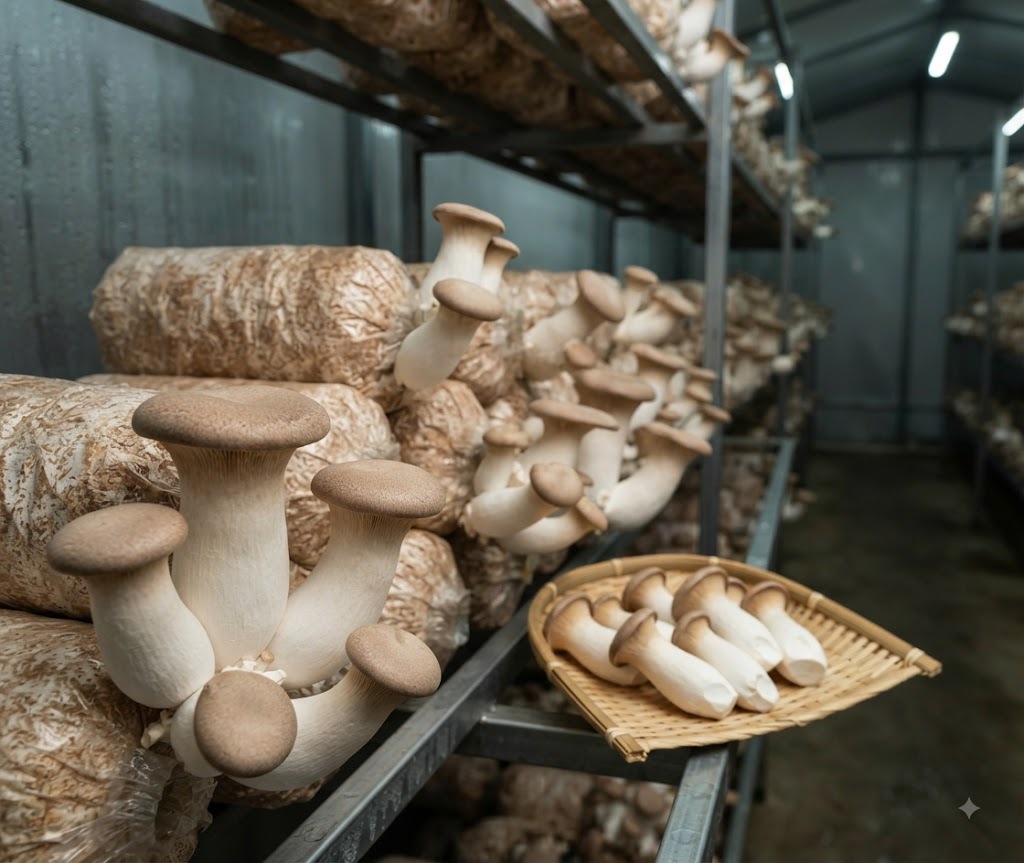
| production method | Bottle cultivation accounts for a high proportion commercially, and the production structure follows a process-based model of substrate preparation → bottling → sterilization → inoculation → culture → mycelial scraping → fruiting → thinning → growth → harvesting. Nongsaroo provides separate information on bottle-cultivated varieties and techniques for large oyster mushrooms. ( Nongsaroo ) |
| Harvesting principle | Manage Species, Strain, Spawn, Substrate, Bottle Lot, Germination Date, Thinning Date, Harvest Date, Stem Length, Thickness, Cap Diameter, Individual Weight, and Grade as mandatory Lot values. |
| Product separation | Separate into Whole Fresh → Premium Whole → Trimmed → Slice/Steak Cut → Frozen/Dried/Powder/HMR. |
| Separation of similar items | No. 189 Pleurotus ostreatus and Pleurotus eryngii are independent Species/Products. Therefore, P. eryngii is also managed as an independent Species in MycoBank. ( Mycobank ) |
| Importance of varieties | Nongsaroo explains that there are approximately 10 varieties of domestically cultivated king oyster mushrooms, and that each variety has a unique cultivation environment. Since hybridization can cause large-scale production losses, strain verification is essential. ( Nongsaroo ) |
| Domestic varieties | Korean Food presents the characteristics of varieties such as Keunneungari No. 2 and Aerini No. 3, and the cultivation period, days to harvest, and product form differ by variety . |
| Cultivation environment | The Nongsaroo Seolsong case suggests mycelial culture at 22–24°C for 35 days, fruiting at 14–16°C at 95% RH, and growth at 16°C at 80–90% RH at 1,200 ppm CO₂. This is a specific example for the variety and is not used as a fixed standard for all King Oyster mushrooms. ( Nongsaroo ) |
| Domestic statistics | Since the latest nationwide production volume, number of cultivating farms, and production value were not directly verified using the national approved statistical raw tables in this v1.0 version, they will be entered after official raw data verification. |
| export industry | Nongsaroo explains that domestic king oyster mushrooms are a representative mushroom exported overseas, citing past data showing annual exports exceeding $14 million. This figure is based on the time of data compilation and is not used as the 2026 export value. ( Nongsaroo ) |
| Supply and demand risk | The key factors are variety hybridization, spawn quality, substrate raw materials and sterilization, culture contamination, growth environment, thinning labor, individual uniformity, refrigeration and packaging, export shelf-life, and price fluctuations. |
| Operating Principles | Species/Strain–Spawn–Substrate–Bottle–Incubation–Fruiting–Thinning–Harvest–Product–Buyer Connect the RFQ. |
| Final goal | It is to connect the production history of varieties, spawn, and bottle cultivation to standards, export markets, and buyer repurchase. |
Basic fields | detail |
| Korean name | King oyster mushroom / Large oyster mushroom |
| English name | King Oyster Mushroom / King Trumpet Mushroom |
| Representative scientific name | Pleurotus eryngii (DC.) Quel. |
| classification | Fungi → Basidiomycota → Agaricomycetes → Agaricales → Pleurotaceae → Pleurotus |
| Fungal Name DB | MycoBank No.170772 ( Mycobank ) |
| Edible parts | fruiting body |
| Non-edible · Separate management | spawn, mycelium, culture medium, spent medium, contaminated medium, base |
| Major production stages | Medium preparation → Bottle filling → Sterilization → Cooling → Inoculation → Mycelial culture → Mycelial scraping → Fruiting → Thinning → Growth → Harvesting |
| Major harvesting stages | Stem length, thickness, cap diameter, cap shape, individual weight, Buyer Spec |
| Basic product form | Fresh Whole·Premium Whole·Trimmed·Slice·Steak Cut·Frozen·Dried·Powder |
| Basic processing stage | Sorting → Pre-cooling → Packaging or cutting → Freeze-drying → Grinding |
| Basic use | Grilled, Stir-fried, Hot Pot, Dining Out, School Meals, HMR, Meal Kits, Export |
| Similarity Principle | No. 189 Separation of Pleurotus ostreatus and other species, maintenance of Strain Masters by variety and strain |
MycoBank records not only Pleurotus eryngii but also subclassification names such as P. eryngii var. eryngii. Therefore, if a variety is specified in literature or spawn data, it is preserved as a Taxonomic Alias rather than being arbitrarily deleted. ( Mycobank )
Product Master
Product | Product stage | Key Management Standards |
| King Oyster Strain | strain | Species · Strain ID · Breeding Institute |
| Liquid Spawn | liquid spawn | Strain · Date of manufacture · Purity · Vitality |
| Solid Spawn | solid spawn | Strain · Medium · Lot |
| Sawdust Raw Material | Culture medium raw materials | Tree Species · Origin · Grain Size |
| Nutrient Material | Nutrition Center | Rice bran, etc. · Origin |
| Mixed Substrate | mixed medium | Formula · Moisture · Uniformity |
| Bottle Substrate | Bottle media | Bottle specifications and culture medium weight |
| Sterilized Bottle | Sterilization medium | Time, Temperature, Equipment |
| Inoculated Bottle | Inoculation medium | Spawn Lot · Inoculation Date |
| Incubated Bottle | Culture complete | Mycelial attachment and contamination |
| Scratched Bottle | After scraping off the fungus | Gum scraping date/condition |
| Primordia Lot | foot stage | Birth date · Individual count |
| Thinned Fruiting Lot | After thinning | Number of remaining entities · Work days |
| Fresh Whole King Oyster | Fresh king oyster mushrooms | Stem, Mustard, Weight, Harvest Date |
| Premium King Oyster | Premium fresh fruit | Size, uniformity, and surface |
| Small-size King Oyster | small | Variety, Standard, Use |
| Retail Pack | Retail packaging | Quantity, Weight, Packaging |
| Foodservice Bulk | For dining out | Specifications, Weight, Delivery Time |
| Trimmed King Oyster | Selected | Base removal · Appearance |
| Sliced King Oyster | sliced | Thickness and uniformity |
| Steak-cut King Oyster | Thick cut | Diameter, thickness, shape |
| Cubed/Strip Cut | For HMR | Cutting specifications |
| Frozen King Oyster | freezing | Pretreatment and freezing |
| Dried King Oyster | dry | Moisture, color, scent |
| King Oyster Powder | powder | Parent Lot · Grain Size |
| HMR Ingredient | Pre-treated products | Cutting, Microorganisms, Packaging |
| OEM·PB Product | finished product | Formula · MOQ · Contract |
| Spent Substrate | waste badges | Raw materials, pollution, and treatment |
Classification criteria | Subdivision type | Management principles |
| Species | Pleurotus eryngii | Primary Entity |
| Variety | P. eryngii var. eryngii, etc. | Official Taxonomy Confirmation |
| Varieties and strains | Large Pleurotus ostreatus No. 2, Aerini No. 3, Seolsong, etc. | Strain Master |
| spawn form | Liquid / Solid | Spawn Lot Separation |
| Edible parts | Fruiting Body | Separation of mycelium and culture medium |
| Cultivation type | Bottle cultivation center | Facility/Batch Management |
| badge | Sawdust + Nutrient | Separation by Formula |
| Foot condition | Primordia | Fruiting Stage |
| Thinning status | Before/After Thinning | Labor/Grade Management |
| Harvesting stage | Size, cap, and weight specifications | Buyer Grade |
| Distribution methods | Fresh / Chilled / Frozen / Dried | Product Separation |
| Preprocessing | Whole / Trimmed / Slice / Steak Cut | Product Separation |
| Processing form | Frozen · Dried · Powder · HMR | Processing |
| Final use | Retail·Grill·Foodservice·HMR·Export | Application |
| Transaction type | Regular Supply · Contract Production · OEM · PB · Export | RFQ |
step | Essential Dataset | Management purpose |
| Production plan | Species·Strain·Buyer Spec | Production Design |
| Strain identification | Strain ID · Gene identification | Identity |
| Genus management | Preservation Number · Household · Vitality | Genetic Stability |
| Liquid starter culture preparation | Culture medium, culture, purity | Spawn Quality |
| solid starter culture production | Badge · Lot | Spawn |
| sawdust delivery | Tree Species · Origin · Moisture | Raw Material |
| Nutrition Center Arrival | Type · Lot | Traceability |
| Media mixture | Formula · Moisture | Uniformity |
| mouth ulcers | Bottle specifications and filling weight | Batch |
| sterilization | Temperature and time | pollution prevention |
| cooling | Medium temperature and time | Vaccination preparation |
| inoculation | Spawn Lot · Date | Traceability |
| Mycelial culture | Temperature · Period · CO₂ | Colonization |
| Confirmation of variety contamination | DNA/Marker or Verification Method | Mix-up Prevention |
| Microbial contamination test | Bacteria and mold | Loss Control |
| Gum scraper | Date/Method | Fruiting Induction |
| feet | Primordial formation · Individuals | Yield Forecast |
| Thinning | Remaining population · Working hours | Product Size |
| growth | Temperature · RH · CO₂ · Light · Ventilation | Morphology |
| Harvest judgment | Large, large, and large individuals | Buyer Grade |
| harvest | Date, Weight, Number of Bottles | Harvest Lot |
| Trimming the base | Removal of substrate residue | Fresh QC |
| Selection | Size, shape, and damage | Grade |
| Pre-cooling | Fresh Product | Shelf-life |
| cold storage | Temperature and period | Quality |
| packaging | Object · Weight · Film | Retail/Export |
| sliced | thickness | Foodservice/HMR |
| Steak cutting | Diameter and thickness | Premium Application |
| freezing | Pretreatment and freezing | Frozen |
| dry | Temperature, time, moisture | Dried |
| smash | Island | Powder |
| shipment | Buyer · Quantity · Date | transaction |
| Escape from the disease | waste culture removal | Factory Cycle |
| Bottle washing | Cleaning and disinfection | Reuse |
| waste badges | Pollution, Raw Materials, Treatment | Circularity |
Quality items | Fresh king oyster mushrooms | Slicing and Pre-processing | Freeze-drying | finished product | Public rating |
| Species | essential | succession | succession | tracking | Public/Verified |
| Strain | essential | succession | succession | tracking | Verified |
| Spawn Lot | essential | succession | succession | tracking | Verified/NDA |
| Substrate Batch | essential | succession | succession | tracking | Verified/NDA |
| Bottle Lot | essential | succession | succession | tracking | Verified |
| production facilities | essential | succession | succession | tracking | Verified |
| Vaccination date | essential | succession | succession | tracking | Verified |
| Bal-i-il | essential | succession | succession | tracking | Verified |
| Thinning day | essential | succession | succession | tracking | Verified |
| Harvest day | essential | succession | succession | tracking | Verified |
| Among the objects | core | Raw material specifications | Raw material characteristics | By product | Verified |
| Great length | core | Before amputation | Raw material characteristics | By product | Verified |
| Thickness | core | Slice Yield | Raw material characteristics | By product | Verified |
| Cap diameter | core | Before amputation | Raw material characteristics | By product | Verified |
| God color | core | Raw material inheritance | Processed color | By product | Verified |
| Big color | core | Raw material inheritance | Processed color | By product | Verified |
| Cap shape | core | Raw material inheritance | — | By product | Verified |
| uniformity | core | uniform cutting | By product | core | Verified |
| Hardness and texture | core | core | Post-processing evaluation | By product | Verified |
| impairment | core | core | Raw material inspection | QC | Verified |
| deformity | core | Raw material inspection | — | — | Verified |
| Base and substrate residue | core | eliminate | Raw material inspection | — | Verified |
| alien substance | check | core | core | core | Verified |
| moisture | Fresh | By product | Drying core | By product | Verified |
| microorganism | If necessary | core | core | Conformity to standards | Verified/NDA |
| pesticide residues | Conformity to standards | test | succession | Conformity to standards | Verified/NDA |
| heavy metals | Risk-based | test | test | Conformity to standards | Verified/NDA |
| Pre-cooling and refrigeration | core | core | Before freezing | tracking | NDA |
| Cutting history | — | essential | succession | succession | NDA |
| Freeze-drying | — | — | essential | succession | NDA |
| packaging | essential | essential | essential | essential | Verified |
| Expiration date | By product | By product | By product | By product | Verified |
| Shipment | essential | essential | essential | essential | Verified |
| Returns and Claims | record | record | record | record | NDA |
| Repurchase | Buyer Connection | Buyer Connection | Buyer Connection | Buyer Connection | NDA |
The variety data from Agri-Food Olbaro indicates that Keunneungari No. 2 is characterized by low individual populations and heavy individual weight, while Aerini No. 3 is characterized by dense tissue and excellent quality. Therefore, individual weight, body shape, and texture are treated not merely as external indicators, but as key fields connecting Strain Performance and Buyer Grade. ( Korean Food )
Lot Master Required Field
Lot ID · Item/Product Type · Scientific Name · Variety/Strain · Variety Identification ID · Mother Culture ID · Spawn Type · Spawn Lot · Substrate Ingredients/Origin · Substrate Formula · Substrate Batch · Bottle Specifications/Substrate Weight · Sterilization/Cooling History · Production Facility/Room/Rack · Inoculation Date · Mycelial Culture Start/Completion Date · Mycelium Scrape Date · Fruiting Date · Thinning Date/Remaining Individuals · Harvest Date · Individual Weight · Stem Length/Thickness/Color · Cap Diameter/Color/Shape · Hardness/Texture · Uniformity · Deformity · Damage · Contamination · Base · Substrate Residue · Foreign Matter Check · Pesticide Residue/Microorganism/Heavy Metal Test Report · Pre-cooling/Refrigeration History · Raw Material Lot · Slicing/Cutting/Freezing/Drying/Grinding History · Packaging Date · Best Before Date · Shipper · Returns/Claims · Repurchase
Customers | Purchase criteria | Cooperation opportunities |
| breeding institutions | Strain · Market Trait | Variety Collaboration |
| spawn companies | Variety purity and vitality | Spawn RFQ |
| Culture medium raw material supplier | Sawdust, Nutrient Source, Safety | Input Supply |
| King Oyster Mushroom Production Factory | Variety · Substrate · Energy · Purchasing Agency | Production |
| Producer organizations | Scheduled Production · Joint Shipment | Supply |
| wholesale market | Individual weight · Large · Mustard · Freshness | Fresh |
| Large-scale distribution | Size, uniformity, and small packaging | Retail |
| Online distribution | Freshness, Packaging, Refrigeration | D2C |
| School and public meals | Domestic, Standards, Safety | Regular RFQ |
| food service companies | Thickness, Size, Price | Foodservice |
| Grilled meat and meat specialty restaurant | Thick stems and texture | Specialty |
| Hotel · Restaurant | Premium Whole Steak Cut | Premium |
| HMR | Slice/Cube | Ingredient |
| Meal kit | Fresh Cut · Weight | Meal-kit |
| Development of plant-based menus | Texture and cutting ability | New Food |
| frozen food | Slice/Frozen | Industrial |
| Dry/Powder | Ingredients and moisture | Ingredient |
| OEM·PB | Fresh Pack · HMR | Private Label |
| exporters | Breed · Size · Shelf-life | Export |
| smart farm companies | Environment, AI Sorting, Automation | AX |
| Research Institute | Variety · Medium · Gene Editing · Storage | R&D |
step | Key variables | Operational judgment |
| sarcoma | Domestic/Imported Varieties/IP | Genetic Supply |
| Source culture and spawn | Variety purity and vitality | Spawn |
| sawdust and nutrients | Origin · Price · Quality | Input |
| Media manufacturing | Formula · Moisture | Yield |
| Mouth disease and sterilization | Capacity·Automation | Factory |
| inoculation | Prevention of variety mixing | Traceability |
| culture | Period/Pollution Rate | Production |
| Thinning | Labor/Personnel | Grade |
| growth | Environment/Large/Gadus Shape | Quality |
| Harvesting and sorting | Among the objects · Standards | Fresh Supply |
| Pre-cooling and packaging | Shelf-life | Domestic/Export |
| Preprocessing | Slice/Steak/Cube | HMR |
| export | Variety, Standard, and Cold Storage | Global RFQ |
| Variety/IP | Licenses and spawn | Technology Trade |
| RFQ | Spec · Quantity · Delivery Date | Procurement |
| Repurchase | Quality, Price, Delivery Time | Supplier Score |
Trade Dataset
item | v1.0 processing |
| Fresh/Chilled King Oyster HS | Future verification of the Korea Customs Service's current HS-K |
| Frozen King Oyster HS | Verification by freezing state |
| Dried King Oyster HS | Confirmation of Dried Mushroom Subclassification |
| Prepared King Oyster HS | Verification by cutting and preparation status |
| Mushroom Powder HS | Verification by degree of processing |
| Spawn HS | Check spawn customs classification |
| Inoculated Substrate HS | Check by badge status |
| Korea's export volume | Input after official verification of raw data |
| Korea's export value | Input after official verification of raw data |
| Korea's import volume | Input after official verification of raw data |
| Major exporting countries | Verification of HS raw data by country |
| Major importing countries | Verification by country of origin |
| Customs clearance unit price | Calculation only within the same HS, Product, and Unit |
| FTA | Verification by Country, HS, and Criteria of Origin |
| Quarantine | Confirmation by spawn, inoculation medium, and fresh mushrooms |
| Variety license | Separate IP Dataset |
Products and processes | Key conditions | RFQ conversion |
| Premium Whole | Size, cap, individual weight, uniformity | Retail/Premium |
| Standard Whole | Specifications and Price | Retail |
| Small-size Whole | Variety/Size | HMR/Foodservice |
| Foodservice Bulk | Quantity, Weight, Delivery Date | Foodservice |
| Trimmed Whole | base removal | HMR |
| Thin Slice | Thickness and uniformity | Stir-fry/HMR |
| Thick Slice | Thickness and diameter | Grill |
| Steak Cut | Large diameter and thickness | Restaurant |
| Cube Cut | standard | HMR |
| Strip Cut | Length and width | Meal-kit |
| Frozen Slice | Pretreatment and freezing | Industrial |
| Dried Slice | Moisture and color | Ingredient |
| King Oyster Powder | Particle size and microorganisms | Seasoning |
| Extract | Parent Lot · Extraction Conditions | Food Ingredient |
| Off-grade Mushroom | Appearance/Deformity | Processing conversion |
| Small Fruiting Body | Undersized | HMR conversion |
| Trim Residue | base, etc. | Review of utilization after safety verification |
| Spent Substrate | waste badges | Review of feed, compost, and biomaterials |
| Contaminated Substrate | pollution | Food supply chain exclusion |
The Saene developer data released by the Gyeongnam Agricultural Research and Extension Services in 2025 specifies that while existing king oyster mushrooms possess excellent appearance and texture, they require significant labor for tasks such as thinning. Therefore, Thinning Labor is managed as an independent production cost variable in the king oyster PRP. ( Korea Data Strategy Committee )
PRP — Product Research Profile
King oyster mushroom PRP operates with the following structure.
Species → Strain/IP → Mother Culture → Spawn → Substrate Formula → Bottle → Sterilization → Incubation → Fruiting → Thinning → Harvest Grade → Processing → Buyer Application → RFQ Performance
PRP | Key research questions |
| Species PRP | Can P. eryngii and other Pleurotus be accurately distinguished? |
| Strain PRP | How do culture, germination, growth, and quality characteristics differ by variety? |
| Spawn PRP | Are the variety purity and vitality of the source and liquid spawn guaranteed? |
| Variety Verification PRP | Can hybrids and erroneous registrations be quickly identified? |
| Substrate PRP | How do sawdust, nutrients, and moisture affect yield and individual size? |
| Bottle PRP | Are the culture medium weight and bottle specifications suitable for the number of individuals and quantity? |
| Thinning PRP | What is the optimal relationship between the number of surviving individuals and the population weight and large thickness? |
| Morphology PRP | How CO₂, temperature, and humidity are connected to stem and cap shapes |
| Fresh PRP | Do the stem thickness, cap, and texture match the Buyer Grade? |
| Slice PRP | Are cutting yield, browning, and microorganisms suitable for HMR? |
| Export PRP | Do the packaging, refrigeration, and shelf-life meet the destination country's requirements? |
| Automation PRP | Is it possible to automate thinning, sorting, and packaging? |
| By-product PRP | What are the safe conversion routes for spent badges and off-grade materials? |
first of all | Execution item | Performance indicators |
| 1 | Species·Strain·Mother Culture·Spawn·Lot become mandatory values | Identity completion rate |
| 2 | One-stop variety identification DB connection | Variety Verification Rate |
| 3 | Automatic recording of culture medium ingredients, formula, and moisture | Substrate Traceability |
| 4 | Automatic bottle weight measurement | Bottle CV |
| 5 | Sterilization and Cooling Data Connection | Process Compliance |
| 6 | Strain Barcode at Vaccination | Mix-up Rate |
| 7 | Mycelial culture video AI | Colonization Score |
| 8 | Contamination AI determination | Contamination Detection |
| 9 | Automatic measurement of foot population | Primordia Count |
| 10 | AI Thinning Target Determination | Thinning Efficiency |
| 11 | Thinning robot demonstration | Labor Hours/kg |
| 12 | Automatic control of temperature, RH, CO₂, and ventilation | Environment Stability |
| 13 | Image measurement of stem length, thickness, and cap | Grade Accuracy |
| 14 | Prediction among individuals | Yield Forecast |
| 15 | Harvest timing prediction | Harvest Accuracy |
| 16 | Automatic sorting | Grade Throughput |
| 17 | Pre-cooling and Refrigeration IoT | Cold-chain Coverage |
| 18 | Export Shelf-life forecast | Rejection Rate |
| 19 | Product–Buyer AI Match | RFQ → Sample Conversion Rate |
| 20 | Buyer Evaluation → Strain Improvement Connection | Repeat Order Rate |
Problem group | Problem Definition | Required data |
| Confusion with oyster mushrooms | Treating the same genus Pleurotus as the same item | Species |
| hybrid breed | Mixing of other varieties during the spawn manufacturing and distribution process | DNA/Strain ID |
| Wonkyun generational management | Quality may change during long-term serialization | Culture History |
| Liquid spawn quality | Variation in vitality, contamination, and purity | Spawn QC |
| Variation in culture medium raw materials | Sawdust and Nutrient Quality Fluctuation | Substrate |
| Variation in substrate moisture | Effect on mycelium and yield | Moisture |
| Variation in bottle weight | Non-uniform individual productivity | Bottle Weight |
| Poor sterilization | bacterial contamination | Sterilization |
| Inoculation contamination | Batch loss | Inoculation |
| Heterogeneous mycelial culture | Production difference by bottle | Colonization |
| The feet are uneven | Differences in thinning and harvesting times | Primordia |
| Excessive occurrence | Increased thinning labor and decreased population weight | Fruiting Count |
| Thinning labor | Increase in production costs | Labor |
| Temperature deviation | Growth differences by variety | Temperature |
| humidity deviation | Shape and surface quality | RH |
| CO₂ deviation | Non-uniform stem and cap shape | CO₂ |
| Thickness deviation | Buyer Grade downgrade | Stem Diameter |
| God oversized/undersized | Deviation from product specifications | Cap Diameter |
| deformity | Complex problem of environment, variety, and culture medium | Vision |
| Harvest labor | Individual selection and harvesting burden | Labor |
| freshness deterioration | Storage and export losses | Cold Chain |
| Browning and surface damage | Decline in retail marketability | Color/Image |
| microorganism | Pre-processing and HMR Safety | Microbiology |
| Export Zhejiang Province | Responding to the long-distance market | Shelf-life |
| overproduction | Simultaneous shipment from large-scale factories | Supply |
| Price fluctuations | Short-term supply and demand in the Fresh market | Market Price |
| waste badges | Mass by-products | SMS |
| Variety IP | Management of rights to domestic varieties and technologies | License |
| Buyer Spec Discrepancy | Differences in demand between domestic, dining out, and exports | RFQ |
| Repurchase not reflected | Buyer results unlinked to Strain/Farm improvement | Evaluation |
RFQ Type | Public Registration | Verify/NDA |
| King oyster mushroom strain | Species · Strain · Uses | Breeding organs and performance |
| Supply of original bacteria | Variety/Origin | Culture ID · Rights |
| liquid spawn | Strain · Shape | Purity · Vitality · Lot · Unit Price |
| solid spawn | Strain · Shape | Manufacturer · Lot |
| sawdust supply | Tree Species · Origin | Volume/Unit Price |
| Nutrition supply | Type · Origin | Ingredients and Price |
| Bottle medium supply | Specifications and Applicable Product Types | Formula · Quantity |
| Selling fresh king oyster mushrooms | Variety, Specifications, Origin | Farm · Quantity · Actual Unit Price |
| Buy fresh king oyster mushrooms | Large, large, and large individuals | Target quantity and price |
| Premium Whole | Standards and uniformity | Buyer Spec |
| Regular supply | Grade · Period | Weekly/Monthly Volume |
| contract production | Strain · Standard | Facilities · Capacity · Unit Price |
| School meal delivery | Domestic and safe | Cycle/Volume |
| Foodservice delivery | Thickness/Weight | Buyer demand |
| For grilling | Large diameter and texture | Restaurant Spec |
| HMR · Meal Kit | Slice/Cube | Microorganisms and Packaging |
| frozen food | Slice/Cut | Freeze · MOQ |
| Dry/Powder | Ingredients and moisture | COA · Price |
| OEM·PB | Fresh/HMR | Formula·MOQ |
| export | Fresh·Grade | Destination Country · HS · Shelf-life |
| Variety identification | Strain Verification | DNA/Marker |
| Automation demonstration | Thinning, sorting, and packaging | Production data |
| Smart farm demonstration | Environment and quantity | raw data |
| Waste badge cooperation | Raw material composition | Quantity and processing |
| Research cooperation | Variety · Gene Editing · Medium · Storage | IP · Exam materials |
① Need Products & Materials
Companies and institutions seeking necessary products, agricultural products, raw materials, and processed goods register purchasing demands. Registered requests are utilized to review cooperation with potential suppliers and producers based on the RFQ Intelligence Library.
Process:
RFQ Registration → Supplier/Product Review → Collaboration Connection → Future AI Matching
Register
② We are looking for production and manufacturing partners. (Need Suppliers & Manufacturers)
Register a request to find necessary production and supply partners, ranging from farms and producer organizations to processing companies, OEM, ODM, and Private Label manufacturers.
Process:
RFQ Registration → Review of Production & Manufacturing Capabilities → Collaboration Connection → Future AI Partner Matching
Register
③ We are looking for domestic and international buyers. (Need Buyers)
Farmers, producer organizations, and manufacturing companies are requesting cooperation with new buyers, such as domestic and international distributors, importers, brand companies, and food service and catering businesses.
Process:
RFQ Registration → Product & Supply Capability Review → Market & Buyer Connection → Future AI Buyer Matching
Register
Contact : mail@markethub.org
Version | Main contents | situation |
| v1.0 | P. eryngii Identity · No.189 Oyster Mushroom Isolation · Strain–Mother Culture–Spawn · Bottle Cultivation · Thinning · Fresh · Slice · Export · RFQ Basic Structure Registration | complete |
| v1.1 | Verification of raw data for national and regional production statistics, domestic varieties, mother strains, factory status, HS codes, imports and exports, and price formulas | expected |
| v2.0 | Quality, Yield, and PRP segmentation by Strain, Spawn, Substrate, Bottle, Thinning, Fresh Grade, Slice/Steak, and Export | expected |
| v3.0 | Breeding Institutions – Source & Spawn Companies – Culture Medium Companies – King Oyster Mushroom Factories – Pre-processing, HMR, Foodservice, Distribution – Combination of Overseas Buyer Verified Containers | expected |