

Judgment axis | Key judgment |
| Item Identity | Gim is not a single species but a commodity encompassing various edible gim species and varieties; therefore, the Species, Variety, and Lineage must be linked to an actual Lot. The National Institute of Fisheries Science presents five types of gim that can be used as domestic food ingredients. ( National Institute of Fisheries Science ) |
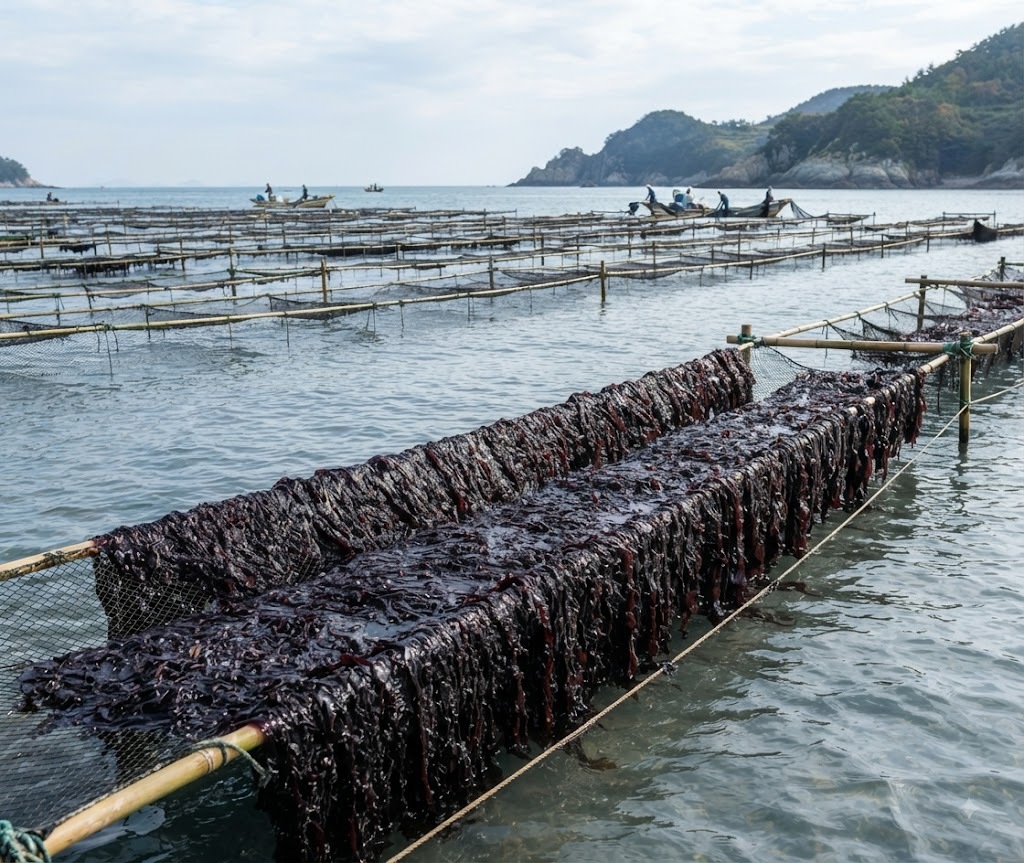
| Key role | It is a representative seafood product that handles both domestic consumption and export by adding high value to farmed raw seaweed into dried laver, roasted laver, seasoned laver, snacks, and powder. |
| Harvesting principle | Classify the farm, species, variety, seed lot, spat collection date, rearing area, collection order, collection date, raw material weight, color, foreign matter, moisture, and quality into a Lot. |
| Product separation | Separate seeds → cultivation nets → wet seaweed → dried seaweed → roasted seaweed → seasoned seaweed → seaweed snacks, seaweed powder, and complex processed products into independent products. |
| Separation of similar items | For *Chamgim*, *Bangsamunigim*, *Itbadidolgim*, *Momunuidolgim*, and *Dunggeundolgim*, the Species Entity is separated, while product names such as *Gopchanggim* are managed as Product Aliases after verifying the Species and varieties. |
| domestic production | The Ministry of Oceans and Fisheries announced in August 2026 that the domestic production of laver in 2025 is 718,000 tons . This is based on the production volume of major aquaculture items. ( Ministry of Finance and Economy ) |
| export | In 2025, seaweed exports reached $1.13 billion , a 13.7% increase from the previous year , marking an all-time high. ( Ministry of Finance and Economy ) |
| Supply Chain Policy | The government is pursuing the establishment of a stable laver production base of over 180 million bundles annually by 2030 , the stockpiling of dried laver, the AI grading system, and the expansion of smart factories and physical AI. ( Ministry of Finance and Economy ) |
| Seed Risk | Because it is difficult to distinguish laver species based on morphology alone, the National Institute of Fisheries Science developed DNA markers for *Pteris multifida*, *Pteris radiata*, *Pteris mouli*, and *Pteris ittadi*. ( National Institute of Fisheries Science ) |
| Climate Risk | Gim is a type of seaweed that grows from autumn to winter, and high water temperatures pose a risk of seaweed diseases, physiological disorders, and reduced yields. ( National Institute of Fisheries Science ) |
| Operating Principles | Connect Species/Strain–Seed–Farm Site–Net–Harvest–Wet GIM–Dried GIM–Seasoned GIM–Buyer RFQ. |
| Final goal | We manage quality and supply stability simultaneously by connecting the entire process genealogy, from farmed raw materials to processing, export, and buyer evaluation. |
The Ministry of Oceans and Fisheries officially announced that South Korea's laver production is projected to reach 718,000 tons in 2025. In the same year, laver exports recorded an all-time high of $1.13 billion, demonstrating that laver has grown from a mere raw seafood product into a core processed food item in the national export supply chain. ( Ministry of Finance and Economy )
Basic fields | detail |
| Korean name | seaweed |
| English name | GIM / Laver / Nori series product names |
| Representative Food Species | True laver, Radial laver, Itbadi stone laver, Momuni stone laver, Round stone laver |
| Representative scientific name examples | Pyropia yezoensis lineage, etc. — Verification of the latest taxonomy by actual lot |
| classification | Rhodophyta red algae |
| Edible parts | thallus |
| Non-edible · Separate management | Filaments · Shell filaments · Seed cultures · Culture nets · Attached organisms · Discarded raw materials |
| Major production stages | Seed production → Seedling collection → Seedling cultivation → Main cultivation → Harvesting → Regeneration → Repeated harvesting |
| Major harvesting stages | Leaf length, color, thickness, maturity, harvesting date, and raw material quality |
| Basic product form | Fresh seaweed, dried seaweed, roasted seaweed, seasoned seaweed, gimbap seaweed, lunchbox seaweed, seaweed flakes, seaweed snacks |
| Basic processing stage | Raw material → Washing → Removal of foreign matter → Cutting/Solution → Preparation → Drying → Sorting → Roasting/Seasoning → Packaging |
| Basic use | Home cooking, Gimbap, School meals, Dining out, HMR, Snacks, Seasonings, Exports |
| Similarity Principle | Separate Species, trade names, and variety names, and manage them separately from other seaweeds such as wakame and kelp. |
The National Institute of Fisheries Science has published official data summarizing the characteristics of 12 species and 2 varieties of laver native to Korea , as well as 4 species and 18 strains being cultivated at the time . Since these figures reflect the survey scope of 2013, they are not used directly as the current number of species and varieties; however, they serve as the official basis establishing that the classification of Species, Variety, and Strain is essential in the laver industry. ( National Institute of Fisheries Science )
In addition, in 2019, the National Institute of Fisheries Science developed mitochondrial DNA markers for *Pteris multifida*, *Pteris radiata*, *Pteris mouli*, and *Pteris lutea*, and implemented a service to identify species at the seed stage. ( National Institute of Fisheries Science )
Product Master
Product | Product stage | Key Management Standards |
| GIM Species Master | Biological Entity | Species · Taxonomy · Food Usability |
| Variety/Strain | Varieties and lineages | Variety Name · Breeding Agency · Variety Protection |
| Free-living Conchocelis | glass filament | Species·Culture ID |
| Shell Conchocelis | Shell filaments | Species · Production Date · Vitality |
| Seed Lot | satellite | Species DNA · Varieties · Manufacturers |
| Seeded Net | Seed collection net | Net ID · Seedling Collection Date · Seed Lot |
| Nursery Net | Seedling net | Sea area, water temperature, and net conditions |
| Grow-out Net | Main cultivation network | Farm Site·Net ID |
| Wet GIM | Water seaweed/raw seaweed | Species · Harvesting Order · Origin · Weight |
| Premium Wet Gim | High-quality raw materials | Color, leaflets, foreign matter, processing suitability |
| Gopchang GIM Product | Gopchang Gim product | Verification of actual species and breed is essential |
| Dried GIM | dried seaweed | Longevity, speed, weight, moisture, color, luster |
| Sushi/Gimbap GIM | For Gimbap | Strength, color, holes, uniformity |
| Roasted GIM | Roasted seaweed | Roasting conditions, moisture, color |
| Seasoned GIM | Seasoned seaweed | Oil, Salt, Seasoning Formula |
| Lunchbox GIM | Lunchbox seaweed | Cutting size · Packaging unit |
| GIM Flake | Seaweed flakes | Cutting, seasoning, moisture |
| GIM Powder | dried seaweed flakes | Particle size, foreign matter, moisture |
| GIM Snack | snacks | Formula · Oil · Seasoning |
| OEM·PB GIM | finished product | Recipe · MOQ · Country-specific display |
| Export GIM | export products | Destination Country · Packaging · Certification · Label |
| Off-grade Wet GIM | Non-commercial raw materials | Processing conversion after safety verification |
| Processing Residue | Processing by-products | Separate verification of food, feed, and material utilization |
Classification criteria | Subdivision type | Management principles |
| Species | True laver, Radial laver, Itbadi stone laver, Momuni stone laver, Round stone laver | Separation of Species and Entities |
| Varieties and lineages | Domestic varieties, registered varieties, and lineage | Variety Master |
| Seed form | Glassy filaments, shell filaments, spat collection nets | Product Separation |
| Formation method | Holding type, floating type, etc. | Farm Type |
| sea area | Actual fishing grounds such as the West Sea and South Sea | Farm Site |
| Seedling status | Seedling collection, seedling cultivation, and main training | Production Stage |
| Collection round | 1st, 2nd, and repeated sampling | Harvest Lot |
| primitive form | Fresh seaweed, premium raw seaweed, for processing | Wet GIM Product |
| Primary processing | dried seaweed | Dried Product |
| Secondary processing | Roasted seaweed and seasoned seaweed | Processed Product |
| Detailed uses | For Gimbap, Lunch Boxes, Snacks, Powder | Application |
| Transaction type | Auction · Production Area Contract · Regular Procurement · OEM · PB · Export | RFQ separation |
step | Essential Dataset | Management purpose |
| Production plan | Species · Breeds · Sea Area · Buyer | Production Design |
| Imitation management | Species·Strain ID | Genetic Identity |
| filamentous culture | Culture ID · Incubation Date | Seed Production |
| Shell filaments | Shell Lot·Vitality | Seed Quality |
| Spore release | Timing and environment | Seed collection |
| Seed collection | Seed Lot · Net ID · Date | Traceability |
| Seedling cultivation | Water temperature, netting, and thallus | Nursery |
| Main positive | Sea Area/Fishing Ground/Net ID | Production |
| water temperature | Daily and weekly | Growth and High Temperature Risk |
| salt | Observation value | growing environment |
| Nutrients | Nitrogen, phosphorus, etc. | Quality and Yellowing Risk |
| Solar radiation and weather | Temperature and waves | Production Risk |
| disease | Gaetbyeong, etc. | Loss Control |
| Attached organisms | Diatoms and foreign matter | quality |
| First collection | Date/Original Weight | Harvest |
| Repeated sampling | Sampling order and interval | Yield |
| Collection at the production site | Time · Weight | Logistics |
| Auction | Origin, Volume, Price | Market |
| Raw selection | Color, length, and foreign matter | Processing |
| purifying | Water and time | Food Safety |
| Foreign object removal | Shells, marine debris, etc. | QC |
| Shredded | Island | Choje |
| Liquid | Concentration and homogeneity | Sheet Quality |
| Choje | Raw material quantity per sheet · Molding | Dried GIM |
| dehydration | moisture removal | Drying |
| dry | Temperature, time, and final moisture | Stability |
| Selection | Color, gloss, holes, foreign matter | Grade |
| Bundles and inner packaging | Longevity/Weight | Trading Unit |
| roast | Temperature and time | Roasted GIM |
| seasoning | Oil, Salt, Seasoning | Seasoned GIM |
| cutting | Gimbap, lunch boxes, snacks | Product |
| packaging | Oxygen, moisture, and shading | Shelf-life |
| save | Temperature and humidity | Quality |
| shipment | Buyer · Quantity · Lot | Delivery |
Laver primarily grows from autumn to winter, and high water temperatures can lead to diseases and physiological disorders, potentially reducing production. To address this climate change, the National Institute of Fisheries Science has researched laver's heat tolerance genes and officially proposed the need to develop heat-tolerant varieties. ( National Institute of Fisheries Science )
Quality items | Water seaweed | dried seaweed | Roasted and seasoned seaweed | finished product | Public rating |
| Species | essential | succession | succession | tracking | Public/Verified |
| Variety/Strain | essential | succession | succession | tracking | Verified |
| Seed Lot | essential | succession | succession | tracking | Verified/NDA |
| sea area | essential | succession | succession | origin | Public/Verified |
| Farm Site | essential | succession | succession | tracking | Verified/NDA |
| Net ID | essential | succession | succession | tracking | Verified |
| Collection round | core | succession | succession | tracking | Verified |
| Collection date | essential | succession | succession | tracking | Verified |
| primordial color | core | color | Grilled color | Product color | Verified |
| Falseness length | core | Raw material characteristics | — | — | Verified |
| Falseness | core | Raw material characteristics | — | — | Verified |
| Original foreign matter | core | core | core | core | Verified |
| primordial moisture | Fresh | — | — | — | Verified |
| Weight per sheet | — | core | succession | Product specifications | Verified |
| moisture | — | core | core | core | Verified |
| Color and gloss | — | core | core | core | Verified |
| Holes/Damage | — | Grade | Grade | Grade | Verified |
| Uniform thickness | — | core | core | By product | Verified |
| alien substance | core | core | core | core | Verified |
| microorganism | If necessary | test | core | core | Verified/NDA |
| heavy metals | test | test | test | test | Verified/NDA |
| radioactivity | When required by policy or exporting country | If necessary | If necessary | If necessary | Verified/NDA |
| Washing water | — | Process essential | succession | succession | NDA |
| Drying history | — | essential | succession | succession | NDA |
| Grilling conditions | — | — | essential | succession | NDA |
| Seasoning | — | — | essential | succession | NDA |
| Salt and seasoning | — | — | essential | succession | NDA |
| rancidity indicator | — | — | Review of seasoning products | finished product | Verified/NDA |
| packaging | raw transport | moisture-proof | Oxygen and moisture resistance | By product | Verified |
| Expiration date | — | By product | By product | By product | Verified |
| Shipment | essential | essential | essential | essential | Verified |
| Returns and Claims | record | record | record | record | NDA |
| Repurchase | Buyer Connection | Buyer Connection | Buyer Connection | Buyer Connection | NDA |
The government's 2026 plan for innovation in the dried seaweed supply chain proposed introducing an AI-based grading system and enhancing transparency in grade-based transactions. Accordingly, MarketHub will add AI Grade ID, Model Version, Defect Score, and Color/Gloss Score to the Lot Dataset in the future, in addition to the existing visual grade. ( Ministry of Finance and Economy )
Furthermore, as the government is promoting the development of heavy metal reduction technologies and strengthening hygiene management during the dried seaweed manufacturing process, heavy metals need to be linked not only to simple raw material inspection but also to Processing PRP. ( Ministry of Finance and Economy )
Lot Master Required Field
Lot ID · Item/Product Type · Species · Variety/Strain · Species DNA Verification · Seed Producer · Conchocelis ID · Seed Lot · Seed Collection Date · Seeded Net ID · Farming Method · Farm Site/Sea Area · Aquaculture Farm/Producer Organization · Seedling Date · Main Rearing Date · Water Temperature/Salinity/Nutrients · Diseases/Yellowing/Attached Organisms · Collection Cycle · Collection Date/Time · Raw Weight/Color/Fall Length/Thickness · Foreign Matter/Abnormal Condition · Wet GIM Lot · Local Auction/Collection · Washing/Foreign Matter Removal · Cutting/Picking/Dehydration/Drying History · Dried GIM Lot · Weight per Sheet/Moisture/Color/Gloss/Pores · Grade · Test Reports for Microorganisms, Heavy Metals, Radioactivity, etc. · Roasting/Seasoning/Cutting History · Packaging Date · Best Before Date · Exporting Country/Buyer · Returns/Claims · Repurchase
Customers | Purchase criteria | Cooperation opportunities |
| Seed producers | Species·Varieties·DNA | Seed RFQ |
| fish farms | Seed, Seedling Quality, and High Temperature Response | Production |
| Producer organizations | Sea area · Expected production · Auction | Supply |
| Raw materials wholesale | Fresh seaweed quality and harvesting cycle | Procurement |
| Dried seaweed processing plant | Color, foreign matter, and raw material yield | Primary Processing |
| Seasoned seaweed companies | Dried seaweed Grade · Moisture · Strength | Secondary Processing |
| Gimbap seaweed company | Strength, uniformity, color | Foodservice |
| school meals | Domestic, Safety, Standards | Regular RFQ |
| Foodservice and franchises | Gimbap seaweed · Roasted seaweed | Contract |
| HMR | Cut, Flake, Powder | Ingredient |
| Large-scale distribution | Brand, Weight, Seasoning | Retail |
| online | Small packaging · Brand · Origin | D2C |
| PB | Recipe · Package · MOQ | Private Label |
| snack companies | Seasoning · Texture | Snack |
| Overseas Retail | Roasted/Seasoned GIM | Export |
| Overseas Foodservice | Sushi/Gimbap GIM | Export B2B |
| exporters | Country-specific Labels, Certifications, and Shelf-life | Export RFQ |
| logistics center | Low-moisture, storage, and export logistics | Supply Chain |
| Research Institute | Seeds, high water temperature, disease, processing | R&D |
| AX Company | AI Grade · Foreign Object Inspection · Automated Packaging | Smart Factory |
step | Key variables | Operational judgment |
| satellite | Species · Varieties · Variety Rights | Genetic Supply |
| Seed collection | Timing and Attachment Rate | Production Start |
| Aquaculture area | Water temperature, salinity, and nutrients | Harvest Risk |
| Water seaweed production | Sampling order and weight | Raw Supply |
| Fish market | Quantity, Quality, Price | Price Discovery |
| Raw material procurement | Contract/Transportation Time | Processor Supply |
| Dried seaweed processing | Yield · Grade | Primary Processing |
| save | Moisture and stock | Supply Adjustment |
| Grilled and seasoned | Recipe · Oil · Salt | Value Add |
| packaging | Country · Buyer Spec | Export Readiness |
| Domestic distribution | Retail, catering, and foodservice | Domestic Demand |
| export | Country, Type, Price | Global Demand |
| RFQ | Product·Grade·Volume | Procurement |
| Repurchase | Quality, Delivery, Claims | Supplier Score |
Gim exports are projected to reach a record high of $1.13 billion in 2025. The Ministry of Oceans and Fisheries attributes this to expanded demand in overseas markets, including North America and Europe, as well as the development of diverse products. ( Ministry of Finance and Economy )
By 2026, the government has proposed a direction to expand the export share of seasoned laver to 60% and to promote the English name "GIM" for Korean-style laver. Accordingly, Dried Laver, Seasoned GIM, and GIM Snack will be maintained as separate product categories in the export RFQ. ( Ministry of Finance and Economy )
Trade Dataset
item | v1.0 processing |
| Kim HS Code | Future direct verification of current HSK by product type |
| Dried seaweed HS | Verification by product description and degree of processing |
| Seasoned Seaweed HS | Verification based on preparation and seasoning status |
| Seaweed Snack HS | Verification by formulation and processing type |
| Gimgaru HS | Verification by composition and degree of processing |
| 2025 export value | $1.13 billion — Officially confirmed ( Ministry of Finance and Economy ) |
| 2025 Export Value by Country | Input after verification of raw data by the Korea Customs Service |
| Export volume | Input later after official HS raw data verification |
| Import volume | Input later after official HS raw data verification |
| Major exporting countries | Verification of raw data by country |
| Major importing countries | Verification of raw data by country |
| Customs clearance unit price | Calculation only within the same HS, product type, and unit |
| FTA | Verification by Country, HS, and Criteria of Origin |
| Food certification | Confirm by Destination Country and Buyer |
| Label | Check ingredients, allergens, and nutritional labeling by country |
| Intellectual property rights | GIM·Brand·Trademark Management |
Products and processes | Key conditions | RFQ conversion |
| Wet GIM | Species · Origin · Harvesting Date | Raw Material RFQ |
| Premium Wet Gim | Color, foreign matter, thallus | Premium Dried |
| Dried GIM | Moisture, color, gloss, strength | Processor RFQ |
| Gimbap GIM | Strength, holes, uniformity | Foodservice |
| Sushi GIM | Grade · Roasting | Export |
| Roasted GIM | Roasting temperature and color | Retail |
| Seasoned GIM | Oil, salt, and seasoning | Retail/Export |
| Lunchbox GIM | Cutting and small packaging | Retail |
| GIM Flake | Cutting and seasoning | HMR |
| GIM Powder | Moisture, particle size, and foreign matter | Ingredient |
| GIM Snack | Texture·Seasoning | Export Snack |
| Seaweed Mix | Mix of other seaweeds | HMR |
| OEM·PB | Formula·Package | Private Label |
| Export GIM | Destination Country · Label | Global RFQ |
| Off-grade Dried GIM | Below Grade | Powder/Flake Review |
| Broken Sheet | break | Seaweed flakes and seasoned seaweed |
| Trimming Residue | Cutting by-products | Review of food conversion |
| Wash Residue | Contains foreign matter | Food supply chain exclusion |
| Waste Net/Plastic | Aquaculture materials | Separate management of resource circulation |
PRP — Product Research Profile
Kim PRP operates with the following structure.
Species → Variety/Strain → Seed → Farm Environment → Harvest → Wet GIM Quality → Drying Yield → Dried GIM Grade → Seasoning/Processing → Buyer Application → RFQ Performance
PRP | Key research questions |
| Species PRP | Are they actually food-grade species? |
| Seed PRP | Are seed species, varieties, and DNA identities confirmed? |
| High-temperature PRP | How does high-temperature tolerance by variety affect production stability? |
| Farm PRP | How do water temperature, salinity, and nutrients affect growth, color, and quality? |
| Harvest PRP | What are the differences in raw material quality and yield by harvesting cycle? |
| Wet GIM PRP | How raw color, thallus, and foreign matter are connected to dried seaweed grade |
| Drying PRP | What are the yield and quality of dried laver per 1 kg of raw laver? |
| Grade PRP | How color, gloss, holes, thickness, and foreign matter are related to price |
| AI Grade PRP | Does the AI rating match the existing expert grade? |
| Seasoning PRP | How do oil, salt, and grilling conditions affect taste, rancidity, and shelf life? |
| Export PRP | How do taste, size, packaging, and label requirements differ by country? |
| By-product PRP | What is the conversion yield of broken laver and substandard laver into laver powder and seasoned laver? |
first of all | Execution item | Performance indicators |
| 1 | Make Species, Varieties, and Seed Lot mandatory | Species Traceability |
| 2 | DNA species identification link | Seed Verification Rate |
| 3 | Fish farm GIS registration | Farm Coverage |
| 4 | Form Network · Net ID Assignment | Net Traceability |
| 5 | Water temperature, salinity, and nutrients IoT | Environment Coverage |
| 6 | Linking satellite and ocean observation data | Marine Risk Coverage |
| 7 | High temperature and chlorosis prediction | Early Warning Accuracy |
| 8 | Prediction of extraction volume | Harvest Forecast |
| 9 | Quality analysis by sampling round | Grade Prediction |
| 10 | AI Quality Assessment of Water Seaweed Videos | Raw Grade Accuracy |
| 11 | Dried seaweed AI grading system | Grade Accuracy |
| 12 | AI foreign object inspection | Foreign Matter Detection |
| 13 | Automatic control of initial processing and drying | Process Stability |
| 14 | Automatic packaging | Packs/hour |
| 15 | Physical AI Process Automation | Automation Ratio |
| 16 | Raw seaweed → Dried seaweed yield prediction | Yield Accuracy |
| 17 | Production, Inventory, and Price Forecasting | Supply Forecast |
| 18 | Product–Buyer AI Match | RFQ Conversion |
| 19 | Claim → Farm/Processing Lot Traceback | Trace Time |
| 20 | Buyer Evaluation → Improvement of Species and Sea Areas | Repeat Order Rate |
Problem group | Problem Definition | Required data |
| Mixed Species | Seaweed product name does not indicate Species | Taxonomy |
| illegal seeds | Risk of production and distribution of domestic unapproved seeds | DNA/Seed |
| Mixing of varieties | Mixed seed production stages | Strain |
| High temperature | Growth, disease, and production decline | Water Temperature |
| climate change | Changes in production period and suitable location | Climate |
| Yellowing | Quality degradation due to nutrient deficiency, etc. | Nutrients |
| Gaetbyeong | Aquaculture net production loss | Disease |
| marine pollution | Original safety risk | Water Quality |
| Attached organisms and foreign matter | Deterioration of dried seaweed quality | Foreign Matter |
| Fluctuation in extraction volume | Production deviations by sea area and period | Harvest |
| Raw price fluctuations | Impact of export demand and production volume | Auction Price |
| Discontinuity of raw-processing history | Form Lot not connected to finished product | Traceability |
| Dried Seaweed Grade Opaque | Lack of standardization in transaction grades | AI Grade |
| Foreign object inspection labor | dependence on manpower | Vision AI |
| Initial yield deviation | Differences in raw materials, equipment, and processes | Processing |
| Drying deviation | Changes in moisture, color, and gloss | Drying |
| heavy metals | Raw material and processing safety management | Test |
| Seasoning oil rancidity | Seasoned Seaweed Shelf-life | Oil Quality |
| Lack of processing automation | Labor shortage and productivity | Factory |
| Storage/Inventory Shortage | Limitations in responding to supply and demand fluctuations | Inventory |
| Domestic-export competition | Conflict between export expansion and domestic prices | Demand |
| Price increase | Consumer price burden | Retail Price |
| Export country standard vehicle | Diverse requirements for label, flavor, and packaging | Buyer Spec |
| Country of Origin/Brand | K-GIM Counterfeiting · Brand Risk | IP/Origin |
| Low value-added structure of processed goods | Excessive specific gravity of dried seaweed | Product Mix |
| waste aquaculture materials | Marine Environment and Resource Circulation | Waste |
| Repurchase not reflected | Buyer evaluation not linked to variety/sea area improvement | Evaluation |
RFQ Type | Public Registration | Verify/NDA |
| Seaweed seed supply | Species · Varieties | Company · DNA · Quantity · Unit Price |
| Shell filaments | Species · Varieties | Lot · Vitality · Price |
| Seed collection net | Species · Seedling Collection Date | Seed Lot · Quantity |
| Seaweed sales | Species · Origin · Harvesting Date | Fish price, quantity, actual unit price |
| Buying fresh seaweed | Original Spec | Daily demand and price |
| Regular supply | Sea Area/Sea Season | Weekly/Monthly Volume |
| Mountain land contract | Species·Season | Producer, quantity, price |
| dried seaweed supply | Grade · Standard | Manufacturer, Quantity, Price |
| Gimbap seaweed | Robbery, Color, Longevity | Buyer Spec |
| Roasted seaweed | Grade·Roast | MOQ · Price |
| Seasoned seaweed | Formula General Information | Recipe · MOQ · Price |
| Lunchbox seaweed | Weight · Package | Production capacity and unit price |
| dried seaweed flakes | Particle size and moisture | Parent Lot·COA |
| Seaweed snack | Flavor·Pack | Recipe · MOQ |
| School meal delivery | Domestic and safe | Period/Quantity |
| Foodservice supply | For Gimbap and Grilling | Monthly demand and price |
| HMR | Flake Powder | Spec·COA |
| OEM | Product Type | Recipe · MOQ |
| PB | Brand·Package | Contract terms |
| export | Country/Product Type | HS · Certification · Price |
| AI Grade Verification | dried seaweed | Image·Grade Data |
| Verification of foreign substance inspection | dried seaweed | Vision Dataset |
| smart factory | Preparation, drying, and packaging | Process Data |
| Research cooperation | Variety, high temperature, disease | IP · Exam materials |
① Need Products & Materials
Companies and institutions seeking necessary products, agricultural products, raw materials, and processed goods register purchasing demands. Registered requests are utilized to review cooperation with potential suppliers and producers based on the RFQ Intelligence Library.
Process:
RFQ Registration → Supplier/Product Review → Collaboration Connection → Future AI Matching
Register
② We are looking for production and manufacturing partners. (Need Suppliers & Manufacturers)
Register a request to find necessary production and supply partners, ranging from farms and producer organizations to processing companies, OEM, ODM, and Private Label manufacturers.
Process:
RFQ Registration → Review of Production & Manufacturing Capabilities → Collaboration Connection → Future AI Partner Matching
Register
③ We are looking for domestic and international buyers. (Need Buyers)
Farmers, producer organizations, and manufacturing companies are requesting cooperation with new buyers, such as domestic and international distributors, importers, brand companies, and food service and catering businesses.
Process:
RFQ Registration → Product & Supply Capability Review → Market & Buyer Connection → Future AI Buyer Matching
Register
Contact : mail@markethub.org
Version | Main contents | situation |
| v1.0 | Gim Commodity · 5 Species · Seed DNA · Cultivation Net · Wet Gim · Dried Gim · Roasted Gim · Seasoned Gim · Export · AI Grade · RFQ Basic Structure Registration | complete |
| v1.1 | Verification of raw data for production statistics by species, production volume by region, seeds, aquaculture farms, exports and imports by HS code, and auction prices | expected |
| v2.0 | Seed · Farm Environment · Harvest Round · Wet GIM · Preparation · Drying · AI Grade · Seasoned GIM · Quality by Export · Yield · PRP Segmentation | expected |
| v3.0 | Seed Company – Aquaculture Farms/Producer Organizations – On-site Auction – Dried Seaweed Factory – Seasoned Seaweed/OEM/PB – Domestic Distribution/Overseas Buyer Verified Container Combination | expected |