

Judgment axis | Key judgment |
| Item Identity | Maca is managed primarily by Lepidium meyenii Walp. of the Brassicaceae family and is an accepted species in Kew's current taxonomy. ( Plants of the World Online ) |
| Key role | It is a specialty crop of the Peruvian Andes that is processed in multiple stages from fresh and dried enlarged parts into dried maca, powder, gelatinized powder, extracts, beverages, and food ingredients. |
| Harvesting principle | The maturity, origin, cultivation site, harvest date, and color phenotype of the enlarged edible part are managed on a Lot basis. Specific harvest time and moisture standards are entered after verification of official cultivation data. |
| Product separation | Separate into Fresh Maca → Dried Maca → Raw Powder → Gelatinized Powder → Extract → Blend/Finished Product. |
| Separation of similar items | The naming issues of L. meyenii and L. peruvianum are not arbitrarily merged but are managed under the Botanical Alias/Taxonomy Verification field. Other Lepidium species are separate Plant Entities. ( Promperú ) |
| Domestic statistics | National approved statistics on the commercial cultivation area and production volume of maca in South Korea were not verified in this v1.0; therefore, they will be entered later after verification of official raw data. |
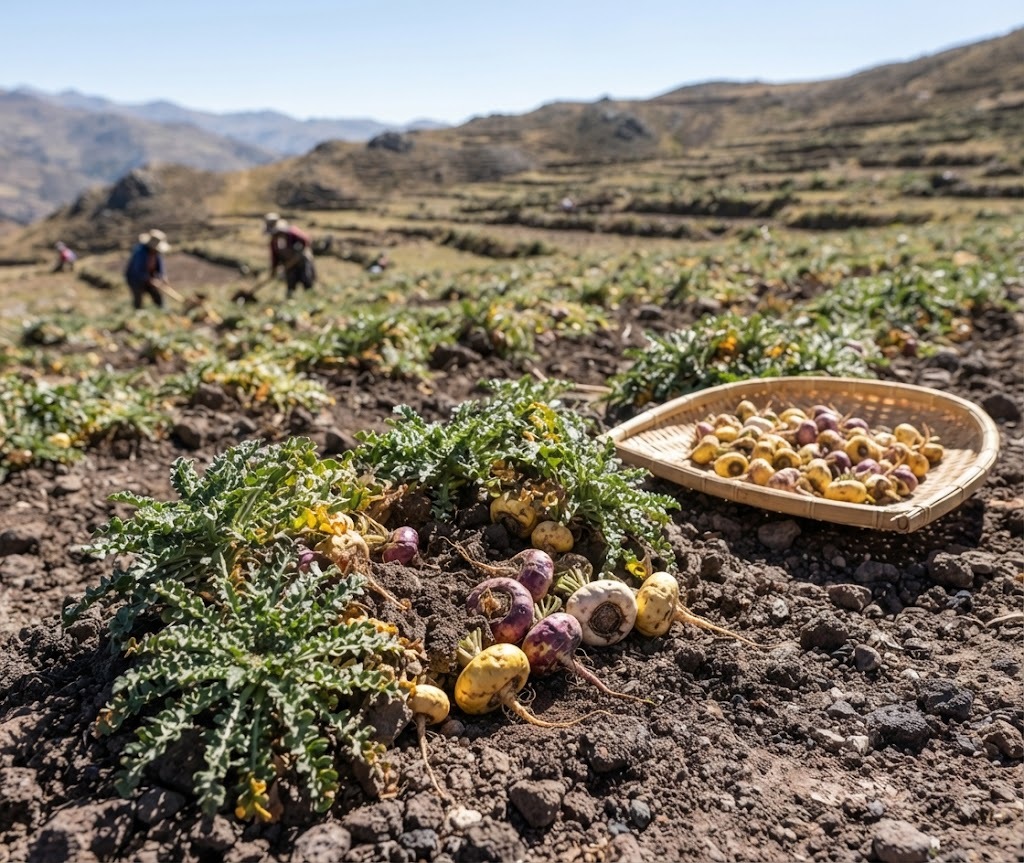
| overseas production base | Maca is a representative crop of the central Andean highlands of Peru, and Peruvian public research data describes it as a crop cultivated at altitudes above 4,000 meters. This altitude is managed as a characteristic of specific research and cultivation areas. ( Rpmesp ) |
| origin protection | Maca Junín-Pasco is a designation of origin protected by Peru's INDECOPI, covering fresh and dried maca. ( Indecopi Repository ) |
| Supply and demand risk | The key factors are alpine climate, soil, monoculture, mislabeling of origin, mixing of color phenotypes, drying, microorganisms, pesticide residues, heavy metals, powder authenticity, processing method, yield, international price, and exchange rate. |
| Operating Principles | Species-Origin-Farm-Phenotype-Harvest Lot-Drying-Powder/Gelatinized/Extract-Buyer Connect RFQ. |
| Final goal | It is to establish Traceable Supply Intelligence that extends from agricultural products in the Peruvian highlands to global food, powder, and extract raw materials. |
Basic fields | detail |
| Korean name | Maca |
| English name | Maca / Peruvian Maca |
| Representative scientific name | Lepidium meyenii Walp. |
| classification | Brassicaceae → Lepidium → L. meyenii |
| Edible parts | Mainly enlarged hypocotyl and root |
| Non-edible · Separate management | Leaves, flowers, seeds, cultivation residues, etc. are separated from the food-grade enlarged parts. |
| Major harvesting stages | The maturity stage of non-loan goods and processing purposes |
| Basic product form | Fresh Maca·Dried Maca·Slices·Powder·Gelatinized Powder·Extract |
| Basic processing stage | Harvesting → Washing → Sorting → Drying → Cutting/Grinding → Gelatinization/Extraction/Concentration |
| Basic use | Food, Beverage, Powder, Mixed Food, Extract Raw Material |
| Principle of similar items | L. meyenii Primary Entity, L. peruvianum name separate Taxonomy Verification, other Lepidium spp. separate Entity |
Kew manages Lepidium meyenii as an accepted species. Since PROMPERÚ’s Maca Botanical Data shows that both L. meyenii and L. peruvianum names have been discussed in Peru, commercial practices do not establish botanical identity solely as “Maca.” ( Plants of the World Online )
Product Master
Product | Product stage | Key Management Standards |
| Maca Seed Lot | breeding materials | Species·Seed Center·Lot |
| Maca Field Lot | production stage | Origin · Farm · Altitude · Sowing Date · Field History |
| Fresh Maca Hypocotyl/Root | Harvested raw materials | Harvest date, origin, color, size, damage |
| Fresh Maca – DO Candidate | Origin type | Junín/Pasco/Origin Evidence |
| Cleaned Maca | Preprocessing | Washing water, foreign matter, appearance |
| Selected Maca | Selected items | Color·Size·Defect·Lot |
| Dried Whole Maca | dried raw materials | Moisture · Drying History · Origin |
| Dried Maca Slice | cut parts | Raw Material Lot, Thickness, Dryness |
| Raw Maca Powder | Crushed product | Raw Material Lot, Particle Size, Microorganisms, Authenticity |
| Gelatinized Maca Powder | heat processing powder | Raw Material Lot · Heat/Moisture Processing · Batch |
| Maca Flour | food ingredients | Powder specifications, particle size, microorganisms |
| Maca Extract | Extracted raw materials | Raw Material Type · Solvent · Concentration · Batch |
| Maca Concentrate | Concentrated raw materials | Solid content and raw material ratio |
| Maca Beverage Ingredient | Beverage ingredients | Dispersibility, scent, color, safety |
| Maca Blend | mixed products | Maca Content · Other Ingredients · Formula |
| Maca Finished Food | finished product | Actual food type, labeling, and ingredient content |
| OEM·PB Maca Product | B2B finished products | Formula · MOQ · Specifications · Contract |
Classification criteria | Subdivision type | Management principles |
| Plant classification | Lepidium meyenii | Primary Species |
| Taxonomy Alias | L. peruvianum et al. | Official Taxonomy Re-verification |
| Edible parts | Hypocotyl/root complex | Separation from Leaf and Seed |
| Color phenotype | Actual Lot colors such as yellow, red, and black | Do not separate species based solely on color name. |
| Harvesting stage | Fresh market · Mature stage for drying | Buyer Goal Connection |
| Cultivation method | Alpine cultivation | Farm·Altitude records |
| origin | Peru→Junín/Pasco etc.→Farm | Traceability |
| Name of origin | Maca Junín-Pasco | DO Evidence Separate |
| Distribution methods | Fresh · Dried · Sliced | Product ID |
| Processing form | Raw Powder·Gelatinized·Extract·Concentrate | Independent Product |
| Final use | Food, Beverage, Powder, Blend, Ingredient | Application |
| Transaction type | Source Procurement · Bulk · Regular Supply · OEM · PB · Export | RFQ |
| certification | Organic, Food Safety, Origin, etc. | Verify actual certificate |
A review of maca by the Peruvian Institute of Public Health explains that maca is an alpine crop cultivated in the central Peruvian Andes at elevations of over 4,000 meters. This figure is used as a reference to describe the production environment centered in Peru, rather than representing the absolute global cultivation range of maca. ( Rpmesp )
step | Essential Dataset | Management purpose |
| Cultivation plan | Species·Origin·Color phenotype·Area·Buyer | Production plan |
| Securing seeds | Source · Seed Lot · Color System | Identity |
| sowing | Sowing date, plot, and sowing rate | Field Traceability |
| germination | Appearance date/density | Growth management |
| Growth management | Leaf growth and enlargement status | Harvest Forecast |
| altitude | Farm altitude | Origin Environment |
| soil | Soil type, pH, organic matter, and field crop | Long-term productivity |
| Field History | Previous maca cultivation and crop rotation | Soil Risk |
| rising | Temperature, rainfall, frost, dryness | Production Risk |
| Watering | Method · Suwon · History | Production Management |
| dispute | Materials, Timing, and Quantity | Quality and Safety |
| pests | Occurrence, Control, and Pesticides | Loss and Safety |
| Harvest judgment | Size, maturity, and weather of the enlarged part | Harvesting at the right time |
| harvest | Date, Section, Weight | Harvest Lot |
| Color selection | Yellow, Red, Black, etc. | Product Segmentation |
| purifying | Water quality and processes | Foreign matter and hygiene |
| Selection | Size, damage, decay | Grade |
| Fresh Maca Storage | Period/Environment | Fresh Quality |
| dry | Method, period, moisture | Dried Product |
| Storage and aging | Environment/Period | Quality stability |
| cutting | Thickness · Batch | Slice |
| smash | Particle Size · Equipment · Batch | Powder |
| gelatinization | Heat, moisture, and process | Gelatinized Powder |
| extraction | Raw materials, solvent, time, temperature | Extract |
| concentration | Solid content and process | Concentrate |
| packaging | Weight · Material · Lot | shipment |
Quality items | Fresh Maca | Dried Maca | Raw/Gelatinized Powder | Extract | finished product | Public rating |
| Species | essential | succession | succession | succession | tracking | Public/Verified |
| Taxonomy Name | essential | essential | succession | succession | tracking | Verified |
| Origin | essential | essential | essential | succession | mark | Public/Verified |
| DO status | The relevant city | succession | Inheritance of raw materials | Inheritance of raw materials | Mark verification | Verified |
| Farm | essential | succession | succession | succession | tracking | Verified |
| Altitude | record | succession | succession | succession | — | Member/Verified |
| Color phenotype | essential | essential | essential | Inheritance of raw materials | Mark verification | Member/Verified |
| Lot | essential | essential | essential | essential | essential | Verified/NDA |
| Harvest day | essential | succession | succession | succession | tracking | Verified |
| appearance | Color, shape, and damage | Color and dryness | Raw material inspection | By product | QC | Member |
| weight | essential | Packaging weight | Batch | Batch | finished product | NDA |
| size | core | Grade | — | — | — | Member |
| rating | Origin standards | Buyer Grade | Product Spec | Product Spec | QC | Member |
| decay and mold | core | core | test | Raw material verification | Conformity to standards | Verified |
| alien substance | check | core | core | core | core | Verified |
| moisture | Fresh condition | core | By product | By product | By product | Verified |
| pesticide residues | Production history | test | Inheritance of raw materials | Raw material verification | Conformity to standards | Verified/NDA |
| microorganism | If necessary | test | core | By product | Conformity to standards | Verified/NDA |
| heavy metals | Risk-based inspection | test | Raw material inheritance/inspection | test | Conformity to standards | Verified/NDA |
| authenticity | Species·Origin | core | Reinforcement in powder | Raw material verification | tracking | Verified/NDA |
| Drying history | — | essential | succession | succession | tracking | Verified |
| Grinding history | — | — | Raw powder is essential. | succession | tracking | Verified/NDA |
| gelatinization | — | — | This product is required | succession | tracking | NDA |
| Extraction history | — | — | — | essential | succession | NDA |
| packaging | Fresh packaging | essential | essential | essential | essential | Verified |
| Expiration date | By product | By product | By product | By product | essential | Verified |
| Shipment | essential | essential | essential | essential | essential | Verified |
| Returns | record | record | record | record | record | NDA |
| Claim | record | record | record | record | record | NDA |
| Repurchase | Buyer Connection | Buyer Connection | Buyer Connection | Buyer Connection | Buyer Connection | NDA |
It is more difficult to identify the species and origin of powder through appearance than with fresh or dried whole maca. Therefore, Powder/Extract Products must inherit from the Parent Dried Maca Lot .
Lot Master Required Field
Lot ID · Item/Product Type · Scientific Name · Taxonomy Alias · Edible Part · Color Phenotype · Country/Region/DO Status · Farm/Altitude · Producer · Seed Lot · Sowing Date · Harvest Date · Quality Indicators · Weight/Size/Specifications/Grade · Appearance/Damage/Spoilage/Foreign Matter Check · Pesticide Use History · Pesticide Residue/Microorganism/Heavy Metal Test Report · Washing/Drying/Storage History · Raw Material Lot · Cutting/Grinding/Gelatinization/Extraction/Concentration History · Packaging Date · Best Before Date · Shipper · Returns/Claims · Repurchase
Customers | Purchase criteria | Cooperation opportunities |
| Maca Importer/Distributor | Species·Origin·Color·Raw/Gelatinized | Peru Supplier RFQ |
| health food manufacturers | Powder · Extract · Safety · Raw Material Specifications | B2B Ingredient |
| General food manufacturers | Powder, fragrance, particle size, microorganisms | Food Ingredient |
| Beverage manufacturer | Powder · Extract · Dispersibility | Beverage |
| Smoothie and shake companies | Powder · Flavor · Particle Size | Foodservice |
| Confectionery and Bakery | Powder · Color · Flavor | Bakery |
| Cereals and Energy Bars | Powder · Mixed | Functional-style Food |
| HMR | Powder · Blend | Meal Product |
| cafe | Powder·Beverage Blend | Cafe Ingredient |
| Online/Distribution | Origin · Color · Processing Type | Retail |
| PB | Powder, Blend, Drink | Private Label |
| OEM manufacturer | Raw Material Specifications · Formula | OEM |
| Extraction company | Raw/Gelatinized Raw Material/Yield | Extract RFQ |
| Export and re-export companies | Origin·HS·Standard | Processed Product |
| Research Institute | taxonomy · cultivation · color · ingredients · processing | R&D |
The supply chain for Peruvian maca is managed based on a structure of high-altitude cultivation → Fresh/Dried Maca → Powder/Gelatinization/Extraction → Export → Import/Processing in Korea → Buyer .
Past official market data from Promperú mentions policies in Peru that have restricted the export of raw maca in its natural state, so it is essential to distinguish between raw agricultural products and processed export products. However, as this data is from 2016, current export regulations for 2026 will be applied only after reconfirming the latest regulations from SENASA, Promperú, and Peruvian Customs. ( Promperú )
step | Key variables | Operational judgment |
| Peruvian mountain production | Region·Farm·Altitude·Color | Origin |
| DO production | Junín/Pasco·Proof | Premium Origin |
| harvest | Fresh Lot · Harvest Date | Raw Material |
| dry | Moisture and drying period | Export Raw Material |
| smash | Raw Powder | B2B |
| gelatinization | Process · Batch | Processed Ingredient |
| extraction | Solvent and Concentration | Extract |
| export | Product Form · Origin · Proof | Peru Trade |
| International Logistics | Packaging, Humidity, Delivery Time | Quality |
| Korean imports | HS · Food Ingredients · Customs Clearance | Compliance |
| Domestic processing | Mixing, Serving, Beverages | Product |
| OEM·PB | Formula·MOQ | B2B |
| delivery | Buyer Spec | RFQ |
| Repurchase | Quality, Price, Performance | Supplier Score |
Trade Dataset
item | v1.0 processing |
| Fresh Maca HS | Current Peru/Korea detailed codes to be verified later |
| Dried Maca HS | Input after verifying product classification formula |
| Maca Powder HS | Subsequent verification of Korea Customs Service HS-K |
| Gelatinized Maca | Separate HS verification based on degree of processing |
| Maca Extract | Separate verification of extract classification |
| Korea's import volume | Input after official verification of raw data |
| Korean import value | Input after official verification of raw data |
| Major countries of origin | Korea Customs Service verification of raw data by country of origin |
| Peru export volume | Input after verifying the latest SUNAT/PROMPERÚ raw data |
| Customs clearance unit price | Calculated using the same HS code, product type, and unit |
| DO | Maca Junín-Pasco Origin Evidence |
| Quarantine | Check by Fresh/Dried/Processed |
| FTA | Check the Korea-Peru Agreement and Rules of Origin by HS Code |
| food ingredients | Check MFDS Raw Material Recognition and Standards by Form |
Products and processes | Key conditions | RFQ conversion |
| Fresh Maca | Species · Origin · Color · Size | Fresh/Processing RFQ |
| Cleaned Maca | Cleaning/Foreign matter | Processor |
| Dried Whole Maca | Moisture · Origin · Color | Bulk Ingredient |
| Dried Slice | Thickness · Dryness | Tea/Food |
| Raw Maca Powder | Particle Size, Microorganisms, Raw Material Lot | Food Manufacturer |
| Gelatinized Maca Powder | Process · Batch · Particle Size | Premium Ingredient |
| Maca Flour | Standardization and Dispersion | Bakery/Food |
| Maca Extract | Raw materials, solvents, and concentration | Beverage/Ingredient |
| Maca Concentrate | Solid content and yield | B2B |
| Maca Blend | Formula · Content | Food/PB |
| Maca Beverage | Ingredient Content · Formula | OEM/RTD |
| Powder by color | Yellow/Red/Black Ingredient Proof | Specialized Buyer |
| Non-commercial items | Damage/Deterioration | Verification of the possibility of processing conversion |
| Peel/Trim Residue | Processing by-products | Separate verification for food and feed utilization |
| Extraction Residue | extraction residue | Review of the use of compost, feed, and biomass |
In general maca products, “gelatinized” is a processing stage different from simple powder, so a Process Entity must be created.
When converting to food, health functional, pharmaceutical, or cosmetic materials, the regulations regarding ingredient recognition, safety, and functionality of each country must be verified separately, and the results of physiological activity in research papers are not directly expressed as the functionality of commercial products.
PRP — Product Research Profile
Maca PRP operates with the following structure.
PRP | Key research questions |
| Fresh Maca PRP | Which farm, color, and harvest stage raw material is suitable for drying and powder processing? |
| Dried Maca PRP | How the drying process is connected to moisture, appearance, and shelf life |
| Raw Powder PRP | Are the Dried Parent Lot, particle size, microorganisms, and authenticity suitable? |
| Gelatinized Powder PRP | How processing conditions and raw material lots are connected to final physical properties and quality |
| Extract PRP | Do the raw material form, solvent, concentration, and yield meet the Buyer Spec? |
| Origin PRP | Do you have the proof of production and origin required for the Maca Junín-Pasco DO label? |
| Export PRP | Is it compliant with the destination country's HS, quarantine, food ingredient, and labeling regulations? |
first of all | Execution item | Performance indicators |
| 1 | Species·Taxonomy Alias·Origin·Farm·Harvest Lot required value | Essential Field Completion Rate |
| 2 | Separation of Fresh·Dried·Raw Powder·Gelatinized·Extract Product | Product identification rate |
| 3 | Linking altitude, soil, weather, growth, and harvest data | Field–Lot Connection Rate |
| 4 | Field History · Crop Rotation Data | Soil history completion rate |
| 5 | Color phenotype image classification | Color classification accuracy |
| 6 | AI screening for appearance, decay, and damage | Selection accuracy |
| 7 | Datafication of drying, moisture, and storage history | Post-harvest record rate |
| 8 | Powder upstream genealogy becomes essential | Parent Lot Connection Rate |
| 9 | Processing yield prediction | Dry→Powder Yield Error |
| 10 | Gelatinized/Extract Batch Data Conversion | Process Traceability |
| 11 | Origin/DO Verification Automation | Origin Evidence Completion Rate |
| 12 | Product–Buyer AI Match | RFQ → Sample Conversion Rate |
| 13 | Price, Supply and Demand, and Export Forecasts | Forecast error |
| 14 | Buyer Ratings & Repurchase Link | Repeat Order Rate |
Problem group | Problem Definition | Required data |
| L. meyenii–L. peruvianum naming issue | Mixed taxonomy of supply documents and research data | Accepted Name·Alias |
| Other Lepidium Contamination | Maca and similar species can be mixed. | Species Verification |
| Origin misspelling | Verification of labels such as Peru·Junín/Pasco is required | Origin Evidence |
| DO misuse | Conditions for the use of the protected name Maca Junín-Pasco | DO Certificate |
| Mixed color phenotypes | Unclear distinction between products such as Yellow/Red/Black | Color Dataset |
| Seed lineage unknown | Reduced traceability of color and traits | Seed Lot |
| Alpine climate risk | Frost, dryness, and weather conditions affect production volume | Climate |
| Soil monoculture risk | Soil problems due to repeated cultivation | Field History |
| Fluctuation in production volume | Decline in global procurement stability | Yield |
| Harvest maturity variation | Impact on drying and processing yields | Harvest Maturity |
| Drying deviation | Moisture, mold, and quality changes | Drying |
| microorganism | Safety of powder products | COA |
| pesticide residues | Production Site Safety | Spray Record |
| heavy metals | Need to verify risks related to alpine soil and raw materials | Test Result |
| Raw–Gelatinized confusion | Selling products with different manufacturing processes as the same | Process Record |
| Powder authenticity | Unidentifiable exterior | Botanical/Traceability |
| Extract, unknown ingredients | Parent Lot Disconnection | Genealogy |
| Changes in export regulations | Differences in Peru’s Export Regulations for Raw and Processed Goods | Regulatory Runtime |
| HS error | Fresh/Dried/Powder/Extract Code Differences | HS Mapping |
| Buyer Spec Discrepancy | Requirements vary for powders, beverages, and private brands. | RFQ Spec |
| Price and Exchange Rate | Changes in Peru's procurement costs | Trade/FX |
| Discontinuation of repurchase | Actual usability not reflected | Buyer Evaluation |
RFQ Type | Public Registration | Verify/NDA |
| Peru Fresh Maca Procurement | Species·Region·Color | Farm · Quantity · Unit Price |
| Maca Junín-Pasco | DO Status · Fresh/Dried | Proof of Origin · Lot |
| Dried Whole Maca | Origin·Color·Harvest | Moisture · COA · Price |
| Dried Slice | Origin · Thickness | Lot · Price |
| Raw Powder | Origin · Color · Grain Size | Parent Lot · COA · Price |
| Gelatinized Powder | Processing Type · Color | Process · MOQ · Unit Price |
| Maca Flour | Product Specifications and Uses | Microorganisms and prices |
| Maca Extract | Raw Material Form · Application | Solvent, Concentration, Yield |
| Concentrate | Standard specifications | Solids · Formula |
| Beverage Ingredient | Powder/Extract | Actual Spec |
| Regular supply | Product Cycle | Monthly Volume and Contract Unit Price |
| OEM·PB | Powder, Blend, Drink | Formula · MOQ · Contract |
| Food manufacturing | Raw material form · General specifications | COA · Price |
| Export and re-export | Origin·Product | HS · Country of Origin · Price |
| Technology demonstration | Color, Drying, and AI Sorting | raw data |
| Soil and Cultivation Research | Farm·Field History | Soil data |
| Origin Research | Junín/Pasco· DO | Evidence |
| Research cooperation | taxonomy · quality · processing | IP and test materials |
① Need Products & Materials
Companies and institutions seeking necessary products, agricultural products, raw materials, and processed goods register purchasing demands. Registered requests are utilized to review cooperation with potential suppliers and producers based on the RFQ Intelligence Library.
Process:
RFQ Registration → Supplier/Product Review → Collaboration Connection → Future AI Matching
Register
② We are looking for production and manufacturing partners. (Need Suppliers & Manufacturers)
Register a request to find necessary production and supply partners, ranging from farms and producer organizations to processing companies, OEM, ODM, and Private Label manufacturers.
Process:
RFQ Registration → Review of Production & Manufacturing Capabilities → Collaboration Connection → Future AI Partner Matching
Register
③ We are looking for domestic and international buyers. (Need Buyers)
Farmers, producer organizations, and manufacturing companies are requesting cooperation with new buyers, such as domestic and international distributors, importers, brand companies, and food service and catering businesses.
Process:
RFQ Registration → Product & Supply Capability Review → Market & Buyer Connection → Future AI Buyer Matching
Register
Contact : mail@markethub.org
Version | Main contents | situation |
| v1.0 | Plant Identity · Taxonomy Name Management · Peru Origin · Maca Junín-Pasco DO · Fresh/Dried/Powder/Gelatinized/Extract · RFQ Basic Structure Registration | complete |
| v1.1 | Verification of the latest official raw data on production, import/export, HS, and food ingredients in Peru and Korea | expected |
| v2.0 | Segmentation of Quality, Processing, and Origin PRP by Color Phenotype, Raw Powder, Gelatinized Powder, and Extract | expected |
| v3.0 | Peru Farm·DO Producer–Processor–Exporter–Korean Import/Processing Company–Food·Beverage·PB Buyer Verified Container Combination | expected |