

Judgment axis | Key judgment |
| Item Identity | The representative plant entity of the baobab plant is Adansonia digitata L. of the Malvaceae family, and it is managed as an accepted species in Kew. ( Plants of the World Online ) |
| Key role | It is a multi-purpose African tree resource that separates the mature and internal naturally dried pulp to convert it into Fruit Pulp, Powder, Beverage Ingredient, etc., and utilizes seeds and oil through a separate supply chain. |
| Edible parts | The core product of No. 186 is fruit pulp . While leaves, seeds, and kernels have traditionally been consumed, their status as food ingredients varies by country and is verified separately. FAO data and AGRIS research confirm various food uses for baobab leaves, pulp, and seeds. ( Agris ) |
| Harvesting principle | Record Species, Origin, Tree/Collection Area, Harvest Season, Fruit Maturity, and Fruit Integrity, and separate pulp, seeds, and peels from mature fruits. Enter specific harvest month and yield after obtaining regional formula/verified data. |
| Product separation | It branches into Whole Fruit → Fruit Pulp → Sifted Pulp → Powder / Beverage Ingredient and Whole Fruit → Seeds → Kernel/Oil. |
| Separation of similar items | Other Adansonia species, such as Adansonia digitata and Madagascar, are managed as a separate Plant Entity. ( Plants of the World Online ) |
| International food regulations | In 2008, the EU approved dried fruit pulp of *A. digitata* as a Novel Food ingredient and listed it on the Union List as Baobab fruit pulp. ( EUR-Lex ) |
| Domestic production statistics | The latest government-approved statistics on the commercial cultivation area and production volume of baobab in South Korea were not verified in this v1.0; therefore, they will be entered later after verification of official raw data. |
| production structure | Internationally, since supply chains based on local communities and the collection of native resources are important in addition to cultivation farms, Cultivated, Wild-collected, and Agroforestry varieties are managed separately. FAO data treats the baobab as a major tree food and agroforestry resource in sub-Saharan Africa. ( Open Knowledge FAO ) |
| Supply and demand risk | The key issues are the mixing of species and origin, wild collection traceability, sustainable harvesting, fruit and pulp foreign matter, moisture and microorganisms, powder authenticity, particle size, seed contamination, import standards, exchange rates and logistics, and confusion regarding the use of seed oil. |
| Operating Principles | Species-Country-Collection/Farm Area-Tree/Harvest Lot-Fruit Lot-Pulp Batch-Powder/Oil Product-COA-Buyer Connect RFQ. |
| Final goal | It is to maintain the Parent Lot from production and collection to pulp, powder, seeds, and oil, and to connect it with the recurring procurement of global buyers. |
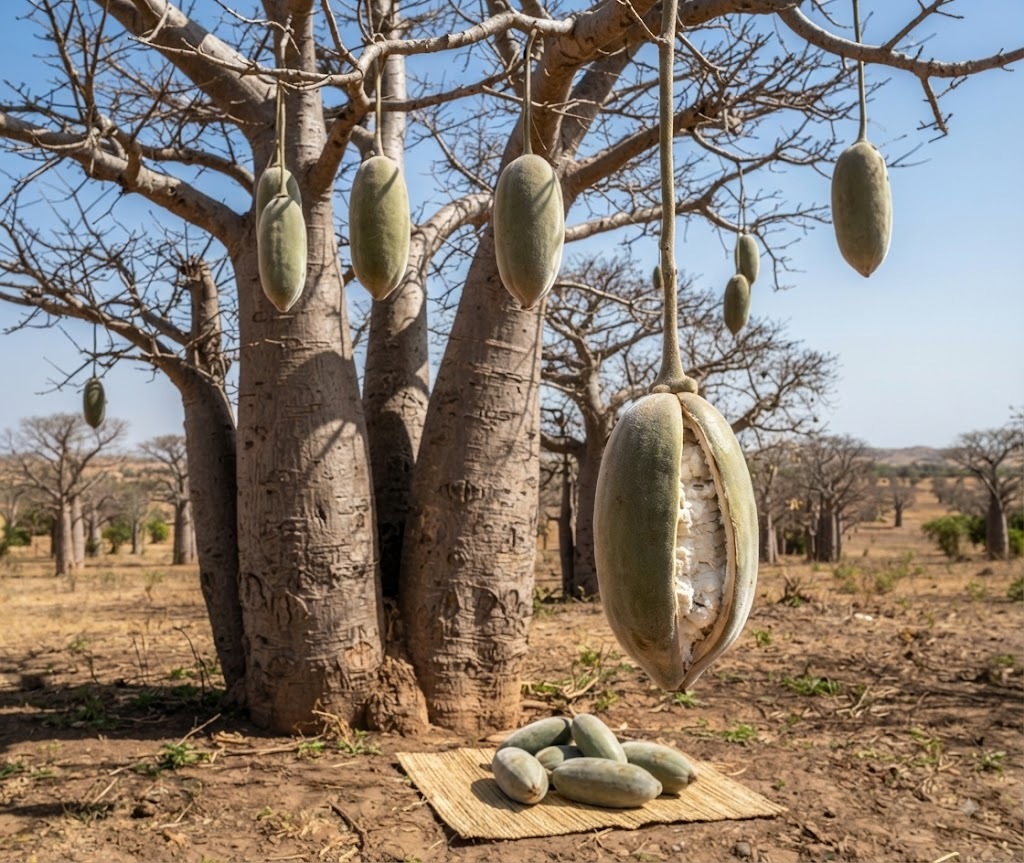
Kew describes A. digitata as a tree that grows primarily in seasonally dry tropical biomes and explains that it is widely distributed in the arid regions of Africa. ( Plants of the World Online )
FAO materials related to Africa's Forgotten Foods also present the fruit pulp of Adansonia digitata as an edible food resource traded in the market . ( Knowledge for policy )
EU Commission Decision 2008/575/EC officially approved dried baobab fruit pulp as a Novel Food ingredient and mandated the use of "baobab fruit pulp" as a labeling name. This can be seen as a representative example of a traditional African food being transformed into a globally standardized food ingredient. ( EUR-Lex )
Basic fields | detail |
| Korean name | Baobab |
| English name | African Baobab / Baobab |
| Representative scientific name | Adansonia digitata L. |
| classification | Malvaceae → Adansonia → A. digitata |
| Growth type | large deciduous trees |
| Edible parts | No. 186 Key Point: Internal pulp of mature fruit |
| Separate management of edible potential | While leaves, seeds, and kernels have traditional uses as food, productization requires verification of regulations by country. |
| Non-edible · Separate management | Peel, woody bark, fiber, defective fruit, non-edible by-products |
| Major harvesting stages | Verification of mature fruit and sufficiently dried pulp by product |
| Basic product form | Whole Fruit·Dried Fruit Pulp·Sifted Pulp·Powder·Beverage Ingredient·Seed·Oil |
| Basic processing stage | Harvesting → Collection → Fruit Opening → Pulp & Seed Separation → Sieving → Grinding → Packaging / Seeds → Sorting → Shelling & Pressing |
| Basic use | Beverages, smoothies, powders, confectionery, dairy products, cereals, sauces, food ingredients, oils |
| Similarity Principle | Other Adansonia species are separate Plant Entity |
Kew records A. digitata as an accepted species distributed in tropical and southern Africa and the southern Arabian Peninsula. ( Plants of the World Online )
Data from the FAO and AGRIS indicate that the fruit pulp, seeds, and leaves of the baobab have been used in various forms of traditional foods. In particular, studies have found instances where the pulp is utilized in beverages, while the seeds and kernels are used in sauces and fermented products. However, these traditional uses do not imply the same permissible range of food ingredients in Korea. ( AGRIS )
Product Master
Product | Product stage | Key Management Standards |
| Baobab Seed Lot | breeding materials | Species·Origin·Seed Lot |
| Baobab Seedling Lot | Seedling cultivation | Seed Source · Plant ID |
| Baobab Tree Entity | Production wood | Tree ID·Origin·Ownership/Collection Right |
| Cultivated Baobab Lot | Cultivation type | Farm · Tree Group · Management History |
| Wild-collected Baobab Area | Self-collecting type | Collection Area·Community·Harvest Right |
| Mature Baobab Fruit | Harvested raw materials | Maturity, skin condition, and harvest time |
| Whole Dried Fruit | Stored raw materials | Fruit Integrity · Foreign Matter · Moisture |
| Baobab Fruit Pulp | Key edible ingredients | Fruit Lot · Seed/Shell Separation · Moisture |
| Coarse Baobab Pulp | Primary separation | Seed and fiber mixing ratio |
| Sifted Baobab Pulp | constitutional product | Mesh · Particle Size · Foreign Matter |
| Baobab Fruit Pulp Powder | powder | Parent Pulp · Particle Size · Microorganisms |
| Fine Baobab Powder | differential | Mesh · Uniformity |
| Baobab Beverage Ingredient | Beverage ingredients | Dispersibility, acidity, and solids |
| Baobab Puree/Slurry | Rehydration/Formulation | Pulp/Water Ratio · Process |
| Baobab Concentrated Base | Concentrated type | Solids · Formula |
| Baobab Food Blend | mixed powder | Baobab content · Other ingredients |
| Baobab Seed | Seed raw materials | Parent Fruit Lot · Moisture · Purity |
| Baobab Kernel | peeling | Seed Lot · Heating History |
| Baobab Seed Oil | Seed oil | Seed/Kernel Lot · Pressing · Refining |
| Baobab Leaf Product | Leaf raw materials | Check food allowances by country |
| Dried Baobab Leaf Powder | leaf powder | Plant Part Labeling · Country of Origin |
| Baobab Pomace/Fiber | by-product | Separate verification for food/feed/material processing |
| OEM·PB Baobab Product | finished product | Ingredient Content · Formula · MOQ · Contract |
Classification criteria | Subdivision type | Management principles |
| Plant classification | Adansonia digitata | Separated from Adansonia species |
| Botanical Alias | A. bahobab et al. synonym | Managed as an Alias field |
| production method | Wild-collected / Agroforestry / Cultivated | Separate Production Type |
| origin | Country → Region → Collection Area/Farm | Traceability |
| Edible parts | Fruit Pulp / Seed / Leaf | Plant Part required |
| Harvesting stage | Mature Whole Fruit | Harvest Status |
| Distribution methods | Whole Fruit Powder | Product Separation |
| Processing form | Coarse/Sifted/Fine Powder·Oil | Process Entity |
| Seed form | Whole Seed, Kernel, Oil | Independent Product |
| Final use | Beverages, powders, confectionery, dairy products, sauces, oils | Application |
| Transaction type | Bulk · Import · Regular Supply · OEM · PB | RFQ |
| Types of regulation | General Foods · EU Novel Food · Country-specific Ingredients | Regulatory Entity |
| Sustainability | Harvest Right·Community·Tree Resource | ESG/Supply field |
Kew describes A. digitata as a tree that grows primarily in seasonally dry tropical biomes . ( Plants of the World Online )
FAO agroforestry data shows that the baobab has been utilized as an important food and livelihood resource in the traditional parkland and tree food systems of sub-Saharan Africa. ( FAOHome )
step | Essential Dataset | Management purpose |
| Supply plan | Species·Origin·Production Type·Buyer | Supply design |
| Securing seeds | Species·Origin·Seed Lot | Plant Identity |
| Seedling cultivation | Seedling ID · Germination · Health | Cultivation-type production |
| Tree Registration | Tree ID · Location · Owner/Management Entity | Traceability |
| Collection Area Registration | Country·Region·Community | Wild Supply |
| Farm Management | Farm·Tree Density·Management Method | Cultivated Supply |
| rising | Rainfall, temperature, dry season, drought | Supply Risk |
| soil | Saturn, Drainage, Organic matter | Cultivation-type management |
| growth | Tree height, crown, flowering, fruiting | Production forecast |
| flowering | Season/Weather | Fruit Forecast |
| moisture | Pollination event | Fruit set |
| Fruit set | Fruit Count | Yield Forecast |
| Fruit growth | Size and appearance | Harvest forecasting |
| Maturity assessment | Fruit maturity·Shell condition | harvest |
| Harvesting and collecting | Date · Tree/Area · Worker | Harvest Lot |
| Collection at the production site | Harvest Lot · Weight | Supply |
| Appearance screening | Damage, mold, contamination | Raw Quality |
| Check dryness status | Fruit/Pulp moisture | Storage |
| Negligence opening | Shell opening | Pulp Processing |
| Pulp–Seed Separation | pulp, seeds, fiber | Product Split |
| constitution | Mesh · Foreign matter | Sifted Pulp |
| smash | Particle size and equipment | Powder |
| metal detection | Process Management | Foreign Matter |
| Microbiological test | Batch Sampling | Safety |
| Seed selection | Moisture and purity | Seed Product |
| Seed shedding | Kernel Yield | Oil Processing |
| pressure | Seed/Kernel Oil Yield | Oil |
| Filtration and purification | Product form | Finished Oil |
| Retaking the water | Beverage Base | Application |
| mix | Formula · Other ingredients | Blend |
| packaging | Moisture-proof, light-blocking, Lot | Quality maintenance |
| save | Conditions by dried raw material and oil | Shelf-life |
| shipment | Buyer · Quantity · Date | transaction |
Quality items | Whole Fruit | Fruit Pulp | Powder | Seed/Oil | finished product | Public rating |
| Species | essential | succession | succession | succession | tracking | Public/Verified |
| Origin | essential | essential | succession | succession | mark | Public/Verified |
| Production Type | Wild/Agroforestry/Cultivated | succession | succession | succession | tracking | Verified |
| Collection Area/Farm | essential | succession | succession | succession | tracking | Verified |
| Tree/Harvest Lot | essential | succession | succession | succession | tracking | Verified/NDA |
| Harvest year | essential | succession | succession | succession | tracking | Verified |
| appearance | Shell · Damage · Contamination | Color and uniformity | Color and uniformity | Seed/Oil Appearance | QC | Member |
| weight | essential | Batch | Batch | Batch | By product | NDA |
| alien substance | check | core | core | core | core | Verified |
| Shell Fragment | — | core | core | — | QC | Verified |
| Seed Fragment | — | core | core | Seed Product | QC | Verified |
| Fiber | — | Product specifications | Product specifications | — | By product | Verified |
| moisture | state of negligence | core | core | Seed Core | By product | Verified |
| Island | — | Coarse/Sifted | core | — | By product | Verified |
| pH | — | Product Test | Product Test | — | By product | Verified/NDA |
| Sando | — | Product Test | Powder Application | — | By product | Verified/NDA |
| microorganism | Risk-based | core | core | By product | Conformity to standards | Verified/NDA |
| Mold and yeast | Original material verification | core | core | Save Seed | Conformity to standards | Verified/NDA |
| pesticide residues | Cultivation type/Risk-based | test | Raw material inheritance | Raw material inheritance | Conformity to standards | Verified/NDA |
| heavy metals | Risk-based | test | test | Oil raw material verification | Conformity to standards | Verified/NDA |
| metallic foreign matter | — | Process Management | Powder core | — | Conformity to standards | Verified/NDA |
| Constitutional history | — | essential | succession | — | tracking | NDA |
| Grinding history | — | — | essential | — | tracking | NDA |
| Seed Separation | — | core | Parent Lot | Seed Lot required | tracking | NDA |
| Pressing and extraction | — | — | — | Oil is essential | tracking | NDA |
| Oil oxidation | — | — | — | core | By product | Verified/NDA |
| packaging | raw materials | moisture-proof | Moisture-proof and light-blocking | Oil shading | essential | Verified |
| Expiration date | By ingredient | By product | By product | By product | essential | Verified |
| Shipment | essential | essential | essential | essential | essential | Verified |
| Returns and Claims | record | record | record | record | record | NDA |
| Repurchase | Buyer Connection | Buyer Connection | Buyer Connection | Buyer Connection | Buyer Connection | NDA |
Since EU 2008/575/EC specifies baobab dried fruit pulp as the approved ingredient, it is necessary to verify in the export RFQ for the EU that the Product Identity matches the scope of the relevant approval. ( EUR-Lex )
Lot Master Required Field
Lot ID · Item/Product Type · Scientific Name · Botanical Alias · Plant Part (Fruit Pulp/Seed/Leaf) · Production Type (Wild/Agroforestry/Cultivated) · Country/Region/Collection Area/Farm · Producer/Collection Organization · Tree/Harvest Group · Harvest Year/Harvest Date · Fruit Integrity · Weight/Specifications/Grade · Shell/Seed/Fiber/Foreign Matter Inspection · Pesticide Use History (Cultivated Type) · Pesticide Residue/Microorganism/Mold/Yeast/Heavy Metal Test Report · Pulp Separation · Sieving Mesh · Grinding/Metal Detection History · Parent Fruit Lot · Seed Lot · Kernel/Pressing/Oil Processing History · Packaging Date · Best Before Date · Shipper · Returns/Claims · Repurchase
Customers | Purchase criteria | Cooperation opportunities |
| imported food companies | Species·Origin·Fruit Pulp Spec | Africa RFQ |
| Powdered raw material distributor | Particle size, moisture, microorganisms, Origin | Bulk Powder |
| Beverage manufacturer | Acidity, Dispersibility, Solids | Beverage |
| Smoothie and juice companies | Pulp Powder · Blend | Cafe/Foodservice |
| Dairy product manufacturer | Powder · Acidity · Dispersibility | Yogurt |
| Cereal and granola manufacturers | Powder·Granule | Food Ingredient |
| Confectionery and Bakery | Powder · Flavor | Bakery |
| Sauce and jam manufacturers | Pulp·Puree Base | Processed Food |
| General health foods | Powder · Ingredient | Utilization within general food regulations |
| HMR | Powder · Sauce | Application |
| Online/Distribution | Powder·Blend | Retail |
| OEM·PB | Drink·Powder·Blend | Private Label |
| Seed and Oil Processor | Seed·Kernel | Oil Processing |
| Cosmetics raw material company | Seed Oil | Food grade and separate RFQ |
| Export and re-export companies | Origin·EU Novel Food | Global Trade |
| Research Institute | Collection, Processing, Food, Sustainability | R&D |
| Fair Trade and Community Development Operators | Community·Traceability | ESG Supply |
In international trade of baobab, Whole Fruit / Dried Fruit Pulp / Powder / Leaf Powder / Seed / Seed Oil / Finished Blend are different products, so their HS and regulatory scope are not grouped together.
step | Key variables | Operational judgment |
| Habitat/Farm | Country·Area·Species | Origin |
| Harvesting and collecting | Tree/Community·Season | Raw Supply |
| Collection at the production site | Harvest Lot · Weight | Traceability |
| Negligence opening | Hygiene · Pulp Separation | Core Processing |
| constitution | Removal of foreign matter/seed/shell | Food Grade |
| smash | Mesh·Metal Detection | Powder |
| Seed separation | Seed Yield | By-product |
| Seed Oil | Pressing and refining | Oil Product |
| Export Packing | Moisture Bag Lot | Logistics |
| International shipping | Dry Container · Humidity | Quality |
| Korean imports | HS·Food Regulation | Compliance |
| Domestic subdivision | Lot Inheritance | Distribution |
| Blending · OEM | Formula | Value Add |
| EU exports | Novel Food compliance | Global RFQ |
| delivery | Buyer Spec | Contract |
| Repurchase | Quality · Origin · Price | Supplier Score |
Trade Dataset
item | v1.0 processing |
| Whole Baobab Fruit HS | Future verification of the Korea Customs Service's current HS-K |
| Dried Fruit Pulp HS | Verification by Product Description |
| Baobab Powder HS | Verification by ingredient and degree of processing |
| Baobab Leaf Powder HS | Check separately from Fruit Pulp |
| Baobab Seed HS | Classification for edible, sowing, and processing use |
| Baobab Seed Oil HS | Verification of vegetable oil subclassification |
| Baobab Extract HS | Verification by extract type |
| Korea's import volume | Input after official verification of raw data |
| Korean import value | Input after official verification of raw data |
| Major countries of origin | Check raw data by country of origin with the Korea Customs Service |
| Major African suppliers | Input after verifying the actual customs clearance and supplier datasets |
| Customs clearance unit price | Calculation only within the same HS, Product, and Unit |
| EU Novel Food | Check Fruit Pulp Application Scope |
| Quarantine | Classification of Seed·Whole Fruit·Processed Powder |
| FTA | Verification by Country, HS, and Criteria of Origin |
| food regulations | Product unit management by Korea, EU, and destination country |
Products and processes | Key conditions | RFQ conversion |
| Whole Mature Fruit | Species·Origin·Fruit Integrity | Raw Material RFQ |
| Fruit Pulp | Shell·Seed Separation·Moisture | Core Ingredient |
| Coarse Pulp | Foreign matter, Seed, Fiber | Primary Processor |
| Sifted Pulp | Mesh·Foreign Matter | Food Manufacturer |
| Fine Powder | Particle size and microorganisms | Food Ingredient |
| Beverage Powder | Dispersibility and acidity | Beverage |
| Rehydrated Pulp | Powder/Water · Viscosity | Cafe/Foodservice |
| Food Blend | Baobab ratio · Other ingredients | OEM/PB |
| Seed | Parent Fruit · Moisture | Seed Processor |
| Kernel | Dehulling · Purity | Oil Processor |
| Seed Oil | Pressing, refining, oxidation | Food/Cosmetic RFQ |
| Leaf Product | Plant Part · Origin | Verification of current food regulations |
| Leaf Powder | Dryness and particle size | Check destination country regulations |
| Fruit Shell | by-product | Review of fuel, materials, compost, etc. |
| Pulp Fiber | Constitutional residue | Verification of food material potential |
| Seed Cake | oil byproducts | Separate verification for food, feed, and compost |
| Reject Fruit | Mold and damage | Food supply chain exclusion |
The FAO AGRIS data reports various traditional foods utilizing baobab pulp, leaves, seeds, and kernels. In particular, since pulp-based drinks and seed/kernel-based sauces and fermented foods are distinguished, the Product Part is not integrated. ( Agris )
PRP — Product Research Profile
PRP | Key research questions |
| Origin PRP | Which country, region, or community's A. digitata is it? |
| Wild Collection PRP | Are extraction rights, sustainability, and tree resources verified? |
| Whole Fruit PRP | How do fruit ripeness, breakage, and contamination affect raw material quality? |
| Fruit Pulp PRP | Are the moisture, foreign matter, and microorganisms of the pulp separated from the Fruit Lot suitable? |
| Powder PRP | Parent Pulp · Mesh · Metal Detection · Is Authenticity Clear? |
| Beverage PRP | Are the acidity, dispersibility, and solid content suitable for the beverage Buyer Spec? |
| Seed PRP | Are the Parent Fruit Lot and Seed Yield tracked? |
| Seed Oil PRP | Is the management of Seed/Kernel, Pressing, Refining, and Oxidation clear? |
| EU Novel Food PRP | Does the product match the approved Baobab fruit pulp range? |
| ESG PRP | Is there a Community, Harvest Right, and sustainable basis for collection? |
| Export PRP | Does it meet HS, food regulations, microbiology, and Buyer Specs? |
first of all | Execution item | Performance indicators |
| 1 | Species·Origin·Production Type·Harvest Lot required values | Essential Field Completion Rate |
| 2 | Separation of Whole Fruit·Pulp·Powder·Seed·Oil Product | Product identification rate |
| 3 | Building Tree/Collection Area–Supplier Relationship | Origin Traceability |
| 4 | Digital records of harvest and collection volume | Collection Coverage |
| 5 | Fault Appearance AI Screening | Reject Detection |
| 6 | AI Image Inspection of Pulp Color and Foreign Objects | QC accuracy |
| 7 | Sieve Mesh · Automatic Particle Size Recording | Batch Consistency |
| 8 | Metal Detection Result Lot Connection | Safety Coverage |
| 9 | Moisture, Microorganisms, and COA Automatic Connection | Certificate connection rate |
| 10 | Fruit → Pulp Yield Data Conversion | Pulp Yield |
| 11 | Fruit → Seed Yield Data Conversion | Seed Recovery |
| 12 | Seed → Oil Yield Data Conversion | Oil Yield |
| 13 | Country/Region Yield Forecast | Supply Forecast |
| 14 | Building Community Supplier Score | Supplier Reliability |
| 15 | Sustainable Extraction Indicator Linkage | ESG Coverage |
| 16 | Product–Buyer AI Match | RFQ → Sample Conversion Rate |
| 17 | Exchange Rate, Logistics, and Inventory Forecast | Supply Risk |
| 18 | Buyer Ratings & Repurchase Link | Repeat Order Rate |
Problem group | Problem Definition | Required data |
| Mixed Species | Integrating other Adansonia species into Baobab | Scientific Name |
| Botanical Alias Confusion | In the past, synonyms were mistaken for different species | Taxonomy |
| Origin unknown | Disconnection from tracking of country, region, and collection location | Origin |
| Wild/Cultivated Mix | Although the production methods differ, they are managed using the same raw materials. | Production Type |
| Collection and supply rights unknown | Opaque nature of local resource trading entities | Harvest Right |
| Sustainability | Possibility of excessive harvesting of leaves, bark, and fruit | Harvest Pressure |
| Tree Resource Aging | Difficulty in predicting long-term supply | Tree Population |
| Yield fluctuations | Differences in fruit production by climate and individual | Harvest Data |
| Negligence contamination | Contamination on the ground, during storage, and during transportation | Harvest Handling |
| Shell breakage | Risk of internal pulp contamination | Fruit Integrity |
| Pulp moisture variation | Differences in shelf life and powder quality | Moisture |
| Mold and yeast | Safety of stored raw materials | Microbiology |
| alien substance | Contamination of Shell, Seed, Fiber, Stone, etc. | Foreign Matter |
| Powder particle size variation | Buyer Usability Differences | Mesh |
| metallic foreign matter | Grinding Process Risk | Metal Detection |
| Parent Lot Disconnection | Unable to trace the collection site from the powder | Genealogy |
| Seed mixing | Fruit Pulp Grade Degradation | Seed Fragment |
| Fruit Pulp–Leaf Confusion | Different Plant Part | Product Master |
| Seed Oil Specifications Unknown | Mixed use for food and cosmetics | Intended Use |
| Functional exaggeration | Expanding research data into the efficacy of the finished product | Regulatory Status |
| EU Novel Food range error | Expanding Fruit Pulp permission to other areas | Regulatory Entity |
| HS classification error | Pulp, Powder, Seed, and Oil differences | HS Mapping |
| Discrepancy with import standards | Differences in microorganisms, product form, and labeling | Buyer/Regulation |
| Community Benefit Unknown | Difficulty in verifying supply chain ESG performance | Supplier Payment |
| Fluctuations in exchange rates and logistics costs | Fluctuations in African procurement costs | Trade/FX |
| Repurchase not reflected | Actual Buyer evaluation unlinked to Supplier improvement | Buyer Evaluation |
RFQ Type | Public Registration | Verify/NDA |
| Baobab Seed Supply | Species·Origin | Supplier · Quantity · Unit Price |
| Seedling supply | Species·Origin | Nursery · Lot · Price |
| Whole Fruit Sales | Country·Region·Harvest Year | Community · Quantity · Price |
| Wild-collected Fruit | Region · Collection Type | Harvest Right · Quantity |
| Cultivated Fruit | Farm·Origin | Area, Production Volume, Contract |
| Fruit Pulp | Species · Origin · General Standards | Moisture·COA·Unit Price |
| Sifted Pulp | Mesh · General Grade | Foreign Matter · Price |
| Fine Powder | Grain Size · Origin | Parent Lot·COA |
| Beverage Powder | Uses and Dispersibility | Spec · Actual Unit Price |
| Food Blend | Baobab content | Formula · Price |
| Seed | Parent Fruit · Origin | Volume · Seed Yield |
| Kernel | Origin · Standard Specifications | Descarburization yield · price |
| Seed Oil | Raw Material Part/Process Type | COA · Yield · Unit Price |
| Leaf Product | Plant Part · Origin | Domestic/Destination Country Permissible Range |
| OEM·PB | Powder · Drink · Blend | MOQ · Formula |
| EU exports | Fruit Pulp · Origin | Novel Food·COA·HS |
| Korean imports | Product/Origin | HS, Volume, and Customs Clearance Conditions |
| Regular supply | Pulp/Powder · Period | Monthly Volume and Unit Price |
| Local community cooperation | Collection Area | Contract · Benefit Sharing |
| Sustainability Demonstration | Tree/Area·Harvest | ESG Evidence |
| Technology demonstration | Pulp Yield · Sorting · Foreign Matter | raw data |
| Research cooperation | Processing · Storage · Seed/Oil | IP · Exam materials |
① Need Products & Materials
Companies and institutions seeking necessary products, agricultural products, raw materials, and processed goods register purchasing demands. Registered requests are utilized to review cooperation with potential suppliers and producers based on the RFQ Intelligence Library.
Process:
RFQ Registration → Supplier/Product Review → Collaboration Connection → Future AI Matching
Register
② We are looking for production and manufacturing partners. (Need Suppliers & Manufacturers)
Register a request to find necessary production and supply partners, ranging from farms and producer organizations to processing companies, OEM, ODM, and private label manufacturers.
Process:
RFQ Registration → Review of Production & Manufacturing Capabilities → Collaboration Connection → Future AI Partner Matching
Register
③ We are looking for domestic and international buyers. (Need Buyers)
Farmers, producer organizations, and manufacturing companies are requesting cooperation with new buyers, such as domestic and international distributors, importers, brand companies, and food service and catering businesses.
Process:
RFQ Registration → Product & Supply Capability Review → Market & Buyer Connection → Future AI Buyer Matching
Register
Contact : mail@markethub.org
Version | Main contents | situation |
| v1.0 | Plant Identity · Fruit Pulp Centered · Wild/Agroforestry/Cultivated · Pulp · Powder · Seed · Oil · EU Novel Food · RFQ Basic Structure Registration | complete |
| v1.1 | Verification of domestic food ingredient permissible range, Africa production statistics, Korean HS code, import volume, and official raw data of the country of origin | expected |
| v2.0 | Quality, Sustainability, Processing, and PRP Segmentation by Whole Fruit, Fruit Pulp, Sifted Pulp, Powder, Seed, and Seed Oil | expected |
| v3.0 | African Community/Farm–Collection Area–Processor–Exporter–Combination of Korean Food·Beverage·PB·Global Buyer Verified Container | expected |