

Judgment axis | Key judgment |
| Item Identity | The representative plant entity of Schisandra is Schisandra chinensis (Turcz.) Baill. of the family Schisandraceae, and it is managed as an accepted species in Kew. ( Plants of the World Online ) |
| Key role | It is a domestic specialty fruit that can be expanded into tea, beverages, syrups, food ingredients, and even ingredients for individually recognized health functional foods by drying, sugaring, juicing, extracting, and concentrating the fresh fruit. |
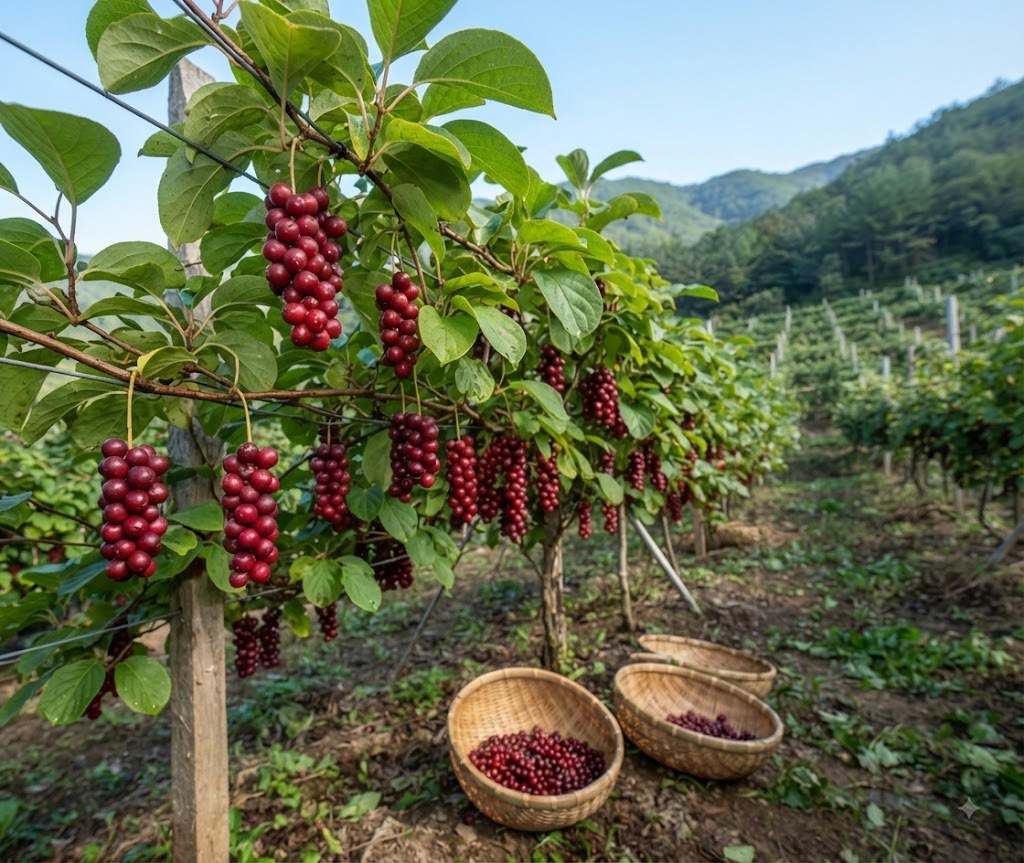
| Harvesting principle | It links variety, flowering date, maturity, harvest date, and final processing purpose. Based on Nongsaroo standards, there are examples of harvesting after flowering of approximately 120 days for early and mid-season varieties and approximately 125–140 days for mid and late-season varieties. ( Nongsaroo ) |
| Product separation | It is separated into Fresh Fruit → Chilled Fruit → Dried Fruit / Sugared Omija / Juice → Extract → Concentrate → Finished Product. |
| Separation of similar items | It is a separate Plant Entity from red fruit specialty crops such as goji berries and Cornus fruit, and other species of the genus Schisandra are also managed separately. |
| Domestic production statistics | The latest nationally approved production volume and cultivation area for the entire country have not been finalized in this v1.0 version, so they will be entered later after verification of official raw data. |
| Cultivation environment | Nongsaroo suggests well-drained sandy loam and loam soils, as well as mid-mountainous areas with high organic matter content and a pH of around 6.0 to 6.5, as suitable sites . |
| functional ingredients | The MFDS provides official data recognizing Schisandra chinensis extract as an individually recognized functional ingredient for health functional foods (No. 2018-9) in 2018. ( Food Safety Korea ) |
| Complex ingredients | The extract complex of Schisandra, Eucommia, and Lycium barbarum in 2024, and the extract complex of Hovenia dulcis fruit stem and Schisandra pith in 2025, have been disclosed as individually recognized ingredients, respectively. These are Product Entities separate from Schisandra as a standalone ingredient. ( Korea Food Safety Information System ) |
| Supply and demand risk | The key factors are moisture, suitable growing area, pests and diseases, concentration of harvest season, fresh fruit storability, moisture and microorganisms in dried products, sugar content ratio, origin and variety, and variations in extraction yield and component specifications. |
| Operating Principles | Connect Cultivar–Farm–Flowering–Harvest Lot–Fresh/Dried/Sugared/Extract Batch–COA–Buyer RFQ. |
| Final goal | It is the establishment of supply chain intelligence that connects fresh produce from the source with processed and functional raw materials, extending even to the buyer's repeat purchase data. |
Nongsaroo suggests mid-mountainous areas with low groundwater levels, well-drained sandy loam or loam soil, high organic matter content, and a pH of around 6.0 to 6.5 as suitable cultivation sites for Schisandra . It also explains that as a sun-loving crop, shade during the flower bud formation period can affect the number of flowers and the ratio of female flowers. ( Nongsaroo )
Basic fields | detail |
| Korean name | Schisandra |
| English name | Omija / Schisandra Berry |
| Representative scientific name | Schisandra chinensis (Turcz.) Baill. |
| classification | Schisandraceae → Schisandra → S. chinensis |
| Growth type | climbing woody plants |
| Edible parts | Mainly fruit |
| Non-edible · Separate management | Stems, leaves, seeds, pruning residues, etc. are separated from the Fruit Product. |
| Major harvesting stages | Examples of technical standards for fruit maturity and approximately 120–140 days after flowering by variety |
| Basic product form | Fresh Fruit·Dried Fruit·Sugared Omija·Juice·Extract·Concentrate |
| Basic processing stage | Harvesting → Sorting → Refrigeration/Drying → Sugar Precipitation/Juicing → Extraction → Concentration |
| Basic use | Fresh fruit, tea, syrup, beverage, dried fruit, food ingredients, functional ingredients |
| Similarity Principle | Plant Entity separate from other Schisandra spp. and Lycium chinense, Cornus officinalis, etc. |
Kew treats names such as Schisandra chinensis var. glabrata and var. leucocarpa as synonyms of the current S. chinensis. Therefore, when past cultivar or variety names appear in a document, they are not immediately separated into distinct species; instead, the modern taxonomy is checked first. ( Plants of the World Online )
Product Master
Product | Product stage | Key Management Standards |
| Omija Seed Lot | breeding materials | Species·Seed Source·Lot |
| Omija Planting Material | Seedlings and propagation materials | Breed, Mother Plant, and Health |
| Omija Field Lot | production stage | Farm · Variety · Planting Date · Tile Facilities |
| Flowering Lot | Flowering stage | Flowering date, female flower ratio, weather |
| Fresh Omija Fruit | Fresh fruit | Harvest date, variety, color, maturity |
| Premium Fresh Omija | For fresh consumption | Color, size, appearance, and freshness |
| Chilled Omija | refrigerated ingredients | Storage Temperature · Period · Lot |
| Dried Omija | Drying | Moisture, Color, and Drying History |
| Dried Omija Tea Raw | Dimensional materials | Dryness, foreign matter, extraction suitability |
| Omija Powder | powder | Parent Lot · Particle Size · Microorganisms |
| Sugared Omija | Sugar-preserved ingredients | Schisandra, Sugar Ratio, Extraction Period |
| Omija Syrup | Syrup | Parent Lot · Sugar Content · Filtration |
| Omija Juice | Extracted | Raw Material Lot, pH, Solids |
| Omija Puree | Fruit products | Homogeneity and raw material content |
| Omija Extract | extract | Solvent · Time · Concentration · Batch |
| Omija Concentrate | Concentrated raw materials | Solids and Concentrated Drainage |
| Omija Extract Functional Ingredient | functional ingredients | Certification Number · Manufacturing Specification · Ingredients · COA |
| Omija Tea | finished product | Raw material form and extraction conditions |
| Omija Beverage | drinkables | Ingredient Content · Sugars · Formula |
| Omija Fermented Product | Fermented type | Fermented Ingredients · Microorganisms · Batch |
| Omija Pomace | Juicing and extraction by-products | Safety and Recyclability |
| OEM·PB Omija Product | finished product | Formula · MOQ · Contract |
Classification criteria | Subdivision type | Management principles |
| Plant classification | Schisandra chinensis | Separated from other species |
| varieties | Early, mid, and late varieties and registered varieties | Variety verification link |
| Edible parts | Fruit | Other parts separate |
| Harvesting stage | Days after blooming, fruit color, maturity | Harvest Lot required |
| Cultivation method | Open fields, facilities, rain shelters, etc. | Farm Entity |
| Cultivation terrain | mid-mountain areas, slopes, etc. | Site Dataset |
| Distribution methods | Fresh · Chilled · Dried | Product Separation |
| Processing form | Sugared·Juice·Powder·Extract·Concentrate | Independent Product |
| Fermentation status | Non-fermented/Fermented | Process Separation |
| Final use | Tea, fruit extracts, beverages, processed foods, functional ingredients | Application |
| Transaction type | Fresh fruit · Dried fruit · Contract farming · Processed raw materials · OEM · Private label | RFQ |
| Types of regulation | General food · Individually recognized functional ingredients | Regulatory Entity |
step | Essential Dataset | Management purpose |
| Cultivation plan | Variety · Area · Fresh Fruit/Processing Use · Buyer | Production Design |
| Seedlings and propagation materials | Variety · Mother Plant · Lot | Identity |
| Selection of cultivation sites | Slope, drainage, and soil | Determination of enemy territory |
| Soil testing | pH · Organic matter · EC · Drainage | Soil management |
| formula | Date, plot, planting | Traceability |
| Duck installation | Facility type, height, and maintenance history | Vine management |
| invitation | New shoots, main branches, and result branches | Water canopy management |
| Growth management | New shoots, leaf weight, and growth status | Production forecast |
| Light environment | Shade | Flower buds and blooming |
| rising | Temperature, Rainfall, and Humidity | Supply Risk |
| Watering | Suwon, period, amount | growth |
| dispute | Materials, Quantity, and Timing | Production and soil |
| pests | Occurrence, Control, and Pesticides | Quality and Safety |
| Flower bud formation | Timing and light environment | Production forecast |
| flowering | Date · Female flower ratio | Harvest Forecast |
| Fruit set | Fruit set · Clusters | Yield |
| Excessive negligence | Color and Maturity | Harvest Decision |
| Harvest judgment | Variety, Days After Blooming, Color | Harvesting at the right time |
| harvest | Date, Section, Weight | Fruit Lot |
| Origin sorting | Immaturity, damage, decay, foreign matter | Grade |
| Pre-cooling and refrigeration | For fresh consumption | Fresh Quality |
| purifying | Water quality and hygiene upon application | Processing |
| dry | Temperature, time, moisture | Dried Product |
| Sugar syrup | Fruit/Sugar Ratio · Period | Sugared Product |
| Juicing | Juice Yield·pH | Juice |
| percolation | Filter · Sedimentation | Liquid Quality |
| extraction | Solvent, Temperature, Time | Extract |
| concentration | Solids and Concentrated Drainage | Concentrate |
| fermentation | Microorganisms, Temperature, Period | Fermented Product |
| packaging | Packaging by product | shipment |
| save | Conditions by Fresh/Dried/Liquid | Shelf-life |
| shipment | Buyer · Quantity · Date | transaction |
Nongsaroo suggests sandy loam and loam soils with good drainage and high organic matter content, with a pH of approximately 6.0 to 6.5, as suitable cultivation sites , and explains that shading during the flower bud formation stage can result in fewer flowers and a lower proportion of female flowers. Therefore, it designates drainage, pH, and light environment as key production fields. ( Nongsaroo )
Quality items | Fresh Fruit | Dried Fruit | Sugared/Juice | Extract/Concentrate | finished product | Public rating |
| Species | essential | succession | succession | succession | tracking | Public/Verified |
| varieties | essential | succession | succession | succession | tracking | Verified |
| mountainous district | essential | essential | succession | succession | mark | Public/Verified |
| Farm | essential | succession | succession | succession | tracking | Verified |
| Lot | essential | essential | essential | essential | essential | Verified/NDA |
| Flowering day | record | succession | succession | succession | tracking | Verified |
| Harvest day | essential | succession | succession | succession | tracking | Verified |
| Maturity | core | Raw material inheritance | succession | succession | tracking | Verified |
| color | core | core | Liquid color | By product | QC | Member |
| Cluster condition | core | — | — | — | — | Member |
| weight | essential | Batch | Batch | Batch | finished product | NDA |
| appearance | Damage/Deterioration | Color and uniformity | Liquid homogeneity | By product | QC | Verified |
| alien substance | check | core | Filtration management | core | core | Verified |
| moisture | Fresh | core | By product | By product | By product | Verified |
| Sweetness | If necessary | Raw material characteristics | The core of green juice | concentrate | By product | Verified/NDA |
| pH | — | — | Juice core | By Extract | By product | Verified/NDA |
| microorganism | If necessary | core | core | core | Conformity to standards | Verified/NDA |
| pesticide residues | core | test | Raw material inheritance | test | Conformity to standards | Verified/NDA |
| heavy metals | Risk-based | test | test | test | Conformity to standards | Verified/NDA |
| Refrigeration history | Fresh fruit core | — | Raw material stage | succession | tracking | Verified/NDA |
| Drying history | — | essential | — | Inheritance when extracting data | tracking | Verified |
| Sugar soaking history | — | — | Essential for cleaning | — | succession | NDA |
| Juicing history | — | — | Juice is essential | When extracting juice | succession | NDA |
| Extraction history | — | — | — | essential | succession | NDA |
| Concentration history | — | — | — | essential | succession | NDA |
| Fermentation history | — | — | The relevant city | The relevant city | succession | NDA |
| packaging | Fresh | essential | essential | essential | essential | Verified |
| Expiration date | By product | By product | By product | By product | essential | Verified |
| Shipment | essential | essential | essential | essential | essential | Verified |
| Returns and Claims | record | record | record | record | record | NDA |
| Repurchase | Buyer Connection | Buyer Connection | Buyer Connection | Buyer Connection | Buyer Connection | NDA |
Lot Master Required Field
Lot ID · Item/Product Type · Scientific Name · Variety · Edible Part (Fruit) · Cultivation Type · Country/Region/Cultivation Area · Producer · Planting Material Lot · Planting Date · Flower Bud/Flowering Date · Harvest Date · Days After Flowering · Fruit Maturity · Quality Indicators · Cluster/Weight/Color/Specifications/Grade · Pest/Disease/Appearance/Spoilage/Foreign Matter Check · Pesticide Use Records · Pesticide Residue/Microorganism/Heavy Metal Test Reports · Pre-cooling/Refrigeration/Drying History · Raw Material Lot · Immersion/Juicing/Filtering/Extraction/Concentration/Fermentation History · Packaging Date · Best Before Date · Shipper · Returns/Claims · Repurchase
Customers | Purchase criteria | Cooperation opportunities |
| Schisandra farm | Varieties, Seedlings, and Buyers | contract farming |
| production area distribution organization | Fresh fruit, mushrooms, harvest date | Joint screening |
| Fresh fruit distributors | Color, Maturity, Freshness | Fresh RFQ |
| Drying processing company | Dryness and moisture | Dried Omija |
| Omija syrup manufacturer | Fresh fruit and sugar-soaked fruit | Sugared Product |
| car manufacturers | Dry fruit and extraction aptitude | Tea |
| Beverage manufacturer | Juice, Extract, Concentrate | Beverage |
| Fermented food company | Raw materials, sugar, and fermentation suitability | Fermented Product |
| Confectionery and Desserts | Concentrate, Powder, Color | Food Ingredient |
| HMR | Blue Sauce Concentrate | Application |
| Dining Out & Cafe | Juice & Beverage Base | B2B |
| Online/Distribution | Dried fruit, greens, and tea | Retail |
| Local specialty company | Origin · Variety · Story | Premium Product |
| Health functional food manufacturers | Recognized Raw Materials, Specs, and COAs | Functional Ingredient |
| OEM·PB | Green tea, beverage, and extract products | Private Label |
| exporters | Origin · Pesticide Residue · Product Specifications | Export RFQ |
| Research Institute | Variety · Cultivation · Extraction · Functionality | R&D |
step | Key variables | Operational judgment |
| Jongmyo Shrine | Species · Varieties | production base |
| Domestic production | Region · Cultivation Type · Season | Domestic Supply |
| harvest | Ripening · Fresh Grade | Raw Quality |
| Fresh fruit distribution | Refrigeration and delivery time | Fresh Market |
| dry | Yield, Moisture, Color | Dried Supply |
| Sugar syrup | Ingredients, Sugars, Period | Sugared Product |
| Juicing | Juice Yield·pH | Beverage |
| Extraction and Concentration | Yield and specifications | Ingredient |
| imported raw materials | Species·Origin·Product | Global Supply |
| Customs clearance | HS · Product Type | Compliance |
| Domestic processing | Extracts | Value Add |
| functional ingredients | Recognition Number/Standard | Regulatory |
| export | HS · Pesticide Residue · Country of Origin | Global RFQ |
| delivery | Buyer Spec | Contract |
| Repurchase | Quality, Price, Delivery Time | Supplier Score |
Trade Dataset
item | v1.0 processing |
| Fresh Omija Fruit HS | Future official verification of the current HS-K |
| Dried Omija HS | Verification by degree of processing and item description |
| Omija Powder HS | Verification by composition and processing type |
| Omija Juice HS | Verification based on whether it is fruit juice or mixed beverage |
| Omija Extract HS | Verification of extract subclassification |
| Omija Concentrate HS | Verification by actual composition |
| Korea's import volume | Input after official verification of raw data |
| Korean import value | Input after official verification of raw data |
| Korea's export volume | Input after official verification of raw data |
| Korea's export value | Input after official verification of raw data |
| major trading partners | Korea Customs Service Confirmation by Country of Origin and Destination |
| Customs clearance unit price | Calculated only within the same HS, Product, and Unit |
| Quarantine | Classification by seedlings, fresh fruit, dried fruit, and processed products |
| FTA | Verification by HS, Country of Destination, and Criteria of Origin |
Products and processes | Key conditions | RFQ conversion |
| Fresh Omija | Variety, Maturity, Color, Harvest Date | Fresh RFQ |
| Chilled Omija | Storage temperature and period | Fresh Processor |
| Dried Omija | Moisture, Color, and Drying History | Tea/Retail |
| Omija Powder | Parent Lot · Particle Size · Microorganisms | Food Ingredient |
| Sugared Omija | Fruit/Sugar · Infusion Period | Cheong manufacturing |
| Omija Syrup | Filtration, Sweetness, Color | Cafe/Beverage |
| Juice | Raw Material Lot · Extraction Yield | Beverage |
| Puree | pulp content | Food Manufacturer |
| Extract | Raw materials, solvents, and concentration | Ingredient |
| Concentrate | Solids and Concentrated Drainage | B2B |
| Functional Extract | Recognition Number · Ingredient Specification | Health Functional Food |
| Fermented Omija | Microorganisms and Fermentation Conditions | Fermented Food |
| Beverage Base | Extract · Concentrate · Formula | Cafe/OEM |
| Tea Blend | Ratio of dried fruit and other raw materials | PB |
| Pomace | Juice extraction by-products | Separate verification of potential for food and functional materials |
| Extract Residue | extraction by-products | Review of feed, compost, and bio-utilization |
| Reject Fruit | Damage/Overripe | Safety verification during food conversion |
The complex extract of Hovenia dulcis fruit stems and Schisandra pomace disclosed on the Korea Food Safety Information System (KFSA) in 2025 demonstrates the potential for Schisandra pomace—a byproduct of Schisandra juicing and processing—to serve as a component of functional ingredients through a verified, specific manufacturing process. However, since this case involves a specific complex ingredient designated as No. 2025-18, general Schisandra pomace should not be regarded as a functional ingredient in its entirety. ( KFSA )
PRP — Product Research Profile
PRP | Key research questions |
| Fresh Omija PRP | Which varieties, days after flowering, and origins are suitable for fresh fruit and green fruit processing? |
| Dried Omija PRP | How drying conditions affect color, moisture, and shelf life |
| Sugared Omija PRP | How Fruit/Sugar and Aging Period Are Connected to Refreshment Quality |
| Juice PRP | Do the raw material maturity, extraction yield, pH, and solids meet the Buyer Spec? |
| Extract PRP | Do the raw material lot, solvent, concentration, and yield match the specifications? |
| Functional Ingredient PRP | Do the manufacturing, ingredient, and recognition number of the MFDS individually recognized raw material match the actual batch? |
| Pomace PRP | Under what conditions can juicing and extraction by-products be converted into food or research raw materials? |
| Export PRP | Does it meet HS, pesticide residues, destination country food regulations, and Buyer Specs? |
first of all | Execution item | Performance indicators |
| 1 | Species·Variety·Farm·Flower Date·Harvest Date·Lot made mandatory | Essential Field Completion Rate |
| 2 | Separation of Fresh·Dried·Sugared·Juice·Extract Products | Product identification rate |
| 3 | Soil, weather, light, growth, flowering, and fruit set connection | Field–Lot Connection Rate |
| 4 | Video AI screening for overcoloration, maturity, and damage | Grade Accuracy |
| 5 | Prediction of optimal harvest time based on flowering date | Harvest Forecast |
| 6 | Production volume forecast | Yield Forecast |
| 7 | Pest and disease AI diagnosis | Early detection rate |
| 8 | Data on fresh fruit refrigeration temperature and duration | Fresh Loss Rate |
| 9 | Automatic recording of drying temperature, time, and moisture | Drying Consistency |
| 10 | Fruit→Dried Yield Prediction | Dry Yield Error |
| 11 | Fruit→Juice Yield Prediction | Juice Yield Error |
| 12 | Extract/Concentrate Yield Data | Process Yield |
| 13 | COA, pesticide residues, and microorganisms link | Certificate connection rate |
| 14 | Runtime Verification of Recognized Standards for Functional Ingredients | Compliance Rate |
| 15 | Product–Buyer AI Match | RFQ → Sample Conversion Rate |
| 16 | Price, Inventory, and Supply & Demand Forecasts | Forecast error |
| 17 | Buyer Ratings & Repurchase Link | Repeat Order Rate |
Problem group | Problem Definition | Required data |
| Mixed Species · Variety Mix | Variety/raw material identity unknown | Scientific Name: Cultivar |
| Discontinuity of grave history | Insufficient tracking of mother plants/seeds to farms | Planting Lot |
| Unsuitable growing site | Poor drainage, soil, and light conditions | Soil/Site |
| humid | Damage to growth and roots due to poor drainage | Drainage |
| Lack of light | Possibility of reduced ratio of flower buds and female flowers | Light |
| Weather Risk | Effects on flowering, fruit set, and diseases | Climate |
| pests | Impact of quantity, quality, and pesticide use | Pest/Spray |
| Flowering deviation | Difficulty in predicting harvest time | Flowering Date |
| Harvest season concentration | Shortage of labor and processing capacity | Harvest Forecast |
| Maturity deviation | Quality fluctuations of fresh and processed products | Maturity |
| Fresh fruit storage | Short-term quality deterioration after harvest | Cold Storage |
| Drying deviation | Differences in moisture, color, and shelf life | Drying |
| microorganism | Dried Fruits, Fruit Syrups, and Juice Safety | Microbiology |
| pesticide residues | Key Points of Domestic and Export RFQs | Spray·COA |
| Sugar Precipitation Formula Deviation | Differences in green quality, sweetness, and cost | Formula |
| Variation in juice extraction yield | Changes in processing costs by raw material and variety | Juice Yield |
| Variation in extraction yield | Changes in B2B Specs by Raw Material and Process | Extract Yield |
| Confusion between general foods and functional ingredients | Expansion of individually recognized functional properties for regular Schisandra | Regulatory Status |
| Confusion regarding the use of omija pomace | Extending specific recognized composite material cases to general by-products | By-product Evidence |
| Mixed origins | Distinction between domestic and imported products | Origin |
| HS classification error | Different classifications for fresh fruit, dried fruit, fruit syrup, and extracts | HS Mapping |
| Buyer Spec Discrepancy | The requirements for fresh fruit, fruit extracts, tea, and health supplements are different. | RFQ Spec |
| Repurchase not reflected | Delivery performance not linked to variety or farm evaluation | Buyer Evaluation |
RFQ Type | Public Registration | Verify/NDA |
| Schisandra seedling supply | Species · Varieties · Regions | Seedling Producer, Quantity, Unit Price |
| Fresh Fruit Sales | Variety, Origin, Expected Harvest | Farm price, quantity, actual unit price |
| Fresh Fruit Purchase | Maturity, Standards, and Uses | Target quantity and price |
| Regular supply | Fresh/Dried · Cycle | Monthly Volume and Contract Unit Price |
| contract farming | Variety/Processing Purpose | Farms, Area, and Purchase Conditions |
| Dried Schisandra | Origin · Moisture · General Grade | Lot · COA · Unit Price |
| Omija syrup ingredients | Fresh Fruit · Sugar Preservation | Sweetness, Quantity, Price |
| Schisandra powder | Origin · Entry | Parent Lot·COA |
| Tea ingredients | Dried fruit and specifications | Moisture · Price |
| Juice | Raw Material Form · General Spec | pH, Solids, Unit Price |
| Extract | Raw Material Lot · General Spec | Solvent, Concentration, Yield |
| Concentrate | Solid content and uses | Concentration ratio · Price |
| Functional extracts | Recognition Number · General Standard | COA · Manufacturing Conditions · Contract |
| fermented products | Product Type | Fermentation process · Microorganisms |
| Dining Out & Cafe | Refreshment and Beverage Base | Delivery time · Actual unit price |
| HMR · Confectionery | Powder · Concentrate | Formula |
| OEM·PB | Green tea, beverage, extract | MOQ · Formula · Contract |
| export | Product · Destination Country | HS · Quarantine · Price |
| Technology demonstration | Harvest forecasting, AI sorting, and drying | raw data |
| Research cooperation | Variety · Cultivation · Extraction · Functionality | IP · Exam materials |
① Need Products & Materials
Companies and institutions seeking necessary products, agricultural products, raw materials, and processed goods register purchasing demands. Registered requests are utilized to review cooperation with potential suppliers and producers based on the RFQ Intelligence Library.
Process:
RFQ Registration → Supplier/Product Review → Collaboration Connection → Future AI Matching
Register
② We are looking for production and manufacturing partners. (Need Suppliers & Manufacturers)
Register a request to find necessary production and supply partners, ranging from farms and producer organizations to processing companies, OEM, ODM, and private label manufacturers.
Process:
RFQ Registration → Review of Production & Manufacturing Capabilities → Collaboration Connection → Future AI Partner Matching
Register
③ We are looking for domestic and international buyers. (Need Buyers)
Farmers, producer organizations, and manufacturing companies are requesting cooperation with new buyers, such as domestic and international distributors, importers, brand companies, and food service and catering businesses.
Process:
RFQ Registration → Product & Supply Capability Review → Market & Buyer Connection → Future AI Buyer Matching
Register
Contact : mail@markethub.org
Version | Main contents | situation |
| v1.0 | Plant Identity · Cultivation Site · Flowering–Harvesting · Fresh/Dried · Syrup · Juice · Extract · Functional Ingredient · RFQ Basic Structure Registration | complete |
| v1.1 | Verification of official raw data by nationwide production, regional supply, HS code, import/export, and variety | expected |
| v2.0 | Quality, processing, and PRP segmentation by Fresh, Dried, Sugared, Juice, Extract, Concentrate, and Pomace | expected |
| v3.0 | Seedlings & Farms – Origin Distribution, Drying, Fruit Syrups, Beverages, Extraction Companies – Food, Health Functional Foods, Exports Buyer Verified Container Combination | expected |