

Judgment axis | Key judgment |
| Item Identity | A representative spice vegetable that utilizes the rhizomes of the ginger family, Zingiber officinale. |
| Key role | Kimchi, Cooking, School Meals, Dining Out, Sauces, HMR, Juicing, Pickling, Freezing, Drying, Powdered Ingredients |
| Harvesting principle | Assess seed type, cultivation type, rhizome enlargement, branching, outer skin, ripeness, storage purpose, and buyer's use together. |
| Product separation | Separate seed ginger, young ginger, soil ginger, washing, peeling, slicing, Julienne, minced, juice, frozen, dried, powder, and pickled. |
| Separation of similar items | Separating plant classification, edible parts, and market roles from garlic, turmeric, Paviflora ginger, etc. |
| Domestic statistics | Nationwide ginger cultivation area and production volume: To be entered after verification of official national statistical raw data. |
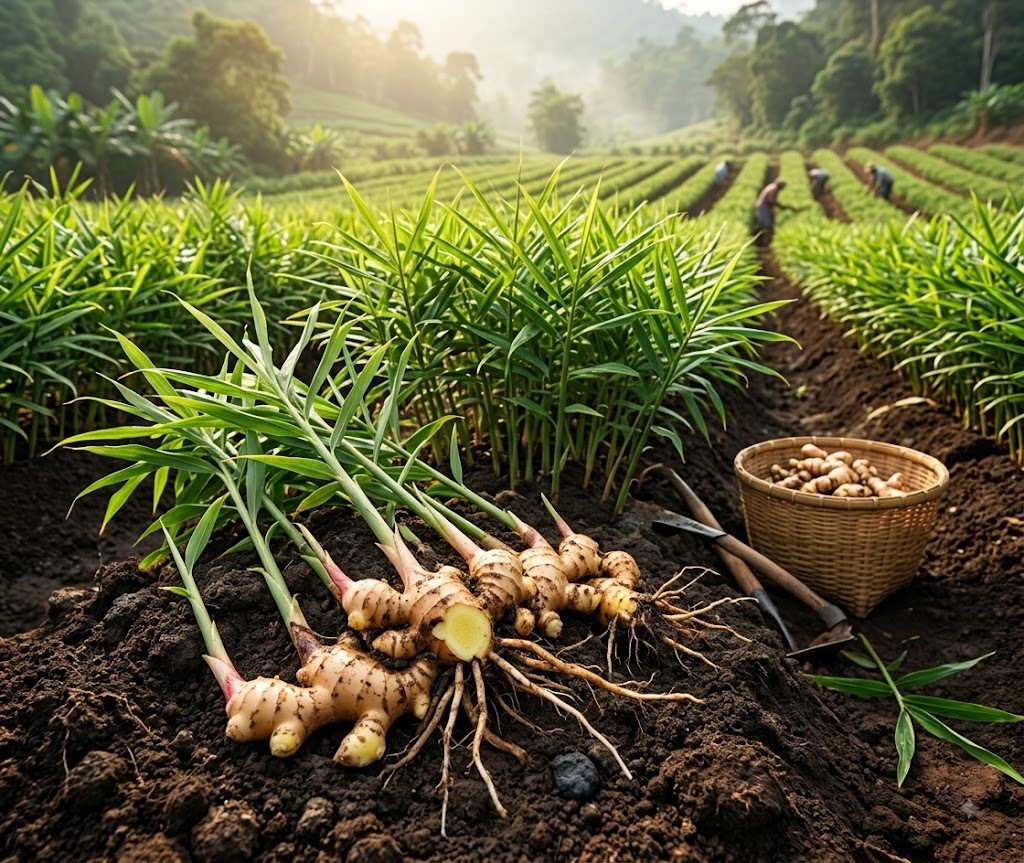
| Growth characteristics | The Rural Development Administration describes ginger as a semi-shade tolerant, stating that a growing temperature of 25–30°C is suitable and that it is susceptible to both dryness and excessive moisture. ( Nongsaroo ) |
| Cultivation schedule | Nongsaro urban farming data presents examples of sowing in April–May and harvesting in late October–early November, but this is not generalized as the national standard for commercial cultivation. ( Nongsaroo ) |
| Storage risk | Cold damage, high temperature, high humidity, dryness, decay, sprouting, moisture loss, storage diseases |
| Processing risk | Washing loss, peeling yield, fiber content, juice extraction yield, drying yield, color, and aroma variation |
| Operating Principles | Seed Rhizome–Field–Harvest Lot–Curing–Storage–Processing–Buyer RFQ |
| Final goal | Converting storability, washability, processing capacity, and Buyer suitability into actual supply capacity rather than yield. |
The Rural Development Administration describes ginger as a semi-shade plant, noting that its optimal growth temperature is 25–30°C and that it is a crop susceptible to both drought and excessive moisture. It also identifies soil rich in organic matter and well-drained as a key factor in the cultivation environment. These values are based on general cultivation information from Nongsaroo, and recipes specific to varieties and regions must be verified separately. ( Nongsaroo )
Plant Identity
Basic fields | Ginger Registration Standards |
| Korean name | ginger |
| English name | Ginger |
| Representative scientific name | Zingiber officinale Roscoe |
| classification | Zingiberaceae · Zingiber |
| Edible parts | Mainly rhizome |
| Reproductive part | ginger seed |
| Separate usage area | According to Nongsaroo and Food Safety Korea standards, rhizomes, roots, stems, leaves, etc., must be checked separately by intended use. |
| Non-edible · Separate management | Aging, disease, decaying rhizomes, soil, and poor quality by-products |
| Major harvesting stages | Young ginger / Commercial ginger / For storage / For processing / For seed ginger |
| Basic product form | Unpeeled ginger · Wash · Peel · Slice · Shred · Dice · Minced · Juice · Frozen · Dried · Powder · Pickled |
| Basic processing stage | Sorting → Curing → Storage → Washing → Peeling → Cutting/Mincing → Juicing/Freezing/Drying/Grinding/Pickling |
| Basic use | Spices · Kimchi · Cooking · School Meals · Dining Out · Sauces · Beverages · HMR · Pickles · Seasoning Ingredients |
| Similarity Principle | Isolation of Turmeric, Paviflora Ginger, and Other Zingiberaceae Species |
Kew recognizes Zingiber officinale Roscoe as an accepted species and describes it as a rhizomatous geophyte that forms rhizomes. ( Plants of the World Online )
Ginger, scientifically known as Zingiber officinale Roscoe, is also confirmed in the food ingredient list on Food Safety Korea, with rhizomes, roots, stems, and leaves listed as usable parts. However, the basic Food Products section of MarketHub is established around rhizomes , the primary commodity in domestic agriculture and distribution , and other parts will be expanded after separate product verification. ( Food Safety Korea )
Product Master
Product ID | Product type | Key Management Standards |
| GIN-P01 | End of semester | Breed · Source · Rhizome Lot · Health |
| GIN-P02 | Cutting end | Cut size · Eye · Wound · Disease |
| GIN-P03 | Tissue-cultured ginger seeds | Source · Growth Stage · Soundness |
| GIN-P04 | young ginger | Harvesting stage · Sheath · Fiber texture |
| GIN-P05 | Mountain soil ginger | Variety, Origin, Harvest Date |
| GIN-P06 | ginger before curing | Surface moisture, wounds, and outer skin |
| GIN-P07 | Ginger curing complete | Wound healing, outer skin, decay |
| GIN-P08 | Ginger for storage | Storage history, sprouting, spoilage |
| GIN-P09 | Selective large underground tunnel | Weight, Branch, Appearance |
| GIN-P10 | Selected medium-sized underground organ | Weight, shape, and uniformity |
| GIN-P11 | Washed ginger | Soil removal, surface damage, and sanitation |
| GIN-P12 | peeled ginger | Peeling yield, color, and hardness |
| GIN-P13 | Whole peeled | Size, Surface, Refrigeration |
| GIN-P14 | Slice | Thickness, fiber, scent |
| GIN-P15 | Julienne | Thickness, length, and cookability |
| GIN-P16 | Dice | Specifications and heating suitability |
| GIN-P17 | minced ginger | Particle size, color, scent, microorganisms |
| GIN-P18 | Refrigerated minced ginger | Temperature and expiration date |
| GIN-P19 | Frozen Whole | Freeze-thaw quality |
| GIN-P20 | Frozen Slice | Thickness and thawed tissue |
| GIN-P21 | Frozen Minced | Grain size, thawing, scent |
| GIN-P22 | ginger for juicing | Ripening · Fiber · Juice Yield |
| GIN-P23 | ginger juice | Juicing, filtration, heating, and packaging |
| GIN-P24 | ginger puree | Viscosity, particle size, and solid content |
| GIN-P25 | Pickled ginger ingredients | Young/Tender Underground · Slice Aptitude |
| GIN-P26 | Pickled ginger | Salt, Acid, Sugar, and Aging Conditions |
| GIN-P27 | Dry Slice | Moisture, color, scent |
| GIN-P28 | Dry Flake | Particle size, moisture, scent |
| GIN-P29 | ginger powder | Final moisture content, particle size, and aroma |
| GIN-P30 | Tea and beverage ingredients | Slice·Powder·Juice Spec |
| GIN-P31 | Sauce/Seasoning Base | Minced·Purée |
| GIN-P32 | Extra-standard healthy ginger | Processing upon safety compliance |
| GIN-P33 | Peeling and cutting by-products | Review of Generation and Resource Utilization |
| GIN-P34 | Diseased and rotten ginger | Food supply chain exclusion |
| GIN-P35 | PB·OEM finished products | Raw Material Lot · Processing Batch |
Classification criteria | Subdivision type | Management principles |
| Plant classification | Zingiber officinale | Separated from other ginger family plants |
| Variety/Type | Small ginger, medium ginger, large ginger, etc. | Official · Seed Source Verification |
| breeding materials | Seeds, cut seeds, tissue-cultured ginger | Propagation Product |
| Harvesting stage | Young · Product · Storage · Processing · End of season | Product Separation |
| rhizome size | Weight, Length, Branch | Actual measurements |
| Sukdo | Young/Mature | Fiber, pickling, and processing suitability |
| Cultivation method | Areas, open fields, rain shelters, etc. | Production Container |
| Distribution methods | Soil · Washing · Peeling · Fresh-cut | Product Separation |
| Saved status | Immediately after harvest · Curing · Storage | Separate state |
| Processing form | Minced·Juice·Frozen·Dry·Powder·Pickled | Process Lot |
| Final use | Kimchi, School Meals, Dining Out, Beverages, HMR, Sauces, Spices | Buyer-specific management |
| Transaction type | In-kind · Regular supply · Contract farming · OEM · PB | Contract |
| origin | Domestic/Imported | Traceability |
step | Essential Dataset | Management purpose |
| Cultivation plan | Variety · Region · Buyer · Product | Production plan |
| Secure the end of the semester | Source·Lot·Soundness | production base |
| Save for end of semester | Temperature, period, spoilage | Seed Quality |
| End-of-semester selection | Size, eyes, wounds, diseases | uniform germination |
| Final steel cutting | Size, number of teeth, and cross-section | Planting Unit |
| Sowing and planting | Date·Density·Deepness | Production schedule |
| furrow creation | Height and drainage | Rainy season risk |
| covering | Rice straw, mulching, etc. | Moisture and temperature |
| Germination and emergence | Appearance Date · Appearance Rate | Early growth |
| Growth | Plant height, hardness, leaf count | Production forecast |
| rising | Temperature, precipitation, humidity, solar radiation | Environmental management |
| sunshade | Shading status and ratio | High temperature and light management |
| Watering | Soil moisture and timing | Drying Risk |
| drainage | Flooding and drainage conditions | Excessive moisture and diseases |
| dispute | Soil testing and fertilizer | Growth management |
| Underground hypertrophy | Branch · Weight · Size | Harvest Forecast |
| pests | Occurrence and Control | Product rate |
| Harvest judgment | Above ground, underground, and dormitory | Buyer Spec |
| harvest | Date · Rhizome Lot | Harvest Lot |
| soil removal | mud and wounds | Pre-processing |
| curing | Temperature, humidity, and period | Wound Healing · Storage |
| Selection | Size, wounds, decay | Grade |
| Storage | Receipt Date · Lot | Inventory |
| save | Temperature, humidity, and period | Dormant and Corruption Management |
| Storage check | Sprouting, decay, weight loss | Available shipment volume |
| purifying | Water quality, soil, and surface damage | commercialization |
| peeling | Yield · Color | Fresh-cut |
| cutting | Slice, Julien, and Dice | Buyer Spec |
| resolution | Particle Size · Batch | Kimchi · HMR |
| Juicing | Input·Juice Yield | Beverage |
| freezing | Whole/Slice/Minced | Year-round supply |
| dry | Slice/Flake | Ingredient |
| smash | Powder | Seasoning |
| pickles | Slice · Salt · Acid · Sugar | Pickled Product |
| packaging | Fresh/Processed | trading unit |
| shipment | Buyer · Lot · Delivery Date | Delivery |
Quality items | raw materials | Pre-treated products | processed goods | finished product | Public rating |
| Species | essential | succession | succession | tracking | Public |
| Variety/Type | essential | succession | tracking | tracking | Public/Verified |
| End of semester Source | essential | succession | tracking | - | Verified |
| mountainous district | essential | succession | succession | mark | Public |
| farmhouse | ID | succession | tracking | - | Verified |
| Lot | Harvest Lot | Process Lot | Processing Lot | Manufacturing Lot | Verified/NDA |
| Sowing date | record | succession | - | - | Verified |
| Harvest day | core | succession | succession | tracking | Verified |
| underground diameter weight | Actual measurements | Batch | Input | - | Verified |
| rhizome size | Actual measurements | Selection | Cut Input | - | Member |
| Branching shape | Photos and actual measurements | Selection | - | - | Member |
| outer skin color | check | Before peeling | Product color | By product | Member |
| flesh color | Cut confirmation | core | Processing quality | By product | Verified |
| hardness | raw materials | Fresh-cut | process | By product | Verified |
| fibrous texture | Harvest maturity | Slice · Pickle | Fabrication aptitude | - | Verified |
| incense | Sensory analysis as needed | core | Juice/Dry | By product | Member/Verified |
| wound | test | Selection | Processing review | - | Verified |
| bud | Storage check | Selection | Processing review | - | Verified |
| disease and decay | exception | exception | Food conversion ban | - | Verified |
| Foreign matter/soil | check | purifying | Compliance with standards | Compliance with standards | Verified |
| pesticide residues | test | succession | Compliance with standards | Compliance with standards | Verified/NDA |
| microorganism | If necessary | Solidified Core | processed goods | Compliance with standards | Verified/NDA |
| Curing history | core | succession | tracking | - | Verified |
| Save history | essential | succession | tracking | - | Verified |
| Storage loss | record | - | - | - | NDA |
| Washing yield | - | core | cost | - | NDA |
| Peeling yield | - | core | cost | - | NDA |
| Cutting yield | - | core | Input | - | NDA |
| Compaction yield | - | core | Input | - | NDA |
| Juice extraction yield | - | - | core | cost | NDA |
| Refrigeration yield | - | - | core | cost | NDA |
| drying yield | - | - | core | cost | NDA |
| Powder yield | - | - | core | cost | NDA |
| Final moisture | - | - | Dry/Powder | Product Spec | Verified |
| Island | - | - | Minced/Powder | Product Spec | Verified |
| Pickling conditions | - | - | Hydrochloric acid, sugar, and time | Product Spec | NDA |
| packaging | raw materials | cold storage | process | Final | Member |
| Expiration date | The relevant city | essential | processed goods | mark | Member |
| Returns and Claims | record | record | record | record | NDA |
| Repurchase | connection | connection | connection | connection | NDA |
Lot Master Required Field
Lot ID · Item/Product Type · Scientific Name · Variety/Type · Seed Source · Seed Rhizome Lot · Cultivation Type · Origin/Cultivation Area · Producer · Sowing Date · Emergence Date · Weather/Soil Moisture History · Harvest Date · Rhizome Weight/Size/Branching Pattern · Skin Color/Flesh Color · Hardness/Fiber Texture/Aroma · Damage/Branching/Disease/Sprouting · Pesticide Use History · Pesticide Residue/Microbiological Test Report · Curing Lot · Curing Conditions · Storage Lot · Storage Temperature/Humidity · Duration · Weight Loss/Branching/Sprouting · Rot · Raw Material Lot · Washing/Peeling/Slice/Julienne/Dice/Minced/Juice/Frozen/Drying/Powder/Pickling History · Packaging Date · Best Before Date · Shipper · Returns/Claims · Repurchase
Customers | Purchase criteria | Cooperation opportunities |
| Production Area Distribution Organizations · Agricultural Cooperatives | Variety, Origin, Harvest Season, Specifications | Contract shipment |
| wholesale market | Weight, Appearance, Origin, Grade | Raw material trading |
| End-of-season producers and sellers | Breed · Health · Rhizome Size | Farmer RFQ |
| Storage company | Curing · Soundness · Sprouting Risk | Storage |
| Kimchi manufacturer | Washing, mincing, flavor, safety | Core B2B |
| school meals | Washing, peeling, and compaction | Preprocessing |
| food service companies | Whole · Slice · Minced | Regular supply |
| HMR | Minced·Purée·Frozen | semi-finished products |
| Sauce and seasoning companies | Minced Juice Purée | Ingredient |
| Beverage and tea manufacturing | Juice·Slice·Powder | Beverage |
| Pickled food companies | Young ginger · Slice · Hardness | Pickled Product |
| Refrigeration company | Whole/Slice/Minced | Frozen |
| Drying company | Slice, Flake, Drying Yield | Dried |
| spice companies | Powder · Particle Size · Fragrance | Seasoning |
| PB·OEM | Minced, pickled, beverage, powder | Product Development |
| exporters | Fresh/Frozen/Dried/Powder | Trade |
| Research Institute | Seedlings, cultivation, storage, and processing | PRP |
step | Key variables | Operational judgment |
| Secure the end of the semester | Breed · Health · Source | production base |
| Save for end of semester | Temperature, sprouting, decay | Seed Supply |
| Sowing and growth | Schedule, weather, moisture | Production forecast |
| Underground hypertrophy | Branching · Weight | Supply Forecast |
| contract farming | Buyer Spec · Estimated Quantity | stable procurement |
| harvest | Ripeness, Weight, Outer Shell | Product Branch |
| curing | Wound, temperature and humidity, period | Storage suitability |
| save | Temperature, humidity, decay, sprouting | Inventory |
| Washing and sorting | Soil, debris, wounds, size | Grade |
| Peeling and amputation | Yield and fiber texture | Foodservice |
| resolution | Entry point/fragrance | Kimchi · HMR |
| Juicing | Juice Yield | drinkables |
| freezing | Whole/Slice/Minced | Year-round supply |
| Dry/Powder | Yield, Moisture, Scent | Ingredient |
| pickles | Young ginger · Slice | process |
| Distribution and supply | Product Temperature, Packaging, Delivery Time | Buyer SLA |
| RFQ | Fresh/Stored/Processed | Match |
| Repurchase | Quality, Yield, Delivery Time | Repeat trading |
HS·Trade Management
Product | HS Operating Principles |
| Fresh and refrigerated ginger | Current Korea Customs Service HSK verification |
| frozen ginger | Three separate numbers depending on processing status |
| dried ginger | Check the classification formula for dried spices and vegetables |
| ginger powder | Three verifications based on drying and grinding conditions |
| ginger juice and puree | Verification by processing and preservation status |
| Pickled ginger | Prepared product, three separate items |
| End of semester | Verification of suitability for sowing and plant quarantine |
Products and processes | Key conditions | RFQ conversion |
| End of semester | Breed and health | Farmer RFQ |
| Soil ginger | Variety, Origin, Ripening | Fresh |
| Stored ginger | Curing, decay, sprouting | Storage |
| Washed ginger | Cleaning yield · Wounds | Retail/B2B |
| peeled ginger | Peeling yield · Color | Foodservice |
| Slice | Thickness and fiber texture | Eating Out · Pickles |
| Julienne | Thickness and length | cooking |
| Dice | Specifications and heating properties | HMR |
| Minced | Particle size, scent, color | Kimchi and sauce |
| Juice | Juice yield, flavor, and solids | Beverage |
| Purée | Viscosity and particle size | Sauce |
| Frozen Whole | Freezing and thawing | B2B |
| Frozen Minced | Entry point/fragrance | HMR |
| Dried Slice | Final moisture, color, and scent | Ingredient |
| Flake | Particle size and moisture | Seasoning |
| Powder | Moisture, particle size, scent | Food manufacturing |
| Pickled | Young ginger · Slice · Pickling conditions | Retail/PB |
| Non-standard health underground organs | Safety and soundness | Minced/Juice/Dry |
| Peeling and amputation residue | Generation Amount · Safety | Resource utilization research |
| Diseased and decayed underground stems | Food supply chain exclusion | Review of waste and compost |
Separate grounds are required for the expansion of food and functional materials. While there is a case on the Korea Food Safety Information System ( KFDA) where steamed ginger extract powder (GGE03) was registered as an individually recognized health functional food ingredient in 2022, the functionality of a specific recognized ingredient is not extended to general ginger or general ginger powder. (KFDA )
In addition, the Parviflora ginger root extract recognized in 2025 has the English ingredient name Kaempferia parviflora Extract; since it belongs to a different species than general ginger (Zingiber officinale), it is a separate ingredient entity. ( Korea Food Safety Agency )
PRP — Product Research Profile
PRP ID | Product Research Profile |
| PRP-GIN-01 | Final Course Quality – Appearance/Quantity |
| PRP-GIN-02 | Seed size – early growth |
| PRP-GIN-03 | Tissue-cultured ginger seed – integrity |
| PRP-GIN-04 | Temperature – Growth · Rhizome enlargement |
| PRP-GIN-05 | Shading – Growth and Yield |
| PRP-GIN-06 | Soil moisture – Rhizome enlargement |
| PRP-GIN-07 | Waterlogging/Drainage – Diseases |
| PRP-GIN-08 | Harvest Raturity – Fiber |
| PRP-GIN-09 | Sukdo – Pickling suitability |
| PRP-GIN-10 | Curing – Wound healing · Decay |
| PRP-GIN-11 | Storage temperature – Sprouting and spoilage |
| PRP-GIN-12 | Storage period – Washing and peeling yield |
| PRP-GIN-13 | Cleaning Method – Surface Damage |
| PRP-GIN-14 | Peeling yield – Rhizome shape |
| PRP-GIN-15 | Slice/Minced Processing Yield |
| PRP-GIN-16 | Variety · Ripeness – Juice Yield |
| PRP-GIN-17 | Drying conditions – Color and scent |
| PRP-GIN-18 | Powder Moisture, Particle Size, Fragrance |
| PRP-GIN-19 | Non-standard ginger Product Recovery |
| PRP-GIN-20 | Seed–Storage–Processing–Buyer AI Match |
first of all | Execution item | Performance indicators |
| 1 | Variety, Seed Steel, Origin, Sowing Date, Harvest Date, and Lot are mandatory. | Required input rate |
| 2 | Seed/Fresh/Stored/Peeled/Processed Product Separation | Product identification rate |
| 3 | Connection between weather, soil moisture, growth, and rhizome enlargement | Runtime connection rate |
| 4 | Data conversion of quality, certificates, curing, and storage history | Lot completion rate |
| 5 | Farm–Storage–Processing–Buyer RFQ Connection | Match rate |
| 6 | Video AI rhizome size and branch selection | Grade Accuracy |
| 7 | AI wound and decay detection | Defect detection rate |
| 8 | Prediction of emergence and growth | Forecast Error |
| 9 | Yield prediction | Forecast Error |
| 10 | Harvest timing prediction | Harvest Error |
| 11 | Curing completion point management | Inappropriate storage and receiving rate |
| 12 | Prediction of storage spoilage and sprouting | Storage Loss |
| 13 | Washing and peeling yield prediction | Actual measurement error |
| 14 | Minced Juice Yield Prediction | Input–Output Error |
| 15 | Dry/Powder Yield Prediction | Input–Output Error |
| 16 | Fresh→Processing Transition AI | Recovery rate |
| 17 | Price and supply forecast | Forecast Accuracy |
| 18 | AI Buyer Match | Sample approval rate |
| 19 | Traceability | Finished Product → Seed Rhizome Traceability |
| 20 | Repurchase Runtime | Buyer reorder rate |
Problem group | Problem Definition | Required data |
| End-of-course quality deviation | Differences in emergence, growth, and yield | Seed Rhizome |
| End of semester supply | Next crop production base instability | Seed Supply |
| End of semester save error | Low temperature, decay, and germination abnormalities | Storage |
| Mixed varieties and types | Differences between Small, Medium, and Large Ginger Products | Variety |
| Non-uniform appearance | Effects of end of season, temperature, and soil | Emergence |
| High temperature risk | Deterioration of growing environment | Climate |
| Drying Risk | Reduction in rhizome hypertrophy | Soil Moisture |
| Excessive moisture and rainy season | Increase in disease and decay | Rainfall·Drainage |
| Shading management | High temperature and solar radiation response deviation | Shade |
| pests | Impact on production volume and storability | Disease |
| Rhizome size variation | Buyer specification discrepancy | Rhizome Geometry |
| Branching pattern deviation | Effect on washing and peeling yield | Shape |
| Variation in harvest maturity | Differences in fiber content, pickling, and juicing | Maturity |
| Harvest season rainfall | Quality Risk Before Storage | Weather |
| Curing deviation | Zhejiang Province difference | Curing |
| Storage spoilage | Reduced available shipment volume | Storage |
| bud | Deterioration of storage quality | Sprouting |
| Storage loss | Decrease in actual supply | Weight Loss |
| Washing loss | B2B cost increase | Washing Yield |
| peeling loss | Fresh-cut cost impact | Peeling Yield |
| Fiber variation | Minced Juice Processing Aptitude | Fiber |
| Variation in juice extraction yield | Beverage cost | Juice Yield |
| Drying yield variation | Powder cost | Dry Yield |
| Scent variation | Product quality | Sensory/Chemical |
| Utilization of non-standard products | Fresh rejection loss of value | Recovery |
| Import competition | Need to assess the effective cost of domestic products | Trade |
| Discrepancy in contract farming | Buyer Specifications & Production Volume Gap | Contract |
| Lot history interruption | End of semester → Lack of traceability for finished products | Traceability |
| Repurchase not reflected | Buyer evaluation non-recovery | Repurchase |
RFQ Type | Public Registration | Verify/NDA |
| End-of-semester purchase | Variety, Type, Origin | Seed Lot · Volume · Unit Price |
| End-of-semester sales | Breed, health, size | Actual Lot/Price |
| Tissue-cultured ginger seeds | Propagation stage · Variety | Facilities and Inspections |
| Procurement of ginger from the mountain area | Variety, Origin, Harvest Season | Farm, Volume, Unit Price |
| Fresh Sales | Size, Appearance, and Sleep Level | Lot · Price |
| Purchase for storage | Curing · Soundness | Inventory/Actual Unit Price |
| Storage and Shipment | Delivery Period · Grade | Available shipment volume |
| Regular supply | Product Cycle | Weekly and monthly volume |
| contract farming | Variety · Seed Steel · Buyer Purpose | Area, Price, Quantity |
| Washed ginger | Size and cleanliness | Yield and Test Report |
| peeled ginger | Peeling condition/color | Peeling yield |
| Minced ginger for kimchi | Entry point/fragrance | Processing yield |
| For school meals | Whole/Slice/Minced | Microorganisms · Delivery Time |
| For dining out | Slice·Julienne | Delivery cycle |
| HMR | Minced/Frozen/Purée | Process conditions |
| For juicing | Ripness, fiber, scent | Juice Yield |
| freezing | Whole/Slice/Minced | Thawing test |
| pickles | Young ginger · Slice | Pickling test |
| dry | Slice/Flake | drying yield |
| powder | Moisture, particle size, scent | Test Reports · MOQ |
| PB·OEM | Juice·Pickle·Powder | contract |
| export | Fresh/Dried/Powder | HS·Quarantine |
| Technology demonstration | End of semester · Save · AI screening | Dataset |
| Research cooperation | Seedlings, cultivation, storage, and processing | PRP |
① Need Products & Materials
Companies and institutions seeking necessary products, agricultural products, raw materials, and processed goods register purchasing demands. Registered requests are utilized to review cooperation with potential suppliers and producers based on the RFQ Intelligence Library.
Process:
RFQ Registration → Supplier/Product Review → Collaboration Connection → Future AI Matching
Register
② We are looking for production and manufacturing partners. (Need Suppliers & Manufacturers)
Register a request to find necessary production and supply partners, ranging from farms and producer organizations to processing companies, OEM, ODM, and private label manufacturers.
Process:
RFQ Registration → Review of Production & Manufacturing Capabilities → Collaboration Connection → Future AI Partner Matching
Register
③ We are looking for domestic and international buyers. (Need Buyers)
Farmers, producer organizations, and manufacturing companies are requesting cooperation with new buyers, such as domestic and international distributors, importers, brand companies, and food service and catering businesses.
Process:
RFQ Registration → Product & Supply Capability Review → Market & Buyer Connection → Future AI Buyer Matching
Register
Contact : mail@markethub.org
Version | Main contents | situation |
| v1.0 | Plant Identity · Seed Coarseness · Cultivation Environment · Rhizome · Curing · Storage · Washing · Mincing · Juicing · Freezing · Drying · Powder · Pickling · RFQ Basic Structure | complete |
| v1.1 | Verification of official production, region, market, price, HS, and import/export raw data | expected |
| v2.0 | Detailed quality standards by variety, seed, rhizome, ripeness, storage, peeling, juice, dry, powder, and pickled | expected |
| v3.0 | Steel Producer–Farmer–Storage–Processing Enterprise–Kimchi·Food Service·Beverage·HMR·Buyer Verified Container Combination | expected |