


Judgment axis | Key judgment |
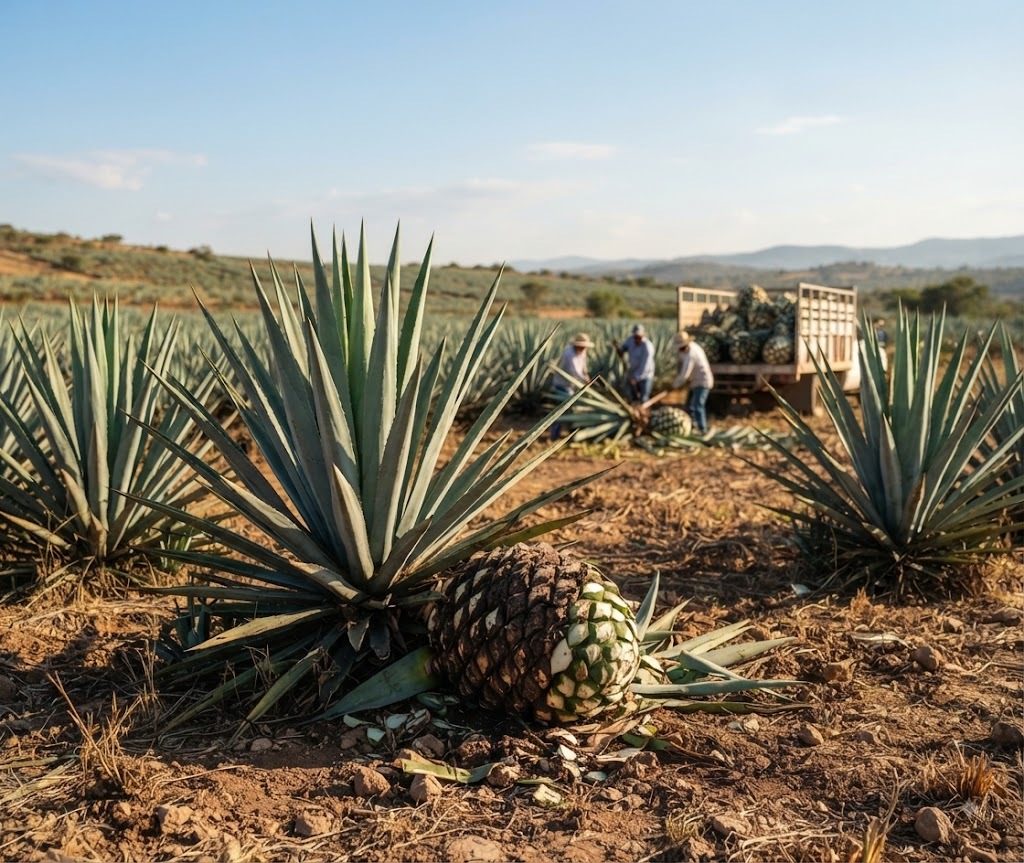
| Item Identity | A group of perennial succulents of the genus Agave. On MarketHub, Species are managed as independent entities under the Genus-level Commodity Container. |
| Representative Species | Food, Syrup, and Tequila Reference Species is Agave tequilana FACWeber |
| Key role | Piña/Core → Fructan → Heating/Hydrolysis/Juicing → Agave Syrup or Fermentation Feedstock |
| Harvesting principle | Manage Species, Cultivar, Planting Year, Plant Age, Core Weight, Fructan/Sugar Characteristics, and Harvest Date together. |
| Product separation | Fresh Piña·Cooked Piña·Juice·Fructan·Agave Syrup·Partially Hydrolyzed Syrup·Fermentation Material Separation |
| Separation of similar items | Do not combine A. tequilana, A. angustifolia, A. salmiana, A. americana, etc. into the same Plant Entity |
| Difference from sugarcane | Sugarcane is centered on sucrose in its stem juice, while the core of agave is a sugar supply chain derived from the hydrolysis of fructan accumulated in the core. |
| Official syrup definition | The Mexican NOM defines Agave Syrup as a syrup produced by the hydrolysis of agave fructan. ( Diario Oficial de la Federación ) |
| Tequila Species | Tequila raw materials are limited to Agave tequilana Weber variedad azul. ( Diario Oficial de la Federación ) |
| Mexican production | The Mexican Ministry of Agriculture announced in 2025 that Tequila Agave production exceeded 2.1 million tons in 2023. This figure is based on Agave Tequilero, not the total *Agave spp.*. ( Gobierno de México ) |
| Changes in cultivated area | The Mexican Ministry of Agriculture/SIAP announced that the cultivated area of Tequila Agave increased by 167%, or 134,329 ha , from 2014 to 2023. ( Gobierno de México ) |
| Major production areas | According to official Mexican data, Jalisco is the representative Tequila Agave production region, and it also produces Guanajuato, Michoacán, and Nayarit. ( Gobierno de México ) |
| Differences between Mezcal Species | INIFAP identifies A. angustifolia Haw. Espadín as the major mezcal agave of Oaxaca. ( Gobierno de México ) |
| Domestic production statistics | Commercial cultivation area and production volume of food and industrial agave in South Korea: To be entered after verification of official raw data. |
| Domestic import | 2025/2026 Import Volume and Value of Agave Syrup, Fructan, and Processed Products: Entered after verification of raw data by the Korea Customs Service |
| Supply and demand risk | Long growing period · Species mixing · Diseases · Drought · Raw material price fluctuations · Maturity · Core weight · Sugar recovery rate · Origin · Authenticity |
| Operating Principles | Species–Planting Material–Field–Plant Age–Piña Lot–Fructan–Processing Lot–Buyer RFQ Connection |
| Final goal | Connecting producers, processing, syrup, and fermentation companies, importers, food manufacturers, and foodservice, distribution, and PB buyers all the way to repurchase. |
In 2023, Mexico's Tequila Agave production exceeded 2.1 million tons based on official figures , and there was also a significant increase in cultivated area from 2014 to 2023. However, since this is a statistic covering the specific industry/species of Tequila Agave rather than the total production of Agave , it is not aggregated with other Agave species such as A. angustifolia. ( Mexico )
Basic fields | detail |
| Korean name | Agave |
| English name | Agave |
| Representative Reference Species | Agave tequilana FACWeber |
| Commodity range | Agave spp. |
| classification | Asparagaceae, Agave genus |
| Edible and processed parts | Mature Core/Piña and the sugars/Fructan obtained therefrom |
| Non-edible · Separate management | Leaves, fibers, thorns, roots, Bagasse, etc. |
| Major harvesting stages | Vegetative growth → Core enlargement/Fructan accumulation → Maturation → Jima |
| Basic product form | Fresh Piña·Cooked Piña·Juice·Fructan·Agave Syrup·Fermentation Material |
| Basic processing stage | Leaf removal, heating, crushing, juicing, hydrolysis, filtration, concentration, fermentation |
| Basic use | Sweeteners, food ingredients, beverages, fructan materials, fermentation, and distillation ingredients |
| Similarity Principle | Not consolidating all Agave species into a single scientific name |
Kew classifies Agave tequilana as a currently recognized species and describes it as a perennial succulent native to western and central Mexico. He also recognizes A. angustifolia and A. americana as independent species. ( Plants of the World Online )
Species Master
Species ID | Species | Representative Industry Role | Management principles |
| AGAVE-S01 | Agave tequilana | Agave Syrup, Tequila, Fructan | Core Reference Entity |
| AGAVE-S02 | Agave angustifolia | Mezcal, food, etc. | Separate Species |
| AGAVE-S03 | Agave salmiana | Pulque · Fermentation · Others | Separate Species |
| AGAVE-S04 | Agave Americana | Traditional foods and other uses | Separate Species |
| AGAVE-S05 | Other Agave spp. | By Species | New Entity after verification |
In the Mexican Tequila supply chain, only *A. tequilana Weber variedad azul* is recognized, while in the Oaxaca Mezcal supply chain, *A. angustifolia Espadín* is the major species. It is difficult to determine the origin, product authenticity, and suitability for processing in transactions involving Agave Raw Material from which species names have been removed. ( Crt )
Product Master
Product ID | Actual product form | Key Management Standards |
| AGAVE-P01 | Breeding Cats · Hijuelos | Species·Cultivar/Variety·Source·Health |
| AGAVE-P02 | Mature Agave Plant | Plant Age, Field, and Maturity |
| AGAVE-P03 | Fresh Piña/Core | Species · Weight · Harvest Date · Characteristics |
| AGAVE-P04 | Cut Piña | Cutting specifications · Freshness |
| AGAVE-P05 | Cooked Agave | Heating process, time, temperature |
| AGAVE-P06 | Crushed Agave | Fiber and Juice Separation State |
| AGAVE-P07 | Agave Juice | Sugar, solids, and hygiene |
| AGAVE-P08 | Agave Fructan Ingredient | Fructan Profile·Purity |
| AGAVE-P09 | Hydrolyzed Agave Juice | Degree of Hydrolysis · Sugar Profile |
| AGAVE-P10 | Agave Syrup | Sugar composition, solid content, color, authenticity |
| AGAVE-P11 | Partially Hydrolyzed Agave Syrup | DP·Fructan·Party Profile |
| AGAVE-P12 | Organic Agave Syrup | Authentication · Origin · Traceability |
| AGAVE-P13 | Fermentation Feedstock | Species · Sugar Concentration · Fermentation Suitability |
| AGAVE-P14 | Tequila Agave Raw Material | A. tequilana Weber var. azul·DOT |
| AGAVE-P15 | Mezcal Agave Raw Material | Species·Origin·DO rule |
| AGAVE-P16 | Agave Bagasse | Utilization of Fiber, Moisture, and Non-food |
| AGAVE-P17 | Food/PB Agave Product | Ingredients · Sugar Composition · Labeling · Lot |
Classification criteria | Subdivision type | Management principles |
| Plant classification | Agave Genus | Commodity Master |
| Species | A. tequilana·A. angustifolia·A. salmiana, etc. | Independent Species Entity |
| Variety | Azul·Espadín et al. | Species sub-Attribute |
| production purpose | Syrup·Fructan·Tequila·Mezcal·Pulque·Fiber | Use Type |
| Harvesting stage | Immature·Mature·Jima-ready | Harvest Stage |
| Processed part | Core/Piña·Juice·Fiber | Product Separation |
| Processing form | Fresh·Cooked·Juice·Hydrolyzed·Concentrated | Process ID |
| Syrup type | Fully/Partially Hydrolyzed | Product Separation |
| Fermentation form | Fermentation Feedstock·Distillation Material | Separate Product |
| Final use | Sweetener·Food Ingredient·Beverage·Fermentation·Distilled Beverage | Buyer Spec |
| Transaction type | Contract cultivation·Piña Supply·Syrup Bulk·Ingredient·OEM/PB | Verified/NDA |
In the case of Tequila, the key origin requirements are not just general agave, but the Species/Variety *A. tequilana Weber variedad azul* and the designated production region. NOM-006-SCFI-2012 mandates the management of the supply and planting registration of the relevant agave. ( Diario Oficial de la Federación )
step | Essential Dataset | Management purpose |
| Production plan | Species · Variety · Usage · Area · Buyer | Long-term production plan |
| Breeding material | Hijuelos/Plantlet·Source·Species | Identity |
| Seedling cultivation | Nursery · Soundness | Establishment |
| formula | Planting Date·Density·Field | Field Master |
| Early growth | Survival Rate · Plant Size | Plantation Establishment |
| rising | Temperature, rainfall, and drought | Climate Risk |
| soil | Saturn · pH · Drainage | productivity |
| Watering | By cultivation method | Drought Management |
| dispute | Type, Quantity, and Time | Production history |
| weeds | Occurrence and Control | growth |
| pests | Occurrence and Control | Plant Survival |
| Plant Age | Age and growth status | Maturity Forecast |
| Leaf development | Leaf Number · Size | Vegetative Growth |
| Core hypertrophy | Diameter·Weight Forecast | Piña Yield |
| Fructan accumulation | Analysis value | Raw Material Quality |
| Monitoring of flower appearance | Reproductive change | Harvest Decision |
| Maturity assessment | Age, Core, and Sugar Characteristics | Jima Timing |
| Jima | Leaf Removal · Core Recovery | Harvest Lot |
| Piña Gyegeun | Weight·Species·Field | Procurement |
| transit | Field→Processor | Freshness |
| Washing and cutting | Foreign matter/Specifications | Processing |
| heating | Time·Temperature | Fructan Hydrolysis |
| Crushing | Fiber/Juice Separation | Extraction |
| Juicing | Juice Recovery | Process Yield |
| hydrolysis | Hydrolysis Degree | Syrup |
| percolation | Foreign matter/color | Quality |
| concentration | Soluble Solids | Syrup Product |
| fermentation | Yeast, Sugar, Time | Fermentation Product |
| distillation | The relevant industry | Distilled Beverage |
| Storage and Packaging | Tank·Drum·Retail | Finished Product |
| shipment | Buyer·Lot | Delivery |
Quality items | Piña raw material | Juice · Pre-treated products | Syrup · Processed Product | finished product | Public rating |
| Genus | essential | succession | succession | tracking | Public |
| Species | essential | essential | essential | tracking | Verified |
| Variety | When applicable | succession | succession | Display/Track | Verified |
| Origin | essential | succession | succession | mark | Public |
| Field | essential | tracking | tracking | - | Verified |
| Planting Year | essential | succession | - | - | Verified |
| Plant Age | essential | succession | - | - | Verified |
| Lot | essential | new | new | new | Verified/NDA |
| Harvest Date | essential | succession | succession | tracking | Verified |
| Piña Weight | core | Yield connection | - | - | NDA |
| Maturity | core | Party characteristic connection | - | - | Verified |
| Fructan | core | core | hydrolysis linkage | By product | Verified/NDA |
| Soluble Solids/Brix | Raw material analysis | core | core | standard | Verified/NDA |
| Dangjoseong | analyze | core | core | core | Verified/NDA |
| Appearance/Corruption | essential | Raw material history | - | - | Verified |
| alien substance | essential | essential | Filtration management | standard | Verified |
| pesticide residues | Legal standards | succession | check | Product Standards | Verified/NDA |
| microorganism | Raw material status | Juice core | core | Product Standards | Verified/NDA |
| Hydrolysis Degree | - | The relevant city | core | standard | Verified/NDA |
| color | - | Juice | Syrup Core | Product specifications | Verified |
| Moisture and solids | - | core | core | Product specifications | Verified |
| Authenticity | Species/Origin | Raw material history | core | core | Verified/NDA |
| Processing history | Cutting and heating | Crushing and juicing | hydrolysis and concentration | essential | NDA |
| certification | Cultivation/Organic | Inheritance of raw materials | Product Certification | mark | Verified |
| packaging | Bulk | Tank | Drum/Tank | Retail | Member |
| Expiration date | - | The relevant city | By product | mark | Verified |
| Shipment | record | record | record | record | Verified |
| Returns and Claims | record | record | record | record | NDA |
| Repurchase | connection | connection | connection | connection | NDA |
Agave syrup is a product where authenticity is particularly important. Official documents related to Mexican NOMs include an analytical system to identify cases of contamination with other sugars or High-Fructose Corn Syrup. ( Diario Oficial de la Federación )
Lot Master Required Field
Lot ID · Item · Product Type · Genus · Species · Variety · Production Purpose · Country · Origin · Field · Producer · Propagation Source · Planting Date/Year · Plant Age · Harvest/Jima Date · Piña Weight · Size · Maturity · Pests · Appearance · Spoilage · Pesticide Usage Records · Pesticide Residue Test Report · Fructan · Brix · Sugar Composition · Raw Material Piña Lot · Transport/Processor Reception · Cooking Lot · Crushing Lot · Juice Recovery · Juice Lot · Hydrolysis Method · Degree · Filtration Lot · Concentration Lot · Syrup Brix · Sugar Profile · Color · Authenticity · Fermentation Lot (If Applicable) · Quality · Microbiological Test Report · Certification · Packaging Date · Use-by Date · Shipper · Returns · Claims · Repurchase
Customers | Purchase criteria | Cooperation opportunities |
| Food ingredient importers | Species·Origin·Syrup Spec | Import RFQ |
| sweetener distribution company | Brix · Sugar composition · Color · Certification | B2B Supply |
| Beverage manufacturer | Agave Syrup·Flavor·Brix | Ingredient |
| sauce manufacturer | Sweetness, Viscosity, Color | Formulation |
| Confectionery and Bakery | Syrup · Solids | Food Ingredient |
| Cereals and convenience foods | Syrup/Powder Ingredient | B2B |
| Cafes & Dining Out | Agave Syrup | Foodservice |
| Health and general food companies | Fructan/Agave Ingredient | Legal raw material verification |
| PB·OEM | Syrup·Sweetener Product | Manufacturing |
| liquor importers | Origin of Tequila and Mezcal | Trade |
| Fermentation and distillation companies | Agave Feedstock | Verification of laws and origin |
| Distribution/Online | Retail Syrup | Commerce |
| Research Institute | Fructan·Species·Authenticity | R&D Pilot |
| Inspection agency | Sugar composition, authenticity, and pesticide residues | Validation |
| local demonstration farms | Domestic adaptability | Climate Pilot |
step | Key variables | Operational judgment |
| Production by Species | Country·Species·Area | Raw Supply |
| Planting Inventory | Planting Year · Age | Future Supply |
| Piña harvest | Weight·Maturity | Raw Value |
| Processor procurement | Species·Origin·Volume | Procurement |
| Heating and juicing | Juice Recovery | Processing |
| Syrup production | Fructan Conversion·Yield | Sweetener Supply |
| Tequila Chain | Blue Agave·DOT·NOM | Protected Supply |
| Mezcal Chain | Species·Origin·DO | Separate Supply |
| export | Syrup/Raw/Alcohol Product | Global Trade |
| Korean imports | HS·Origin·Quantity·Value | Import Runtime |
| Domestic distribution | Bulk/Retail Ingredient | Buyer Allocation |
| RFQ · Repurchase | Authenticity · Quality · Price · Delivery Time | Supplier Ranking |
Unlike general agricultural trade, the Mexican Tequila supply chain directly links production areas and species to legal standards. CRT registers and updates A. tequilana Weber varied azul plantations for Tequila and tracks the supply of raw materials. ( Crt )
Import and export management
item | Management principles |
| Fresh Agave/Piña | Check HS codes and quarantine status of fresh produce and agricultural products |
| Agave Juice | HS verification based on concentrated, non-concentrated, and sugar composition |
| Agave Syrup | Accurately check the current HSK regarding sugars and syrups |
| Agave Fructan | Check classification by ingredients and processing form |
| Fermentation Feedstock | Check separately by raw material type |
| Tequila | Separate HS·NOM/DOT management for distilled spirits |
| Mezcal | Tequila and separate product |
| Korea's import volume | Input after verification of raw data by the Korea Customs Service for 2025/2026 |
| Revenue | Input after official verification of raw data |
| Major suppliers | Enter after verifying HS, Country, Quantity, and Amount |
| FTA | Check origin regulations by Product State and Origin |
| Quarantine | Check quarantine conditions when importing plants, propagation materials, and piñas |
| Food inspection | Check domestic food standards by syrup and ingredient |
| Customs clearance unit price | Calculate Syrup, Fructan, and Alcohol Product separately |
Products and processes | Key conditions | RFQ conversion |
| Propagation Plant | Species · Variety · Soundness | Nursery RFQ |
| Mature Agave | Plant Age · Maturity | Farm Contract |
| Fresh Piña | Weight·Fructan·Origin | Processor RFQ |
| Cut Piña | Size·Freshness | Cooking |
| Cooked Agave | Temperature·Time | Juice Processing |
| Crushed Agave | Fiber·Juice | Extraction |
| Agave Juice | Brix · Sugar composition · Microorganisms | Ingredient |
| Agave Fructan | Purity·DP/Profile | Food Ingredient |
| Hydrolyzed Juice | Conversion·Sugar Profile | Syrup |
| Agave Syrup | Brix · Color · Authenticity | Food RFQ |
| Partially Hydrolyzed Syrup | Fructan·DP·Party Profile | Specialty Ingredient |
| Organic Syrup | Authentication · Traceability | Premium Buyer |
| Fermentation Mash | Sugar·Species·Origin | Fermentation |
| Tequila Agave Raw | Blue Agave·DOT | Distiller |
| Mezcal Agave Raw | Species·Origin | Mezcal Producer |
| Bagasse | Fiber · Moisture | Biomass/Material |
| Leaf Fiber | Species·Fiber Quality | Non-food Material |
| Wastewater/Residue | Organic matter and treatment history | Circular Pilot |
| Non-conforming Syrup | Authenticity · Microorganisms · Pollution | Food Supply excluded |
Regarding Agave Syrup, since Mexican standard NOM-003-SAGARPA-2016 specifies Sanitary Quality, Agri-food Quality, Authenticity, Labeling, and Conformity Assessment, it is appropriate to require at least Species/Origin, Sugar Profile, Authenticity, and Traceability in the RFQ. ( Platiica )
Product Research Profile (PRP)
PRP area | Key question |
| Species | Which Agave Species is the actual ingredient? |
| Variety | What is Variety, such as Azul and Espadín? |
| Origin | Does it meet legal and commercial origin requirements? |
| Plant Age | What are the industrial maturity and Piña quality like? |
| Piña | Do the core weight, appearance, and spoilage meet the buyer's specifications? |
| Fructan | What are the actual fructan content and profile? |
| Jima | How efficient is Leaf Removal and Core Recovery? |
| Cooking | How does the heating method affect sugar recovery? |
| Hydrolysis | How much Fructan→Sugar conversion has occurred? |
| Juice Recovery | What is the actual juice yield per kg of Piña? |
| Syrup Yield | What is the yield from raw material to syrup? |
| Sugar Profile | Is the final sugar composition suitable for the Buyer's requirements? |
| Authenticity | Is it possible to verify whether other party members are mixed in? |
| Fermentation | Is the sugar profile suitable as a raw material for fermentation? |
| Bagasse | Is an economic transition to fiber/biomass possible? |
| Buyer | How do Species, Origin, Quality, Authenticity, and Delivery Time Affect Repurchase? |
first of all | Execution item | Performance indicators |
| 1 | Species·Variety·Field·Planting Year·Plant Age·Lot become mandatory values | Required value completion rate |
| 2 | Piña·Juice·Fructan·Syrup·Fermentation Product Separation | Product identification rate |
| 3 | Linking Weather, Growth, Plant Age, Core Enlargement, Maturity, and Harvest Data | Production history connection rate |
| 4 | Datafication of quality, certificates, heating, hydrolysis, and concentration history | Traceability rate |
| 5 | Farm–Processor–Syrup/Fermentation–Buyer RFQ Connection | RFQ Match Rate |
| 6 | Video AI Plant Size and Maturity Determination | Maturity assessment accuracy |
| 7 | Drone/Image-based Plant Inventory | Plant Count Error |
| 8 | Pest and disease AI diagnosis | Early detection rate |
| 9 | Piña Yield Prediction by Plant Age | Error compared to performance |
| 10 | Harvest time prediction | Mature Harvest Rate |
| 11 | Piña Weight prediction | Error relative to actual weight |
| 12 | NIR/Analysis-based Fructan prediction | Error compared to Lab |
| 13 | Juice Recovery Prediction | Error compared to the actual |
| 14 | Syrup Yield Prediction | Error compared to the actual |
| 15 | Sugar Profile Automatic Classification | Accuracy compared to Lab |
| 16 | Authenticity anomaly detection | Contamination detection rate |
| 17 | Long-Term Planting–Harvest Supply Forecast | supply forecast error |
| 18 | AI Supplier/Buyer Match | Sample→Contract Conversion Rate |
| 19 | Field→Syrup Lot Traceability | traceability |
Problem group | Problem Definition | Required data |
| Genus/Species mixed | Treat all agave as a single ingredient | Species |
| Variety Mix | Loss of Product Identity in Azul, Espadín, etc. | Variety |
| Mixed-use | Syrup, Tequila, Mezcal, Pulque, Fiber Supply Chain Mix | Use Type |
| long production cycle | Long supply lag between planting and harvest | Planting Year |
| overproduction/shortage | Supply fluctuations due to the planting cycle | Inventory |
| Plant Age Variation | Maturity, Piña Weight, and Variation in Sugar Characteristics | Age |
| Climate Risk | Effects of drought, high temperatures, and excessive humidity | Climate |
| disease | Cumulative production loss during perennial cultivation | Pest/Disease |
| Variation in raw material maturity | Difference in Fructan and Sugar Recovery Rate | Maturity |
| Piña Weight deviation | Processor Raw Material Yield Fluctuation | Weight |
| Jima quality | Difference between Leaf Retention and Core Recovery | Harvest |
| Harvest–Processing Delay | Change in raw material state | Logistics |
| Juice Recovery deviation | Difference in process efficiency per kg of raw material | Processing Yield |
| Hydrolysis deviation | Final Party Composition Discrepancy | Hydrolysis |
| Syrup Yield Deviation | Difference in manufacturing costs | Yield |
| Authenticity | Possibility of mixing other party members | Sugar Fingerprint |
| Origin confusion | Legality issues of DO products such as Tequila | Origin/DOT |
| Raw Material–Syrup Lot Disconnection | Difficulty in tracing Species and Fields | Relationship |
| Market price fluctuations | Planting Cycle and Demand Mismatch | Price |
| Low value-added by-products | Unrecovered Value of Bagasse & Leaf Fiber | By-product |
| Repurchase not reflected | Buyer results not fed back to farms/fields | Evaluation/Reorder |
RFQ Type | Public Registration | Verify/NDA |
| Agave contract farming | Species·Variety·Region·Plant Age | Farms, Area, Unit Price |
| Mature Agave Sales | Species·Harvest Window | Plant Count · Volume |
| Piña sales | Origin · Species · Maturity | Actual weight · Fructan · Price |
| Piña purchase | Maturity · Core Weight | MOQ · Yield |
| Regular supply | Harvest Year · Region | Contract quantity |
| Agave Juice | Brix·Sugar Profile | Test Reports · MOQ |
| Agave Fructan | Purity·Profile | Food Ingredient |
| Agave Syrup | Brix · Color · Authenticity | Bulk Contract |
| Partially Hydrolyzed Syrup | Fructan·DP | Specialty Buyer |
| Organic Syrup | Authentication · Origin | Premium Buyer |
| Food and beverage supply | Syrup Spec · Delivery Date | Regular supply |
| Dining Out & Cafe | Syrup · Packaging | Foodservice |
| PB·OEM | Agave Sweetener | Manufacturing conditions |
| Tequila Agave | Blue Agave·DOT | Plantation Registration/Contract |
| Mezcal Agave | Species·Origin | DO·Producer |
| import | Syrup/Ingredient·Origin | Exporter·Freight |
| export | Product·HS·Spec | Contract |
| Bagasse/Fiber | Properties and moisture | Non-food Buyer |
| Technology demonstration | AI Inventory·Fructan·Yield | Pilot |
| Research cooperation | Species·Authenticity·Fructan | Dataset·IP |
① Need Products & Materials
Companies and institutions seeking necessary products, agricultural products, raw materials, and processed goods register purchasing demands. Registered requests are utilized to review cooperation with potential suppliers and producers based on the RFQ Intelligence Library.
Process:
RFQ Registration → Supplier/Product Review → Collaboration Connection → Future AI Matching
Register
② We are looking for production and manufacturing partners. (Need Suppliers & Manufacturers)
Register a request to find necessary production and supply partners, ranging from farms and producer organizations to processing companies, OEM, ODM, and private label manufacturers.
Process:
RFQ Registration → Review of Production & Manufacturing Capabilities → Collaboration Connection → Future AI Partner Matching
Register
③ We are looking for domestic and international buyers. (Need Buyers)
Farmers, producer organizations, and manufacturing companies are requesting cooperation with new buyers, such as domestic and international distributors, importers, brand companies, and food service and catering businesses.
Process:
RFQ Registration → Product & Supply Capability Review → Market & Buyer Connection → Future AI Buyer Matching
Register
Contact : mail@markethub.org
Version | Main contents | situation |
| v1.0 | Agave Genus Container·Species Separation·Piña·Fructan·Juice·Agave Syrup·Fermentation Raw Material·Bagasse·RFQ Basic Structure Registration | complete |
| v1.1 | Domestic Production Statistics · Official Production Volume by Species · Current HS · Korean Imports · Food Standards · Verified Latest NOM Status | expected |
| v2.0 | Plant Age·Piña Weight·Fructan·Juice Recovery·Hydrolysis·Syrup Yield·Sugar Profile·Authenticity Specification Subdivision | expected |
| v3.0 | Propagation Supplier–Producer–Field–Processor–Syrup/Fermentation Manufacturer–Exporter/Importer–Food Manufacturer–Restaurant/Retail Buyer Verified Container combined | expected |