

Judgment axis | Key judgment |
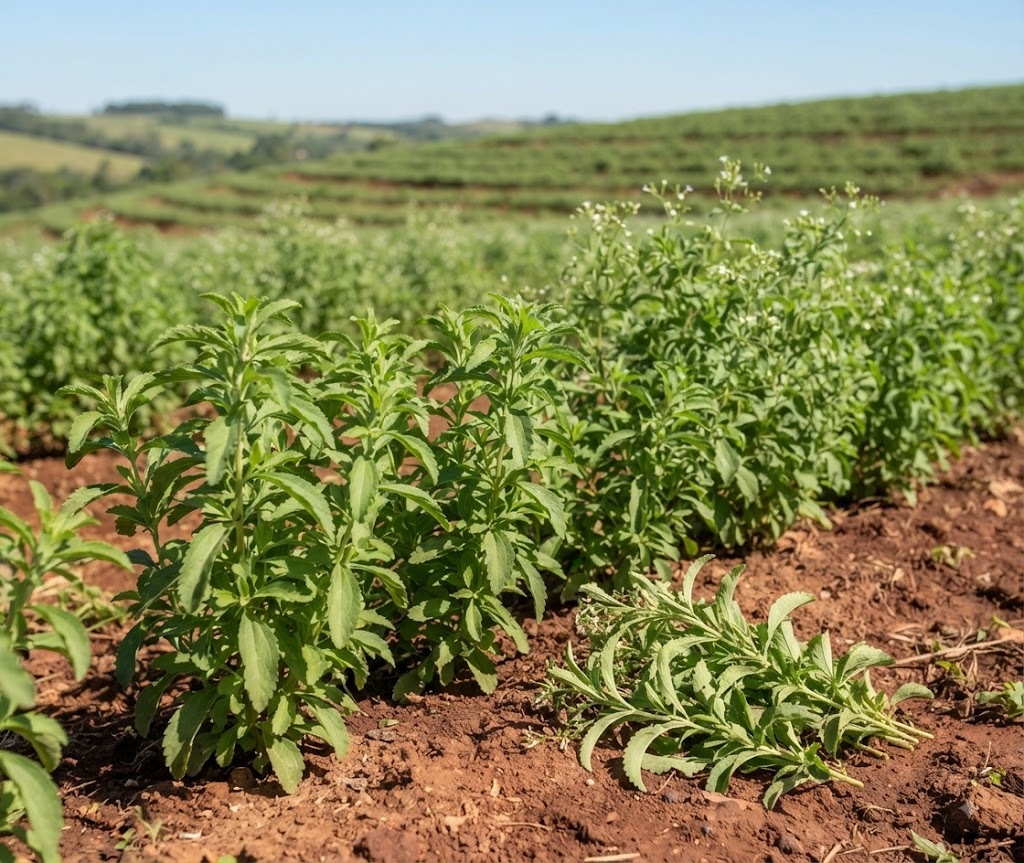
| Item Identity | The representative plant entity of Stevia is Stevia rebaudiana (Bertoni) Bertoni of the Asteraceae family. Kew manages it as an accepted species. ( Plants of the World Online ) |
| Key role | It is a crop linked to the agriculture-extraction-refining-food industry , in which the leaves themselves are dried and powdered to be used as food ingredients, or sweeteners are extracted and refined from the leaves to be converted into a food additive called steviol glycosides . |
| Harvesting principle | Harvesting is performed based on leaf yield, sweetness content, and processing purpose, and the harvest date, growth stage, and Leaf Lot are recorded. Specific optimal harvest values are entered after verifying the conditions according to official cultivation technical data. |
| Product separation | Separate into Fresh Leaf → Dried Leaf → Leaf Powder → Crude/Intermediate Extract → Purified Steviol Glycosides → Bio-converted/Processed Glycosides → Blended Sweetener → Finished Food. |
| Separation of similar items | Other Stevia spp. are separate Plant Entities. Stevia leaves, Stevia powder, Stevia extract, and steviol glycosides are also managed as separate Product Entities. |
| domestic cultivation | Official data on stevia cultivation techniques is provided on the Rural Development Administration's Nongsaroo website, and domestic cultivation itself is confirmed. However, the latest national-level cultivation area and production volume are not finalized in this v1.0 version. ( Nongsaroo ) |
| Domestic official statistics | The latest government-approved statistics on nationwide stevia cultivation area and production volume will be entered later after verification of official raw data. |
| food additives | The MFDS regulates steviol glycosides as sweeteners and has also permitted bioconversion manufacturing methods as of 2024. ( Ministry of Food and Drug Safety ) |
| Supply and demand risk | Varieties and component variations, leaf yield, harvest and drying quality, pesticide residues and microorganisms, extraction yield, degree of purification, component composition, bitterness and aftertaste, raw material-additive lot discontinuity, and changes in imports, prices, and regulations are key factors. |
| Operating Principles | Seed/Cutting–Farm–Leaf Lot–Drying–Extraction–Purification–Steviol Glycoside Batch–Food Manufacturer–Buyer Connect RFQ. |
| Final goal | It is to build supply chain intelligence that connects stevia leaves, an agricultural raw material, and steviol glycosides, a high-intensity food additive, into a single lineage but manages them as different Product and Regulatory Entities. |
In 2025, the Ministry of Food and Drug Safety introduced steviol glycosides as a food additive to provide sweetness in place of sugar, citing stevioside and rebaudioside A as representative components. The same document explains that steviol glycosides are sweeteners used in various beverages and foods. ( Ministry of Food and Drug Safety )
Basic fields | detail |
| Korean name | Stevia |
| English name | Stevia / Sweetleaf |
| Representative scientific name | Stevia rebaudiana (Bertoni) Bertoni |
| classification | Asteraceae → Stevia → S. rebaudiana |
| Edible parts | Mainly leaves |
| Non-edible · Separate management | Roots, aged stems, flower stalks, trimming residues, etc. are separated from edible leaves. |
| Major harvesting stages | Harvesting of nutrient portions tailored to leaf yield, sweetness content, and processing purpose |
| Basic product form | Fresh Leaf·Dried Leaf·Cut Leaf·Leaf Powder·Extract·Steviol Glycosides |
| Basic processing stage | Harvesting → Sorting → Drying → Cutting/Grinding → Extraction → Purification → Enzymatic Treatment/Bioconversion (if necessary) → Mixing |
| Basic use | Extraction · Food Ingredients · Powder · Sweeteners · Food Additives · Beverages · Processed Foods |
| Similarity Principle | Separate from other Stevia spp., and manage plant-based ingredients and refined sweeteners as separate products. |
Kew treats Eupatorium rebaudianum Bertoni as a synonym for Stevia rebaudiana. Therefore, the corresponding scientific name in past literature is linked to the Legacy/Synonym field rather than the new Plant Entity. ( Plants of the World Online )
Product Master
Product | Product stage | Key Management Standards |
| Stevia Seed Lot | breeding materials | Species·Varieties·Seed Source·Germination·Lot |
| Cutting/Seedling Lot | Seedling cultivation | Mother plant · Breeding method · Seedling Lot |
| Stevia Field Lot | production | Variety · Origin · Planting/Sowing · Cultivation Method |
| Fresh Stevia Leaf | raw materials | Harvest date, leaf ratio, appearance, weight |
| Fresh Leaf & Tender Stem | Harvested raw materials | Leaf/stem ratio · Processing suitability |
| Cleaned Leaf | Preprocessing | Foreign matter, damage, moisture |
| Dried Stevia Leaf | dried raw materials | Drying method, moisture, color, and sweetness characteristics |
| Cut Dried Leaf | For leaching | Cut Size · Stem Ratio · Foreign Matter |
| Stevia Leaf Powder | food ingredients | Particle size, raw material lot, microorganisms |
| Crude Stevia Extract | 1st extract | Raw Material Lot, Solvent, Extraction Yield |
| Purified Extract | refined product | Purification process, ingredient composition, purity |
| Steviol Glycosides | food additives | MFDS/JECFA Standards · Ingredient Composition · Batch |
| Stevioside-rich Product | Ingredient-based Product | Actual composition/test report |
| Rebaudioside A-rich Product | Ingredient-based Product | Reb A Content · Sweetness Profile |
| Bio-converted Steviol Glycoside | Process-type Product | Enzymes, Raw Materials, Processes, and Standards |
| Enzyme-treated Stevia | Separate Additives/Process Product | Check domestic official definitions and usage standards |
| Stevia Sweetener Blend | Mixed sweeteners | Actual Formula including steviol glycoside and erythritol |
| Liquid Sweetener | Liquid finished product | Raw material ratio, concentration, preservation, labeling |
| Tabletop Sweetener | Retail products | Sweetener composition, serving size, packaging |
| Food/Beverage Ingredient | B2B | Sweetness intensity, aftertaste, solubility, application |
| OEM·PB Sweetener | finished product | Formula · MOQ · Specifications · Contract |
Classification criteria | Subdivision type | Management principles |
| Plant classification | Stevia rebaudiana | Separated from other Stevia spp. |
| Variety/Lineage | High-intensity, multi-leaf, and cultivation-adapted lines, etc. | Connecting Seed and Seedling Suppliers |
| Edible parts | Whether leaf/tender stem is included | Leaf ratio recorded separately |
| Harvesting stage | Actual harvesting stages, such as before and after growth and flowering | Standardization after quality verification |
| Cultivation method | Open field, greenhouse, and regional cultivation | Farm Standards |
| Distribution methods | Fresh · Dried · Cut | Product Separation |
| Processing form | Powder·Extract·Purified Glycoside | Separate Product ID |
| Ingredient Form | Stevioside and Rebaudioside series, etc. | Test report based |
| manufacturing process | Extraction, Purification, Enzyme Treatment, Bioconversion | Process Entity |
| Final use | Tea · General Food · Beverages · Sweeteners · Mixed Sweeteners | Application |
| Transaction type | Source Procurement · Regular Supply · Extraction Contract · OEM · PB | RFQ |
| Types of regulation | Food Ingredients / Food Additives / Finished Products | Separation of Regulatory Entities |
Kew identifies S. rebaudiana as an accepted species native to the region of Brazil from Minas Gerais and Mato Grosso do Sul to Paraguay. ( Plants of the World Online )
The Rural Development Administration's Nongsaroo provides data on domestic stevia cultivation techniques and explains that rapid growth, abundant leaves, cold tolerance, and high sweetness content are considered for varieties suitable for domestic cultivation. ( Nongsaroo )
step | Essential Dataset | Management purpose |
| Cultivation plan | Variety · Target Product · Area · Buyer | Production plan |
| Seeds and mother plants | Seed Source · Mother Plant · Lot | Plant Identity |
| Seedling cultivation | Sowing/Cuttings·Rooting·Seedling Status | Tomb quality |
| formula | Date, Block, Planting | Field Traceability |
| Growth management | Plant height, branching, number of leaves, leaf weight | Harvest forecasting |
| rising | Temperature, rainfall, humidity, and solar radiation | Production Risk |
| soil | pH, soil type, organic matter, EC, etc. | Cultivation suitability |
| Watering | Water source, quantity, and timing | Growth and Components |
| dispute | Materials, Timing, and Quantity | Leaf production |
| pests | Occurrence, Control, and Pesticides | Production and Safety |
| Flowering status | Flowering stage | Harvest and component analysis |
| Harvest judgment | Leaf yield, growth stage, and Buyer's purpose | Harvesting at the right time |
| harvest | Date, Section, Weight | Leaf Lot |
| Separation of leaves and stems | Leaf ratio · Stem ratio | Raw Material Grade |
| Selection | Damage, disease, foreign matter | quality |
| purifying | Water quality and processes when applied | hygiene |
| dry | Method, temperature, time, final moisture | Quality and Storage |
| Jeongseon | Removal of stems, foreign matter, and defective leaves | Grade |
| cutting | Cut Size | Tea/Extraction |
| save | Temperature, humidity, and period | Raw material stability |
| smash | Particle Size · Batch | Powder |
| extraction | Amount of raw materials, solvent, time, temperature | Extract |
| percolation | Filtration conditions | Pre-treatment of purification |
| tablet | Actual processes such as adsorption, separation, and crystallization | Glycoside Quality |
| Concentration and drying | Solids and pulverization | Additive Product |
| Bioconversion | Enzyme, Substrate, Process Conditions | Modified Glycoside |
| mix | Glycoside Carrier/Sweetener | Final Sweetener |
| packaging | Packaging Material · Weight · Lot | shipment |
Quality items | Fresh Leaf | Dried Leaf | Powder | Steviol Glycosides | finished product | Public rating |
| Species | essential | succession | succession | Botanical Source Connection | tracking | Public/Verified |
| varieties | essential | succession | succession | Raw material inheritance | If necessary | Verified |
| mountainous district | essential | essential | succession | Raw material traceability | tracking | Public/Verified |
| farmhouse | essential | succession | succession | Raw material connection | tracking | Verified |
| Lot | essential | essential | essential | Batch required | essential | Verified/NDA |
| Harvest day | essential | succession | succession | succession | tracking | Verified |
| Growth stage | record | succession | succession | Raw material history | — | Verified |
| Leaf/Stem ratio | core | core | Raw material inheritance | Ingredient Information | — | Verified |
| appearance | Leaf color/damage | Color and dryness | Color and uniformity | Powdered state | QC | Member |
| weight | essential | essential | Batch | Batch | finished product | NDA |
| moisture | Fresh condition | core | core | Standard testing | By product | Verified |
| alien substance | check | core | core | Purification stage management | core | Verified |
| disease and decay | check | check | Raw material inspection | — | — | Verified |
| pesticide residues | core | test | Raw material inheritance/inspection | Verification by raw material and product | Conformity to standards | Verified/NDA |
| microorganism | If necessary | test | core | By specification and process | Conformity to standards | Verified/NDA |
| heavy metals | Risk-based | test | test | Check additive specifications | Finished product standards | Verified/NDA |
| Stevioside | analyzable | Key Research Indicators | analyze | Product composition | By product | Verified/NDA |
| Rebaudioside A | analyzable | Key Research Indicators | analyze | Product composition | By product | Verified/NDA |
| Other steviol glycosides | analyze | analyze | analyze | Key Spec | By product | Verified/NDA |
| Total Sweetness Profile | Sensory and Ingredients | core | core | core | core | Verified/NDA |
| Bitter taste and aftertaste | sensuality | sensuality | core | Buyer Spec | Application | Member/Verified |
| Drying history | — | essential | succession | succession | tracking | Verified |
| Grinding history | — | — | essential | Raw material history | tracking | Verified |
| Extraction history | — | — | — | essential | succession | NDA |
| Refining history | — | — | — | essential | succession | NDA |
| Bioconversion | — | — | — | This product is required | succession | NDA |
| Mixed Formula | — | — | — | If necessary | core | NDA |
| packaging | raw material | essential | essential | essential | essential | Verified |
| Expiration date | By ingredient | By ingredient | By product | By product | essential | Verified |
| Shipment | essential | essential | essential | essential | essential | Verified |
| Returns | record | record | record | record | record | NDA |
| Claim | record | record | record | record | record | NDA |
| Repurchase | Buyer Connection | Buyer Connection | Buyer Connection | Buyer Connection | Buyer Connection | NDA |
The Ministry of Food and Drug Safety revised the standards and specifications in 2024 to permit bioconversion by enzymatic treatment for the manufacturing method of steviol glycosides . Therefore, MarketHub does not treat Extracted/Purified and Bio-converted as the same Process Batch. ( Ministry of Food and Drug Safety )
Since JECFA also operates an international food additive standard monograph for Steviol Glycosides, B2B import/export RFQs can simultaneously link MFDS standards and JECFA standards via an Evidence Link. ( FAO Home )
Lot Master Required Field
Lot ID · Item/Product Type · Scientific Name · Variety/Strain · Edible Part (Leaf) · Leaf/Stem Ratio · Cultivation Method · Country/Origin/Cultivation Area · Producer · Seed/Mother Plant Lot · Planting Date · Harvest Date · Growth Stage · Quality Indicators · Weight/Specifications/Grade · Checking for Leaf Color/Damage/Diseases/Foreign Matter · Pesticide Use Records · Pesticide Residue/Microorganism/Heavy Metal Test Reports · Drying/Selection/Storage History · Raw Material Lot · Grinding/Extraction/Filtering/Purification/Concentration/Bioconversion History · Ingredient Composition (e.g., Stevioside, Rebaudioside) · Packaging Date · Best Before Date · Shipper · Returns/Claims · Repurchase
Customers | Purchase criteria | Cooperation opportunities |
| Domestic stevia farms | Variety, Seedling, Purchaser, Processing Purpose | contract farming |
| Mountain production organization | Joint drying · Leaf grade | Raw Material RFQ |
| Herb and tea manufacturers | Dried Leaf Cut Scent | leachate product |
| Powder manufacturer | Dried leaves, moisture, microorganisms | Leaf Powder |
| Extraction company | Steviol Glycoside content and yield | Extraction RFQ |
| food additive manufacturer | Raw leaf, extract, and purification suitability | Glycoside Production |
| sweetener manufacturers | Composition including Stevioside and Reb A | B2B Sweetener |
| Beverage manufacturer | Sweetness Profile · Solubility · Aftertaste | Zero/Reduced Sugar |
| Fruit and vegetable juice manufacturers | Usage Standards · Flavor Profile | Sweetening |
| Confectionery and Bakery | Heat processing suitability · rear end | Formula |
| Sauces and seasonings | Sweetness adjustment · Solubility | Ingredient |
| Dairy products and desserts | Flavor · Sweetness | Application |
| HMR | Sweeteners · Labeling | Product Reformation |
| General health foods | Food Type and Labeling | Ingredient |
| Distribution/Online | Distinguishing between Leaf/Powder/Sweetener | Retail |
| OEM·PB | Mixed sweeteners, beverages, and food | Formula |
| export companies | Target country additive standards, E/INS, etc. | Global RFQ |
| Research Institute | Variety, Ingredients, Extraction, Sensory | R&D |
In the international supply chain of stevia, a structure in which the product undergoes multiple transformations— from raw leaves → extract → purified steviol glycosides → sweetener blend → finished product— is more important than simple leaf export.
step | Key variables | Operational judgment |
| Seeds and seedlings | Variety/Composition Lineage | production base |
| Farm production | Region · Climate · Leaf Yield | Raw Supply |
| harvest | Growth stage and leaf ratio | Quality |
| dry | Moisture, Color, and Ingredients | Raw Ingredient |
| Bulk distribution | Origin·Crop Lot | Ingredient Trade |
| powder | Particle size and microorganisms | Food Ingredient |
| extraction | Yield and Solvent | Crude Extract |
| tablet | Glycoside Composition | Additive Grade |
| Bioconversion | Enzymes and Processes | New-generation Ingredient |
| Imports and exports | HS · Product Type · Country of Origin | Trade Classification |
| Domestic blend | Glycoside·Carrier | Sweetener Blend |
| Food manufacturing | Usage Standards · Formula | Finished Product |
| RFQ | Ingredients · Sweetness · Aftertaste · MOQ | Procurement |
| delivery | COA · Batch | Compliance |
| Repurchase | Sensory · Cost · Claim | Supplier Score |
Trade Dataset
item | v1.0 processing |
| Fresh/Dried Stevia Leaf HS | Input after verification of official raw data from the Korea Customs Service by product type |
| Stevia Leaf Powder HS | Further verification |
| Crude Stevia Extract HS | Verification by composition and processing state |
| Steviol Glycosides HS | Enter after confirming the detailed customs classification of food additives |
| Blended Sweetener HS | Separate verification by mixed composition |
| Korea's import volume | Input after official verification of raw data |
| Korean import value | Input after official verification of raw data |
| Major countries of origin | Input after verifying raw data by country with the Korea Customs Service. |
| Customs clearance unit price | Calculated from the same Product, HS, and quantity unit |
| EU additive code | Steviol glycosides E960 series; current detailed classifications must be checked by product. |
| JECFA | Steviol Glycosides Specification Framework Connection |
| FTA | Verification of origin and product by HS code |
| Quarantine | Separation of Seed/Plant/Fresh/Dried and purified additive |
| Food Additive Regulation | Verification of Korea MFDS and destination-specific usage standards |
7. Processing, By-products & PRP Intelligence
Products and processes | Key conditions | RFQ conversion |
| Fresh Stevia Leaf | Species · Varieties · Harvest Date | Farm RFQ |
| Dried Leaf | Moisture · Color · Leaf Ratio | Tea/Extraction |
| Cut Leaf | Cut Size · Stem | Herbal Product |
| Leaf Powder | Particle size and microorganisms | Food Ingredient |
| Crude Extract | Raw Material Lot, Solvent, Yield | Refinery RFQ |
| Purified Extract | Degree of Purification and Ingredient Composition | Additive Processor |
| Steviol Glycosides | MFDS/JECFA Spec | Food Manufacturer |
| Stevioside-rich Fraction | Ingredients and Aftertaste | Buyer-specific RFQ |
| Reb A-rich Fraction | Ingredients and Sensory | Beverage RFQ |
| Other Reb Fractions | Ingredient Profile | Premium Sweetener |
| Bio-converted Glycosides | Process and composition | Advanced Ingredient |
| Enzyme-treated Stevia | Domestic Legal Items/Specs | Food Additive |
| Sweetener Blend | Glycoside · Carrier · Sweetener | OEM/PB |
| Liquid Sweetener | Concentration · Formula | Retail/B2B |
| Tabletop Sweetener | Construction and paving | Consumer |
| Beverage Premix | Sweetness Profile · Solubility | RTD OEM |
| Extraction Residue | leaf residue | Legal verification of feed, compost, and bio-utilization |
| Stem Fraction | Stem by-products | Review of raw material suitability, compost, etc. |
The 2024 revision of MFDS standards and specifications provides the direct institutional basis for distinguishing between extraction-based products and bioconverted products based on manufacturing methods . ( Ministry of Food and Drug Safety )
JECFA maintains the Steviol Glycosides Framework as an independent standards system. ( FAO Home )
PRP — Product Research Profile
Stevia PRP operates with the following structure.
PRP | Key research questions |
| Stevia Leaf PRP | Which varieties and harvest stages of leaves are suitable as raw materials for drying and extraction? |
| Dried Leaf PRP | What are the effects of drying conditions on moisture, color, composition, and shelf life? |
| Powder PRP | Are the Parent Leaf Lot, particle size, microorganisms, and components suitable for the Buyer Spec? |
| Extract PRP | What are the effects of raw leaves, solvent, and extraction conditions on extraction yield and composition? |
| Steviol Glycoside PRP | Which glycoside composition is associated with sweetness intensity, bitterness, and aftertaste? |
| Bio-conversion PRP | What are the differences in manufacturing, specifications, and sensory characteristics between extracts/purified products and bioconverted products? |
| Beverage PRP | What is the optimal sweetness profile for each application, such as carbonated drinks, tea, fruits and vegetables, and dairy products? |
| Export PRP | Does it comply with the destination country's additive identity, usage standards, and labeling regulations? |
first of all | Execution item | Performance indicators |
| 1 | Make Species·Variety·Farm·Harvest Date·Lot mandatory | Essential Field Completion Rate |
| 2 | Fresh·Dried·Powder·Extract·Glycoside Product Separation | Product identification rate |
| 3 | Linking soil, weather, growth, flowering, and harvest data | Field–Lot Connection Rate |
| 4 | Leaf/Stem Ratio Video AI Analysis | Accuracy of raw leaf ratio |
| 5 | Leaf color, damage, and disease AI screening | Selection accuracy |
| 6 | Linking component datasets such as Stevioside and Reb A | Component Coverage |
| 7 | Harvest Timing · Leaf Yield Prediction | Forecast error |
| 8 | Drying Conditions – Prediction of Composition and Color Quality | Quality Prediction |
| 9 | AI Extraction Yield Prediction | Extraction Yield Error |
| 10 | Prediction of purification yield and composition | Purification KPI |
| 11 | Sweetness/Aftertaste Sensory Datafication | Sensory Dataset Completion Rate |
| 12 | Bio-conversion Batch Traceability | Process inheritance rate |
| 13 | Product–Buyer AI Match | RFQ → Sample Conversion Rate |
| 14 | Cost, Price, and Supply & Demand Forecast | Forecast error |
| 15 | Buyer Ratings & Repurchase Link | Repeat Order Rate |
Problem group | Problem Definition | Required data |
| Species confusion | Can coexist with other Stevia species | Scientific Name |
| Unmanaged varieties and lines | Difficult to track differences in sweeteners and quantities | Cultivar |
| Leaf/Stem ratio deviation | Effect on extraction efficiency and quality | Plant Part Ratio |
| Harvesting stage deviation | Differences in leaf yield and composition | Growth Stage |
| weather risk | Leaf yield and growth variation | Climate |
| pests | Impact of raw material quantity and pesticide residues | Pest/Spray |
| pesticide residues | Leaf Raw Material Safety | COA |
| Drying deviation | Effects of moisture, color, microorganisms, and components | Drying |
| Deterioration of storage quality | Moisture absorption and raw material spoilage | Storage |
| Powder authenticity | Unable to verify appearance | Parent Lot |
| Variation in extraction yield | Yield differences by raw material and process | Extraction Dataset |
| Variation in degree of refinement | Additive quality and sensory effects | Purification |
| Glycoside composition variation | Difference between Sweetness and Aftertaste | Component Analysis |
| Stevioside–Reb A mixture | Sensory differences based on composition | COA |
| Leaf–Additive Confusion | Selling other products under the single name “Natural Stevia” | Regulatory Entity |
| Bioconversion process not indicated | Difference from existing extraction, purification, and manufacturing methods | Process Record |
| Confusion over food ingredient and additive regulations | The application criteria are different. | MFDS Classification |
| Mixed sweetener Formula Unknown | Confusion with the composition of other ingredients such as erythritol | Formula |
| HS classification error | Different codes for leaves, extracts, and additives | HS Mapping |
| Severing the origin of imported raw materials | Loss of Farm information in final sweetener | Traceability |
| Buyer Spec Discrepancy | Sensory requirements differ by beverage, confectionery, and sauce | Application Dataset |
| Price and yield risks | Leaf Yield and Purification Yield Affect Cost | Cost/Yield |
| Repurchase not reflected | Actual product performance is not linked to raw material selection | Buyer Evaluation |
RFQ Type | Public Registration | Verify/NDA |
| Stevia seedling supply | Variety, Region, General Characteristics | Seedling Producer, Quantity, Unit Price |
| Fresh Leaf for Sale | Variety, Origin, Expected Harvest | Farms, Volume, Price |
| Dried Leaf Supply | Origin · Moisture · General Grade | Lot · COA · Unit Price |
| Cut Leaf | Cut Size · Usage | Actual Specs and Prices |
| Leaf Powder | Particle size and general specifications | Parent Lot · Microorganisms · Unit Price |
| contract farming | Variety · Target Use | Farms, Area, and Purchase Conditions |
| Regular raw material supply | Leaf/Powder · Period | Monthly volume and price |
| Crude Extract | Raw Material Source · Product Type | Process, Yield, Concentration |
| Purified Extract | General Spec | Glycoside composition and price |
| Steviol Glycosides | Specifications and Uses | COA · Composition · MOQ · Unit Price |
| Stevioside-rich Product | Main ingredients | Actual content · Sensory |
| Reb A-rich Product | Main ingredients | Actual content and price |
| Bio-converted Product | Manufacturing Method · General Spec | Enzymes · Process · COA |
| Mixed sweeteners | Scope of disclosure of ingredients | Formula · Mixing Ratio · Price |
| Beverage sweeteners | Application · General Sweetness Profile | Actual Usage · Recipe |
| For confectionery and sauces | Heat processing and tail requirements | Formula · Price |
| OEM·PB | Sweetener·Drink·Food | MOQ · Recipe · Contract |
| export | Product · Destination Country | HS · Usage Standard · Unit Price |
| Technology demonstration | Variety · Ingredient · Extraction · AI | raw data |
| Research cooperation | Breeding, cultivation, components, and sensory | IP · Exam materials |
① Need Products & Materials
Companies and institutions seeking necessary products, agricultural products, raw materials, and processed goods register purchasing demands. Registered requests are utilized to review cooperation with potential suppliers and producers based on the RFQ Intelligence Library.
Process:
RFQ Registration → Supplier/Product Review → Collaboration Connection → Future AI Matching
Register
② We are looking for production and manufacturing partners. (Need Suppliers & Manufacturers)
Register a request to find necessary production and supply partners, ranging from farms and producer organizations to processing companies, OEM, ODM, and private label manufacturers.
Process:
RFQ Registration → Review of Production & Manufacturing Capabilities → Collaboration Connection → Future AI Partner Matching
Register
③ We are looking for domestic and international buyers. (Need Buyers)
Farmers, producer organizations, and manufacturing companies are requesting cooperation with new buyers, such as domestic and international distributors, importers, brand companies, and food service and catering businesses.
Process:
RFQ Registration → Product & Supply Capability Review → Market & Buyer Connection → Future AI Buyer Matching
Register
Contact : mail@markethub.org
Version | Main contents | situation |
| v1.0 | Plant Identity · Domestic Cultivation · Fresh/Dried/Powder · Extract · Steviol Glycoside · MFDS/JECFA · RFQ Basic Structure Registration | complete |
| v1.1 | Verification of the latest domestic official raw data on Leaf Yield and Glycoside by production, import, HS, and variety | expected |
| v2.0 | Segmentation of Quality, Process, and Sensory PRP by Dried Leaf, Powder, Extract, Stevioside, Rebaudioside, and Bio-conversion | expected |
| v3.0 | Seedlings & Farms – Drying & Extraction Companies – Sweetener Manufacturing – Beverages, Food, & PB Buyer Verified Container Combination | expected |