


Judgment axis | Key judgment |
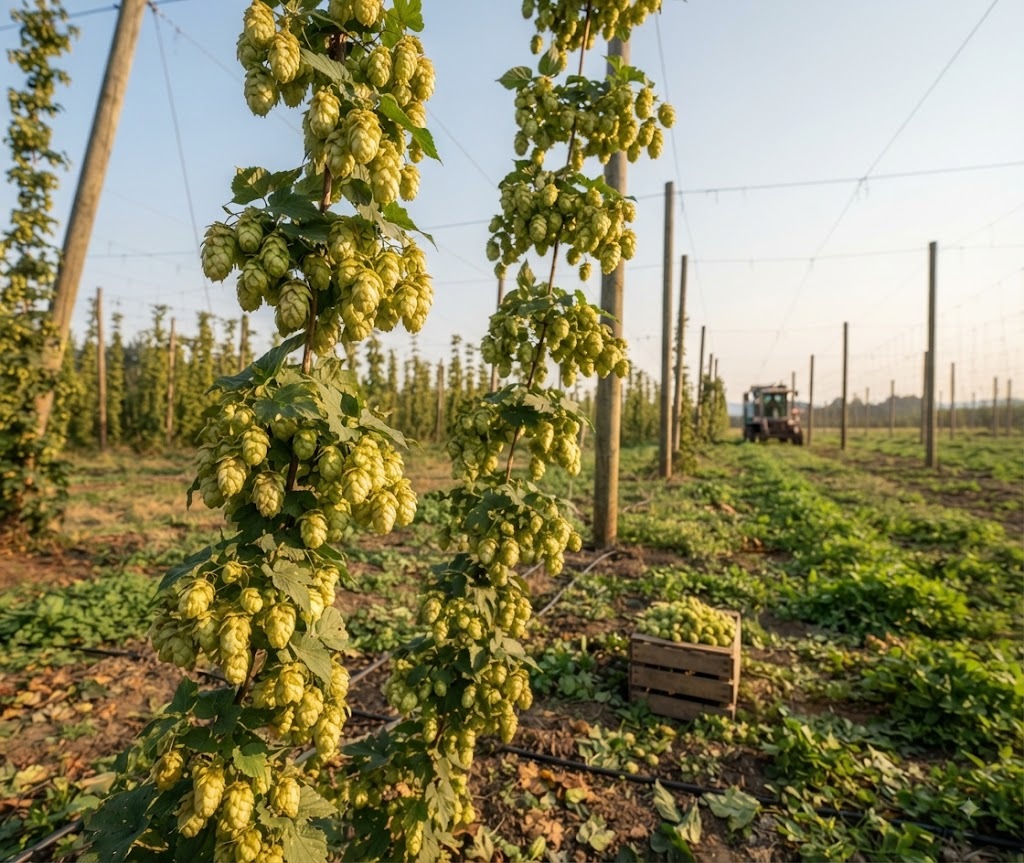
| Item Identity | Hops are a perennial vine, Humulus lupulus L., belonging to the Cannabaceae family, and MarketHub defines the female inflorescence cones used for brewing and other purposes as a core agricultural product. Kew classifies it as an accepted species and a temperate climbing perennial. ( Plants of the World Online ) |
| Key role | The primary industrial role of hops is as a bitterness and flavor ingredient for beer brewing. FAO data explains that hops are one of the major raw materials for beer production and that alpha acids are important for the bitterness and aroma characteristics of beer. ( FAOHome ) |
| Harvesting principle | Since the optimal harvest time varies depending on the variety, cultivation site, and growth year, harvest determinations for each lot are recorded based on the maturity status and quality indicators of the cones. Specific dates or moisture levels are not applied uniformly to all production areas. |
| Product separation | Fresh Cone → Dried Whole Cone → Powder → Pellet → Lupulin-enriched Product → Hop Extract are separated by product stage. The EU also defines cone, powder/pellet, and extract as separate hop product families. ( Agriculture and rural development ) |
| Separation of similar items | Other species of the genus Humulus are managed as separate Plant Entities. Varieties of H. lupulus are linked to the Variety/Cultivar Entity without creating a new Plant Species. |
| Domestic statistics | Regarding the hop cultivation area and production volume in South Korea, nationally approved statistical figures directly verified in this v1.0 will be entered later after verification of official raw data . Figures from local projects and private cultivation cases will not be replaced with national statistics. |
| Supply and demand risk | Major risks include reliance on overseas raw materials, variations in variety and harvest year, changes in alpha acid and aroma compounds, post-harvest oxidation and storage conditions, international prices, exchange rates, and shipping, and differences in specifications required by breweries. |
| Operating Principles | Establish traceability that is inheritable from Cultivar–Farm–Harvest–Cone Lot–Drying Lot–Pellet/Extract Lot–Certificate–Brewery RFQ. |
| Final goal | Rather than simple agricultural product registration, we build supply chain intelligence that enables repurchase by connecting variety, origin, harvest year, alpha acid, aroma characteristics, processing type, brewery recipes, and Buyer RFQs. |
The FAO crop classification system identifies hops as Humulus lupulus, manages fresh/dried, ground, powdered, and pellet forms of hop cones within a single agricultural product line, and treats lupulin as a related commodity. ( Open Knowledge FAO )
Basic fields | detail |
| Korean name | hop |
| English name | Hop / Hops |
| Representative scientific name | Humulus lupulus L. |
| classification | Cannabaceae → Humulus → H. lupulus |
| Edible parts | cone/strobile center formed in the female inflorescence |
| Key ingredient location | Connecting the lupulin gland inside the cone to major quality and brewing component management targets |
| Non-edible · Separate management | Stems, leaves, roots, processing residues, etc. are separated from the brewing hop cone. |
| Major harvesting stages | cones that have reached optimal brewing maturity by variety |
| Basic product form | Fresh Cone, Dried Whole Cone, Powder, Pellet, Lupulin-rich Product, Extract |
| Basic processing stage | Harvesting → Cone Separation → Drying → Sorting → Packaging/Compression → Grinding → Pelletization or Extraction |
| Basic use | Bittering/aroma/flavor ingredients for beer brewing |
| Additional uses | The use of food or other materials must be registered as a separate Product after verifying actual laws, safety, and official grounds. |
| Similarity Principle | Other Humulus species are a separate Plant Entity, while H. lupulus varieties are a Cultivar Entity. |
USDA ARS research data explains that the lupulin gland in hop cones produces alpha and beta acids and essential oils, and that these are related to the flavor and aroma of beer. ( ARS )
Product Master
Product | Product stage | Key Management Standards |
| Fresh Hop Cone | raw materials | Scientific name, variety, origin, harvest date, maturity, appearance, pests and diseases |
| Wet/Fresh Harvest Lot | Lot immediately after harvest | Harvest time, raw material temperature, moisture, time of arrival at processing facility |
| Dried Whole Hop Cone | Primary processed products | Variety, Harvest Year, Drying Conditions, Moisture, Alpha Acid, Aroma Characteristics |
| Selected Whole Cone | Selected items | Foreign matter, leaves, stems, damage, discoloration, uniformity |
| Baled/Compressed Hop | Storage and transport type | Compression·Packaging·Oxygen·Temperature·Lot |
| Hop Powder | Crushed product | Raw Material Lot · Particle Size · Antioxidant · Quality Components |
| Hop Pellet | Processed raw materials | Raw material variety · Pellet type · Alpha acid · Packaging · Storage |
| Lupulin-rich Product | Concentrated raw materials | Manufacturing Method · Ingredient Content · Raw Material Lot · Buyer Spec |
| Hop Extract | Extracted raw materials | Extraction Method · Ingredient Specifications · Batch · Application |
| Isomerized Hop Product | Highly processed raw materials | Separate manufacturing process, ingredient specifications, and legal classification |
| Brewing-specific Hop Blend | Specific Use Formulations | Variety Combination · Harvest Year · Alpha Acid · Aroma Profile |
| Brewery Contract Lot | Contractual products | Brewery Spec · Quantity · Delivery Date · Inspection · Repurchase Conditions |
Classification criteria | Subdivision type | Management principles |
| Plant classification | Humulus lupulus | Separated from other Humulus species |
| varieties | Classification possible for market purposes such as Aroma, Bittering, and Dual-purpose | Connect actual analysis values without determining functionality based solely on the commercial name. |
| gender | Female plant-centered commercial production | Manage in Plant/Field Dataset |
| Harvesting stage | Immature, ripe, overripe | Harvest Decision Dataset Connection |
| Cultivation method | Open field, experimental cultivation, and others | Separate management by cultivation site |
| cultivation area | Country → Mountain Area → Farm | Terroir·Origin Tracking |
| Harvest year | Crop Year | Quality and Inventory Key Fields |
| Distribution methods | Fresh · Dried · Compressed | Separate Product ID |
| Processing form | Whole·Powder·Pellet·Extract | Separate Product ID |
| Functional classification | Bittering·Aroma·Dual-purpose | Linking Analytical Components and Buyer's Purpose of Use |
| Final use | Beer, non-alcoholic/other beverages, food, etc. | Separation after verification of legal compliance |
| Transaction type | Spot · Contract · Regular Supply · Sample | Connect Contract Dataset |
| certification | Organic, Geographical Indication, Others | Verification of certification body, scope, and validity period |
| Saved status | Refrigeration, freezing, and other | Record of actual storage standards by product type |
step | Essential Dataset | Management purpose |
| Cultivation plan | Variety · Target Yield · Buyer · Area · Expected Harvest | contract production |
| breeding materials | Actual supply forms such as rhizomes, seedlings, and tissue cultures | Variety identity |
| formula | Official work, planting distance, and land ownership system | Production history |
| Landlords and Inducements | trellis·string·training method | Water canopy and production management |
| Growth management | Germination, stem elongation, flowering, cone formation | Growth stage |
| rising | Day length, temperature, rainfall, humidity, wind speed | Yield and Quality Risk |
| Watering | Supply volume, timing, and water source | Moisture stress management |
| dispute | Fertilizer, Timing, and Usage | Quantity and environmental management |
| pests | Diseases, Pests, Occurrence Date, Control | Loss and Safety Management |
| Harvest judgment | Cone appearance, scent, moisture, and quality analysis | Optimal harvest |
| harvest | Variety, Block, Date, Weight | Raw Material Lot Creation |
| cone separation | Separation of stem, leaf, and cone | Jeongseon quality |
| Selection | Foreign matter, damage, discoloration, non-marketable items | Grade |
| dry | Input, Time, Temperature, Termination Conditions | Storage and ingredient preservation |
| Stabilization and cooling | Uniformization and cooling after drying | Quality stability |
| compression | bale etc. | Storage and transportation efficiency |
| smash | whole cone → powder | pellet pretreatment |
| pelletization | Raw materials, processes, and yields | Brewing Product |
| extraction | Raw Materials · Extraction Method · Batch | Hop Extract |
| packaging | Oxygen, Light, Packaging Material, Weight | Quality maintenance |
| save | Temperature, Period, Inventory | Oxidation and Quality Loss Management |
| shipment | Buyer · Shipment Date · Shipping Conditions | RFQ implementation |
Hop quality is not judged solely by appearance grade; variety, harvest year, origin, alpha acid, aroma compounds, moisture content, processing method, and storage conditions must be managed together. Recent EU hop certification regulations also place importance on the harvest year and raw material management, based on the premise that alpha acid can decrease over time. ( EUR-Lex )
Quality items | Raw Fresh Cone | Dry Whole Cone | Pellet·Powder | Extract · Processed product | Public rating |
| mountainous district | essential | essential | Inheritance of raw materials | Inheritance of raw materials | Public/Verified |
| Cultivation method | essential | succession | succession | succession | Member |
| varieties | essential | essential | essential | Raw material connection | Public/Verified |
| farmhouse | essential | essential | Raw material connection | Raw material connection | Verified |
| Lot | essential | essential | essential | essential | Verified/NDA |
| Harvest year | essential | essential | essential | Raw material connection | Public/Verified |
| Harvest day | essential | essential | Inheritance of raw materials | Inheritance of raw materials | Verified |
| appearance | cone maturation, color, and damage | Color, shape, damage | The relevant city | By product | Member |
| weight | Raw material weight | Dry weight | Packaging weight | Packaging weight | NDA |
| size | cone size | If necessary | Not applicable/Particle size | Not applicable | Member |
| rating | Internal grade | Transaction rating | Product specifications | Product specifications | Member |
| pests | essential | record | Inheritance of raw materials | Inheritance of raw materials | Verified |
| Damage/Discoloration | check | essential | Raw material inspection | Raw material inspection | Verified |
| alien substance | check | core | core | Manufacturing QC | Verified |
| moisture | Harvest Judgment Reference | core | Standard management | By product | Verified |
| Alpha acids | If necessary | Key Analysis | Key Analysis | Product specifications | Member/Verified |
| Beta acids | If necessary | analyze | analyze | Product specifications | Member/Verified |
| essential oil | If necessary | Scent Profile | Scent Profile | By product | Member/Verified |
| Flavor Profile | On-site evaluation | Essential Recommendation | Essential Recommendation | By use | Member |
| pesticide residues | Cultivation history | test | Raw material inheritance/inspection | Compliant with standards | Verified/NDA |
| microorganism | If necessary | By Product | By Product | By Product | Verified/NDA |
| purifying | Typically, a separate record of process status is kept. | The relevant city | — | — | Verified |
| dry | — | core | Inheritance of raw materials | Inheritance of raw materials | Verified |
| Processing history | — | — | essential | essential | Verified/NDA |
| packaging | — | essential | essential | essential | Member/Verified |
| save | Rapid post-processing | core | core | By product | Verified |
| Refrigeration and freezing conditions | If necessary | Product/Buyer Standards | Key Review | By product | Verified/NDA |
| Consumption/Preservation Period | — | Supplier Spec | Supplier Spec | By product | Verified |
| Shipment | essential | essential | essential | essential | Verified |
| Returns | record | record | record | record | NDA |
| Claim | record | record | record | record | NDA |
| Repurchase | Buyer Connection | Buyer Connection | core | core | NDA |
Lot Master Required Field
Lot ID · Item/Product Type · Scientific Name or Variety · Cultivation Type · Origin/Cultivation Area · Producer · Cultivation Method · Propagation/Planting Date · Harvest Year · Harvest Date · Quality Indicators · Alpha/Beta Acid · Aroma Profile · Weight/Specifications/Grade · Pests/Diseases/Appearance Check · Pesticide Use Records · Pesticide Residue/Microbiological Test Reports · Drying/Storage History · Raw Material Lot · Grinding/Pellet/Extraction Processing History · Packaging Date · Best Before Date · Shipper · Returns/Claims · Repurchase
Customers | Purchase criteria | Cooperation opportunities |
| Hop producing farms and production organizations | Variety, Contract Demand, Cultivation Technology | contract farming |
| local agricultural organizations | Regional adaptability, processing facilities, joint drying | Regionally Specialized Hops |
| Imported raw material supplier | Variety · Country · Crop Year · Alpha Acid | Global Supplier RFQ |
| large beer manufacturers | Standard quality, mass supply, continuity, price | long-term contract |
| craft beer brewery | Variety · Aroma Profile · Small Packaging · Freshness | Specialty Hop |
| Brewpub | Various varieties, small quantities, delivery times | Small quantity RFQ |
| Non-alcoholic and low-alcohol beverage companies | Aroma, bitterness, design, and specifications | Product development |
| Food manufacturer | Raw material suitability and legal usability | Food material verification |
| HMR · Meal Kit | Limited to applicable products | Product development after verification |
| Distribution/Online | Packaging, Labeling, Variety, Country of Origin | B2C/B2B ingredients |
| PB | Recipe · OEM · MOQ | Local Beer · Private Brand |
| Local specialty product business operator | Linking local cultivation, stories, and breweries | Local Beer |
| exporters | HS, Quality, and Destination Country Standards | K-Craft Beer |
| Research and technology institutions | Variety adaptation, composition, harvest, drying, and brewing trials | Demonstration and R&D |
The EU classifies hops into fresh/dried cones, powder/pellets, and extracts, and within the EU customs system, cones, powders/pellets, and extracts are managed under separate code systems. In EU documents, hop cones are classified under the CN 1210 series, while hop extracts are classified under the CN 1302 series. The actual HS-K 10-digit codes for Korea are verified separately using raw data from the Korea Customs Service. ( EUR-Lex )
step | Key variables | Operational judgment |
| Production in the producing region | Country, region, variety, weather | Origin Risk |
| Contract farming and procurement | Variety, Area, Estimated Production | Securing supply |
| harvest | Crop Year · Harvest Date · Maturity | Lot quality |
| dry | Moisture, temperature, time | Ingredient preservation |
| Selection and compression | Foreign matter, quality, and bale | Shipping specifications |
| Pellet processing | Raw Material Lot, Grinding, and Pelletization | standardization |
| Extract processing | Ingredients · Batch · Ingredients | Highly processed product |
| save | Temperature, Oxygen, Period | Quality loss |
| International shipping | Shipping · Air/Sea · Transit | Delivery time and quality |
| Import customs clearance | HS · Country of Origin · Inspection | Compliance with regulations |
| Domestic distribution | Inventory, Subdivision, Storage | Brewery supply |
| Brewery supply | Variety · Alpha acid · Packaging | Buyer Spec |
| RFQ · Repurchase | Usage Results · Yield · Flavor · Delivery Time | Next Crop Year Procurement |
Trade Dataset
item | v1.0 processing |
| Hop cones HS | Further verification of Korean HS-K detailed codes based on the HS 1210 series |
| Whole Hop Import Volume | Input after official verification of raw data by the Korea Customs Service |
| Pellet import volume | Enter after checking the detailed HS description |
| Extract import volume | Verified as a separate HS Product |
| Revenue | Enter after confirming the base year, USD/KRW, and unit. |
| Country of origin by country | Input after official verification of raw data |
| Customs clearance unit price | Calculate after matching the quantity unit and product type. |
| FTA | Verification of Rules of Origin by Country, Agreement, and HS |
| Quarantine | Check Animal and Plant Quarantine Agency regulations applicable by import type |
| Food safety | Check MFDS regulations by food ingredient and product type |
Products and processes | Key conditions | RFQ conversion |
| Fresh Cone | Variety, Harvest Date, Aroma, Freshness | Fresh Hop Brewery RFQ |
| Selected Cone | Appearance, foreign matter, uniformity | Whole Cone |
| Dried Cone | Moisture, dryness, alpha acid, scent | Brewery/Processor |
| Compressed/Baled Hop | Compression, Packaging, Storage | Bulk Trade |
| Hop Powder | Grinding, Particle Size, and Oxidation Management | Pellet raw materials |
| Hop Pellet | Pellet form · alpha acid · fragrance | Standard Brewery RFQ |
| Lupulin-rich Product | Concentration, Ingredients, Manufacturing Method | Specialty Brewing |
| Hop Extract | Extraction method and ingredient specifications | Mass and precision brewing |
| Isomerized Product | Process and active ingredients | Special Brewing RFQ |
| Hop Blend | Variety · Mix · Crop Year | Recipe-specific RFQ |
| Finished Brewing Ingredient | Standards and Packaging | Brewery regular supply |
| Stem and leaves | Harvest by-products | Review of compost and agricultural return |
| Pellet/Processing Residue | Process by-products | Utilization after ingredient and safety analysis |
| Non-standard Cone | Raw materials other than quality grade | Review of non-food items, compost, etc. |
| waste packaging | Packaging by-products | Recycling and waste reduction |
In the EU hop market structure, the processing of cones into powder/pellets and extracts is clearly separated; therefore, MarketHub also manages these product stages as independent products. ( Agriculture and rural development )
The expression "converting by-products into food, functional, pharmaceutical, or cosmetic materials" is elevated to Product Master status only when official safety, raw material recognition, and legal and research grounds are confirmed.
PRP — Product Research Profile
Hop's PRP operates with the following structure.
Plant Identity → Cultivar Profile → Growing Region → Crop Year → Harvest Maturity → Drying Profile → Alpha/Beta Acid Profile → Essential Oil/Aroma Profile → Storage Stability → Processing Profile → Brewing Trial → Buyer Specification → RFQ Performance
first of all | Execution item | Performance indicators |
| 1 | Item, Variety, Origin, Crop Year, Harvest Date, Lot required values | Essential Field Completion Rate |
| 2 | Fresh·Whole·Pellet·Extract Product Separation | Product separation rate |
| 3 | Linking weather, growth, pests and diseases, cone formation, and harvest data | Field–Lot Connection Rate |
| 4 | Alpha/Beta Acid, Fragrance Profile, and Moisture Data | Analysis value acquisition rate |
| 5 | Linking drying, processing, storage, and test report history | Processing Traceability |
| 6 | Video AI-based cone maturity and appearance screening | Screening accuracy and testing time |
| 7 | Pest and disease AI diagnosis | Early diagnosis rate · Control response time |
| 8 | Harvest timing prediction | Prediction error and quality deviation |
| 9 | Production and Shipment Forecasts | Prediction error |
| 10 | Prediction of storage environment and quality deterioration | Quality loss rate |
| 11 | Buyer Style–Hop AI Match | RFQ → Sample Conversion Rate |
| 12 | Brewery Performance & Repurchase Runtime Connection | Repurchase rate · Claim rate |
Problem group | Problem Definition | Required data |
| Confusion in variety identification | Mixing of product names, trademark names, and variety names | Cultivar · Supplier · Proof |
| Lack of domestic production base | Insufficient assessment of official cultivation and production scale | KOSIS · Agricultural Statistics · Regional Data |
| Regional adaptability | It cannot be assumed that foreign varieties adapt equally to the domestic climate. | Variety, Weather, Growth, Yield |
| weather risk | Temperature, rainfall, drought, etc., affect water quantity and composition | Weather, Field, and Components |
| pests | Decrease in yield and quality due to disease | Occurrence, Control, and Loss |
| Variation in optimal harvest time | Lot quality differences during early/delayed harvesting | Maturity, Moisture, and Components |
| Drying deviation | Variations in shelf life and aroma quality due to uneven drying | Time, temperature, moisture |
| Alpha acid deviation | Differences in content by variety, origin, and crop year | COA · Analysis Value |
| Scent Profile Deviation | Differences between essential oils and fragrance characteristics | Analysis · Sensory |
| Quality degradation during storage | Changes in composition according to time, oxygen, and temperature | Storage temperature, duration, and packaging |
| Raw Material – Pellet Traceability | Difficulty tracing the original growing lot in Pellet | Lot Genealogy |
| Extract Traceability | Reduced raw material traceability in highly processed products | Batch · Raw Material Lot |
| Dispersion of test reports | Differences in Analysis Items and Units by Supplier | COA Standard Dataset |
| dependence on imports | Impact of Overseas Crop Year and Logistics Disruptions | Country · Supplier · Inventory |
| Exchange rates and price fluctuations | Long-term contract cost fluctuations | Price, Exchange Rate, Contract |
| Brewery Spec discrepancy | Even for the same variety, requirements vary by brewery. | Buyer Spec |
| Inventory Management | Mixing of crop years or occurrence of old inventory | In/Out · Lot · Age |
| Repurchase data disconnection | Brewing results will not be reflected in the next purchase | Brewing Result · Evaluation |
RFQ Type | Public Registration | Verify/NDA |
| Procurement of raw materials from the source | Variety · Region · Crop Year | Farm · Quantity · Price · Lot |
| Fresh Hop Sales | Variety, Expected Harvest, Region | Harvest date, actual quantity, unit price |
| Dried Hop Sales | Variety/Product Type | Moisture · COA · Price |
| purchase | Desired Variety · Product | Target Price and Volume |
| Regular supply | General Standards and Periods | Monthly Volume and Contract Unit Price |
| contract farming | Variety, Region, Use | Area, Producer, Price |
| Supply of processed raw materials | Whole/Powder/Pellet | Lot·COA·MOQ |
| Pre-treated products | Dried/Selected/Compressed | Process and Unit Price |
| Pellet supply | Type · Crop Year · Variety | Ingredients · Lot · Price |
| Extract supply | Product Type/Use | Process, Test Report, Price |
| Supply to restaurants and brewpubs | Small Quantity & Variety Information | MOQ · Delivery Cycle |
| OEM·PB | Local beer and product concept | Recipe · Production Cost |
| export | Product · Destination Country | HS · Price · Certification |
| Technology demonstration | Variety · Smart Farm · Drying · AI | Raw data and performance |
| local specialties | Local hops and brands | Actual production and manufacturing conditions |
| Research cooperation | Variety, Climate, Ingredients, Brewing | IP, raw data, test conditions |
① Need Products & Materials
Companies and institutions seeking necessary products, agricultural products, raw materials, and processed goods register purchasing demands. Registered requests are utilized to review cooperation with potential suppliers and producers based on the RFQ Intelligence Library.
Process:
RFQ Registration → Supplier/Product Review → Collaboration Connection → Future AI Matching
Register
② We are looking for production and manufacturing partners. (Need Suppliers & Manufacturers)
Register a request to find necessary production and supply partners, ranging from farms and producer organizations to processing companies, OEM, ODM, and private label manufacturers.
Process:
RFQ Registration → Review of Production & Manufacturing Capabilities → Collaboration Connection → Future AI Partner Matching
Register
③ We are looking for domestic and international buyers. (Need Buyers)
Farmers, producer organizations, and manufacturing companies are requesting cooperation with new buyers, such as domestic and international distributors, importers, brand companies, and food service and catering businesses.
Process:
RFQ Registration → Product & Supply Capability Review → Market & Buyer Connection → Future AI Buyer Matching
Register
Contact : mail@markethub.org
Version | Main contents | situation |
| v1.0 | Registration of basic structure of Plant Identity, Production, Product, and RFQ | complete |
| v1.1 | Verification of official domestic and global production, market, and HS import/export raw data | expected |
| v2.0 | Detailed quality and processing specifications by Whole Cone, Powder, Pellet, Lupin, and Extract | expected |
| v3.0 | Producer–Processor–Raw Material Supplier–Brewery Buyer Verified Container Combination | expected |