

Judgment axis | Key judgment |
| Item Identity | Cacao is a tropical perennial woody crop that utilizes the seeds inside the mature pods of Theobroma cacao L. as its core economic part. |
| Key role | In Korea, cacao beans and processed products such as cacao mass, butter, and powder are more important as raw materials for the chocolate, confectionery, beverage, and food ingredient industries than fresh fruit for consumption. |
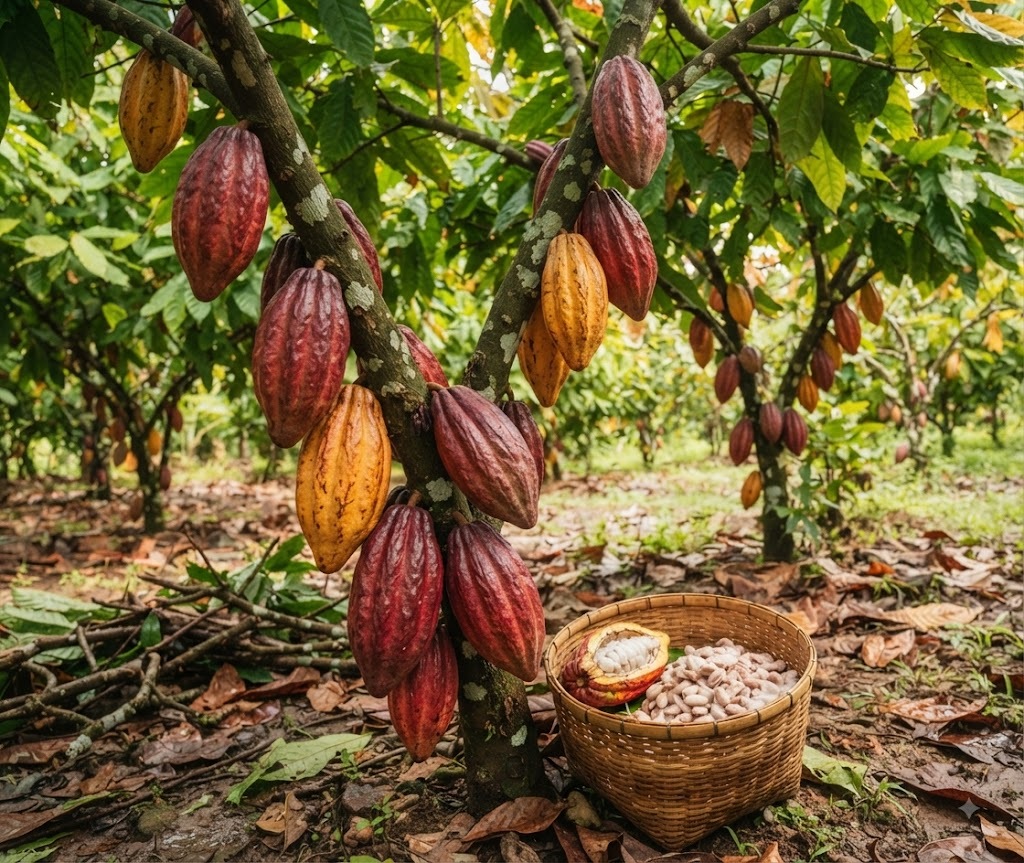
| Harvesting principle | The basic post-processing structure at the production site involves harvesting mature pods, opening them to separate the seeds from the surrounding pulp, and then fermenting and drying them. Kew states that a single pod typically contains 30 to 40 seeds and describes the fermented and dried seeds as cocoa beans. ( Plants of the World Online ) |
| Product separation | Pods, wet cacao seeds, fermented cacao beans, dried beans, nibs, cacao mass/liquor, cacao butter, cacao cake, cacao powder, and chocolate raw materials are managed as separate products. |
| Separation of similar items | Since it differs from coffee in family, genus, scientific name, processing method, and final market, it is managed as a separate Plant Entity. Closely related species of the genus Theobroma are also not registered as the same item as T. cacao. |
| Domestic statistics | Directly verified values for national approved statistics regarding domestic commercial cocoa production will be entered later after official raw data verification . Import statistics will also be entered after verifying raw data from the Korea Customs Service by HS code. |
| Supply and demand risk | Reliance on overseas production areas, local weather and disease conditions, variations in fermentation and drying, fluctuations in international prices, supply concentration by country, safety regarding heavy metals, pesticide residues, and microorganisms, as well as maritime transport and inventory, are key variables. |
| Operating Principles | Connect Plant–Origin–Harvest–Fermentation–Drying–Bean Lot–Processing Lot–Certificate–Buyer RFQ, and separate the actual quantity, price, contract, and certificate into Verified/NDA. |
| Final goal | We build RFQ Intelligence capable of recurring procurement by connecting origin, processing, quality, and buyer specifications, rather than simply providing Kakao information. |
FAOSTAT provides official international agricultural production statistics, including crop yields and harvested area. However, since this entry has not directly cross-referenced the latest country-specific cacao production figures with the source data, specific production figures are not arbitrarily listed. ( FAOHome )
Basic fields | detail |
| Korean name | Kakao |
| English name | Cacao / Cocoa |
| Representative scientific name | Theobroma cacao L. |
| classification | Plantae → Malvales → Malvaceae → Theobroma → T. cacao ( Plants of the World Online ) |
| Edible parts | Mainly seeds inside the pod and their processed products |
| Non-edible · Separate management | By-products such as pod hulls and seed coats must be separated from the main product, and their safety and legal compliance must be verified separately when utilized. |
| Major harvesting stages | Mature Ford |
| Basic product form | Pods, wet beans, fermented/dried cocoa beans, nibs, mass/liquor, butter, cake, powder |
| Basic processing stage | Harvesting → Fruit splitting → Fermentation → Drying → Sorting → Roasting, etc. → Crushing/Separation → Grinding → Pressing, etc. |
| Basic use | Chocolate, confectionery, bakery, beverages, and food ingredients |
| Principle of similar items | Closely related species of the genus Theobroma are a separate Plant Entity. T. cacao derivatives are linked as a Product Entity. |
Kew explains that the fruit of the Theobroma cacao is commonly called a cocoa pod, which usually contains 30 to 40 seeds inside, and that fermenting and drying these seeds produces cocoa beans. ( Plants of the World Online )
Product Master
Product | Product stage | Key Management Standards |
| Cacao Pod | raw materials | Species/Genotype/Variety, Origin, Maturity, Harvest Date, Diseases/Damage |
| Wet Cocoa Beans | Harvesting and fruiting raw materials | Pod Lot, Dog Fruit, Seed/Pulp Condition, Fermentation Input Time |
| Fermenting Cocoa Beans | Primary processed intermediate product | Process records including fermentation lot, method, time, temperature, etc. |
| Dried Cocoa Beans | B2B basic raw materials | Origin, fermentation status, dryness, moisture, defects, foreign matter, safety |
| Cocoa Nibs | Pre-processed and processed products | Roasting/crushing, hull removal, particle size, microorganisms |
| Cocoa Mass/Liquor | Processed raw materials | Raw Bean Lot, Roasting, Grinding, Fat/Quality Standards |
| Cocoa Butter | Separated processed product | Raw Material Lot, Pressing/Refining Status, Quality/Food/Other Uses |
| Cocoa Cake | Pressed Busan/Intermediate Product | Residual fat, moisture, storage conditions before grinding |
| Cocoa Powder | Powdered products | Fat content, alkali treatment status, particle size, color/aroma, microorganisms |
| Chocolate Ingredient | For specific purposes | Cocoa solids, butter, recipe suitability, buyer specifications |
| Cosmetic-grade Cocoa Butter | Industrial Product | Separation from food grade, verification of manufacturing, purification, standards, and legal uses |
Classification criteria | Subdivision type | Management principles |
| Plant classification | Theobroma cacao | Separated from Theobroma species |
| Genotypes and varieties | Origin-registered genotypes, clones, and varieties | Connecting evidence without confirming based solely on the name used by the supplier |
| Harvesting stage | Immature, ripe, overripe | Linking Maturity with Quality and Fermentation Results |
| Cultivation method | Tropical open fields, agricultural-forest complexes, plantations, etc. | Records of country, production area, and cultivation system |
| mountainous district | Country → Region → Farm/Cooperative | Origin Traceability Core |
| fermentation | Unfermented, partially fermented, fermented | Separate Product/Grade |
| dry | Cheonil, Machinery, Complex, etc. | Linking Moisture, Scent, and Contamination Risks |
| Distribution methods | bulk bag, sack, etc. | Record of weight, packaging, and container conditions |
| Processing form | bean·nib·mass·butter·cake·powder | Separate Product ID |
| Final use | Chocolate, confectionery, beverages, bakery, food ingredients, and others | Separation by Buyer Spec |
| Transaction type | spot · periodic supply · contract procurement · processing contract | The condition is Verified/NDA |
| certification | Organic, sustainability, etc. | Display after verifying the actual certificate and validity period. |
Cacao is a crop adapted to humid tropical regions. Kew describes its natural growing environment as the understory of tropical evergreen rainforests, stating that it grows primarily at elevations below 300 meters and in environments with annual precipitation of approximately 1,000 to 3,000 mm. This is based on natural distribution and ecological data and is not equated with the optimal cultivation standards for specific commercial varieties. ( Plants of the World Online )
step | Essential Dataset | Management purpose |
| Cultivation plan | Country·Region·Farm·Genetic/Variety·Area | Verification of production base |
| Seeds, seedlings, propagation | Seedlings, clones, and breeding grounds | Plant Identity |
| formula | Official date, planting system, shading | Production history |
| Growth management | Flowering, fruit setting, and pod development | Harvest forecasting |
| rising | Temperature, rainfall, humidity, and abnormal weather | Production risk |
| Watering | Water source, timing, and amount | Moisture stress management |
| dispute | Fertilizer, Timing, and Usage | Production and Safety Management |
| pests | Occurrence, Control, and Chemicals | Management of Losses and Pesticide Residues |
| Harvest judgment | Ford Maturity and Exterior | Ensuring uniformity |
| harvest | Date · Farm · Harvest Lot | Traceability Start |
| Dog family | Dog fruit · Pod condition | Create Bean Lot |
| fermentation | Method, Period, Temperature, and Switching Management | Flavor and quality formation |
| dry | Method, period, moisture | Shelf life and quality |
| Selection | Defects, foreign matter, size | Grade settings |
| save | Warehouse, temperature and humidity, period | Prevention of mold and quality degradation |
| packaging | Packaging, Weight, and Lot Marking | Export/Supply |
| shipment | Shipment Date, Quantity, Destination | Supply chain tracking |
| Roasting | Time, Temperature, Equipment Lot | Product quality |
| Crushing and peeling | Nib and shell separation | Processing yield |
| smash | nib→mass/liquor | Raw Material Product Production |
| pressure | butter and cake separation | Product-specific Lot creation |
| Grinding and pulverization | cake→powder | Powder standardization |
Quality items | Raw materials · Pods | Fermented and dried beans | processed goods | finished product | Public rating |
| mountainous district | essential | essential | Raw Material Lot Inheritance | Raw material tracking | Public/Verified |
| Crop type and cultivation system | record | succession | succession | If necessary | Member |
| Variety/Genetic | record | succession | succession | If necessary | Member/Verified |
| farmhouse | essential | essential | Provider Connection | tracking | Verified |
| Lot | essential | essential | essential | essential | Verified/NDA |
| Harvest day | essential | essential | succession | tracking | Verified |
| appearance | Ford status | Bean state | By product | By product | Member |
| weight | Lot weight | Packaging unit | standard | standard | NDA |
| size | Ford/Seed | Bean specifications | Particle size, etc. | By product | Member |
| rating | Mountain area standards | Transaction rating | Product specifications | Finished product specifications | Member |
| pests | essential | History Link | Raw material history | tracking | Verified |
| impairment | record | Defect management | Raw material inspection | Finished Product QC | Verified |
| decay and mold | check | core | Raw material inspection | Safety Management | Verified |
| alien substance | check | core | core | core | Verified |
| pesticide residues | Cultivation history | Examination required | Raw material inheritance/inspection | Compliant with standards | Verified/NDA |
| microorganism | If necessary | verification | Product-specific inspection | Compliant with standards | Verified/NDA |
| heavy metals | If necessary | Raw material verification | Product-specific verification | Verification of legal standards | Verified/NDA |
| purifying | The relevant city | By process | Process records | — | Verified |
| fermentation | — | core | succession | Quality Connection | Verified |
| dry | — | core | succession | Quality Connection | Verified |
| Processing history | — | — | essential | essential | Verified/NDA |
| packaging | — | essential | essential | essential | Member/Verified |
| save | — | essential | essential | essential | Verified |
| refrigeration conditions | Typically, judgment by item | Judgment by item | By product | By finished product | Verified |
| Expiration date | — | Raw material shelf life | By product | essential | Verified |
| Shipment | — | essential | essential | essential | Verified |
| Returns | — | record | record | record | NDA |
| Claim | — | record | record | record | NDA |
| Repurchase | — | Buyer Connection | Buyer Connection | Buyer Connection | NDA |
Lot Master Required Field
Lot ID · Item/Product Type · Scientific Name or Variety/Genetic Type · Cultivation Type · Country/Origin/Cultivation Area · Producer · Cultivation Method · Sowing/Planting Date · Harvest Date · Fruit Opening Date · Fermentation History · Drying History · Quality Indicators · Weight/Specifications/Grade · Pest/Disease/Appearance Check · Pesticide Use Records · Pesticide Residue/Heavy Metal/Microbiological Test Reports · Storage History · Raw Material Lot · Pre-treatment/Processing History · Packaging Date · Use-by Date/Best Before Date · Shipper · Returns/Claims · Repurchase
Customers | Purchase criteria | Cooperation opportunities |
| Raw material import and distribution company | Country · Origin · Grade · Fermentation · Moisture · Safety · Delivery Date | Origin Supplier RFQ |
| chocolate manufacturer | Flavor, processing suitability, cocoa solids, and butter characteristics | Bean/Mass/Butter Regular Procurement |
| Confectionery and Bakery | Powder, Mass, and Chocolate Raw Material Specifications | B2B raw material supply |
| Beverage manufacturer | Powder dispersibility, color, scent, and safety | Beverage Product |
| Food manufacturer | Standards, Safety, and Supply Stability | Industrial raw materials |
| Cafes & Dining Out | Taste, color, ease of use, and packaging unit | Small packaging B2B |
| School meals | Food Safety, Labeling, Delivery Time, Product Specifications | Processed finished product focus |
| HMR · Meal Kit | Standardized processed raw materials and small packaging | Dessert/HMR materials |
| Distribution/Online | Brand, Country of Origin, Labeling, and Expiration Date | Sales of finished products |
| PB | Product Development · OEM · MOQ · Pricing · Delivery Time | Private Label |
| local product business owner | Differentiating ingredients, story, and processability | Local Dessert Development |
| exporters | Target country standards, specifications, certifications, and marks | K-Food processed products |
| Research and technology institutions | Variety, Fermentation, Flavor, Processing, and By-product Data | Joint research and demonstration |
step | Key variables | Operational judgment |
| Production in the producing area | Country·Region·Climate·Disease·Producer | Origin Risk Assessment |
| Contract farming and procurement | Variety/Genotype·Quality·Estimated Quantity | Supplier Portfolio |
| Harvest · Opening | Maturity, Harvest Date, and Candle | Lot Start |
| Fermentation and drying | Fermentation conditions, drying, moisture, defects | Key to Purchasing Quality |
| Sorting and packaging | Grade · Foreign matter · Packaging | Export standards |
| export | Country·Port·Inspection·Documents | Trade Lot |
| International shipping | Shipment · Container · Temperature and Humidity · Period | Quality and Delivery Risk |
| Import customs clearance | HS · Origin · Quarantine · Food Safety | Compliant with Korean regulations |
| save | Inventory, Warehouse, Temperature and Humidity | stable procurement |
| Preprocessing | Roasting and crushing | Processing Lot |
| process | Mass, butter, cake, powder | Product Separation |
| Distribution and supply | Manufacturers, private brands, food service, etc. | Buyer Spec Connection |
| RFQ · Repurchase | Quality, Price, Delivery, Claims | Supplier Score Update |
Although cacao beans are linked to the HS Code 18 (cocoa and its preparations) in international trade, cacao beans, cacao paste, cacao butter, cacao powder, and chocolate must be classified as different HS items. Therefore, the actual import volume, value, and customs clearance unit price in Korea are not aggregated into a single 'cacao' figure.
Trade Dataset | v1.0 processing |
| Cacao Bean HS | Re-verification of raw data by the Korea Customs Service regarding HS descriptions and detailed codes |
| Annual import volume | Input after official verification of raw data |
| Annual income | Input after official verification of raw data |
| Imports by country | Input after official verification of raw data |
| Kakao Mass | Verified as a separate HS Product |
| cocoa butter | Verified as a separate HS Product |
| Cacao powder | Verified as a separate HS Product |
| Chocolate and prepared products | Separation from raw cacao |
| FTA | Verification of origin and tariff rates by agreement/HS |
| Quarantine and food inspection | Verification of applicable regulations by actual imported product status |
Products and processes | Key conditions | RFQ conversion |
| Mature Ford | Variety, Origin, Maturity | Mountain Production Dataset |
| Wet Bean | Dog meat, pulp, freshness | Procurement of fermentation facilities |
| Fermented beans | Fermentation method, duration, and uniformity | Specialty/Industrial Bean RFQ |
| Dry bin | Moisture, defects, foreign matter, scent | Import/Processing RFQ |
| Selection bin | Grade/Bean Characteristics | Manufacturer standard procurement |
| Roasting beans | Roasting Profile | For processing |
| Cocoa Nib | Crushing, shell separation, particle size | Confectionery, Bakery, Retail |
| Cocoa Mass/Liquor | Grind, fat, flavor | Chocolate Manufacturing RFQ |
| Cocoa Butter | Pressing, Refining, Quality | Chocolate, food ingredients, etc. |
| Cocoa Cake | Residual fat amount and storage | Powder processing raw materials |
| Cocoa Powder | Fat, color, particle size, and treatment method | Beverages, Confectionery, and Bakery |
| Chocolate Ingredients/Semi-finished Products | Mixing, viscosity, and processing suitability | OEM·PB |
| finished product | Formulation, Labeling, Packaging, Safety | Retail/PB/Export |
| By-products such as bean shells | Pollution, safety, and legal use | Separate RFQ after usability verification |
| Non-commercial bin | Defects/Sources of Contamination | Feed, compost, etc. are determined after verification of legal compliance. |
| Ford by-products | Occurrence volume and characteristics of mountainous areas | Compost and Biomaterial Research Candidates |
When converting by-products into food, animal feed, cosmetics, or functional materials, mere potential is not expressed as commercial suitability. They are upgraded to a "Product" only after verifying food safety, raw material recognition, contaminants, relevant laws and regulations specific to each application, and official research grounds.
PRP — Product Research Profile
Kakao PRP is centered on the Daum Research Profile.
Origin Profile → Genetics/Cultivar Profile → Harvest Profile → Fermentation Profile → Drying Profile → Bean Quality Profile → Safety Profile → Sensory Profile → Processing Profile → Yield Profile → Product Application Profile → Buyer Specification → RFQ Performance
first of all | Execution item | Performance indicators |
| 1 | Item, Origin, Genotype/Variety, Harvest Date, Lot made mandatory | Essential Field Completion Rate |
| 2 | Separation of products such as Bean, Nib, Mass, Butter, and Powder | Product identification rate |
| 3 | Linking weather, pests, growth, and harvest data | Production Lot Connection Rate |
| 4 | Digitization of fermentation and drying data | Fermentation and drying history securing rate |
| 5 | Linking quality, certificate, storage, and processing history | Certificate–Lot Connection Rate |
| 6 | Demonstration of Image AI-based Bean Appearance and Defect Classification | Screening accuracy and testing time |
| 7 | Production and yield prediction | Prediction error |
| 8 | Linking international price, supply and demand, and inventory data | Procurement Risk Early Warning Rate |
| 9 | Processing yield prediction | Bean→Product yield error |
| 10 | Supplier–Processor–Buyer AI Match | Match→Sample conversion rate |
| 11 | End-to-End Traceability | Final Product → Raw Material Lot Traceability |
| 12 | Buyer ratings and repurchase runtime reflected | Repurchase rate · Claim rate |
Problem group | Problem Definition | Required data |
| Concentration of supply in production areas | Supply shocks amplified by dependence on specific producing countries or regions | Production, Import, and Supplier by Country |
| Climate Risk | High temperatures, rainfall fluctuations, and drought affect production and quality | Weather, Growth, Harvest |
| pests | Quantity and quality fluctuations due to pod and tree damage | Affected areas, control, and losses |
| Mixed genotypes and varieties | There is a possibility of discrepancy between the commercial name and the actual cultivated materials. | Breeds, Clones, Farms |
| Variation in harvest maturity | Ford maturity differences affect subsequent quality | Harvest date and maturity |
| Fermentation deviation | Non-uniform flavor and quality due to differences in fermentation conditions | Time, Temperature, Method |
| Drying deviation | Risk of over-drying, under-drying, or contamination | Moisture and dry conditions |
| Bean quality variation | Lot differences such as defects, size, and foreign matter | Examination · Grade |
| Safety risks | pesticide residues, microorganisms, heavy metals, etc. | COA · Test Report |
| International price fluctuations | Changes in raw material costs and manufacturing costs | International prices, contracts, and inventory |
| Logistics risks | Long-distance sea transport, delays, and storage conditions | Shipping · Temperature · Humidity · ETA |
| Discontinuity of raw material-processing history | Lack of connection between Bean Lot and Final Product | Lot genealogy |
| Processing yield deviation | Yield differences in nibs, butter, etc., depending on bean quality | Input and Output |
| Dispersion of test reports | Document formats and test items vary by supplier | Certificate Dataset |
| Buyer Spec Discrepancy | Different specifications required under the same Kakao name | RFQ Spec |
| Repurchase data disconnection | Delivery evaluation not reflected in next procurement | Reviews · Claims · Repurchase |
RFQ Type | Public Registration | Verify/NDA |
| Procurement of raw materials from the source | Country · Region · Product · General Grade | Farm·Quantity·Price·Lot |
| sale | Product · Country of Origin · General Specifications | Inventory · Unit Price · MOQ |
| purchase | Required Product/Use | Target Price, Volume, Contract |
| Regular supply | Items, Periods, and General Specifications | Monthly Volume and Unit Price |
| Contract farming/contract production | Country · Breed/Genetic · Purpose | Producer, Area, Price |
| Supply of processed raw materials | Bean/Mass/Butter/Powder | COA · Lot · Price |
| Pre-treated products | Product types such as Nibs | Process/Test Report |
| processed goods | Mass·Butter·Powder | Process Conditions · MOQ |
| Foodservice and catering supply | Processed products and uses | Unit Price · Delivery Time |
| HMR · Meal Kit | Applicable Products | Formulation · MOQ |
| OEM·PB | Product lines and production forms | Recipe · Cost · Contract |
| export | Product/Destination Country | HS · Price · Certification · Buyer |
| Technology demonstration | Fermentation, sorting, traceability, etc. | Raw data and performance |
| local products | Product concept | Manufacturer, Cost, and Mixture |
| Research cooperation | Research Topic · Dataset Scope | Original data and IP conditions |
① Need Products & Materials
Companies and institutions seeking necessary products, agricultural products, raw materials, and processed goods register purchasing demands. Registered requests are utilized to review cooperation with potential suppliers and producers based on the RFQ Intelligence Library.
Process:
RFQ Registration → Supplier/Product Review → Collaboration Connection → Future AI Matching
Register
② We are looking for production and manufacturing partners. (Need Suppliers & Manufacturers)
Register a request to find necessary production and supply partners, ranging from farms and producer organizations to processing companies, OEM, ODM, and Private Label manufacturers.
Process:
RFQ Registration → Review of Production & Manufacturing Capabilities → Collaboration Connection → Future AI Partner Matching
Register
③ We are looking for domestic and international buyers. (Need Buyers)
Farmers, producer organizations, and manufacturing companies are requesting cooperation with new buyers, such as domestic and international distributors, importers, brand companies, and food service and catering businesses.
Process:
RFQ Registration → Product & Supply Capability Review → Market & Buyer Connection → Future AI Buyer Matching
Register
Contact : mail@markethub.org
Version | Main contents | situation |
| v1.0 | Registration of basic structure of Plant Identity, Production, Product, and RFQ | complete |
| v1.1 | Verification of official domestic and global production, market, supply and demand, and HS trade raw data | expected |
| v2.0 | Detailed processing and quality specifications by Bean, Nib, Mass, Butter, Cake, and Powder | expected |
| v3.0 | Overseas Producer–Exporter–Importer–Processing–Distribution–Buyer Verified Container Combination | expected |